
Sign up to save your podcasts
Or



How do you balance protecting patients from risk with getting potentially life-changing medical technology to the people who need it?
This week on Trying to Keep Up, Allison Komiyama and Michael Nilo are joined by Laura Rose, former FDA reviewer and assistant director and current Chief Regulatory Officer at Deffai, to discuss benefit-risk decision-making in medical device regulation.
Laura shares how reviewers approach uncertainty and why experience with technologies that go wrong can make regulators more conservative. She also explains why benefit-risk decisions should consider what happens to patients when new technology isn't available.
The team also examines the Breakthrough Devices Program. With 1,320 designations granted since the program began, what should Breakthrough designation accomplish? Laura and Michael discuss varying evidentiary expectations across FDA offices and whether the program needs a clearer purpose.
They also look at two newly announced Breakthrough devices: Beyond Air®'s LungFit® GO for at-home inhaled nitric oxide therapy and CorTec's fully implantable Brain Interchange™ BCI, which enables computer control through thought alone.
Additional topics include:
This week on Trying to Keep Up, Allison Komiyama and Michael Nilo are joined by Keith Christopher, former FDA reviewer and current Director of U.S. Regulatory Affairs at JNPMEDI, for an appropriately global episode: Keith is calling in at 1 a.m. from Korea, Michael is in Philadelphia for the Project MedTech Startup Symposium, and Allison is in Boston preparing to speak at the MEDevice Conference.
The team dives into a packed week of FDA and MedTech news, starting with three very different De Novo authorizations—the groundbreaking Qoramatic automated stool management kit, Avulux® precision optical filters for migraine-associated light sensitivity, and ReneuRx™ (Neural Ice), an injectable cold-energy therapy for chronic knee osteoarthritis pain. Keith brings his ophthalmic regulatory background to the Avulux® discussion and shares perspective on his current work connecting U.S. regulatory strategy with markets across APAC.
The conversation also covers new PMAs for the BAGUERA®C Cervical Disc Prosthesis and RefluxStop®, an HDE for bile duct cancer treatment OncoSil™, and two READI-Home Innovation Challenge technologies designed to move more patient monitoring and care into the home.
Additional topics include:
In a world where medical technology is evolving at breakneck speed, the latest innovation could change the way we experience blood draws forever. This week on Trying to Keep Up, Allison Komiyama and Michael Nilo dive into the FDA’s authorization of the first robotic phlebotomy system, Vitestro’s Aletta. The device not only draws blood but also identifies veins using near-infrared light and ultrasound, inserts needles, and even disposes of them, all while putting on a bandage. Allison and Michael discuss where automated blood draws could fit into healthcare, particularly as phlebotomist shortages and access challenges continue to affect care delivery.
The conversation then turns to the FDA’s new discussion paper on generative AI-enabled medical devices. Rather than issuing formal guidance, the FDA is asking stakeholders to weigh in on some of the hardest questions surrounding GenAI: How should manufacturers evaluate systems with variable or non-deterministic outputs? What should premarket evaluation look like? How should risk and performance be assessed? And where do existing AI/ML regulatory approaches fall short?
The team also digs into the FDA’s unusually active year for device reclassification. Eight reclassifications have already occurred in 2026, compared with 51 entries in the reclassification database since 2013. They discuss why some legacy Class III devices may make more sense as Class II products today and how newer De Novo authorizations can help demonstrate that older classifications deserve another look.
Additional topics include:
This week on Trying to Keep Up, Allison Komiyama and Michael Nilo tackle another busy week in MedTech, exploring how FDA policy is increasingly supporting a future where more medical devices move from hospitals into patients' homes.
The episode opens with a deeper look at CaRi-Heart, Caristo Diagnostics' recently classified AI-powered cardiovascular risk prediction software. Allison and Michael discuss the newly released De Novo classification order, including FDA's use of post-market performance management as a special control and what it could mean for future AI-enabled predictive devices.
The conversation then shifts to FDA and CMS's formally proposed RAPID coverage pathway, examining how earlier coordination between regulators and payers could streamline reimbursement planning for Breakthrough Devices while raising new questions about IDE studies and Medicare enrollment requirements.
The hosts also discuss FDA's updated guidance for over-the-counter medical devices, the growing importance of human factors engineering, and why more companies should be thinking about how their devices can safely migrate from clinical settings into patients' homes. Along the way, they highlight FDA's proposal to down-classify digital breast tomosynthesis (3D mammography), preview the upcoming GRAIL Galleri PMA advisory panel, and spotlight FDA's Patient and Caregiver Connection program as an underutilized resource for incorporating patient perspectives into regulatory decision-making.
Additional topics include:
As always, the conversation mixes practical regulatory strategy with real-world MedTech experience, a healthy appreciation for patient-centered innovation, and enough terrible jokes to keep everyone humble.
This week on Trying to Keep Up, Allison Komiyama and Michael Nilo are joined by Daysi Diaz-Diesta, PhD, DABT, Senior Toxicologist at Gradient and ISO Working Group 17 Convener, for a conversation spanning AI-enabled diagnostics, biocompatibility, cardiovascular risk prediction, and the latest FDA regulatory developments.
Daysi shares her unique perspective on biocompatibility evaluation, ISO 10993 updates, and how risk assessment is evolving beyond simple testing checklists toward a more comprehensive, science-based evaluation of medical devices throughout their entire lifecycle. The discussion also explores where artificial intelligence may fit into toxicological risk assessments and why experienced scientific judgment will remain essential.
The team reviews FDA's newest De Novo authorization for CaRi-Heart, an AI-powered software that predicts long-term cardiovascular outcomes using coronary CT imaging and clinical risk factors, along with a newly approved companion diagnostic PMA for melanoma patients, an emergency use authorization for a monkeypox diagnostic assay, and new AI-powered imaging software for breast ultrasound interpretation.
Additional topics include:
This week on Trying to Keep Up, Allison Komiyama and Michael Nilo are joined by Matt Trachtenberg, former FDA reviewer and Senior Director of Regulatory Affairs at Tempus AI, to discuss another eventful week in MedTech.
The conversation explores how regulatory teams are beginning to integrate AI into their daily workflows—from monitoring global regulatory changes to building customized regulatory intelligence tools—while highlighting why experienced regulatory professionals remain essential for strategy, critical thinking, and submission quality.
The team also discusses De Novo authorization for Johnson & Johnson's OTTAVA™ Robotic Surgical System, Freenome’s PMA approval for the SimpleScreen™ CRC blood-based colorectal cancer screening test, FDA's first freeze-dried plasma product, and the potential impact of recent FDA organizational restructuring.
Additional topics include:
This week on Trying to Keep Up, Allison Komiyama and Michael Nilo welcome Mike Ryan, former FDA Deputy Office Director for the Office of Regulatory Programs (ORP) and current consultant at ELIQUENT Life Sciences, for an inside look at some of FDA's biggest regulatory initiatives.
Together, they discuss the proposed MDUFA VI changes, including shorter 510(k) review goals, new pre-submission fees, focused follow-up Q-Subs, De Novo introductory meetings, and what these proposals could mean for both reviewers and industry.
The conversation also covers FDA's announcement of the first participant in the TEMPO Digital Health Pilot, newly authorized and breakthrough devices, and the growing role of AI in orthopedics and diagnostics. Mike shares perspectives from more than two decades at FDA, offering insight into how review teams think, why some regulatory programs succeed, and where innovation can sometimes outpace policy. The episode wraps up with a look at emerging home health technologies, including smarter pulse oximeters and passive patient monitoring devices that could reshape care outside the hospital.
Additional topics include:
Links
This week on Trying to Keep Up, Allison Komiyama and Michael Nilo are joined by former FDA colleague and regulatory expert Dulciana Chan to unpack another busy week across medical devices, diagnostics, and FDA policy.
The conversation covers FDA's newest De Novo authorization for an augmented reality surgical navigation platform, AI-powered diagnostic software receiving Breakthrough Device Designation, and why one ADHD digital therapeutic caught the panel's attention.
The group also takes a deep dive into the FDA's third-party review program, small business fee waivers, FDA recruitment, biocompatibility town halls, non-device software function reporting, why 513(g) requests still aren't anyone's favorite pathway, and whether the Humanitarian Device Exemption (HDE) pathway still works as intended.
Links
This week on Trying to Keep Up, Allison Komiyama and Michael Nilo dive into another busy week in medical device regulation, highlighting new FDA activity affecting sponsors, startups, and regulatory professionals.
The conversation begins with the newly authorized Claria System, a De Novo-cleared minimally invasive hysterectomy device designed to improve tissue extraction while reducing recovery time and patient risk. Allison explains the history of power morcellation, why containment systems matter, and why this authorization represents an important advancement for women's health technology.
The team discusses the FDA's latest women's health communications surrounding metals detected in tampons and menstrual products, explaining why "detected" does not necessarily mean "dangerous" and how FDA toxicology research helps put alarming headlines into context. They also emphasize Marina Dinekho's thoughtful perspective on risk communication and biocompatibility.
A major topic this week is FDA's proposed Medical Device User Fee Amendments (MDUFA VI), including the possibility of charging user fees for Pre-Submissions, new focused follow-up pre-submission meetings, earlier sponsor interactions for De Novo submissions, and the upcoming public meeting on MDUFA reauthorization. The conversation highlights the value of Pre-Subs, when companies rely on them too heavily, and how these proposed changes could affect future FDA interactions.
Additional topics include:
As always, the conversation mixes practical regulatory insights with questionable jokes, industry observations, and plenty of side conversations.
Subscribe
Sign up to receive a calendar invite for weekly TTKU sessions and stay up to date on the latest FDA, medtech, clinical, and regulatory developments.
This week on Trying to Keep Up, Allison Komiyama and Michael Nilo celebrate a holiday-week edition of the podcast while unpacking several important developments affecting medical device and biotechnology companies.
They discuss two newly approved PMAs, including Artivion's hybrid prosthesis for treating acute Type A aortic dissections and LungFX's Centralized Lung Evaluation System, designed to evaluate previously unacceptable donor lungs for transplantation. They also highlight FDA's expanded approval of Casgevy, making the groundbreaking gene therapy available to children as young as two years old with sickle cell disease or transfusion-dependent beta thalassemia.
The conversation also covers:
Subscribe
Sign up to receive a calendar invite for weekly TTKU sessions and stay up to date on the latest FDA, medtech, clinical, and regulatory developments.
From the publisher's feed
The FDA moves fast. Guidance changes. Policies evolve. Submissions get weird.
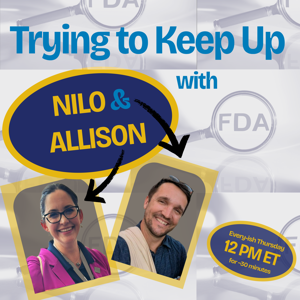
Former-FDA reviewers Michael Nilo and Allison Komiyama started Trying To Keep Up for a…
So they turned that call into a live conversation.
Each week they (try to) unpack what’s actually happening at CDRH...from policy changes and regulatory curveballs to the ripple effects hitting real companies, real submissions, and real timelines.
Expect:
• Hot takes on FDA updates
• Deep regulatory dives (and occasionally shallow ones)
• Guests, Q&A, and off-script conversations
• A healthy dose of jokes and regulatory nerd humor
This isn’t a polished podcast and there’s no rigid agenda...just two former FDAers (and sometimes guests) talking through a regulatory landscape that seems to change by the week. If you work in MedTech and sometimes feel like the rules changed overnight…you’re not alone.
We’re all just trying to keep up.