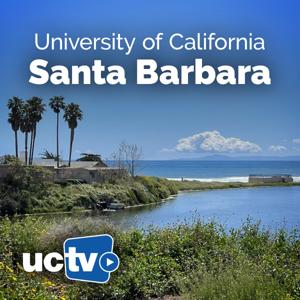
UC Santa Barbara (Audio)

UC Santa Barbara (Audio)

By UCTVEducation
Download on the App Store

UC Santa Barbara (Audio) episodes

  • Microscale Thermal-Fluids Engineering for Energy and Water Applications
    Effective management of thermal-fluids transport has become a critical challenge in many energy, water, and electronic applications due to the increasing power density and shrinking length scales. In this talk, I will first describe our effort to manipulate multi-phase fluid motion using light-responsive surfactants. Upon illuminating droplets and bubbles with light, the surfactants at the fluid-fluid interfaces go through photo-isomerization, which changes the local interfacial tension and introduces a Marangoni flow. The resulting interfacial shear stress generates a net force on the bubble or the droplets, causing them to depart or slide along the surface. We demonstrate real-time manipulation of multi-phase fluidic systems using low intensity light which can potentially enhance phase change heat transfer. I will also describe our effort to achieve passive salt-rejecting solar thermal desalination by thin-film condensation in microporous membrane which utilizes ample three-phase contact area, salt diffusion and a low vapor transport resistance. With our design, we demonstrate continuous desalination of seawater for 7-days in one Sun with no salt precipitation. These examples demonstrate the potential of combining fundamental thermo-fluid science and advanced micro/nano engineering approaches to address many of the pressing thermal challenges in energy and water systems. Series: "GRIT Talks" [Science] [Show ID: 39330]
    27 min
  • From Brain to Artificial Intelligence / Machine Learning and Back
    Artificial intelligence and machine learning (AI/ML) have been extremely successful in predicting, optimizing, and controlling the behavior of complex interacting systems. Robustness and explainability of existing AI/ML methods, however, remain big challenges, and clearly new approaches are needed. In this program, Ambuj K. Singh, Distinguished Professor of Computer Science at the UC, Santa Barbara, explains that the human brain motivated the early development of the field of deep learning, and neuroscientific concepts have contributed to the profound success of deep learning algorithms across many areas. The next leap in AI/ML may again come from a deeper understanding of modularity, robustness, and adaptability of brain architectures. Series: "GRIT Talks" [Science] [Show ID: 39331]

    29 min
  • Grounding Ethics in Clinical Practice
    Dr. Stuart Finder, a renowned clinical ethicist, will discuss the meaning of ethics as it is encountered and understood in actual healthcare contexts. This lecture will explore what matters to patients, families, and healthcare professionals in real-world clinical settings. Using concrete examples, ranging from end-of-life choices to reproductive decisions, to simply coming up with appropriate care plans, Dr. Finder will show how clinical ethics is grounded in the real dynamics and complexities that drive contemporary healthcare practices. Series: "Ethics, Religion and Public Life: Walter H. Capps Center Series" [Health and Medicine] [Humanities] [Show ID: 39150]
    1 hr 22 min
  • Groundwater Depletion: the Haves and Have Nots
    Groundwater is often referred to as an invisible resource, hidden beneath our feet. Groundwater wells—the infrastructure used to access groundwater—are small, distributed, and lost among landscapes. By contrast, our surface water infrastructure is large and visible—reservoirs that support water supply and recreation, dams, and . In this talk, Debra Perrone reveals the results of a five-year research project to record the location and construction details of millions of groundwater wells. The research provides vital insights into the haves and have nots of water and identifies strategies to minimize the impacts of groundwater depletion. Series: "GRIT Talks" [Science] [Show ID: 39278]
    23 min
  • Water Always Wins: Thriving in an Age of Drought and Deluge
    As new climate disasters remind us every day, our world is not stable—and it is changing in ways that expose the deep dysfunction of our relationship with water. Increasingly severe and frequent floods and droughts inevitably spur calls for higher levees, bigger drains, and longer aqueducts. But as we grapple with extreme weather, a hard truth is emerging: our development, including concrete infrastructure designed to control water, is actually exacerbating our problems. Because sooner or later, water always wins. Science journalist Erica Gies introduces us to innovators in what she calls the Slow Water movement who start by asking a revolutionary question: What does water want? Experts in ecology, engineering, and other fields are already transforming our relationship with water. Figuring out what water wants—and accommodating its desires within our human landscapes—is now a crucial survival strategy. Series: "Ethics, Religion and Public Life: Walter H. Capps Center Series" [Humanities] [Science] [Show ID: 39149]
    1 hr 12 min
  • Big Tech TV and the Politics of Gender Race and Class in Silicon Valley
    Professors France Winddance Twine (Sociology, UCSB) and Lisa Parks (Film and Media Studies, UCSB) join Marc Francis (Assistant Editor of Film Quarterly) in a conversation about power dynamics and inequality in the tech world of Silicon Valley, showing and discussing clips of the shows Super-Pumped and WeCrash. The topics they discuss expand upon their published article in Film Quarterly, addressing the exploitative working conditions for women and people of color inside this industry. Their conversation highlights the wastefulness and corruption of massive Silicon Valley corporations and unpacks larger cultural assumptions about corporate self-regulation and the celebrity personas of CEOs. Series: "Carsey-Wolf Center" [Humanities] [Show ID: 39055]
    58 min
  • Big Screen: TÁR
    Writer/director Todd Field joins moderator Tyler Morgenstern (Assistant Director of the Carsey-Wolf Center) in a post-screening discussion of TÁR. Field details the origins and development of the film, including the creation of protagonist Lydia Tár. He elaborates on the public persona she curates in the film and larger thematic questions of exploitation, cultural authority, and the geopolitics of abuse. They also discuss the involvement of non-profit organization Xapiri Ground and their work with the Indigenous people of the Amazon rainforest, as well as photographer David Díaz Gonzales, who created a key image with actress Cate Blanchett for the film. Series: "Carsey-Wolf Center" [Humanities] [Show ID: 39057]
    45 min
  • CWC TV: White House Plumbers
    Director/executive producer David Mandel joins Patrice Petro (Dick Wolf Director of the Carsey-Wolf Center) for a post-screening discussion about the HBO miniseries White House Plumbers. In their discussion, Mandel details the origins of the show and distinguishes it from other noteworthy historical adaptations of the Watergate scandal, emphasizing its focus on overlooked figures and its balancing of political drama and tragedy. He also shares his experiences working with lead actors Justin Theroux and Woody Harrelson, as well as the efforts he and his crew made to faithfully recreate the show’s period aesthetic in the midst of a pandemic. Series: "Carsey-Wolf Center" [Humanities] [Show ID: 39056]
    54 min
  • Challenging Hate: How to Stop Anti-AAPI Violence and Bias
    Sparked by the COVID-19 pandemic, Asian American and Pacific Islander (AAPI) communities across the country have been subjected to increased hate incidents, including verbal harassment, civil rights violations, and physical assaults. Since its founding in March 2020, thousands of incidents have been reported to the Stop AAPI Hate coalition. Manjusha Kulkarni will discuss how Stop AAPI Hate is addressing anti-Asian hate through civil rights enforcement, education equity, community-based safety, and building a movement against systemic racism. Series: "Ethics, Religion and Public Life: Walter H. Capps Center Series" [Public Affairs] [Show ID: 39081]
    1 hr 22 min
  • Big Screen: Gaslight
    Shelley Stamp (Film & Digital Media, UC Santa Cruz) joins moderator Kelsey Moore (Film and Media Studies, UCSB) in a post-screening discussion on George Cukor’s classic 1944 film Gaslight, sharing thoughts on genre, the origin of gaslighting as a term, and the film’s historical legacy. Their conversation also dives into the complexities of gender and the historical contexts of the Second World War and Hollywood’s Golden Age. They discuss the relationships between Gothic melodrama and film noir, as well as these films’ appeal to female audiences. Series: "Carsey-Wolf Center" [Humanities] [Show ID: 39053]
    39 min

About UC Santa Barbara (Audio)

From the publisher's feed

Programs from the University of California, Santa Barbara.

More shows like UC Santa Barbara (Audio)

Science (Video) by UCTV

Science (Video)

9 Listeners

UC Berkeley (Audio) by UCTV

UC Berkeley (Audio)

4 Listeners

CARTA - Anthropogeny (Video) by UCTV

CARTA - Anthropogeny (Video)

5 Listeners

CARTA - Anthropogeny (Audio) by UCTV

CARTA - Anthropogeny (Audio)

7 Listeners

Public Policy and Society (Audio) by UCTV

Public Policy and Society (Audio)

1 Listeners

Robert Reich by UCTV

Robert Reich

34 Listeners

The Career Channel (Audio) by UCTV

The Career Channel (Audio)

4 Listeners

University of California Audio Podcasts (Audio) by UCTV

University of California Audio Podcasts (Audio)

11 Listeners

University of California Video Podcasts (Video) by UCTV

University of California Video Podcasts (Video)

7 Listeners

Religion and Spirituality (Audio) by UCTV

Religion and Spirituality (Audio)

3 Listeners