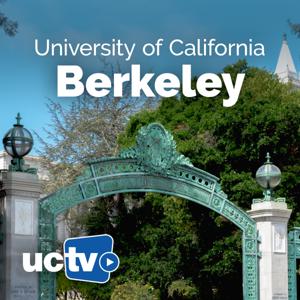
UC Berkeley (Audio)

UC Berkeley (Audio)

By UCTVEducation
Download on the App Store

UC Berkeley (Audio) episodes

  • The Moment of Decision
    What is a decision, and why does decision-making matter in politics, history, war, and public life? This panel examines how decisions differ from choices, when decisions become political, and how theories of rational choice, game theory, cognitive bias, neuroscience, and emotion shape our understanding of judgment. They explore how constitutional, legal, cultural, and social frameworks influence government decision-making, with special attention to decisions for or against war. And they trace how history uses moments of decision to explain sovereignty, leadership, democracy, authoritarianism, and crises such as climate change. Series: "UC Berkeley Graduate Lectures" [Public Affairs] [Show ID: 41450]

    1 hr 52 min
  • The Decision in History
    Decision-making in history affects how societies understand power, responsibility, and change. Sir Christopher Clark, Regius Professor of History at the University of Cambridge, explains how narratives turn moments of decision into markers of sovereignty and political action. Clark examines real and ostensible decisions, deterministic political environments, and modern pressures from democracy, authoritarianism, and climate change, helping clarify why deciding can become harder over time. This work helps explain how historical narratives shape political judgment and points toward a more careful understanding of choice, power, and consequence. Series: "UC Berkeley Graduate Lectures" [Public Affairs] [Show ID: 41449]
    2 hr
  • What is a Decision?
    Political decision-making affects governments and societies in important ways. Sir Christopher Clark, Regius Professor of History at the University of Cambridge, explains how choices become decisions within political, legal, and cultural systems. Clark examines rational choice theory, cognitive bias, and decisions about war, helping clarify how power acts under pressure. This work helps explain why decisions are never purely abstract and points toward a richer understanding of political judgment. Series: "UC Berkeley Graduate Lectures" [Public Affairs] [Show ID: 41448]
    1 hr 56 min
  • The Constitutional Right to Transition: Reconstruction and the Political History of Transphobia
    Award-winning historian Jules Gill-Peterson examines transgender identity and politics through the lens of American liberalism, arguing that anti-transgender politics cannot be understood by analyzing conservatism alone. She traces the emergence of transgender identity from middle-class cross-dressing cultures, the development of transgender medicine, and the class tensions surrounding transition. Gill-Peterson connects this history to U.S. v. Skrmetti, the vulnerability of transition-related health care, and what she describes as liberal discomfort with dysphoria and changing sex. She calls for a politics centered on defending transsexual people and a right to transition. Series: "UC Berkeley Graduate Lectures" [Public Affairs] [Show ID: 41447]
    1 hr 19 min
  • Is This Your Only Life?
    Embodiment affects how we understand personhood, moral status, and whether this life is our only life. Mark Johnston, Henry Putnam University Professor, Princeton University, explains how competing theories of mind and matter shape the question of whether a will could have an embodiment other than its present one. Johnston examines the failures of functionalism, reductive and non-reductive materialism, and strong emergence, along with the role of will, awareness, and evolved animal life, helping clarify what embodiment really is. He explains why the will matters for moral respect and points toward the possibility that embodiment may not be limited to a single life. Series: "UC Berkeley Graduate Lectures" [Humanities] [Show ID: 41446]
    1 hr 21 min
  • Three Ages and Three Intelligences: Exploit Explore Empower with Alison Gopnik
    A common model of AI suggests that there is a single measure of intelligence, often called AGI, and that AI systems are agents who can possess more or less of this intelligence. Cognitive science, in contrast, suggests that there are multiple forms of intelligence and that these intelligences trade-off against each other and have a distinctive developmental profile and evolutionary history. Exploitation, the pursuit of goals, resources and utilities, is characteristic of adult cognition. Alison Gopnik, professor of psychology and affiliate professor of philosophy at the UC Berkeley, and a member of the Berkeley AI Research Group, argues that two very different kinds of cognition characterize childhood and elderhood. Childhood is characterized by exploration. In particular, children seek out information about the world. However, forgoing reward for exploration requires support, care and teaching from others. Care and teaching are particularly characteristic of elders and the intelligence of care has a distinctive structure – it involves empowering others – giving them the resources they need to be effective. The combination of these different kinds of intelligence across the course of a life explains human success. Series: "UC Berkeley Graduate Lectures" [Humanities] [Science] [Show ID: 41068]
    1 hr 18 min
  • Can a Liberal Polity Survive the Politics of Grievance?
    Contemporary populism is almost everywhere; a right wing phenomena that focuses on a politics of white working class grievance. A set of grievances that are to be addressed, when in power, with policies of expulsion, exclusion, and domination. Attempts by liberal states to deal with such movements paradoxically rely on a similar politics of exclusion, such as building so-called firewalls against the right, which are themselves deeply anti-democratic. Mark Blyth, professor of international economics at Brown University, says that given that these grievances are based on real social and economic problems that have blighted working class communities across the world, can a liberal polity address such grievances in a more positive way? Or must it, to protect itself, similarly exclude and dominate such parties, movements and such grievances? Series: "UC Berkeley Graduate Lectures" [Public Affairs] [Show ID: 41069]
    1 hr 25 min
  • The Squiggly Line with Katelyn Jetelina
    How do you navigate a nonlinear, “squiggly line” career in science and public health? Dr. Katelyn Jetelina, an epidemiologist and scientific communicator, explores challenges of science communication within academia—from cultural resistance to misaligned incentives—and why so much vital research never reaches the public. Joined by Dr. John Schwartzberg, Professor Emeritus, School of Public Health, they discuss the growing opportunities for scientists both within and beyond academia, and what needs to change to better support public impact across all career paths. Series: "UC Berkeley Graduate Lectures" [Health and Medicine] [Science] [Education] [Show ID: 41067]
    41 min
  • The Soul – Spirit is My Altar with Marta Moreno Vega
    Espiritismo traces its roots to the sacred knowledge of West and Central African peoples carried into the Americas by enslaved ancestors between the 15th and 19th centuries. Marta Moreno Vega, Ph.D., scholar and co-founder of Corredor Afro, explores how these traditions—sustained in Cuba, Haiti, Brazil, Puerto Rico, other Caribbean islands, and U.S. urban centers—function as systems of memory, survival, and continuity. Drawing on personal and family experiences, Moreno Vega reflects on the challenges of centering African Diaspora spiritual practices in academia, which often privileges “objective” distance over embodied knowledge. She emphasizes the resilience of these ancestral practices and the ways they continue to manifest in contemporary life through remembrance, ritual, and cultural expression. Series: "UC Berkeley Graduate Lectures" [Humanities] [Show ID: 40425]
    57 min
  • Public Health: How to Make the Invisible Visible with Katelyn Jetelina
    Public health often works behind the scenes—preventing illness, protecting communities, and generating research that too often stays hidden behind paywalls. In a world of eroding trust and rising falsehoods, Dr. Katelyn Jetelina, an epidemiologist and scientific communicator, explores how we can make the value of public health visible: by telling better stories with data, making science more accessible, and ensuring communities see themselves in the work before, during, and after crisis. Series: "UC Berkeley Graduate Lectures" [Health and Medicine] [Show ID: 41066]
    1 hr 13 min

About UC Berkeley (Audio)

From the publisher's feed

Programs from the University of California, Berkeley.

More shows like UC Berkeley (Audio)

Aging and Senior Health (Audio) by UCTV

Aging and Senior Health (Audio)

21 Listeners

Physics (Audio) by UCTV

Physics (Audio)

2 Listeners

Evolution by UCTV

Evolution

17 Listeners

Autism (Video) by UCTV

Autism (Video)

14 Listeners

Poetry (Audio) by UCTV

Poetry (Audio)

2 Listeners

Film and Television (Audio) by UCTV

Film and Television (Audio)

3 Listeners

Cancer Frontiers (Video) by UCTV

Cancer Frontiers (Video)

5 Listeners

UC Berkeley Graduate Council Lectures (Audio) by UCTV

UC Berkeley Graduate Council Lectures (Audio)

1 Listeners

CARTA - Anthropogeny (Audio) by UCTV

CARTA - Anthropogeny (Audio)

7 Listeners

Robert Reich by UCTV

Robert Reich

34 Listeners