
Sign up to save your podcasts
Or



Most people know George “Pete” Kay only as a name connected to someone else’s story—usually Charles Harrelson, the Dixie Mafia, or the murder-for-hire investigation surrounding the assassination of federal Judge John H. Wood Jr.
But Pete Kay had a story of his own.
In today’s episode, I pull together the scattered pieces of Pete’s life: the criminal allegations, the murder trials, the underworld connections, and the questions that continued to follow him. His name appears in headlines, courtrooms, and the stories of some of Texas’s most notorious figures, yet his role is often treated as a footnote.
This episode puts Pete Kay at the center of the story. Who was he? What was fact, what was rumor, and why did his name keep surfacing around some of the darkest chapters in Texas crime history?
In this episode of Walking Proof, I follow a personal genealogy trail that leads to Pete Kay and Charles Harrelson—two men connected to the violent world of murder-for-hire. Charles Harrelson was convicted of arranging and carrying out the 1979 assassination of federal Judge John H. Wood Jr. Pete Kay was connected to Harrelson’s circle and was repeatedly linked to serious criminal allegations during that era.
As we sort through family records, names, dates, and connections, we explore how these two men tie into my family tree—and what it means to discover that your ancestry may include people whose lives became part of true-crime history.
Join us as we uncover the records, the connections, and the darker side of genealogy—because sometimes the past is not just history. Sometimes, it is Walking Proof.
In this episode of Walking Proof, Shannon and Joseph step back into Houston Texas and the surrounding areas during the 1970s—a time marked by political tension, police scandals, public outrage, and a growing distrust between communities and law enforcement.
We look at the corruption cases that shook the Houston Police Department, the protests and riots that followed police violence, and the downfall of former Houston Police Chief Carrol Lynn, who was convicted on federal extortion, perjury, and obstruction-of-justice charges and later sentenced to 12 years in prison.
This episode is not about claiming every case from that era was connected. It is about context: how the culture, the institutions, and the failures of the time shaped the way crimes were investigated, recorded, and sometimes left unresolved.
For Shannon, that context became essential when researching the violent attack on his mother—and the unanswered questions that led to her own birth story.
This episode is the personal opinion and analysis of PJ and ShanPa after following the trial of James Dolphs Elmore Jr. We're not legal experts or journalists — just two true-crime observers who watched and listened to the evidence and came away questions. In August 2026, a Galveston County jury found Elmore guilty of manslaughter in the death of 16-year-old Laura Miller, whose body was found in the infamous Calder Road oil field in League City, Texas, in 1986. He was sentenced to 20 years. Authorities allege Elmore — a longtime friend of suspected serial killer Clyde Hedrick — prepared the cocaine that was given to Laura and later helped move her body.
For over 40 years, the Texas Killing Fields has haunted the I-45 corridor between Houston and Galveston — a 25-acre patch of land where the remains of at least four young women were found between 1984 and 1991. This verdict may be the closest thing to justice these families have seen in four decades, but for us, it raises more questions than it answers. We may not have the answers, but we think these are the questions worth asking.
DISCLAIMER: The views and opinions expressed are those of PJ and ShanPa based on publicly available information.
Two months after my biological mother’s attack, I started digging into my birth father’s past — and what I found led me straight back to Freeport, Texas. In 1978, he was involved in an incident that, on the surface, looked isolated. But that incident was tied to a murder in Galveston County, and the accused was allegedly killed in a car accident in Harris County. Was it all just a coincidence? Or was it one more piece in a much darker puzzle? What else is hiding beneath the surface?
If you haven’t listened to “Corruption: The Freeport, Texas Files – Part One,” you’ll want to go back and start there; this story builds directly on those events and won’t make full sense without that context.
Freeport, Texas, December 1978. What started as simple genealogy—digging into my birth father’s past after learning I was conceived in a violent attack—turned into something much darker when I found his name tied to a “robbery” charge just two months after my mother’s assault.
When I pulled the original paperwork, that “robbery” shifted into a sexual assault on a woman in front of her husband, hidden behind wording and charges that didn’t match the reality described in the police report.
In this episode, I walk through how a routine search for my father’s record became an investigation into conflicting documents, missing details, and a trail of questions that keeps leading back to Freeport and the way cases were handled in the late 1970s.
This is the first step into a larger story: over the next few episodes, I’ll begin laying out my theories about possible corruption, cover‑ups, and why some violent crimes may have been softened or buried on paper instead of fully named for what they were. All events in this episode are based on public records and my own research, and all individuals mentioned are presumed innocent unless proven guilty in a court of law.
Since our July 2, 2026 episode, Who Killed Gayle Anne Cater?, we’ve uncovered a few new details that add even more depth to this haunting 1978 cold case. In this unplanned bonus episode, we revisit the timeline, share what we’ve learned since the original release, and reflect on how these new pieces may shift the story we thought we knew.
This is a follow-up episode for listeners who want to stay with us as the investigation continues. It’s not a full new chapter yet, but it does bring fresh context, new questions, and one more step toward the truth.
In this episode, I take a step back to explain how this journey truly began. What started as a Christmas gift—a DNA test—opened the door to a deeper understanding of my own history and the circumstances surrounding my conception in October of 1978 that was a result of a sexual assault against my mother.
This episode offers a foundational look at my story, not just from a personal perspective, but through a historical lens. As I began searching for my biological father, my research led me into a broader exploration of Houston in the 1970s, uncovering patterns, cases, and unanswered questions that shaped the path I’m still following today.
There is far more to the story than can be covered in a single episode. For a more detailed account, you can read my book, Walking Proof by Shannon Manley Bales.
We are also joined by a very special guest—our mother, Callie—who shares her perspective and reflects on the Christmas gift that set all in motion.
Step back into October 1978 as PJ and ShanPa unpack the haunting cold case of Gayle Anne Cater, a young woman whose life was cut short in Houston under circumstances that remain clouded in mystery. Decades later, her story still lingers—full of unanswered questions, overlooked details, and a trail that never quite went cold.
In this episode, ShanPa shares a deeply personal and unsettling connection to the case, exploring the possibility that someone from her own past—her biological father—may have crossed paths with this tragedy. Together, PJ and ShanPa sift through timelines, known evidence, and the gaps in the investigation, carefully separating fact from speculation while confronting what it means when a case hits close to home.
With respect for the victim and a commitment to truth, this episode dives into the complexities of memory, family, and justice delayed. Was this a case of missed leads, or is there more beneath the surface waiting to be uncovered?
Listener discretion is advised as the conversation includes sensitive themes and personal reflections tied to an ongoing cold case.
This is the trailer for Walking Proof, a short introduction to who we are—two husbands, grandpas, and true‑crime nerds—and why we’re telling these stories. In it, we share a glimpse of our personal connection to a 1978 attack and what listeners can expect from the show: Houston‑area cold cases, overlooked victims, and a deeply personal lens on true crime.
From the publisher's feed
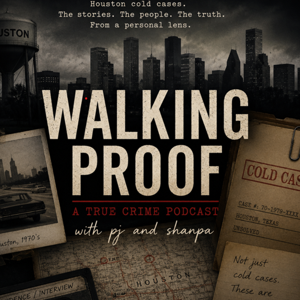
Walking Proof is a true crime podcast exploring the dark, often overlooked history of Houston, Texas in the 1970s and 80s, told through an intensely personal lens. Each week, husbands Shannon and…