
Sign up to save your podcasts
Or



Based on Podcast App listening data
Has our focus on trauma, identity and representation distracted us from the inequalities that really shape people’s lives?
Cultural theorist Catherine Liu thinks the left has lost its way. In her new book, Traumatized, she argues that a culture built around lived experience, public confession and personal trauma is getting in the way of harder conversations about class, work and economic inequality.
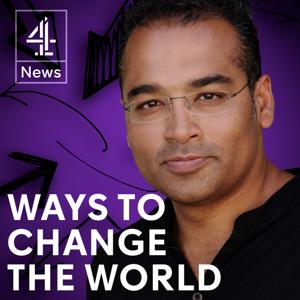
In this episode of Ways to Change the World, Krishnan Guru-Murthy and Catherine Liu discuss Alexandria Ocasio-Cortez, culture wars and the case of the late Cambridge Professor Jason Arday.
How did the porn industry help shape the internet we use today? From Pornhub and OnlyFans to social media, the influence of online pornography extends far beyond what we might imagine.
In this episode of Ways to Change the World, Krishnan Guru-Murthy speaks to Financial Times investigative journalist Patricia Nilsson, author of Guilty Pleasure: The Pornification of the Internet, the Economy, and Everything Else.
Nilsson reveals how the porn industry pioneered technologies and business models that underpin much of today's digital economy, from online payments and live streaming to algorithms designed to keep us scrolling. She explores the secretive companies behind some of the world's biggest pornography websites, the closest thing they have to regulation, and the risks posed by the collection of our most intimate personal data.
They also discuss the rise of OnlyFans, whether increasingly extreme online content is changing our relationships and sexual behaviour, and what culture deems acceptable.
Has pornography simply changed the internet, or has it fundamentally changed us?
This podcast contains discussion about the business model and financing of the porn industry. It includes moderately offensive language.
In this episode of Ways to Change the World, Krishnan Guru-Murthy is joined by bestselling author Ann Patchett to discuss her novel, Whistler and the personal inspiration behind it, which she calls the “most romantic” book she has written. A story which explores memory, and chance reunions.
Beyond her acclaimed fiction, Patchett is one of the world's most passionate advocates for independent bookselling. As the co-founder of Nashville’s Parnassus Books and creator of the Parnassus Foundation, she has dedicated years to championing childhood literacy and bringing books directly into local schools across the US state of Nashville.
They also discuss her love of reading and why Ann has chosen not to own a phone.
Known as the Godfather of heavy metal, Black Sabbath guitarist Tony Iommi changed the way the guitar could sound.
After a factory accident cost him the tips of two fingers, he was told he would never play again. Instead, he built his own prosthetic fingertips, adapted his guitar and developed a darker, heavier sound that would define a new genre.
In this episode of Ways to Change the World, Krishnan Guru-Murthy talks to Tony Iommi about growing up in industrial Birmingham, forming Black Sabbath with Ozzy Osbourne, the riffs that changed rock music and the friendship that endured through decades of break-ups and reunions.
As he releases his latest album From The Dark, he also reflects on Black Sabbath’s emotional final performance with Ozzy, his friend’s death shortly afterwards, and why he’s still making music.
Navi Pillay is a renowned human rights lawyer and the recipient of the 2026 Nobel Peace Prize. Her most recent fight for justice was as Chair of a UN Commission which concluded Israel committed acts of genocide in Gaza.
Pillay’s career emerged out of a struggle against apartheid in South Africa where she was born. She became the first woman to establish a law firm defending apartheid activists and political prisoners, and made headlines in 1973 when she secured legal rights for the imprisoned Nelson Mandela. Pillay later became the first non-white woman judge in South Africa’s High Court. She then went on to serve as judge on the UN-backed International Criminal Tribunal for the genocide in Rwanda.
In this episode of Ways to Change the World, Pillay talks to Krishnan Guru-Murthy about her lifelong fight for justice which has challenged impunity at the highest of levels. Pillay’s award has most recently led to both the US and Israeli leaders condemning the decision and issuing sanctions against the International Criminal Court. The 85-year-old also reflects on what international justice looks like today in a conflict-ridden world increasingly dominated by strong men.
Simon Armitage believes poetry changes the world not by telling us what to think, but through persuasion, wonder and the possibilities of language.
In this episode of Ways to Change the World, the Poet Laureate joins Krishnan Guru-Murthy to discuss his new version of Gilgamesh, a story of friendship, power, loss and immortality that has survived for thousands of years. He reflects on discovering poetry through Ted Hughes, leaving behind his career as a probation officer, writing for moments of national significance, and why the oldest stories can still help us make sense of the world today.
Donald Trump called her a “nasty woman”. In private, he called her “the killer”. Now Chrystia Freeland says the lesson for America’s allies is simple: do not capitulate.
In this episode of Ways to Change the World, Krishnan Guru-Murthy speaks to the former Canadian Deputy Prime Minister about standing up to Trump, why she believes Ukraine must defeat Putin, and the growing threat to liberal democracy.
Drawing on her new book Unreliable Boyfriend, Freeland explains how the Western alliance fractured, how it could be rebuilt, and why she remains optimistic about the future of democracy.She also reflects on her journey from journalist to politician, growing up in a small Canadian town, and standing up to Trump at the negotiating table.
Anthony Scaramucci is a Wall Street banker, podcaster and former White House communications director who spent just 11 days working for Donald Trump before being fired. Once a Trump supporter, he has since become one of his most vocal critics, and it would seem that the feeling is mutual, with Trump calling him an "unstable 'nut job'" who showed "gross incompetence" during his 11-day tenure. His new book, All the Wrong Moves, looks at the political and economic decisions he believes helped create the anger and populism that transformed American politics.
In this episode of Ways to Change the World, Scaramucci talks to Krishnan Guru-Murthy about his time inside the Trump White House, why he believes America’s political system needs reform, the role of big money in politics, the impact of China, the wars in Afghanistan and Iraq and the 2008 financial crisis. He also reflects on his Republican identity, why he believes Donald Trump was able to tap into economic and cultural anger, whether the Republican Party can survive Trump, and whether America can find its way back from the political divisions of the last decade.
Alexei Sayle has spent a lifetime mixing comedy with politics, protest and an instinctive suspicion of authority.
Raised in a communist household in Liverpool, he became one of the defining figures of alternative comedy before building a career as a writer, actor and political activist. His latest book, How I’ve Tried to Change the World by Walking Down the Middle of the Street Shouting, looks back at decades of marches, political battles, defeats and moments of hope.
In this episode of Ways to Change the World, Alexei talks to Krishnan Guru-Murthy about Gaza and Israel, and his feelings on the “genocide” of Palestinians (which Israel denies), his Jewish identity, whether protest actually works, why he remains a Marxist, growing up surrounded by communism and how politics shaped his comedy.
He also reflects on falling out of fashion in the 1990s, his unlikely success on TikTok, why comedy should never become a political lecture and why, after decades of campaigning, he still hasn’t entirely given up on changing the world.
Salman Rushdie is one of the world’s most celebrated writers. But for more than three decades, his life has also been bound up with arguments about freedom of expression, religious extremism and the threat of violence.
In 2022, that violence caught up with him when he was attacked on stage and nearly killed. His wife, the poet and visual artist Rachel Eliza Griffiths, began filming his recovery, creating an extraordinarily intimate record of what followed.
In this episode of Ways to Change the World, Salman and Rachel Eliza join Krishnan Guru-Murthy to discuss the attack, anger and forgiveness, the power of love, religious fanaticism, free speech and what it means to rebuild a life after trauma. Salman also reflects on returning to fiction with his new book The Eleventh Hour, and on Knife: The Attempted Murder of Salman Rushdie, Alex Gibney’s new documentary built around Rachel Eliza’s remarkable footage of his recovery.
Knife: The Attempted Murder of Salman Rushdie will be released in UK and Irish cinemas at the end of September.
From the publisher's feed
Ranked by our users in the last 21 days

403 Listeners

1,154 Listeners

264 Listeners
125 Listeners

980 Listeners

261 Listeners

40 Listeners

3,151 Listeners

1,210 Listeners

890 Listeners

455 Listeners

25 Listeners

60 Listeners

100 Listeners

14 Listeners

8 Listeners