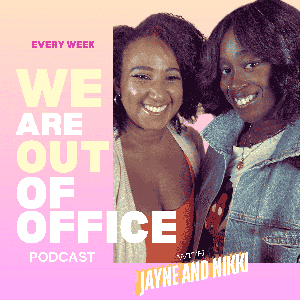
In this week’s episode of We Are Out of Office, Veteran Television Executive Producer Nikki T and Bestselling Author Jayne Allen spiral—in the best possible way—through conversations about creativity, money, nervous system regulation, Michael Jackson, Black ambition, romantic fantasy novels, AI language lovers, and what it means to keep imagining bigger futures for ourselves even while the world feels increasingly strange.
It’s an episode about vibration. About energy. About the stories we inherit and the ones we choose to write ourselves into. From Black women preparing to purchase billion-dollar sports franchises to the emotional realities behind scarcity mindsets, Nikki and Jayne unpack the emotional architecture beneath the lives we build—and the ones we dream about next.
I See You, Girl
Nikki’s “I See You Girl” goes to Kwanza Jones, a Black woman whose résumé feels almost fictional in scope. Potential future MLB owner. Princeton donor. Billboard-charting singer. Lawyer. Philanthropist. Entrepreneur. One half of a billion-dollar power partnership. And somehow still grounded in purpose and impact.
What struck Nikki most wasn’t simply the scale of Kwanza’s accomplishments—it was the way she is being publicly framed not as an accessory to wealth, but as an active architect of empire-building alongside her husband, billionaire investor José E. Feliciano. The conversation becomes larger than one woman. It becomes about the power of Black women being seen as full participants in influence, ownership, leadership, and legacy.
Jayne, meanwhile, finds herself captivated by a different kind of woman entirely: a woman who doesn’t yet exist.
Inspired by the NBA playoffs, Jayne begins imagining the story of the first female head coach in the NBA—a woman navigating locker room politics, masculinity, power, romance, ambition, and leadership in spaces women have historically been excluded from. What would her emotional life look like? What kind of love story would emerge from a woman capable of commanding alpha athletes and billion-dollar franchises?
The result may become a future novel. But for now, it opens a larger conversation about Black women imagining ourselves into spaces the culture still struggles to envision.
What We’re On Right Now
Jayne is officially in her multilingual AI era.
After years of using Duolingo to sharpen her French, she has entered into a new relationship—with ChatGPT’s voice feature, affectionately renamed “Julien.” Through real-time French conversation, tailored pacing, cultural exchanges, and language immersion, Jayne discovers a more fluid and emotionally intelligent way to engage with language learning.
And honestly? Julien sounds fine.
The conversation becomes less about technology and more about the future of learning itself—how AI can personalize growth in ways traditional systems often cannot.
Nikki, meanwhile, is fully immersed in a TikTok series called The Four in the Five, following four ambitious Black women in New York City as they build careers, friendships, and aspirational lives on their own terms. Unlike traditional reality television, these women are directing their own narratives. No screaming matches. No table flips. No manufactured chaos. Just beautiful, ambitious young Black women documenting their lives in real time.
Both Nikki and Jayne reflect on how refreshing it feels to witness Black women creating and controlling their own storylines rather than having them shaped through the lens of traditional media systems.
And yes—Michael Jackson remains an active participant in this entire episode.
Mindin’ My Black Business
Nikki spotlights an extraordinary Vaseline campaign created by VML South Africa that instantly resonated across the Black diaspora.
Centered around the deeply familiar ritual of Black mothers and grandmothers slathering children in Vaseline, the ad captures a cultural memory so universal that no explanation is required. The tagline says it all:
“Some traditions aren’t passed down. They’re rubbed in.”
The campaign becomes a meditation on what great advertising actually does: it recognizes people. It says we see you. It honors cultural intimacy without over-explaining it.
Jayne uses the segment to tease a major emerging trend in publishing: Black women writers moving into the world of romantasy and urban fantasy in significant numbers. From magical realism to fantasy romance rooted in Black culture and mythology, she predicts that the next era of publishing may belong to Black women creating expansive imaginative worlds traditionally dominated by others.
The girls are entering their fantasy era—and they’re bringing us with them.
Jesus Take the Wheel
This week’s collective “Jesus Take the Wheel” centers on the recent Kevin Hart roast.
Both Nikki and Jayne wrestle with the increasingly blurred line between edgy comedy and lazy cruelty. While acknowledging that roast culture is built around discomfort and boundary-pushing, they question why so many of the jokes leaned heavily on stale racist tropes rather than genuinely sharp or original writing.
The larger conversation evolves into something deeper: how people excuse harmful behavior whenever there are enough “good moments” surrounding it. Jayne reflects on how societies normalize unacceptable things by selectively focusing on the enjoyable parts while minimizing the harm.
The discussion then pivots into a deeply personal story from Jayne about attending a jazz concert where the artist launched into anti-left political rhetoric mid-performance. The experience forces her to grapple with questions around complicity, discomfort, art, politics, and the emotional cost of remaining silent in moments where values are challenged publicly.
It’s one of the most layered and emotionally complex conversations of the episode.
Health & Healing
Nikki opens up vulnerably about her relationship with money.
Not budgeting. Not investing. Relationship.
She reflects on how scarcity mindsets and overindulgence often stem from the same emotional root: fear. Fear of not having enough. Fear of returning to old versions of ourselves. Fear disguised as control.
In an attempt to heal that relationship, Nikki writes a literal letter to money—apologizing for projecting emotional weight onto it and reimagining herself not as someone who clings to money, but as a steward through which abundance can flow.
The revelation that lands hardest:
Money is called currency because it is meant to move.
The conversation expands into generosity, trust, stewardship, and emotional healing around wealth, worthiness, and abundance.
Jayne then shares her own health milestone: losing 30 pounds of fat post-Ozempic while rebuilding a healthier relationship with her body through intermittent fasting, gut health, probiotics, movement, nutrition, and sustainable habits.
But more importantly, she describes finally feeling connected to her body again—not controlled by restriction, shame, or punishment.
Just alignment.
What’s Good
Nikki gives a passionate, spoiler-free review of the new film Is God Is, adapted and directed by playwright Aleshea Harris.
She describes it as an intense, unapologetically Black exploration of female rage, trauma, agency, and revenge—anchored by astonishing performances from Kara Young, Mallori Johnson, Janelle Monáe, Vivica A. Fox, and especially Sterling K. Brown.
For Nikki, the film’s existence matters just as much as the film itself.
At a time when theaters simultaneously contain projects like Michael, Is God Is, and Boots Riley’s newest work, she sees signs of a larger renaissance emerging in Black cinema—one driven by visionary Black creatives and executives willing to fund unconventional storytelling.
Jayne closes the segment by celebrating her own health milestone and the emotional freedom she’s finding through sustainable wellness practices, better gut health, movement, and reconnecting to her body without obsession or punishment.
Final Word
Nikki:
“Show them how it’s done, girls.”
Jayne:
“Breathe in. Breathe out.”
And maybe…
go listen to Michael Jackson.
Episode Links:
Kwanza Jones
The 4 in The 5
VML South Africa’s Award Winning Vaseline Campaign
IS GOD IS Trailer
Questions? Comments? Email us at: [email protected] or follow us on TikTok and Instagram at: @weareoutofofficepod