
Sign up to save your podcasts
Or

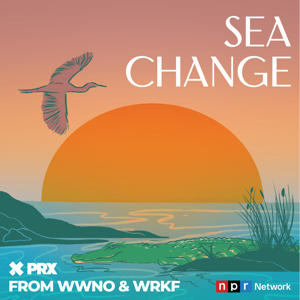

Louisiana is a world leader in coastal restoration. Many would even say number one. The media is full of stories about the coastal land loss crisis in Louisiana, the dire predictions of climate change and sea level rise, and polarizing accounts of controversial projects, but what is also true is that Louisiana is making tremendous strides piecing this ragged shoreline back together little by little.
Over the next four episodes of Sea Change, we're going to feature Wetlands Radio. The series is a deep dive into Louisiana's coast - both how it came to be imperiled and also, the incredible things a mighty group of people are doing to fight land loss.
In part one, how did we get here? From deep geology, to efforts to control the Mississippi River, to the boom days of oil and gas, we discover the backstory that led to the start of coastal restoration.
EPISODE CREDITS
This episode was hosted by Executive Producer Carlyle Calhoun and Wetlands Radio producer Eve Abrams.
Wetlands Radio is produced by Eve Abrams and funded by BTNEP, the Barataria Terrebonne National Estuary Program through the Environmental Protection Agency's National Estuary Program. To hear Wetlands Radio episodes in their entirety, visit btnep.org.
Sea Change is a WWNO and WRKF production. We are part of the NPR Podcast Network and distributed by PRX. Sea Change is made possible with major support from the Gulf Research Program of the National Academy of Sciences, Engineering, and Medicine. Sea Change is also supported by the Water Collaborative of Greater New Orleans. WWNO’s Coastal Desk is supported by the Walton Family Foundation, the Meraux Foundation, and the Greater New Orleans Foundation.
 View all episodes
 By WWNO & WRKF

4.5
101101 ratings
Louisiana is a world leader in coastal restoration. Many would even say number one. The media is full of stories about the coastal land loss crisis in Louisiana, the dire predictions of climate change and sea level rise, and polarizing accounts of controversial projects, but what is also true is that Louisiana is making tremendous strides piecing this ragged shoreline back together little by little.
Over the next four episodes of Sea Change, we're going to feature Wetlands Radio. The series is a deep dive into Louisiana's coast - both how it came to be imperiled and also, the incredible things a mighty group of people are doing to fight land loss.
In part one, how did we get here? From deep geology, to efforts to control the Mississippi River, to the boom days of oil and gas, we discover the backstory that led to the start of coastal restoration.
EPISODE CREDITS
This episode was hosted by Executive Producer Carlyle Calhoun and Wetlands Radio producer Eve Abrams.
Wetlands Radio is produced by Eve Abrams and funded by BTNEP, the Barataria Terrebonne National Estuary Program through the Environmental Protection Agency's National Estuary Program. To hear Wetlands Radio episodes in their entirety, visit btnep.org.
Sea Change is a WWNO and WRKF production. We are part of the NPR Podcast Network and distributed by PRX. Sea Change is made possible with major support from the Gulf Research Program of the National Academy of Sciences, Engineering, and Medicine. Sea Change is also supported by the Water Collaborative of Greater New Orleans. WWNO’s Coastal Desk is supported by the Walton Family Foundation, the Meraux Foundation, and the Greater New Orleans Foundation.

90,994 Listeners

43,898 Listeners

38,062 Listeners

23,765 Listeners

43,528 Listeners

26,197 Listeners

8,454 Listeners
1,483 Listeners

6,435 Listeners

14,656 Listeners

2,252 Listeners
2,212 Listeners

16,399 Listeners

6,564 Listeners

1,736 Listeners