
Sign up to save your podcasts
Or

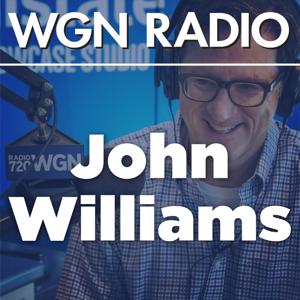

It’s September, and we finally get to ask the question: What’s Sara reading in Reading? Yes, although long-time WGN Radio bookworm Sara Tieman has left the station, and the country, she’s still part of the book club from her new home in Reading, England! So, here are the September picks from Sara, along with John Williams, Steve Alexander and Bob Kessler.
John Williams (weekdays 10am-2pm, including The Wintrust Business Lunch)
The British Are Coming (2019) – Rick Atkinson.
Previously I told you about The Fate of the Day, Atkinson’s 2nd volume in his Revolutionary War trilogy. So I went back to the beginning, book-1. This is another 700-pager, with a 30-page prologue. Detailed, yes. Tedious, no. Have I finished it? No, again. But is it an intriguing journey through the intricacies of life and war 250 years ago? Indeed, it is. A fuller, sometimes less noble picture of Washington, a less caricatured picture of the king, and an intimate look at life of the soldier are all here.
Mr. Jefferson’s Lost Cause (2002) – Roger Kennedy.
This one has been collecting dust on my shelf for a while. Time to sharpen up for our November 1 conversation at the Tivoli Theatre in Downer’s Grove. (Sorry, it’s sold out.) Here, Kennedy looks at the tribulations facing Jefferson – land, farmers, slavery, and the Louisiana Purchase. Too often, Jefferson compromises – or is compromised. America – its soil, its people, its culture – suffered then and now for his failings.
Unforgiving Places (2025) – Jens Ludwig.
The U of Chicago’s expert on crime talks about why violent crime via guns is rampant in Chicago. And America. His ideas to reduce gun deaths don’t cost billions of dollars. Buy this book, read this book, give it to a politician.
Steve Alexander (agribusiness reporter)
I had the privilege of reading two wonderful books this month.
The Nine: The True Story of a Band of Women Who Survived the Worst of Nazi Germany (2021) by Gwen Strauss
The author’s great-aunt was one of “the nine” women who were resistance fighters in France as the Germans invaded. All in their 20s, they helped smuggle weapons, passed messages, hid Jewish children as well as allied “spies.” They were arrested, of course, and sent to a series of prisons and slave labor camps where their treatment became progressively and unbelievably brutal right up until the end of the war, when the Nazis forced them onto a death march.
Skeletal from being starved, ill, and near collapse as they kept their feet to avoid being shot, they still managed to find the strength to escape into the German countryside. Their plight didn’t get easier as they tried to make their way home to France (and one to the Netherlands). I am indescribably in awe of their bravery and moxy. Would I be as courageous in the face of such brutality? I don’t think so.
It’s a great read.
So is Raising Hare (2024) by Chloe Dalton.
I now know nearly 100% more about hares (I thought they were interchangeable with rabbits) after reading this delightful, thoughtful look at nature and human interference with it.
When the pandemic hit, Ms. Dalton put her globetrotting career as a foreign policy specialist on hold and moved from London to a renovated barn in the English countryside to be near her mother.
While on a walk in February of 2021, she came across a baby hare (a leveret). Thinking it had been left temporarily by its mother, she went on. Hours later, the leveret was still there, and with the bark of a dog nearby, she picked it up—barely a handful—and took it home.
The rest of this 304-page book is just brilliant tale of her tender and often surprising relationship with the leveret from when she bottlefed it to keep it alive, to when she watched–with pride and trepidation–as it bounded out the door and into the wild where predators of all types, winged, four-legged, and two-legged, roamed.
There are surprises.
If you enjoyed Sipsworth, I know you’ll love this. Not the same book, but similar feels.
Here’s a video of Chloe discussing her book and showing pictures of her hare: https://www.youtube.com/watch?v=PaOoK5_zg3c
Bob Kessler (news)
Unforgiving Places: The Unexpected Origins of American Gun Violence (2025) – Jens Ludwig
Gun violence in the U.S. has but a few proposed solutions and they tend to run along the lines of a lack of morals or a lack of economic opportunities. As the author lays out, it turns out it’s neither (although both of the above can be factors, they’re not the real cause in most situations). His case is very well laid out, approachable and even applicable in nearly everyone’s day-to-day life, regardless of the presence of guns. Essential reading.
The Emperor of Gladness (2025) – Ocean Vuong
It’s one of those books I knew I would love from the first page. The mundane setting is described in such rich detail with skilled prose I knew I was in for something special in the first chapter alone. It’s a brilliant, sad, but also hopeful novel about a struggling young man and the people he manages to connect with — an elderly woman slipping away from dementia and a group of misfits at a ‘fast casual’ restaurant. But it’s also much more.
The Nimbus (2025) – Robert P. Baird
If a bona fide spiritual phenomenon occurred, how would contemporary society respond to it? Furthermore, would those who’ve dedicated their lives to the study of spiritual practices respond effectively? These are the questions posed in this book. An intriguing premise to be sure, but I think it could have been just as impactful in novella form and not a full-blown novel.
The Road: A Graphic Novel Adaptation (2024) – Manu Larcenet
The original novel by Cormac McCarthy is a story worth telling in many ways. I loved the film adaptation and this is another take that’s just as haunting and redeeming and manages to tell it in a way that only a graphic novel can.
Sara Tieman (promotions & public relations manager emeritus and station book club international correspondent)
Great Big Beautiful Life (2025) – Emily Henry
This is the latest by queen of the romance novel, author Emily Henry. Two writers, Alice Scott and Hayden Anderson, are competing to write the memoirs of a reclusive heiress, Margaret Ives, living in South Carolina. Alice is looking for her big break; Hayden is already a Pulitzer Prize winning biographer. A non-disclosure agreement keeps the two prospective writers from discussing what they’ve learned in their separate interviews with Margaret, but both know Margaret is not revealing her true story. The book’s opening line struck the biggest chord with me: “There’s an old saying about stories, and how there are always three versions of them: yours, mine, and the truth.” Out of everything I’ve read by Henry, her 2022 “Book Lovers” is still my favorite by leaps and bounds.
Tokyo Ever After (2021) – Emiko Jean
In trying to scale back belongings for my move, I took a second look at the books I own but have never read. This encapsulates my never-ending struggle: chasing the newest release or other titles, when you have a shelf in your own home of books on your “TBR” pile. This is a YA book from my personal pile, but I’m of the opinion that YA or middle grade titles shouldn’t scare adults away. I’ve read some truly stand-out books in this range in the past. Tokyo Ever After is a modern fairy tale. Teenager Izumi (“Izzy”) lives in California with her mom and comes to find out that her father, whom she has never known, is the Crown Prince of Japan which means that Izzy is a princess. As someone whose name means “Princess,” this is a dream come true type story, but, of course, it’s never as easy as it sounds as Izzy navigates the culture, her family, and a reckoning of being an “outsider” whether she is home in America with her mom and friends, or home with her dad in Japan.
The Let Them Theory (2024) – Mel Robbins
I don’t read much in the self-help genre, but this book has generated a lot of buzz and I picked up a copy on e-reader through a lucky “Skip the Line” loan. Robbins is the host of a popular podcast and an author of multiple books. She leans on experts to explain the ‘Let Them’ theory which is aimed at you taking your own power back. You can’t control the actions or thoughts of other people, so you say “let them” and follow-up with “let me.” There was a part of the book that didn’t pertain to me and I skimmed past it, but if you’re looking for a reminder on how not to let people you cannot control have influence over you, this book could be the read for you. One part that did stick with me was making friends and how hard it is to make friends as an adult. In the two weeks since I moved to England, I’ve applied this rationale of “Let Me” say hello and have subsequently met two neighbors.
 View all episodes
 By wgnradio.com

4.3
3333 ratings
It’s September, and we finally get to ask the question: What’s Sara reading in Reading? Yes, although long-time WGN Radio bookworm Sara Tieman has left the station, and the country, she’s still part of the book club from her new home in Reading, England! So, here are the September picks from Sara, along with John Williams, Steve Alexander and Bob Kessler.
John Williams (weekdays 10am-2pm, including The Wintrust Business Lunch)
The British Are Coming (2019) – Rick Atkinson.
Previously I told you about The Fate of the Day, Atkinson’s 2nd volume in his Revolutionary War trilogy. So I went back to the beginning, book-1. This is another 700-pager, with a 30-page prologue. Detailed, yes. Tedious, no. Have I finished it? No, again. But is it an intriguing journey through the intricacies of life and war 250 years ago? Indeed, it is. A fuller, sometimes less noble picture of Washington, a less caricatured picture of the king, and an intimate look at life of the soldier are all here.
Mr. Jefferson’s Lost Cause (2002) – Roger Kennedy.
This one has been collecting dust on my shelf for a while. Time to sharpen up for our November 1 conversation at the Tivoli Theatre in Downer’s Grove. (Sorry, it’s sold out.) Here, Kennedy looks at the tribulations facing Jefferson – land, farmers, slavery, and the Louisiana Purchase. Too often, Jefferson compromises – or is compromised. America – its soil, its people, its culture – suffered then and now for his failings.
Unforgiving Places (2025) – Jens Ludwig.
The U of Chicago’s expert on crime talks about why violent crime via guns is rampant in Chicago. And America. His ideas to reduce gun deaths don’t cost billions of dollars. Buy this book, read this book, give it to a politician.
Steve Alexander (agribusiness reporter)
I had the privilege of reading two wonderful books this month.
The Nine: The True Story of a Band of Women Who Survived the Worst of Nazi Germany (2021) by Gwen Strauss
The author’s great-aunt was one of “the nine” women who were resistance fighters in France as the Germans invaded. All in their 20s, they helped smuggle weapons, passed messages, hid Jewish children as well as allied “spies.” They were arrested, of course, and sent to a series of prisons and slave labor camps where their treatment became progressively and unbelievably brutal right up until the end of the war, when the Nazis forced them onto a death march.
Skeletal from being starved, ill, and near collapse as they kept their feet to avoid being shot, they still managed to find the strength to escape into the German countryside. Their plight didn’t get easier as they tried to make their way home to France (and one to the Netherlands). I am indescribably in awe of their bravery and moxy. Would I be as courageous in the face of such brutality? I don’t think so.
It’s a great read.
So is Raising Hare (2024) by Chloe Dalton.
I now know nearly 100% more about hares (I thought they were interchangeable with rabbits) after reading this delightful, thoughtful look at nature and human interference with it.
When the pandemic hit, Ms. Dalton put her globetrotting career as a foreign policy specialist on hold and moved from London to a renovated barn in the English countryside to be near her mother.
While on a walk in February of 2021, she came across a baby hare (a leveret). Thinking it had been left temporarily by its mother, she went on. Hours later, the leveret was still there, and with the bark of a dog nearby, she picked it up—barely a handful—and took it home.
The rest of this 304-page book is just brilliant tale of her tender and often surprising relationship with the leveret from when she bottlefed it to keep it alive, to when she watched–with pride and trepidation–as it bounded out the door and into the wild where predators of all types, winged, four-legged, and two-legged, roamed.
There are surprises.
If you enjoyed Sipsworth, I know you’ll love this. Not the same book, but similar feels.
Here’s a video of Chloe discussing her book and showing pictures of her hare: https://www.youtube.com/watch?v=PaOoK5_zg3c
Bob Kessler (news)
Unforgiving Places: The Unexpected Origins of American Gun Violence (2025) – Jens Ludwig
Gun violence in the U.S. has but a few proposed solutions and they tend to run along the lines of a lack of morals or a lack of economic opportunities. As the author lays out, it turns out it’s neither (although both of the above can be factors, they’re not the real cause in most situations). His case is very well laid out, approachable and even applicable in nearly everyone’s day-to-day life, regardless of the presence of guns. Essential reading.
The Emperor of Gladness (2025) – Ocean Vuong
It’s one of those books I knew I would love from the first page. The mundane setting is described in such rich detail with skilled prose I knew I was in for something special in the first chapter alone. It’s a brilliant, sad, but also hopeful novel about a struggling young man and the people he manages to connect with — an elderly woman slipping away from dementia and a group of misfits at a ‘fast casual’ restaurant. But it’s also much more.
The Nimbus (2025) – Robert P. Baird
If a bona fide spiritual phenomenon occurred, how would contemporary society respond to it? Furthermore, would those who’ve dedicated their lives to the study of spiritual practices respond effectively? These are the questions posed in this book. An intriguing premise to be sure, but I think it could have been just as impactful in novella form and not a full-blown novel.
The Road: A Graphic Novel Adaptation (2024) – Manu Larcenet
The original novel by Cormac McCarthy is a story worth telling in many ways. I loved the film adaptation and this is another take that’s just as haunting and redeeming and manages to tell it in a way that only a graphic novel can.
Sara Tieman (promotions & public relations manager emeritus and station book club international correspondent)
Great Big Beautiful Life (2025) – Emily Henry
This is the latest by queen of the romance novel, author Emily Henry. Two writers, Alice Scott and Hayden Anderson, are competing to write the memoirs of a reclusive heiress, Margaret Ives, living in South Carolina. Alice is looking for her big break; Hayden is already a Pulitzer Prize winning biographer. A non-disclosure agreement keeps the two prospective writers from discussing what they’ve learned in their separate interviews with Margaret, but both know Margaret is not revealing her true story. The book’s opening line struck the biggest chord with me: “There’s an old saying about stories, and how there are always three versions of them: yours, mine, and the truth.” Out of everything I’ve read by Henry, her 2022 “Book Lovers” is still my favorite by leaps and bounds.
Tokyo Ever After (2021) – Emiko Jean
In trying to scale back belongings for my move, I took a second look at the books I own but have never read. This encapsulates my never-ending struggle: chasing the newest release or other titles, when you have a shelf in your own home of books on your “TBR” pile. This is a YA book from my personal pile, but I’m of the opinion that YA or middle grade titles shouldn’t scare adults away. I’ve read some truly stand-out books in this range in the past. Tokyo Ever After is a modern fairy tale. Teenager Izumi (“Izzy”) lives in California with her mom and comes to find out that her father, whom she has never known, is the Crown Prince of Japan which means that Izzy is a princess. As someone whose name means “Princess,” this is a dream come true type story, but, of course, it’s never as easy as it sounds as Izzy navigates the culture, her family, and a reckoning of being an “outsider” whether she is home in America with her mom and friends, or home with her dad in Japan.
The Let Them Theory (2024) – Mel Robbins
I don’t read much in the self-help genre, but this book has generated a lot of buzz and I picked up a copy on e-reader through a lucky “Skip the Line” loan. Robbins is the host of a popular podcast and an author of multiple books. She leans on experts to explain the ‘Let Them’ theory which is aimed at you taking your own power back. You can’t control the actions or thoughts of other people, so you say “let them” and follow-up with “let me.” There was a part of the book that didn’t pertain to me and I skimmed past it, but if you’re looking for a reminder on how not to let people you cannot control have influence over you, this book could be the read for you. One part that did stick with me was making friends and how hard it is to make friends as an adult. In the two weeks since I moved to England, I’ve applied this rationale of “Let Me” say hello and have subsequently met two neighbors.

108 Listeners
1 Listeners

43 Listeners
15 Listeners
1,161 Listeners
35 Listeners

112,194 Listeners
435 Listeners
51 Listeners

11 Listeners
4 Listeners
11 Listeners
21 Listeners
47 Listeners
58,226 Listeners
9 Listeners
1 Listeners
0 Listeners
5 Listeners
10 Listeners
0 Listeners
0 Listeners