
Sign up to save your podcasts
Or

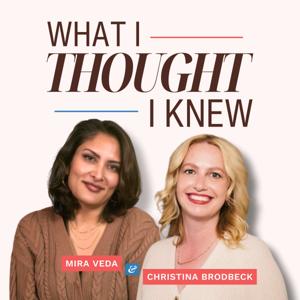


In this episode of What I Thought I Knew, co-hosts Christina Brodbeck and Mira Veda sit down with Ches Wajda, Silicon Valley product design veteran, LinkedIn’s first design hire, and YouTube’s first visual designer. Together, they engage in context-rich conversations exploring how design choices, platform mechanics, and digital media intersect to give power to users and influence modern society.
Ches shares his journey from working in print newspapers and leading design at E-Trade to building onboarding systems at LinkedIn and designing YouTube’s iconic play button. He reflects on how human-centered design can empower individuals, the ongoing friction between user safety and business metrics, and why designers must serve as advocates for the user. The conversation dives into dark patterns like infinite scroll, the attention economy, social media algorithms, and how screen time impacts children.
Throughout the discussion, Ches, Christina, and Mira examine how online platforms shape public discourse, media polarization, and democratic engagement. They also explore the future of design in the age of AI, discussing taste-making, YouTube’s policies on synthetic content, and new tools empowering creators and independent filmmakers.
This episode offers an insightful framework for breaking out binary thinking, questioning everyday norms, and understanding how the platforms we interact with daily shape modern culture.About the Guest
Ches Wajda is a product design veteran who served as LinkedIn’s first design hire and YouTube’s first visual designer. He designed YouTube’s iconic play button and co-invented LinkedIn’s profile progress indicator, a foundational mechanism in onboarding UX. Over his two-decade career, he has advocated for human-centered design across early-stage startups and major tech platforms.Key Moments
Ches Wajda’s design journey: From print newspapers and E-Trade to LinkedIn and YouTube
The role of design in empowering users and advocating for user safety
Social media dark patterns, infinite scroll, comments, and the attention economy
How YouTube’s early culture fostered innovation and democratic creator tools
Discussions on social media polarization and conversations about politics
The future of design, AI tools, taste-making, and synthetic content rules
Time Stamps:
00:00 - Introduction & stepping outside binary thinking
01:23 - Meet Ches Wajda: Early career from print to E-Trade and LinkedIn
05:33 - Gamification and UX: Inventing the LinkedIn profile progress bar
08:13 - Technology, power, and user advocacy in platform design
11:33 - Screen time, dark patterns, and managing social media algorithms
27:03 - Platform responsibility, child safety, and social media regulation
34:16 - Amplified voices, social media polarization, and public discourse
51:41 - The origins of the YouTube play button and design feedback
54:15 - AI in design, taste-making, and YouTube's synthetic content rules
01:04:39 - Empowering creators and below-the-line filmmakers with AI
In this episode of What I Thought I Knew, co-hosts Christina Brodbeck and Mira Veda sit down with Dr. Jason McDaniel, Associate Professor of Political Science at San Francisco State University, for context-rich conversations about politics, election rules, and how voting systems shape modern society. Together, they step outside standard political commentary to explore the mechanics behind voting, redistricting, and party dynamics.
Dr. McDaniel breaks down the differences between single-member districts, proportional representation, ranked-choice voting, and California's top-two primary system. He addresses the realities of gerrymandering and recent Supreme Court decisions impacting the Voting Rights Act, while explaining why voting still matters—especially for younger generations and local communities. The discussion also examines the role of money in elections, candidate-centered politics, and his original research on how election rule changes impact women running for office.
Closing with a deep dive into political identity and representation, Dr. McDaniel shares how his own perspective shifted from viewing class and money as the primary drivers of American elections to recognizing the role of identity, party labels, and structural incentives in US democracy. This conversation offers an insightful framework for breaking out binary thinking and understanding US politics with greater clarity.
About the Guest
Dr. Jason McDaniel is an Associate Professor of Political Science at San Francisco State University. An expert in urban politics and elections, his research focuses on how election rules influence voter behavior, ranked-choice voting, turnout, and racially polarized voting. He is a frequent media commentator on San Francisco and California politics.
Key Moments
Understanding different voting systems: single-member districts vs. proportional representation
Gerrymandering, redistricting, and the impact of Voting Rights Act decisions
Why individual votes matter and the role of youth turnout
The trade-offs and unintended consequences of the top-two primary system
The role of campaign money vs. the informational value of party labels
Research on structural barriers and rule changes affecting women candidates
Rethinking class, money, and identity politics in American elections
Time Stamps:
00:00 - Introduction & stepping outside binary thinking
07:06 - Overview of voting systems and single-member districts
12:35 - Redistricting, gerrymandering, and the Voting Rights Act
20:09 - Does your vote matter? Turnout and civic participation
25:40 - Evaluating the top-two primary system
36:51 - Money in politics vs. the power of party labels
51:21 - Research on how election rules affect women candidates
01:20:25 - Questioning assumptions: Class vs. identity in American politics
In this debut episode of What I Thought I Knew, co-hosts Christina Brodbeck and Mira Veda sit down for a context-rich conversation exploring what it means to feel politically homeless in a deeply polarized world. Together, they step outside binary thinking to take a philosophical approach to modern life, examining the underlying assumptions beneath politics, media, capitalism, and culture.
Christina shares her personal journey from being the first UI designer at YouTube and an angel investor to navigating the Los Angeles fires—an experience that reshaped her definition of home and sparked a shift in her political perspective. In fact, it was after the Palisades fire left her physically homeless that Christina began to realize that she may be politically homeless. Mira reflects on her background as a Canadian immigrant, mother, and former founder of a female-focused website, sharing how recent societal shifts led her to question political party alignment and examine how news and media algorithms shape public trust.
Throughout their discussion, Christina and Mira emphasize the importance of moving past cults of personality in politics to focus on actual policy, human stories, and nuanced perspectives. They explore how personal experiences shape civic engagement and why fostering open dialogue across different viewpoints is essential for understanding modern society.
This introductory episode serves as an invitation to engage in mindful conversations, step out of ideological echo chambers, and question everyday norms to discover what lies in the gray areas of modern life.About the Guest
Christina Brodbeck was an early founding team member and the first UI designer at YouTube before becoming an angel investor and co-founding an investment fund with three other women. After spending years in the Bay Area and Los Angeles, her personal experiences with city governance and losing her home in a fire led her to explore civic involvement and co-create the podcast.
Mira Veda is a Canadian-born mother and former founder of a female-focused media website. With a long-standing passion for civic engagement, political philosophy, and social commentary, she co-created What I Thought I Knew to explore complex cultural and political topics beyond binary viewpoints.Key Moments
Christina and Mira discuss launching the podcast and breaking out binary thinking
Christina's path from YouTube UI designer to feeling politically homeless after the LA fires
Mira on questioning political party alignment, media trust, and motherhood
How cults of personality distort political dialogue and civic participation
Fostering open conversations and rethinking everyday assumptions
Time Stamps:
00:00 - Introduction & stepping outside binary thinking
01:45 - Christina's background: YouTube, investing, and feeling politically homeless
04:00 - Mira's perspective: Immigration, party alignment, and fear in politics
18:41 - Redefining "home" and personal growth through crisis
22:50 - Cults of personality vs. policy and media's impact on trust
You follow the news. You stay engaged. You care about what’s happening in the world. But the story you’re hearing doesn’t always match what you’re living. What I Thought I Knew is a podcast for people who want to question their own assumptions and take a second look at politics, capitalism, and business. We’re not here to change your mind. We’re here to slow the conversation down, break out of binary thinking, and talk through what’s actually going on.
Welcome to What I Thought I Knew
From the publisher's feed
A podcast for the politically homeless. Politics. Capitalism. Business.
Hosted by Mira Veda (Founder Lipstick & Politics/Fmr Board of the Grammy's) & Christina Brodbeck (Founding…