
Sign up to save your podcasts
Or

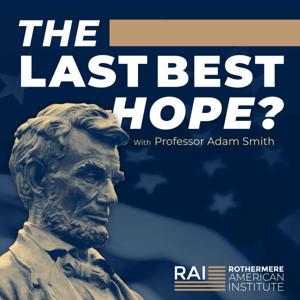

To its principal author, Thomas Jefferson, it was “an expression of the American mind”; to the English philosopher Jeremy Bentham, it was "absurd and visionary". The Declaration of Independence, written 250 years ago, is so layered in myth, so foundational to the idea of America as the last best hope of earth, that it is a challenge, now, to put it into its gritty historical context -- a document that served to justify an act of rebellion, to garner support for it by listing grievances, but which also embedded, perhaps inintentionally, some powerful emancipatory claims. In this two-part episode of The Last Best Hope, Adam asks why the Declaration of Independence said what it did and why it mattered.
Contributors: Professor Lige Gould (University of New Hampshire), author of Among the Powers of the Earth: The American Revolution and the Making of a New World Empire; Professor Steven Sarson (Jean Moulin University Lyon 3) author of The Course of Human Events: The Declaration of Independence and the Historical Origins of the United States; the intellectual historian, biographer of James Harrington, Professor Rachel Hammersley (Newcastle University); Dr Grace Mallon (University of Oxford), Clive Holmes Fellow in History at Lady Margaret Hall; and Bradford Skow, Laurance S. Rockefeller Professor of Philosophy at MIT, author of American Independence in Verse.
The Last Best Hope? is a podcast of the Rothermere American Institute at the University of Oxford and is kindly supported by Tom Amraoui. For details of our programming, go to rai.ox.ac.uk
If you would like to support us by making a donation go to https://www.rai.ox.ac.uk/giving
Producer: Emily Williams. Presenter: Adam Smith
Hosted on Acast. See acast.com/privacy for more information.
 View all episodes
 By Adam Smith

4.6
6060 ratings
To its principal author, Thomas Jefferson, it was “an expression of the American mind”; to the English philosopher Jeremy Bentham, it was "absurd and visionary". The Declaration of Independence, written 250 years ago, is so layered in myth, so foundational to the idea of America as the last best hope of earth, that it is a challenge, now, to put it into its gritty historical context -- a document that served to justify an act of rebellion, to garner support for it by listing grievances, but which also embedded, perhaps inintentionally, some powerful emancipatory claims. In this two-part episode of The Last Best Hope, Adam asks why the Declaration of Independence said what it did and why it mattered.
Contributors: Professor Lige Gould (University of New Hampshire), author of Among the Powers of the Earth: The American Revolution and the Making of a New World Empire; Professor Steven Sarson (Jean Moulin University Lyon 3) author of The Course of Human Events: The Declaration of Independence and the Historical Origins of the United States; the intellectual historian, biographer of James Harrington, Professor Rachel Hammersley (Newcastle University); Dr Grace Mallon (University of Oxford), Clive Holmes Fellow in History at Lady Margaret Hall; and Bradford Skow, Laurance S. Rockefeller Professor of Philosophy at MIT, author of American Independence in Verse.
The Last Best Hope? is a podcast of the Rothermere American Institute at the University of Oxford and is kindly supported by Tom Amraoui. For details of our programming, go to rai.ox.ac.uk
If you would like to support us by making a donation go to https://www.rai.ox.ac.uk/giving
Producer: Emily Williams. Presenter: Adam Smith
Hosted on Acast. See acast.com/privacy for more information.

5,576 Listeners

3,196 Listeners

4,791 Listeners
75 Listeners
1,415 Listeners

15,506 Listeners
3,858 Listeners

350 Listeners

2,552 Listeners
851 Listeners
347 Listeners
149 Listeners

2,536 Listeners

1,153 Listeners
248 Listeners