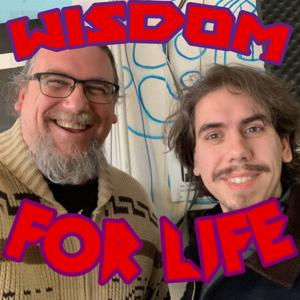
Wisdom for Life
Download on the App Store

Wisdom for Life episodes

  • What We Can Learn From Thought Experiments
    In this twenty-second episode of the Wisdom for Life radio show, hosts Dan Hayes and Greg Sadler examine philosophical thought experiments to see what we can learn from them to improve our lives or to better understand ourselves.  They first discuss what a thought experiment is, and how it differs from other kinds of fictions, counterfactuals, or "what if"s.

    They then turn to in-depth discussion of trolley problems, the Ring of Gyges, the Ship of Theseus, and Roku's Basilisk.  After that, they discuss how one might develop a philosophical practice of creating one's own thought experiments.
     
    Show Music is by Scott Tarulli - https://www.scotttarulli.com/
    59 min
  • A Deeper Dive into Negative Visualization
    In this twenty-first episode of the Wisdom for Life radio show, hosts Dan Hayes and Greg Sadler do a deeper dive into discussion of a practice that they have mentioned on the show previously - Negative Visualization, sometimes called "premeditatio malorum".  This is a practice derived from Stoic philosophy which has proven useful for many people over two millennia for dealing with anxiety, anger, and other emotions, and for developing resilience.

    They also discuss what visualization in this sense is, how it differs from wishful thinking associated with problematic worldviews, and how to do and understand negative visualization in ways that will prove productive for personal growth and development
     
    Show Music is by Scott Tarulli - https://www.scotttarulli.com/
    59 min
  • Hitting the 20-Episode Milestone and Answering Listener Questions
    In this twentieth episode of the Wisdom for Life radio show, hosts Dan Hayes and Greg Sadler take a pause from their normal topic-focused in-depth discussions to talk about what the Wisdom for Life show is about and how they got it started, what challenges they ran into with producing the show in COVID-19 times, and what they have learned by producing the show for nearly half a year.
     
    They also answer a number of questions provided in advance by listeners to the show. 
     
    Show Music is by Scott Tarulli - https://www.scotttarulli.com/
     
    The 2017 Atlantic article, "The Two Clashing Meanings of Free Speech" by Teresa Bejan-  https://www.theatlantic.com/politics/archive/2017/12/two-concepts-of-freedom-of-speech/546791/
    59 min
  • Free Speech: From Rights to Responsibility
    In this nineteenth episode of the Wisdom for Life radio show, hosts Dan Hayes and Greg Sadler discuss a topic of seeming perennial interest - freedom of speech - but attempt to shift the focus from framing it in the usual terms of rights, rules, or overall social benefit towards thinking about speech in terms of one's own responsibility.  
     
    The conversation ranges over how people think about freedom of speech, or portray it in the demands they make about it to others, what genuinely responsible exercise of one's speech or expression would look like, and a useful distinction between two different modes of freedom of speech. In Greek, these were called isegoria (freedom of speech as equal access) and parrhesia (freedom of speech as saying what one wants, to whom one wants, when one wants).
     
    They end the show by discussing a practice that listeners could engage in - "Prudence in use of speech" - making a determination about whether one ought to use one's speech to "make a stand", or whether to devote one's resources where they would be more effective or productive.
     
    Show Music is by Scott Tarulli - https://www.scotttarulli.com/
     
    The 2017 Atlantic article, "The Two Clashing Meanings of Free Speech" by Teresa Bejan-  https://www.theatlantic.com/politics/archive/2017/12/two-concepts-of-freedom-of-speech/546791/
    59 min
  • Giving In To Doing The Wrong Thing
    : In this eighteenth episode of the Wisdom for Life radio show, hosts Dan Hayes and Greg Sadler discuss a puzzle arising early on in ancient literature and continuing on down to the present - if we know right from wrong, and we’re in possession of our faculties, why do we sometimes give in and do the wrong thing instead of the right one? In ancient Greek, this was called “akrasia” - literally lack of self-mastery.  It is a kind of ethical or moral failure that we can call lack or loss of self control, or “weakness of will”.
     
    Dan and Greg examine a number of different approaches to this common experience, including those coming from ancient philosophers and movements like Socrates, Plato, Aristotle and the Stoics, and those from contemporary psychology as well.
     
    They examine a practical question about procrastination in fulfilling tasks and the guilt that often accompanies that failure to follow through
     
    They end the show by discussing a practice that listeners could engage in - deliberately reminding oneself in moments of temptation that in choosing to do what one knows is the right thing, one is helping to establish habits that will help make the right choices easier in the future
     
    Show Music is by Scott Tarulli - https://www.scotttarulli.com/
    59 min
  • Pitfalls to Labelling People Good or Bad
    In this seventeenth episode of the Wisdom for Life radio show, hosts Dan Hayes and Greg Sadler discuss some of the problems and pitfalls that arise when labeling people as entirely good or entirely bad.  Most people fit somewhere in between being perfectly good or bad, so a realistic assessment of other people - or of oneself - would avoid categorizing people uncritically along those lines.
     
    This is somewhat of a meandering conversation, ranging over topics such as the Stanford Prison experiment, insights about goodness and badness in Plato's dialogues, Solzhenitsyn's caution that the line through good and evil runs through human hearts, how we can become aware of our biases, and the difference between stagnant and growth mindsets.
     
    They end the show by discussing a practice that listeners could engage in - reserving judgement when witnessing people doing things that we typically view as bad.
     
    Show Music is by Scott Tarulli - https://www.scotttarulli.com/
    59 min
  • What Is Stoicism?
    In this sixteenth episode of the Wisdom for Life radio show, hosts Dan Hayes and Greg Sadler discuss one of the main philosophical traditions they draw upon in the show – Stoicism – doing a deeper dive on its theory and practice, and discussing the massive interest in Stoicism that has developed in the last two decades.
     
    They discuss some of the main ideas, insights and techniques of Stoicism.  These include living in accordance with nature, the social and rational nature of human beings, the dichotomy of control, the cardinal virtues (wisdom, justice, temperance, and courage), a healthy and rational approach to the emotions, and much more.
     
    They also distinguish genuine Stoicism – grounded in study of classic Stoic texts, application of practices, and adaptation to modern times – from things that aren’t Stoicism.  These include “bro-icism”, where people focus on courage and toughness, but ignore other key Stoic values, and “lower-case-s stoicism”, which is a disposition towards a lack or repression of emotion.
     
    They examine a question raised by a person who claims that Stoicism has left them numb and disengaged, and suggest that this results from misunderstanding and misapplication of Stoic principles and practices.
    They end the show by discussing a practice that listeners could engage in – developing a robust locus of meaning disconnected from work within one’s life.  This is depersonalizing negative experiences, saying “how would I react to this if it was happening to someone else, instead of to me?”
     
    Show Music is by Scott Tarulli – https://www.scotttarulli.com/
    59 min
  • Work, The Future, and Meaning
    In this fifteenth episode of the Wisdom for Life radio show, hosts Dan Hayes and Greg Sadler discuss some of the issues on the horizon facing us in terms of the types and availability of work.  As further developments in robotics, automation, artificial intelligence, surveillance and logistics take place, the jobs and careers of many people are not just at risk, but likely to be phased out in the coming decades.


    They discuss a number of the scenarios projected as possible by different theorists , including Peter Frase (author of Four Futures) and the RSA Action and Research Center.  Some of these are utopian, some are dystopian, and some fit in between.  One of the central questions is how people who currently find a lot of their meaning in work, will manage that if work becomes no longer available in the modes they are accustomed to.

    They end the show by discussing a practice that listeners could engage in – developing a robust locus of meaning disconnected from work within one’s life.
     
    Peter Frase, “Four Futures” – https://jacobinmag.com/2011/12/four-futures
    RSA Action and Research Center report: The Four Futures of Work – https://www.thersa.org/globalassets/pdfs/reports/rsa_four-futures-of-work.pdf
     
    Show Music is by Scott Tarulli – https://www.scotttarulli.com/
    59 min
  • Freedom, Facticity, and Existentialism
    In this fourteenth episode of the Wisdom for Life radio show, hosts Dan Hayes and Greg Sadler discuss some key ideas and issues arising within people’s lives that are illuminated by Existentialist philosophy.  They focus particularly on the concepts of freedom, facticity, responsibility, anxiety or anguish, and meaning, and use concepts and insights from Jean-Paul Sartre, Simone de Beauvoir, Martin Heidegger, and Soren Kirkegaard to make sense of these.


    Without denying that many factors are outside of our control, or even consciousness, Existentialists argues that we are responsible for what we make of ourselves, using what degree of freedom we have. The meaning of our existence is partly a product of our choices and commitments.  Dan and Greg discuss  the meaning of what Sartre calls “bad faith”, which designates ways of using our freedom to deny that very freedom.  They also discuss how the freedom of others can play a central role in our own existence as well

    They end the show by discussing the challenge of not living in bad faith, and practices that could support a more meaningful and authentic life.


    Show Music is by Scott Tarulli – https://www.scotttarulli.com/
    59 min
  • The Social Contract Today
    In this thirteenth episode of the Wisdom for Life radio show, hosts Dan Hayes and Greg Sadler discuss the Social Contract, a classic philosophical concept that plays a key role in American politics and everyday ethics, and which also bears on recent nationwide protests over police misconduct and aggression.
     
    They discuss first what the social contract is and whether or not it has been broken for many Americans, referencing the recent short talk given by Kimberly Jones.  They also look at what ideas from classical social contract theory – found in Thomas Hobbes, John Locke, Jean-Jacques Rousseau, and John Rawls can be useful for understanding our present situation
     
    They also discuss who has been systematically excluded from the social contract, examine a few of the key points that Charles Mills discusses in The Racial Contract, and look at the features Nicholas A Christakis outlines for a better social contract.
    They end the show by discussing a practice that listeners could engage in – trying to imagine a new social contract that would be equitable and just for all.
     

    Kimberly Jones “How We Can Win” video – https://youtu.be/llci8MVh8J4

    Charles Mills, The Racial Contract – https://amzn.to/3ea6rM1
    Nicholas A Christakis, Blueprint: The Evolutionary Origins of a Good Society – https://amzn.to/2BZj9id


    Show Music is by Scott Tarulli – https://www.scotttarulli.com/
    59 min

About Wisdom for Life

From the publisher's feed

Wisdom for Life discusses Practical Philosophy – ideas, insights & practices from philosophical traditions that can be applied to live happier, more intentional, and more productive lives.