
Sign up to save your podcasts
Or



Turning from major to minor, I do a very brief history and explanation of the major/minor duality, and then get into the cadence Fmi6 --> C. Feel free to ask quesitons, as this one goes a bit into the weeds.
Here the traffic circle idea explodes into an infinite pathway concept. I reference a 1945 recording by Don Byas and Slam Stewart that can be found here. Go to 1:48 to hear the thing I'm talking about. Also, attached to this post is a page from my book that diagrams out the pathways. I've only talked so far about the top half of this diagram (not the minor stuff). This one thing could be practiced for many years without being mastered (trust me, I've tried!). So if you have questions, please ask and I'll try to respond in future posts.
This is a continuation of the traffic circle idea, and the beginning of a pathways concept. We are now getting to the juicy part where we connect one traffic circle to another. I demonstrate and talk about why this approach can lead to a more functionalresult than a bunch of scales and altered dominants. I will refer to the attached page for this and subsequent videos.
In the last video we looked at four ways to get to a place. Now we look at, for any particular place, four ways to get out of it. For example, if you are in C (major or minor), you can make that into a C7 to then prepare to go somewhere. You have (in this traffic circle model) four directions: F, Ab, B, or D. These could be major or minor key centers. So in the exercise I just go to a key center, make it dominant, and go somewhere else. For example,
C, C7, Fmi, F7, E, E7, F#, F#7, G#mi, G#7, Bb, Bb7, A, A7, Dmi, D7, Bbmi, Bb7, C
This could go on and on.
Moving back to application, I explain here how the four dominants that we made from the diminished create four "altered dominant" sounds. Specifically:
Bb7 -> C = G7b9#9 -> C
Db7 -> C = G7b9#11 -> C
E7 -> C = G13b9 -> C
and of course
G7 -> C = G7 -> C
So, instead of thinking of four varieties of altered "G7" chords, we are thinking of approaching the destination from four different angles. Could be North, South, East and West, or something like that. Could also think where the roots are - approaching from the 5th (normal), from the b7th (backdoor), from the tritone (tritone sub), or from the major 3rd above (13b9).
Soon we will expand these four dominants in a whole world of symmetry
Back to warmup exercises, here's one looking at the diminished 7th morphing into the four dominant 7th chords that are related to it.
Here's a video to address a member question of application of the stuff from the previous post, using examples on a minor blues and "All the Things You Are."
This will be a series of videos on a single topic that I find extremely useful, which is the use of diminished structures. We start out with thinking about the places where one diminished 7th structure could go, and then turning that into an exercise.
Still using the Chromatic Scale, and then demonstrating with improvising on a blues. Seeing how many levels of dynamics we can get with the pick, playing with the amp turned up to 10.
A couple more quick practice ideas for the chromatic scale, a great way to get your fingers and picking hand going.
From the publisher's feed
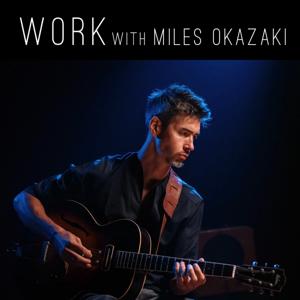
This is a podcast version of Miles Okazaki's patreon channel. Okazaki is a guitarist and composer based in Brooklyn, NY.
Season 1 (Monk, 65 episodes): How this podcast began: individual…
Season 2 (Fall 2024, 48 episodes): A 12-part series on the subject of Symmetry, an 8-part series on Drum rudiments with the pick, and a 5-part series on the "Allegro Assai" from J.S. Bach's C major violin sonata. Other episodes include bebop standards "Donna Lee" and "Wail," a series on the chromatic scale, favorite books, listening sessions and exercises for the ear from my book "Fundamentals of Guitar."
Season 3 (Winter 2024. 63 episodes): An 11-part series on Polyrhythms, a 7-part series on Charlie Christian's "Stompin at the Savoy" solo, a 4-part series on my song "Dog Star," the first "guided practice" episodes, close looks at the standards "Lush Life," "Hot House," and "Danny Boy," Bach on each Sunday, and listener questions. Note: a good number of episodes from this season are on sight reading, and only available as videos on Patreon.
Season 4 (Spring 2024, in progress): A 7-part series on my tune "Kudzu," a 7-part series on the drum exercise "Paradiddle Johnnie," Monday meditations on one of the 351 shapes, Studies of Bach from the Well Tempered Clavier, Art of the Fugue, Musical Offering, and Mass in B minor, listener questions. Note: a good number of episodes from this season are on sight reading, and only available as videos on Patreon.
----------
To see the episodes in video form (including many not shown here), participate in discussions, and download accompanying maiterials, join on Patreon for $10 a month, 7 day free trial available.