
Sign up to save your podcasts
Or

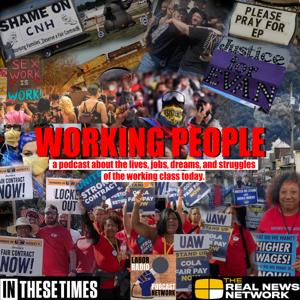


The decade from 2010 to 2020 was one that saw more people around the world participating in protests than at any other point in human history. And yet, looking back, the results of so many of these mass protests, the societal changes that followed, were the opposite of what protestors were demanding. In his new book, If We Burn: The Mass Protest Decade and the Missing Revolution, award-winning journalist and foreign correspondent Vincent Bevins asks: Why? In this special episode, recorded at The Real News Network studio in Baltimore, we talk to Bevins about his new book and about his own working life as a journalist covering people's uprisings around the world.
Additional links/info below...
Permanent links below...
Featured Music (all songs sourced from the Free Music Archive: freemusicarchive.org)
It is looking increasingly likely that Congressional Republicans will bring the federal government to a shutdown starting this weekend. "U.S. government services would be disrupted and hundreds of thousands of federal workers would be furloughed without pay if Congress fails to provide funding for the fiscal year starting Oct. 1," Reuters reports. "Workers deemed essential would remain on the job, but without pay." Among the many agencies that will be furloughing workers in the event of a shutdown is the National Labor Relations Board. Not only will unionized staff workers at the NLRB itself be hurt by the government shutdown—after years of enduring chronic and politically motivated underfunding and understaffing—but so, too, will working people around the country who depend on the NLRB to enforce labor law, investigate Unfair Labor Practice charges, manage union elections, etc. In this urgent mini-cast, we talk with Michael Bilik and Colton Puckett, legislative co-chairs of the National Labor Relations Board Union and full-time NLRB staff workers, about the daily work NLRB staff do, the role that work plays in the broader labor movement, and what it will mean for workers if the government shuts down and nearly all of NLRB staff are furloughed.
Additional links/info below…
Permanent links below...
Featured Music (all songs sourced from the Free Music Archive: freemusicarchive.org)
The United Auto Workers are striking against all of the Big Three automakers at once for the first time in the union's history. The UAW is employing a novel "stand-up strike" strategy: rather than having over 140,000 auto workers hit the picket line at once, UAW members at three strategically targeted plants were called to strike first last Thursday, and union president Shawn Fain has announced that more plants will be called to strike by the end of this week. What are the key demands auto workers are striking over? What's happening on the picket lines? How are active and retired members feeling about the union's new, more militant strategy? And what role do we all have to play in ensuring they win the contract they deserve? On this worker solidarity livestream, hosted by The Real News Network, Max speaks with Martha Grevatt, a retired auto worker and UAW Local 869 member, and Auston Gore, an assembly line worker and UAW Local 12 member who is currently on strike at the Stellantis Toledo Assembly Complex. With permission from TRNN, we are sharing the audio of this livestream, recorded on Sept 20, 2023, on our podcast feed.
Permanent links below...
Featured Music (all songs sourced from the Free Music Archive: freemusicarchive.org)
After the high-stakes contract fight between the Teamsters and UPS, the eyes of labor are now on the contract negotiations currently taking place between the United Auto Workers and the Big Three automakers: Ford, General Motors, and Stellantis (formerly Chrysler). The UAW's master agreement with the Big Three covers around 150,000 autoworkers, and the current contract expires on September 14. If a tentative agreement is not reached by then, the auto industry could be the next to be rocked by a major strike, and UAW president Shawn Fain has stated clearly that the union is prepared to strike at all three automakers if necessary. What brought us to this point, and what's at stake in this contract fight (for autoworkers, for the UAW, and for the labor movement writ large)? What are workers demanding, and what role do we all have to play in ensuring they get the contract they deserve? In this panel discussion, we talk with three rank-and-file workers and UAW members from each of the Big Three automakers: Marcelina Pedraza, a Ford electrician in Chicago and member of UAW Local 551; Torice Sawyer, a Stellantis plant worker at the Detroit Assembly Complex–Jefferson and member of UAW Local 7; Nicholas Livick, a General Motors autoworker and rank-and-file member of UAW Local 31 in Kansas City.
Additional links/info below…
Permanent links below...
Featured Music (all songs sourced from the Free Music Archive: freemusicarchive.org)
At the federal level today, the subminimum wage for tipped workers is still just $2.13 an hour. That is, frankly, a disgrace. "A direct legacy of slavery," the One Fair Wage campaign notes, "the subminimum wage affects a workforce of nearly 5 million tipped workers that is 70 percent women and 43 percent people of color." In this mini-cast, we talk about the fight to end the subminimum wage with Tabina Gipson, a tipped worker in Chicago who's worked in the food industry for over 10 years, a mother of five, and an organizer with One Fair Wage.
One Fair Wage is a national organization of nearly 300,000 service workers, over 2000 restaurant employers, and dozens of organizations nationwide all working together to end all subminimum wages in the United States and improve wages and working conditions in the service sector in particular. One Fair Wage policy would require all employers to pay the full minimum wage with fair, non-discriminatory tips on top, thus lifting millions of tipped and subminimum wage workers nationally out of poverty.
Additional links/info below…
Permanent links below...
Featured Music (all songs sourced from the Free Music Archive: freemusicarchive.org)
Within the past two years, South Korea has seen major labor actions, including a general strike in October of 2021, and major crackdowns on organized labor, including the national intelligence agency raiding the offices of the Korean Confederation of Trade Unions in January of this year. In that same time, military and geopolitical tensions in the region have been rapidly intensifying. What is going on? What is the state of organized labor in South Korea, and how have imperialist and capitalist pressures, especially from the US, shaped the terrain upon which working people across the Korean Peninsula are struggling to live and work with dignity? We talk about all of this and more with Ju-Hyun Park, author, organizer, and Engagement Editor at The Real News Network.
Additional links/info below...
Permanent links below...
Featured Music (all songs sourced from the Free Music Archive: freemusicarchive.org)
The world of higher education has been in shock this past week after West Virginia University President E. Gordon Gee announced plans to dramatically cut academic programs and jobs in the coming year. "West Virginia University, a crucial institution in one of the nation's most impoverished states, is poised to jettison all of its faculty dedicated to teaching Spanish, French, Chinese and other foreign languages," Nick Anderson reports at The Washington Post. "The state's largest public university also is moving toward elimination of a master's degree program in creative writing and a doctoral program in mathematics, among other proposed cuts, in response to declining enrollment and what university officials call a 'structural' budget deficit of $45 million. In all, 32 of the university's 338 majors on its Morgantown campus would be discontinued and 7 percent of its faculty eliminated under a plan made public last week." If WVU proceeds with the proposed cuts, the impact on campus workers—student employees, grad workers, faculty, staff, facilities workers—and the local economy will be massive. What brought WVU to this crisis point? And what can be done to fight back? In this urgent episode, we talk with: Leslie Wilber, an organizer with West Virginia Campus Workers who graduated with a Master of Fine Arts degree from WVU earlier this year; Morgan King, a recent graduate of WVU, a Fulbright Scholar, and a Marshall Scholar; Dr. Jessie Wilkerson, associate professor and Joyce and Stuart Robbins Chair of History at WVU, a member of the West Virginia Campus Workers union, and the author of To Live Here, You Have to Fight: How Women Led Appalachian Movements for Social Justice.
Additional links/info below…
Permanent links below...
Featured Music (all songs sourced from the Free Music Archive: freemusicarchive.org)
Ana Jakopič is a lawyer, organizer, and trade union leader in Slovenia. We talk to Ana about the different kinds of workers she organizes with on a daily basis, the struggles working people across Slovenia are facing, and how connected/disconnected those struggles currently feel to the strikes taking place in Europe and beyond. But we also talk about Ana's life and her winding path into the labor movement; we talk about growing up in the post-Yugoslavian world, and about the impacts the Russo-Ukrainian War is having on Slovenians' lives today.
Additional links/info below...
Permanent links below...
Featured Music (all songs sourced from the Free Music Archive: freemusicarchive.org)
"I've never been an organizer," Khali Jama says, "but I've always fought." As a single mother, a Muslim, and a Somali-American worker living in Minnesota, Jama has always had to fight for the life she, her family, and her fellow workers deserve. And earlier this year, after bringing that fight to the Minnesota state legislature, Khali and her coworkers achieved a major victory. "On May 16," Lisa Kwon reports in PRISM, "Minnesota lawmakers passed the nation's strongest Amazon warehouse worker protection legislation with the Warehouse Worker Protection Act, which ensures that workers can take breaks during the workday and have access to relevant quota and performance standards and data on how fast they're working. The bill's passage marks a significant victory for migrant workers — especially Minnesota's Somali immigrant population, of which the state has the largest in the country. For Khali Jama, a former worker in Amazon's fulfillment center in Shakopee, Minnesota, the new bill offers reprieve and protections that she worked to mobilize. As a Somali and a Muslim, Jama said the Warehouse Worker Protection Act ensures some equity in Minnesota's facilities." In this episode, we sit down and talk with Jama about moving to the midwest as a child, about her path to working in healthcare and at Amazon, and about the incredible story of how Khali, her coworkers, and the team at the Awood Center, which organizes in Minnesota's East African communities, fought to pass the Warehouse Worker Protection Act. Additional links/info below...
Permanent links below...
Featured Music (all songs sourced from the Free Music Archive: freemusicarchive.org)
The Norfolk Southern train derailment and "controlled release" of toxic vinyl chloride in East Palestine, Ohio, was an avoidable catastrophe. Long before the train cars crashed on Feb. 3 and residents' lives were turned completely upside down, railroad workers had been warning anyone who would listen that the relentless cost-cutting and profit-maximizing practices implemented on the freight rail system by greedy rail executives and their Wall Street shareholders would endanger workers and the public, and they were right. In recent hearings held in East Palestine by the National Travel Safety Board (NTSB), testimonies by representatives from rail labor and even Norfolk Southern itself have revealed what workers already knew: a combination of reckless business practices by the rail carriers, including yearly staff cuts to rail maintenance workers and the outsourcing of vital safety functions to unregulated machines, and lax federal regulation of the railroads has created the conditions for catastrophes like East Palestine to happen with greater frequency. But it is not too late to reverse course and build a safer, greener, more efficient, more humane rail system. In this episode, we discuss the latest revelations to come out of the ongoing investigations into the East Palestine disaster with Jason Cox, national representative for the Brotherhood of Railway Carmen, who testified at the NTSB hearings in East Palestine in June.
Additional links/info below...
Permanent links below...
Featured Music (all songs sourced from the Free Music Archive: freemusicarchive.org)
From the publisher's feed

5,745 Listeners

1,859 Listeners
518 Listeners

1,460 Listeners

1,581 Listeners

6,103 Listeners
3,316 Listeners

1,942 Listeners

3,910 Listeners
624 Listeners

215 Listeners
2,706 Listeners
605 Listeners

1,060 Listeners
564 Listeners