
Sign up to save your podcasts
Or



Send us Fan Mail
Is it illegal to call someone a “muppet” in England? Yes, yesterday a man was arrested by British police for, allegedly, calling someone a “muppet”. For more, take a look at our Substack at WorldBriefZMC.
Send us Fan Mail
What’s the real reason for the backlash to the Cracker Barrel Rebrand?
It’s not what you may think -- it might be fatigue from non-stop corporate authoritarianism. Take a listen and tell us what you think.
For a deep dive and a comment on Cracker Barrel’s last PR stunt (the ‘great syrup debacle’), take a look at our Substack at WorldBriefZMC and be sure to subscribe and vote in the poll — link in the bio.
Send us Fan Mail
In a quiet announcement released on Friday, the World Economic Forum(“WEF”), announced that its CEO, Larry Fink, has taken over as interim “co-chair” of the infamous organization.
Deep dive on Substack at WorldBriefZMC.
Send us Fan Mail
Is there a connection between the Roman Emperor Nero and the LA Wildfires?
Yes. Nero infamously “fiddled” while Rome burned to the ground and then took the land and built a palace on it. Now, something similar may be happening to some victims of the LA wildfires.
California law was changed this year to allow the local government to use public funds to buy up the homes and land of the victims of the 2025 LA Fires and we discuss the similarities.
Head to our substack for the Deep Dive at WoldBriefZMC.
Send us Fan Mail
Its August 11, 2025 this is your News Flash
Once in a thousand years floods in Wisconsin, explosion at chemical plant in Pennsylvania, tropical storm Erin in the Atlantic target east coast.
If you know anything about these events please leave a comment below.
Send us Fan Mail
Is it illegal to hike on public land? Yes, in parts of Eastern Canada.
In Nova Scotia - which shares a border with Maine- it is now a criminal offense to hike, camp or drive through the woods on “Crown Land” (public property), from August 5 and October 15, 2025. Violators may be fined as much as $25,000 for violations of the proclamation and at least one man has already been ticketed. The new law applies to some privately owned land as well.
At least two other north eastern Canadian provinces (New Brunswick and Labrador) have passed similar measures though it’s not yet a crime there.
Officials have justified the move citing the dry conditions and the risk of forest fires, though curiously, paid-camping on “Crown land” remains lawful. Some say this was a preventable issue and blame poor forestry practices (like not removing fallen trees and dead limbs) - an echo of legitimate criticisms the fire management practices in California and elsewhere). While most Canadians seem to understand the logic of being cautious (especially during a dry summer) , many view the measures as being heavy handed and draconian. And there are fears that these temporary restrictions may become permanent.
Do you think hiking bans are ok?
For a deep dive visit our Substack at WorldBriefZMC and don't forget to vote in the poll!
Send us Fan Mail
Could a “Digital ID” stop illegal immigration? Yes, if you’re in the UK or so it has been claimed.
According to the British think tank Labour Together, that’s precisely what the “Britcard” would do. The organization, whose ideas have been echoed by British Prime Minister Kier Starmer, thinks that a digital ID that ties everything from citizenship status to health and finance records together is just what the UK needs.
Send us Fan Mail
Will you need ID to watch videos on YouTube? Yes, even in the US, starting August 13th, 2025, if the AI thinks you’re under 18 you might have to provide an ID for full access.
In a move that mirrors the ID verification laws that have recently taken effect in the UK and EU countries, YouTube has announced that it will use AI to determine whether a viewer is 18 or older (purportedly based upon viewing habits). If the AI works as advertised then adult users won’t even know it’s there but if the algorithm gets it wrong, users will have YouTube’s ‘nanny controls’ activated resulting in restrictions on what they can watch. Misidentified users then have the option to provide proof of their age by way supplying a valid credit card or government issued ID.
Supporters claim this will help shield children from harmful content and help fight so-called ‘misinformation’. But privacy advocates note that the duty to protect our children from online threats rests with the parents and not big business. They have labeled these plans as a ‘Trojan Horse’ designed to usher in social credit scoring and “license-for-the-Internet” schemes to limit free speech.
What do you think?
For the deep dive, and the connection to Spotify’s new policy, subscribe to our Substack at WorldBriefZMC.
Send us Fan Mail
If you’re in the US, could you be arrested for violating a foreign country’s online speech laws?
Yes at least in theory. Through a process called extradition, a foreign country (like the UK for example), could decide that you’ve violated their new “Online Safety Act” (OSA), and have you arrested in the US. What’s more, under the terms of the treaty, the UK could have your assets seized too.
Fortunately, the chance of this happening is still pretty low but with the passage of laws like the OSA and others elsewhere abroad, the risk of criminalization of 1st Amendment rights has increased considerably.
To be fair there are some safeguards in the treaty; But those provisions were created before most of the so-called “online speech crimes” were even on the books and the language used was geared towards stopping “mallum in Se” (intrinsically evil”) crimes like murder, theft and similar. In such cases, extradition made sense — if an American hacked a British bank and stole money while on US soil, arresting him and shipping him to the UK to stand trial is ok.
But the United States (and other countries), won its independence to prevent the Crown from criminalizing words and treaties cannot be allowed to undo that, even if only by accident. The paradox of a free Republic is that, it’s frequently when a right is abused that it is hardest and most important to uphold.
And so, whether you’re an American or not, it is important to keep an eye on the unintended consequences of even well-meaning new laws. And perhaps the real question is, even if it feels good sometimes, should there even be “speech crimes”?
What do you think?
Send us Fan Mail
If you ask this question: "Is the American home buying system normal?"
Objectively, the answer is "no". For the most part, the current system — which revolves around 30 year mortgages — was created by central banks to conceal their inflationary policies and make property seem affordable — the old “who cares what the price is if the payments are low?” trick (a ploy that may be familiar to anyone who has shopped at an auto dealership). Sure there have been 'shiny baubles' that have distracted us for the last century and probably made many of us think 'all is well' -- but, like a diet of junk food -- its fun in the beginning but bad in the end; not the players on 'main street' mind you -- there is nothing wrong with real estate as a business or mortgage lending (at the local level), or any of that. The problem is at the very top - where the money polices are made (in the halls of the central bank we call the Fed where the unelected governors make decisions that are rarely focused on the average American's interests).
The reality is that, we've been taxed to a practical breaking point when one views housing and land costs as a percentage of income. When viewed thus, land prices were massively lower before central banking policies evicerated American buying power and people had far less of a need for mortgage debt (which comes with lots of strings attached). For example, in 1918, the median income was approximately $1,000 but the average cost of an acre of land was only $70. An entire home could be bought from a Sears catalog, delivered and constructed for as little as $750. This meant that, an entire acre of land and a brand new home could be had for LESS than the average annual salary.
Today the median American income is $62,000 but the average home price is $422,000 — it now costs approximately 7 times the average annual salary to buy a mid-tier home. But it gets worse. That’s because most homes aren’t on a full acre anymore — the average lot size is less than a Fifth of an acre (and getting smaller). What’s worse, residential acreage is much more scare and far more costly today than it ever was— $200,000 per acre is considered competitive in many markets (and that's when a 'spare' unattached acre can even be found). This puts the total cost of home and land ownership even further out of reach and this is to say nothing of the overall downward trend in the quality of building materials, skyrocketing insurance rates or the absurd hoops that new home buyers are forced to jump through to qualify for mortgages.
So what can be done? This isn't just talk -- as of this writing, some of the highest ranking government officials have been questioning whether the Fed (arguably the World's central bank), is really providing a true benefit to the citizens of this Republic. What is more, central banking is a comparatively new construct -- it is not a constitutional office and tends to serve only a very limited cadre of citizens well while severely taxing the remainder (mostly via inflation). And so, to identify the solution, first we must identify the problem.
The issue is simple in principle but complex in application. Substantively it boils down to this: As far as land is concerned, the first step is remembering that what we think of today as the real estate market is not normal and that we know we can have better because we HAD better before. From there, sticking to ‘real money’ will help prevent these sky-high price hikes for the average citizen.
From the publisher's feed
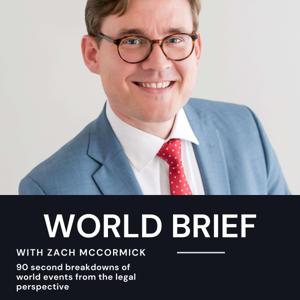
90 second breakdowns of world events from the legal perspective