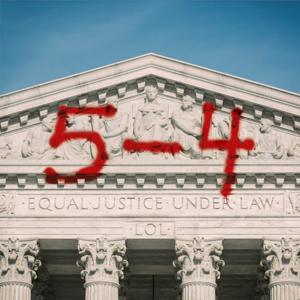
5-4

5-4

By Prologue ProjectsNewsGovernmentNews Commentary
Download on the App Store
  • Ranking

    41st

    on Government

  • Favorites

    752

    Followers

  • Latest release

    4 days ago

  • Typical duration

    46 min

    per episode

  • If it hooks

    41%

    finish an episode

Based on Podcast App listening data

All 5-4 episodes

  • Atkins v. Virginia
    The hosts discuss Atkins v. Virginia, a case in which the Supreme Court held that it is unconstitutional to impose the death penalty on people with intellectual disabilities. But the Court also created a loophole by allowing states to decide the standard for who qualifies as intellectually disabled. As a result of the Court’s lack of clarity, some states have continued to execute people with intellectual disabilities to this day.

    Hosted on Acast. See acast.com/privacy for more information.


    Our Sponsors:
    * Check out Mint Mobile and use my code mintmobile.com/fivefour for a great deal: https://www.mintmobile.com
    * Check out Quince and use my code FIVEFOUR for a great deal: https://www.quince.com


    Advertising Inquiries: https://redcircle.com/brands
    58 min
  • US v. Morrison

    The hosts discuss a case in which the Supreme Court struck down a provision of the Violence Against Women Act (VAWA) that allowed women to sue abusers in federal court for damages. In the process, the Court constrained the ability of Congress to regulate interstate commerce, not only weakening an important civil rights law, but also making it more difficult for Congress to pass progressive legislation going forward.


    Follow eter (@The_Law_Boy), Rhiannon (@AywaRhiannon), and Michael (@_FleerUltra) on Twitter.

    Hosted on Acast. See acast.com/privacy for more information.


    Our Sponsors:
    * Check out Mint Mobile and use my code mintmobile.com/fivefour for a great deal: https://www.mintmobile.com
    * Check out Quince and use my code FIVEFOUR for a great deal: https://www.quince.com


    Advertising Inquiries: https://redcircle.com/brands
    50 min
  • Navarette v. California

    Your hosts discuss Navarette v. California, which held that an unverified anonymous tip about reckless driving could be sufficient grounds for the police to pull over a car. The case exemplifies how deferential the Supreme Court is to police power, and has resulted in an increased reliance on anonymous tips by the cops, and a corresponding erosion of citizens’ privacy rights.


    Follow Peter (@The_Law_Boy), Rhiannon (@AywaRhiannon), and Michael (@_FleerUltra) on Twitter.

    Hosted on Acast. See acast.com/privacy for more information.


    Our Sponsors:
    * Check out Mint Mobile and use my code mintmobile.com/fivefour for a great deal: https://www.mintmobile.com
    * Check out Quince and use my code FIVEFOUR for a great deal: https://www.quince.com


    Advertising Inquiries: https://redcircle.com/brands
    50 min
  • Morse v. Frederick
    In 2002, a student held up a banner that said “Bong Hits 4 Jesus” at an Olympic torch relay, in full view of his classmates and teachers. When he was suspended, he claimed his banner was protected free speech under the First Amendment. The Supreme Court disagreed. In this episode, your hosts discuss the contours of student free speech, the Court’s puritanical moralizing on marijuana, and the importance of absurdist speech in creating real change.

    Hosted on Acast. See acast.com/privacy for more information.


    Our Sponsors:
    * Check out Mint Mobile and use my code mintmobile.com/fivefour for a great deal: https://www.mintmobile.com
    * Check out Quince and use my code FIVEFOUR for a great deal: https://www.quince.com


    Advertising Inquiries: https://redcircle.com/brands
    41 min
  • The Rise and Fall of Roe v. Wade, Pt. 2
    In the second part of a two-episode series on abortion rights, the hosts discuss Planned Parenthood v. Casey, a 1992 case in which the Supreme Court made it easier for states to restrict abortion access so long as abortion regulations don’t create an “undue burden.” The vague standard set lawmakers on a new path of attacking abortion access and fueled anti-abortion groups’ efforts to spread stigma and misinformation, setting up Roe v. Wade for a death by a thousand cuts.

    Hosted on Acast. See acast.com/privacy for more information.


    Our Sponsors:
    * Check out Mint Mobile and use my code mintmobile.com/fivefour for a great deal: https://www.mintmobile.com
    * Check out Quince and use my code FIVEFOUR for a great deal: https://www.quince.com


    Advertising Inquiries: https://redcircle.com/brands
    1 hr 1 min
  • The Rise and Fall of Roe v. Wade, Pt. 1
    The hosts take on one of the Supreme Court’s most famous decisions, Roe v. Wade. In this first episode of a two-part series, they look at the legal and factual origins of Roe v. Wade. They also discuss how Roe was weaponized by the conservative legal movement to rally against an interpretation of the Constitution that allows for flexibility in favor of a far more rigid approach.

    Hosted on Acast. See acast.com/privacy for more information.


    Our Sponsors:
    * Check out Mint Mobile and use my code mintmobile.com/fivefour for a great deal: https://www.mintmobile.com
    * Check out Quince and use my code FIVEFOUR for a great deal: https://www.quince.com


    Advertising Inquiries: https://redcircle.com/brands
    55 min
  • 5-4 x Know Your Enemy

    Peter, Rhiannon, and Michael join the hosts of the podcast Know Your Enemy for a conversation about the conservative legal movement. They discuss the origins of conservative doctrines like originalism and textualism, and the rise of the Federalist Society from a small group of conservative students and academics to an organization whose members constitute the majority of the Supreme Court.


    Follow Peter (@The_Law_Boy), Rhiannon (@AywaRhiannon), and Michael (@_FleerUltra) on Twitter.

    Hosted on Acast. See acast.com/privacy for more information.


    Our Sponsors:
    * Check out Mint Mobile and use my code mintmobile.com/fivefour for a great deal: https://www.mintmobile.com
    * Check out Quince and use my code FIVEFOUR for a great deal: https://www.quince.com


    Advertising Inquiries: https://redcircle.com/brands
    1 hr 25 min
  • Herrera v. Collins
    The hosts take on a 1993 death penalty case that has been called one of the worst decisions in capital punishment jurisprudence. Herrera v. Collins asks whether someone on death row can have new evidence of their innocence reviewed in federal habeas corpus proceedings, often the last resort for someone who has exhausted their appeals. In a 6-to-3 vote, the Court rejected the claim, barely shying away from holding that the Constitution does not protect against an innocent person being executed.

    Hosted on Acast. See acast.com/privacy for more information.


    Our Sponsors:
    * Check out Mint Mobile and use my code mintmobile.com/fivefour for a great deal: https://www.mintmobile.com
    * Check out Quince and use my code FIVEFOUR for a great deal: https://www.quince.com


    Advertising Inquiries: https://redcircle.com/brands
    50 min
  • Roman Catholic Diocese v. Cuomo

    The hosts discuss Roman Catholic Diocese of Brooklyn v. Cuomo, a recent case about COVID-19-related restrictions on religious gatherings. In it, the Supreme Court struck down hard capacity caps on religious gatherings in high-risk areas. The case has already spawned more challenges to pandemic-related restrictions on religious gatherings and likely foreshadows the expansion of legal exemptions for religious groups.


    Follow Peter (@The_Law_Boy), Rhiannon (@AywaRhiannon), and Michael (@_FleerUltra) on Twitter.

    Hosted on Acast. See acast.com/privacy for more information.


    Our Sponsors:
    * Check out Mint Mobile and use my code mintmobile.com/fivefour for a great deal: https://www.mintmobile.com
    * Check out Quince and use my code FIVEFOUR for a great deal: https://www.quince.com


    Advertising Inquiries: https://redcircle.com/brands
    44 min
  • Ashcroft v. Iqbal

    The hosts discuss Ashcroft v. Iqbal, a 2008 case in which the Court created a new pleading standard for legal complaints that made it much harder for plaintiffs to bring their cases. Here, a Pakistani immigrant who claimed he was detained and tortured in the wake of 9/11 had his case dismissed because, according to the Court, his allegations that Bush administration officials were responsible for his treatment were not “plausible.” 


    Follow Peter (@The_Law_Boy), Rhiannon (@AywaRhiannon), and Michael (@_FleerUltra) on Twitter. 

    Hosted on Acast. See acast.com/privacy for more information.


    Our Sponsors:
    * Check out Mint Mobile and use my code mintmobile.com/fivefour for a great deal: https://www.mintmobile.com
    * Check out Quince and use my code FIVEFOUR for a great deal: https://www.quince.com


    Advertising Inquiries: https://redcircle.com/brands
    56 min