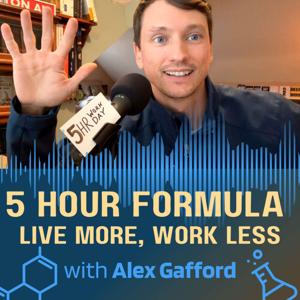
5-Hour Formula: Live More, Work Less

5-Hour Formula: Live More, Work Less

Download on the App Store

5-Hour Formula: Live More, Work Less episodes

  • [#05] Work Less, Achieve More—The Ultimate Routine Shift


    Episode Summary:

    When I look back on my best workdays, they usually have one thing in common: solid routines. And the same goes for my worst days—when I feel scattered or drained, it’s almost always because I skipped my key habits.

    In this episode, I share the three core routines that have helped me thrive while working five-hour days since 2016. These aren’t just time management tips—these are energy and focus systems that set the tone for every part of life.

    By the end, I’ll guide you through a simple experiment to upgrade your own routine and build more intentional structure into your day.

    What I Covered:

    1. A Great Day Starts the Night Before (PM Routine)

    When I improved my evening routine, everything changed. Better sleep, clearer mornings, and more presence during the day.

    Here’s what works for me:

    • I turn off all screens at least an hour before bed.
    • I stretch, read, and wind down without digital inputs.
    • I use a PM alarm on my smartwatch to remind me to start shutting it down.
    • This routine helps me get high-quality sleep—and sleep is the foundation of everything: focus, decision-making, presence, even emotional regulation.


    I used to scroll my phone or watch TV right before bed and wondered why I didn’t sleep well. Now I treat my wind-down time as sacred. As Matthew Walker says in
    Why We Sleep, sleep is the pillar that supports all other pillars of health.

    2. Win the Morning (AM Routine)

    When I stopped grabbing my phone first thing in the morning, my days immediately got better.

    I now prioritize “pre-input time,” which means:

    • No email, news, or social media first thing.
    • Instead, I hydrate, journal, and get moving before screens.


    Some mantras that have stuck with me:

    • Goals before screens (from my cousin Jay Papasan)
    • Sweat before screens (from mental performance coach Brian Cain)
    • Creativity before inputs (inspired by Julia Cameron)


    Most mornings, I get out of bed, drink water, write for 15 minutes, make breakfast for my family, help get the kids on the bus, and then head to the gym or yoga with my wife. No digital noise—just calm, clear, grounded energy.

    When I do this, I step into my five-hour workday feeling rested, focused, and on purpose.

    3. Shutdown Work with Intention

    The biggest challenge I’ve faced—and seen in clients—is not starting work, but stopping it. Without a proper shutdown, I found that work would follow me into dinner, family time, and even sleep.

    Here’s my shutdown routine:

    1. I review what I accomplished that day.
    2. I look at tomorrow’s top priorities.
    3. I say out loud, “Shutdown complete” as I close my laptop.
    4. I leave my phone in my office until after dinner.


    That last step alone—leaving my phone behind—has made the biggest difference in being present with my family. My goal is to finish work before my kids get home from school so when they walk off the bus, I’m
    there, fully. No distractions. No lingering to-dos. Just presence

    Your Turn: Try This Week’s Experiment

    Step 1: Identify your current AM and PM routines
    Grab a notebook and make two columns.

    • In column one, list your current morning and evening habits.
    • In column two, rate them:
      • (+) Positive = supports focus/energy
      • (–) Negative = drains or distracts
      • (=) Neutral = doesn’t really help or hurt


    Step 2: Replace one negative behavior
    Choose
    one habit to shift.
    Example: Instead of checking your phone in bed, put it across the room and stretch or journal instead.

    Small shifts build momentum. You don’t need a perfect routine—just a better one than yesterday.

    Resources I Mentioned:

    • Atomic Habits – James Clear
    • Why We Sleep – Matthew Walker
    • The Compound Effect – Darren Hardy
    • The One Thing – Gary Keller & Jay Papasan
    • The Artist’s Way – Julia Cameron
    • Deep Work – Cal Newport


    20 min
  • [#04] The Cornerstone of Realizing Your Dream Life (but 99% Don't Do It) with Mike Miller

    In this episode of The 5-Hour Formula, host Alex Gafford welcomes Mike Miller, founder of the Vision Creators Club, host of The Boardroom Sessions podcast, and leader of OCTP networking group. Together, they dive into the power of creating a clear vision for your life, setting intentions, and taking daily action to bring your biggest dreams to reality.

    Most people never take the time to define their ideal life, and as a result, they drift aimlessly, letting external circumstances dictate their path. Mike shares how crafting a vision statement and committing to daily rituals can help you set a course and navigate life's inevitable headwinds. Whether you're looking to refine your career, optimize your personal growth, or enhance your overall well-being, this conversation provides a powerful framework to get started.

    What You'll Learn in This Episode:

    • Why having a clear vision is the cornerstone of a fulfilling life.
    • How the Vision Creators Club fosters accountability and intentional growth.
    • The sailing analogy: Why having a defined direction helps you navigate challenges.
    • How to use a vision statement to take daily action toward your goals.
    • The power of morning rituals, gratitude practices, and end-of-day reflections.
    • How identity shifts can help you make better decisions effortlessly.
    • The Misogi Challenge: Why pushing yourself beyond comfort builds resilience and fulfillment.
    • How visualization and affirmations create momentum and success.

    Key Timestamps:

    • [0:00:00] – The importance of setting a course in life.
    • [0:01:34] – How the Vision Creators Club helps people define and execute their goals.
    • [0:03:32] – The sailing analogy: Why lacking a vision leaves you flailing.
    • [0:06:36] – The role of discipline in a 5-hour workday and how to prioritize deep work.
    • [0:10:03] – Bookending your day with gratitude and reflection.
    • [0:14:04] – Identity-based goal setting: How to become the person you envision.
    • [0:19:12] – The importance of holding a vision but staying flexible on the how.
    • [0:24:04] – How vision clarity creates momentum and attracts opportunities.
    • [0:31:02] – The Misogi Challenge: Choosing challenges that stretch you.
    • [0:35:22] – Closing thoughts: Surround yourself with high-achievers and take action.

    Resources & Mentions:

    • The Vision Creators Club – Learn more about Mike’s accountability group.
    • Boardroom Sessions Podcast – Listen to more insights from Mike.
    • The Comfort Crisis by Michael Easter – A book on embracing discomfort and growth.
    • Atomic Habits by James Clear – How identity-based habits shape success.
    • The 5-Hour Formula Podcast – Learn how to work smarter, not longer.

    Action Steps:

    1. Create Your Vision Statement – Start with three categories: Mind (work), Body (health), and Spirit (relationships/lifestyle). Write down who you want to be in each area.
    2. Morning & Evening Reflection – Begin your day with gratitude and end it by recognizing your wins.
    3. Take Daily Aligned Action – Ask yourself: “What would the person I want to become do today?”
    4. Find Your Accountability Group – Surround yourself with growth-minded individuals who challenge and inspire you.
    5. Challenge Yourself – Plan a Misogi Challenge to stretch your limits and build resilience.

    Final Thought:
    Realizing your dream life isn’t about meticulously planning every step—it’s about setting a course, taking intentional daily action, and surrounding yourself with people who push you to be your best. Define your vision, act on it daily, and watch your reality transform.

    Connect with Us:

    • Follow Mike Miller: on Linkedin @ https://www.linkedin.com/in/hbmikemiller/
    • Follow Me: on Linkedin @ https://www.linkedin.com/in/alex-gafford-09b2b87/

    👉 Subscribe & Review: If you enjoyed this episode, please subscribe to the 5-Hour Formula and leave a review on Apple Podcasts or Spotify. Your support helps us reach more listeners and continue bringing you powerful conversations like this one!

    Follow The 5-Hour Formula on social media for more insights and behind-the-scenes content. 🚀

    This podcast is produced in partnership with www.podlad.com

    36 min
  • [#03] Meet the Founder Who Increased Revenue by Working Less - Dave Rhoads

    In this episode, I sit down with Dave Rhoads, Founder and CEO of Blue Street Capital, to discuss how he implemented a five-hour workday and saw an increase in revenue and productivity. Dave hired me 12 years ago, and I was part of the initial five-hour workday experiment in 2016. Today, you’ll hear his perspective on how it transformed his company, his employees, and his personal life.

    We also dive into personal and professional development, the power of focused work, and how optimizing time can lead to a more fulfilling life. Whether you’re a business leader, entrepreneur, or simply looking for ways to work smarter, this episode is packed with insights!

    Timestamps & Key Topics:

    0:00 - Introduction

    • Introducing Dave Rhoads and the five-hour workday experiment.
    • Reading an excerpt from Shorter by Alex Pang, highlighting Blue Street Capital’s journey.

    2:00 - The 5-Hour Workday Experiment

    • Dave shares the backstory of how and why he implemented the five-hour workday.
    • The challenge of cutting work hours while maintaining full salaries.
    • The inefficiencies of the traditional 8-hour workday.

    6:00 - Removing Workplace Inefficiencies

    • The impact of distractions like unnecessary meetings and interruptions.
    • The concept of "Got a minute?" and how eliminating these interruptions increased productivity.
    • How focusing on deep work changed the company culture.


    10:00 - Why the Five-Hour Workday Works (But Isn't for Everyone)

    • The need for discipline and planning to make shorter workdays successful.
    • The balance between deep work, teamwork, and administrative tasks.
    • How the five-hour workday creates true work-life integration.


    15:00 - The Science Behind It

    • Referencing Peak by Anders Ericsson: top performers only engage in 4-5 hours of peak work per day.
    • How companies can cut work hours without cutting output.

    20:00 - Personal Development & Optimized Workflows

    • The importance of structuring work: creative work first, teamwork second, admin work last.
    • The benefits of AI and technology in enabling a shorter workweek.
    • The growing movement toward work flexibility and freedom as the ultimate "flex."

    26:00 - The Role of Personal Development

    • Dave’s journey into personal development, starting with Think and Grow Rich by Napoleon Hill.
    • The power of asking the right questions: "What do I want?" and "How can I get there?"
    • The importance of continuous experimentation and learning.

    30:00 - Daily Routines & Success Habits

    • Dave’s morning routine: meditation, journaling, and planning with the Carpe Diem journal.
    • Structuring the day around energy, work, and relationships.
    • The power of making decisions once: "100% is easy, 99% is a b$tch."

    35:00 - Final Thoughts & Takeaways

    • The 5-hour workday is a tool, not a one-size-fits-all solution.
    • The importance of work-life synergy and intentionality.
    • Encouragement to experiment and find what works best for your lifestyle and business.

    Resources Mentioned:

    • Shorter by Alex Pang
    • Rest by Alex Pang
    • The Ultimate Sales Machine by Chet Holmes
    • Peak by Anders Ericsson
    • The One Thing by Gary Keller
    • Think and Grow Rich by Napoleon Hill
    • The 7 Habits of Highly Effective People by Stephen Covey
    • The Heroic Personal Development Platform by Brian Johnson

    Connect with Us:

    • Follow Dave Rhoads on Linkedin @ https://www.linkedin.com/in/davidrhoads/
    • Follow Me on Linkedin @ https://www.linkedin.com/in/alex-gafford-09b2b87/

    👉 Subscribe & Review: If you enjoyed this episode, please subscribe to the 5-Hour Formula and leave a review on Apple Podcasts or Spotify. Your support helps us reach more listeners and continue bringing you powerful conversations like this one!

    Follow The 5-Hour Formula on social media for more insights and behind-the-scenes content. 🚀

    This podcast is produced in partnership with www.podlad.com

    36 min
  • [#02] How I Found 3 Extra Hours a Day Without Sacrificing My Salary


    In this episode, I share how I discovered that a 5-hour workday can be just as productive as an 8-hour one—without sacrificing income. I break down the four key shifts in thinking that transformed my relationship with time, helping me unlock an extra three hours per day.

    🔹 How we restructured work to maintain productivity in fewer hours
    🔹 The surprising history of the 40-hour workweek and why it's outdated
    🔹 How to rethink time in work, self-improvement, screens, and money
    🔹 A powerful experiment you can try today to reclaim your time

    By the end of this episode, you’ll have a clear roadmap to optimize your time and start designing a life filled with meaning, focus, and freedom.

    Key Takeaways:

    🕰 1. How You Think About Time & Work

    • Work should be measured by results, not hours.
    • The 40-hour workweek is a relic of the industrial age—modern technology allows us to be more productive in less time.
    • The 5-hour workday experiment revealed just how much time is wasted on distractions like social media, meetings, and unnecessary tasks.
    • Freeing up 780 hours per year (or 3 months!) by eliminating wasted time.

    💡 2. How You Think About Time & Self-Improvement

    • With an extra 3 hours per day, I designed my schedule to prioritize:
      ✔ 1 hour for family & relationships
      ✔ 1 hour for health & fitness
      ✔ 1 hour for learning & skill-building
    • Implemented daily walks with my wife and a weekly no-miss date night.
    • Used the extra time to finally learn Spanish, proving that small daily investments compound over time.


    📱 3. How You Think About Time & Screens

    • The average American watches 3+ hours of TV daily and spends 4-5 hours on their phone.
    • At work, we lose 2+ hours daily to non-work distractions, like social media.
    • Conduct an Ohio State Experiment: Track your screen time and compare it to your list of things you "never have time for." You may already have the time—you’re just spending it on the wrong things!

    💰 4. How You Think About Time & Money

    • Time > Money. You can always make more money, but you can’t make more time.
    • The concept of Time Affluence (from Harvard’s Ashley Whillans) shows that protecting our time brings more happiness than making more money.
    • Consider this: Over a lifetime, wasted screen time could add up to 1,000+ weeks—do you really want to spend that much of your life scrolling and watching TV?

    Try This Experiment: Reclaim Your Time

    At the end of the episode, I give you an experiment to uncover how you can reclaim lost time.

    1️⃣ List out the 3 big categories:

    • Health (e.g., daily workouts, better sleep)
    • Relationships (e.g., more family time, date nights)
    • Learning (e.g., a new skill, reading, or language)

    2️⃣ Write down what you’d do if you had more time in each category.
    3️⃣ Reflect on how your life would change if you committed to these things daily.
    4️⃣ Compare your time spent on distractions (screen time, TV, etc.) to see how much time you could reclaim.

    The challenge: Start investing your time intentionally and watch how it transforms your life.

    Resources Mentioned:

    📖 The Distraction Addiction – Alex Pang
    📖 Time Smart – Ashley Whillans
    🌍 4 Day Week Global – Research & case studies on reduced work hours

    Share Your Results!

    Did this experiment open your eyes to how you're spending time? What did you realize?
    💬 Message me on Linkedin@ Alex Gafford and let’s talk about it!

    📌 Subscribe & Review
    If you enjoyed this episode, please subscribe and leave a review—it helps us reach more people looking to reclaim their time!

    🔜 Next Episode: Meet The Founder Who Increased Revenue by Working Less | Dave Rhoades

    🎧 Listen now and start reclaiming your time!

    16 min
  • [#02] Clarity on Autopilot: How a Vision Statement Simplifies Your Choices


    What if you woke up every morning with a crystal-clear picture of where you're headed—not just in your career, but in your relationships, health, and the impact you want to leave on the world?

    In today’s episode, we’re diving into the power of a Vision Statement—a personal roadmap that simplifies decisions, boosts motivation, and ensures your daily actions are aligned with the life you truly want.

    By the end of this episode, you'll have a first draft of your personal vision statement—one that fires you up and keeps you on track, day after day.


    🔹 Why clarity matters more than productivity
    🔹 How to create a powerful vision statement in 3 steps
    🔹 How to stay motivated and refine your vision over time
    🔹 Two hands-on experiments to help you uncover what truly matters

    Your vision statement is your compass, your guiding star, helping you stay on course—even when the path isn’t perfectly clear. Let’s get started!


    Key Takeaways:

    🌟 1. Why You Need a Clear Vision Before Focusing on Productivity

    • Stephen Covey: “If the ladder is not leaning against the right wall, every step we take just gets us to the wrong place faster.”
    • Without a clear destination, we end up reacting to life instead of shaping it intentionally.
    • Even small misalignments in direction (like a plane being a few degrees off course) can lead to entirely different destinations over time.
    • My 5-hour workday forced me to prioritize what matters most—a vision statement makes sure my time is spent on what truly counts.

    ✍️ 2. How to Create Your Personal Vision Statement

    A vision statement is not just a list of goals—it’s a detailed picture of who you want to become and how you want to live.

    Here’s a 3-step process to create yours:

    Step 1: Organize Your Vision into 3 Big Categories

    1️⃣ Mind (Work, creativity, learning, personal growth)
    2️⃣ Body (Health, fitness, energy, recovery)
    3️⃣ Soul (Relationships, faith, giving back, community)

    ➡ Brainstorm your biggest aspirations for each category. Don’t overthink where things go—just get them down on paper!

    Step 2: Define Your Identity & Virtues

    • James Clear: “Every action you take is a vote for the type of person you wish to become.”
    • Instead of just setting goals, identify who you want to become:
      • Example (Health): I am a Spartan Athlete. → Now I ask, How does a Spartan eat? Train? Recover?
      • Example (Relationships): My core virtue is Presence. → Now I ask, How can I be more present with my family today?

    ➡ Define an identity & key virtue for each category. This makes your vision real and actionable.

    Step 3: Write Your 1-5-10 Year Vision in Present Tense

    • Don’t write “I want to…,” write as if you’re already living it.
    • Example: “We have a weekly date night full of adventure—paddleboarding, hiking, and exploring new places. We read books on marriage and discuss them over coffee.”
    • The more specific and vivid, the more powerful it becomes.

    ➡ Write your vision for 1, 5, and 10 years into the future—and read it daily!

    🏆 3. How to Stay Motivated & Bring Your Vision to Life

    • Measure progress backward, not forward. Instead of focusing on how far you have to go, celebrate how far you’ve come.
    • Review your vision statement daily. (I keep mine open on my computer every morning.)
    • Track wins and milestones. Write down 3 wins every day, no matter how small.
    • Stay flexible. Your vision will evolve—refine it every few months!

    ➡ “Our ideals are more like guiding stars than distant shores.” – Tal Ben-Shahar

    Try These 2 Hands-On Experiments

    🔬 EXPERIMENT #1: The Eulogy Exercise (Long-Term Alignment: Identity, Values, Legacy)

    • Picture yourself at your own funeral (5 years from now). What would your loved ones say about you?
    • What would your spouse, kids, friends, and colleagues say about the person you were?
    • This exercise helps clarify your true priorities and who you want to become.
    • Use this to define your identity in your vision statement.

    📌 Ask yourself:

    • How do I want to be remembered?
    • What impact do I want to have on my family, friends, and community?
    • Am I living in alignment with these values today?

    📝 Example:
    Instead of just saying “I want to be a great dad,” I define it as:
    💡 “I am a Virtuous Family Patriarch. I am present, I listen deeply, I prioritize meaningful time with my kids.”

    🔬 EXPERIMENT #2: The Ideal Day Exercise (Short-Term Clarity: Daily Routines & Work-Life Balance)

    • Imagine you could design your perfect day (with no time or money limitations).
    • Walk through your morning, workday, relationships, and free time—what does it look like?
    • This helps identify how you want to structure your life and what small changes you can make NOW.

    📌 Ask yourself:

    • What time do I wake up? What’s my morning routine?
    • How do I spend time with my family?
    • What kind of work brings me energy?
    • What do I do for fun, health, and growth?

    📝 Example:
    For me, the 5-hour workday has allowed me to:
    ✅ Have 3-4 workouts per week with my wife.
    ✅ Eat 2-3 meals a day with my family.
    ✅ Be off work by 3:00 PM to greet my kids at the bus stop.
    ✅ Keep a weekly “no-miss” date night with my wife.

    ➡ This isn’t luck—it’s intentionality. What small steps can you take right now?

    Final Thoughts & Recap

    Today, we covered:
    ✔ Why You Need a Vision Statement – Without clarity, you risk climbing the wrong ladder.
    ✔ How to Create Your Vision – Using the Mind, Body, Soul framework, defining your identity & virtues, and writing in present tense.
    ✔ How to Stay Motivated – Reviewing your vision daily, measuring progress, and staying flexible.

    🚀 Your Next Steps:
    1️⃣ Complete the Eulogy Exercise – Get clear on your identity & values.
    2️⃣ Do the Ideal Day Exercise ...

    25 min
  • [#01] An introduction to the 5-Hour Formula with Alex Gafford

    Host Alex Gafford introduces The 5-Hour Formula, a podcast designed to challenge the way you think about work, productivity, and time.

    In This Episode:

    • What inspired Alex to start the podcast and his own 5-hour workday journey since 2016.
    • How working fewer hours with more focus can transform both work and life.
    • What to expect in upcoming episodes: actionable insights, experiments, and expert interviews.
    • Why rethinking how you use time benefits everyone—whether you work 40, 60, or more hours per week.
    • A special invite for members of the 10-week experiment group to test and share their experiences in real-time.

    Why Listen?

    ✅ Learn to work smarter, not longer.
    ✅ Free up time for what truly matters—health, relationships, and passion projects.
    ✅ Join a community of like-minded professionals redefining productivity.

    🔔 Subscribe now—the first full episode drops soon!

    📢 Connect & Share:

    • Join the conversation: 5-hourformula.com or on Linkedin @ Alex Gafford
    • Follow Alex on Linkedin @ Alex Gafford
    • 🚀 Ready to rethink how you work and live? Tune in to The 5-Hour Formula and start your own experiment today!

    Produced in partnership with www.podlad.com


    3 min

About 5-Hour Formula: Live More, Work Less

From the publisher's feed

Based on my personal experience working 5-hour workdays since 2016– I will help you learn how to get more done in less time while reinvesting the freed-up hours into what truly matters most to you.