
Sign up to save your podcasts
Or

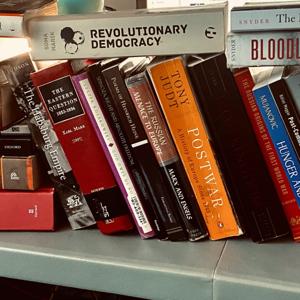


Regardless of whether I agree with Joe Biden’s politics, after reading about him in depth I really like Joe Biden. I did not expect to like Joe Biden. I expected to find him to be an acceptable alternative to Donald Trump. But now I have real hope that a Biden presidency could transform our nation. Hear me out!
In 2010 Jules Witcover published an excellent biography of Joe Biden entitled: “Joe Biden: A Life of Trial and Redemption.” If you can only read one book about Joe Biden, that should be the one. Biden’s 2007 autobiography “Promises to Keep: On Life and Politics” give a little more detail about his motivations at key moments. His 2017 book “Promise Me, Dad: A Year of Hope, Hardship and Purpose” is Joe Biden’s telling of the year his son Beau died of cancer and how Biden managed being the Vice President through that. Joe Biden is like FDR in that they both suffered great hardship, and that personal tragedy drove them to seek out compassionate policy. But we should start from the beginning.
Joe Biden’s childhood was idyllic. Joe was a star athlete throughout childhood, and apparently a fearless little dare devil. He did stunts, like Jackass, except he never got hurt. He had a community that rallied to him and lifted him up. His family was not wealthy, but they were not poor. They were upper middle class, though his Father Biden Sr. suffered a series of business failures and periodic unemployment throughout Joe’s early childhood in Scranton, Pennsylvania. The family is Irish Catholic, and so Biden had temperance drilled into him at a young age. It’s possible Joe Biden has never had an alcoholic drink. His parents seem to have succeeded in instilling in Joe Biden a basic optimism about human nature: the idea that people don’t mean to harm each other really, but they end up doing it on accident seems to be something Joe Biden fundamentally believes in. When Joe was 10 his family moved to Wilmington, Delaware where Biden Sr. got work cleaning boilers. Joe’s family couldn’t afford to send him to private school, but the young athletic teen had ambitions so he did a work study program. He worked as a janitor at the school so he could attend Archmere Academy (Witcover, p. 21). Joe Biden has a stutter, and he was made fun of by other kids and even one of the nuns who taught at his private school. That first experience of being humiliated for something he had no control over seems to inform the rest of his career: it’s probably why he became a civil rights activist.
Teen Joe Biden hung out at a burger joint called the Charcoal Pit. I just imagine the typical 50s pharmacy hang out where kids would go to have milkshakes after school. Joe Biden was a football star who wanted to become a priest. His mother insisted that he go to college first. The Archmere football team, the Archmere Archers, ended a long losing streak in 1960 thanks in part to Joe’s talents at playing half-back. Wilmington was not as segregated as much of the United States, and the football team had a Black player, Frank Hutchins. One day the owner of the Charcoal Pit refused to serve Frank Hutchins, and in response Joe Biden led the team in a walk out in protest. I’ve been around activist culture for a long time, but I haven’t met anyone who led a protest against racial discrimination in High School. That’s who Joe Biden is. Around this time is when Joe Biden became a lifeguard at a public swimming pool in the Black part of town. Ta-Nehisi Coates was recently interviewed by Ezra Klein. One of the things Coates mentions that makes him optimistic about the current moment is that white people seem to be aware of the racial discrimination that Black people face in America, an awareness that was missing in ‘68. It’s no small thing that Joe Biden was aware of racial discrimination in ‘61. Though he was not throughout his life big on going to protests, he did march in the sixties in support of desegregation (Witcover, p. 31).
In 1969 Joe Biden was a lawyer working at a fancy law firm Pricket, Ward, Burt and Sanders (Witcover, p.51). It was his first job as a lawyer. One day that year Biden helped write the defense of a company, Catalytic Construction Company. A welder had been badly burned and crippled, but because the worker had not been wearing protective gear the lawsuit failed to get him compensation. Biden decided he didn’t like practicing that kind of law, so he quit and took a much lower paying job as a public defender. Most of his clients were Black. His first case was a robbery, and the defendant, Mr. Earl Larkin, confessed the crime to Biden. Biden had been given one day to prepare to defend Larkin and lost the case. Several years later Biden, then a Senator, was touring a state prison with a reporter. All these inmates recognized Joe Biden, and the reporter quipped that Biden must be a helluva lawyer or something like that, making fun of the fact that many of Biden’s clients were behind bars. Witcover describes what happened next: “an arm reached out and grabbed the reporter, telling him ‘I’ll tell you one thing. Biden will stand up for a black motherfucker, unlike you!’ The inmate, Biden said, was none other than his first client, Earl Larkin.” (p. 55). In 1970 Joe Biden successfully runs for a county council seat. He won by 2,000 votes in an election where Democrats suffered big losses statewide (Wicover, p. 59). Biden made a name for himself on the council for fighting corporate developments, particularly in the oil industry, that threatened the local environment, taking on Shell’s attempts to set up refineries along Delaware’s coastline. (p. 62).
In 1972 Joe Biden ran for Senate. He was running against a three term incumbent. Delaware is a small state, so Joe Biden was able to engage most of the electorate in a street fight, going door to door. He ran against the Vietnam War, though not against any and all American intervention overseas. He was also against granting amnesty for people who had dodged the draft, and against legalizing marijuana. In other words, there has always been in Joe Biden’s platform something for everyone to hate. But Joe Biden was never able to lie to people for political advantage. He never pandered to the public for personal gain. This will come up again and again in the discussion that follows: you may not like what Joe Biden is saying, but you can be sure he means it. One thing that forces itself on you when you investigate Joe Biden’s political career is that he was in the fight for racial equality before he was a politician, all the way back to High School. It was his strong stand for desegregation that earned him the support of Sonia Sloan. She passed away this past October at the age of 91, and according to her obituary she “was an advocate for Planned Parenthood in Delaware, the ACLU and the YWCA. She also opposed the Vietnam War” (https://www.delawarepublic.org/post/delaware-democratic-activist-sonia-sloan-dies-age-91). Sloan supported every one of Joe Biden’s campaigns over the years, and that started in 1972 when by her recommendation the Council for a Livable World invested $25,000 in Biden’s longshot Senate campaign. They are taking a bet on desegregation, because that’s what Joe Biden is about. Biden was running on a platform of voting rights, civil rights, calling for a national health care program for families in need and a capital gains tax. Regarding his fund raising efforts during that campaign he wrote this: “when I began to show strength adn it looked as though I might win, thirteen multimillionaires from my state invited me to cocktails. The spokesman of the group said, ‘Well, Joe, we would like to ask you a few questions. We know that everybody running for public office feels compelled to talk about tax reform, and we know that you have been talking tax reform, particularly capital gains and gains for millionaires by consequence of unearned income.’ Then one man -as if to say it was just among us- ‘Joe, you really don’t mean what you say about capital gains, do you?’ Again, I knew what the right answer to that question [and it] was worth $20,000 in contributions. I did not give the correct answers… and accordingly I received no money.’” (Wicover, p. 79).
He won that first senate bid, and before he was even sworn in he suffered a terrible tragedy. His wife and young daughter were killed in a car accident. He almost didn’t serve as Senator, but people convinced him that his country needed him and that diving into the work would help him forget. He kept his house in Delaware, and his sister Valerie moved in to help him take care of his two remaining sons Beau and Hunter. This is when he became notorious for taking Amtrak trains every day early in the evening, around 4pm. He had to get home to be with his family. It meant he didn’t socialize with the other Senators. It meant he wasn’t as popular personally. He would often miss votes on the Senate floor. This is part of what I meant earlier when I said that Joe Biden is someone who has suffered terribly in life, and that this is part of where his compassion comes from. That compassion isn’t fake. It’s not political theatre. Again, you may disagree with him on policy, but I don’t think anyone who looks at Joe Biden’s life can really claim he isn’t motivated by a real desire to serve the public and to be a comfort for those who suffer.
Before we get into Biden’s political career is as good a moment as any to address the accusation of corruption. It’s a banal commonplace on the left today to call Biden a corporate Democrat, to casually assume that Biden’s political judgements are controlled by corporate interests. We’ve already discussed the David v. Goliath struggles of Biden as a county councilman, and his refusal of quid pro quo arrangements to fund his campaign in 1972. But what about Biden the full grown Senator? Delaware experienced a boom in its banking sector after some key deregulation at the state level in 1980 (Witcover, p. 292). Biden has never served on the Senate’s Banking Committee, though he is obligated to provide constituency services to some of the biggest financial institutions in the world. David Bakerian, the president and CEO of the Delaware Bankers Association describes Biden this way, from Witcover: “we have upward of thirty-five thousand people working in the banking community in Delaware, a very large employment force in a state this small, the largest non farming industry in Delaware. People would say Biden was close to the industry because we were such a large constituency, so whether we were banking or autos, depending on what state it was, he would listen to our concerns and he would vote with us sometimes and not vote with us other times. Joe was always fairly evenhanded. In the same vein, he would not be what I would call an overly probusiness legislator. He was supported generally by the banking industry, but that had more to do with his seniority than with his voting record.” (p. 295). In Biden’s 1996 bid for the Senate Biden’s opponent claimed that the Maryland Bankers National Association had overpaid when Joe Biden sold his house in Wilmington. Biden released the financial records of the deal showing the appraised value was about the same as the price paid (p. 295). Ok, so we don’t have any proof of financial wrongdoing over the span of a 36 year career in the Senate. That doesn’t prove 100% that there never was any. Well, consider that according to the required public statements regarding personal finances, again from Witcover, Biden is “among the least financially secure of all members of the Senate. His home was his most valuable material possession, and he and Jill were living off his Senate salary of about $166,000 a year in 2006 and her smaller salary as a community college teacher” (p. 299). If Biden is bought by corporate interests, then he’s doing it wrong. Let’s talk about Biden’s political career, starting in 1972 as the young civil rights activist and former public defence attorney is beginning the healing process from having lost his wife and child and his first term as a Senator at the same time.
Within the civil rights movement there was a split about how to desegregate. In an earlier episode we discussed how in 1972 Amiri Baraka and Julian Bond and too many others to mention all met in Gary, Indiana to work out a united political front to advance the interests of Black people at the National Black Political Convention (NBPC). Richard G. Hatcher had become the first Black mayor of Gary in 1967. Hatcher was a lawyer who won a landmark desegregation case in Gary in 1962 (Johnson, p. 102). There were lots of different ideas about how to desegregate. One of these ideas was to take school busing, which in many places was in place to enforce school segregation, and to use busing instead to desegregate schools. The Black Agenda that came out of the 1972 NBPC rejected busing as a tool for desegregation stating that busing was “a bankrupt, suicidal method of desegregating schools, based on the false notion that black children are unable to learn unless they are in the same setting as white children.” (Delmont, p.1). The anti-busing part of the 1972 statement was publicly denounced by many Black leaders including the Congressional Black Caucus (https://www.nytimes.com/1972/05/20/archives/black-convention-eases-busing-and-israeli-stands-but-the-guidelines.html). The civil rights movement was split. Joe Biden opposed busing as a tool for desegregation, preferring progressive measures to help Black people get access to quality housing. To be clear, Biden was for busing to desegregate schools wherever a court mandated it: wherever a court could prove that public policy was creating segregated schools, Biden was all for the courts ordering an end to those policies. But when people were trying to make busing a method to try and desegregate places that were de facto segregated, not by any government policy but just because of history, Biden thought some other kind of policy should be used, namely housing policy, which he thought would get at the root of the matter. He also thought that busing would make white flight worse: that turned out to be true. In ‘72 Biden could see that the public housing blocks that the previous generation of liberal politicians had built were a poverty trap. In his first term in office Biden pushed for housing reform, specifically urban homesteading. He wanted the Federal Housing Administration to take over abandoned homes and sell them cheaply to low income households. In other words, he didn’t want to just bus a lucky few token Black children to another school district, he wanted to give Black families a chance to move into better neighborhoods. It’s a more radical kind of desegregation. The old Democratic establishment, people like Hubert Humphrey, felt that Biden was attacking their accomplishments and feeding the right wing narratives that public housing was a failure. But public housing in the form of large block house tenements was a failure: it’s just that Biden recognized it before any of the old guard democrats. (Biden, PTK, p. 108).
Much has been made lately of Biden’s friendly relationship with segregationists. Biden wasn’t friends with segregationists because he shared their racialist philosophies. He was friendly with them because that helped him beat their segregationist policies. I’ll talk some about what his approach was and what it accomplished, but first I have to speak with woke white people for a moment. Here’s another PSA:
Dear woke white people,
Over the course of this podcast I have regularly recalled to the listener that the task of government is to promote the well being of the people and to negotiate differences of opinion. Where governments have failed to represent the will of the people they have suffered illegitimacy, for instance the managed democracy of Germany after 1871, or they have devolved into civil war as in Spain in the 30s. Joe Biden has one political value that is stronger than any other: that is that government shouldn’t represent the interests of any minority but should reflect the consensus opinion of society so far as that is possible. That’s why when he describes his first term in the Senate he describes so emotively how his desk sat between those of the radical Democrat Webster and the state’s rights Calhoun. After 30 years of these two men debating the issue the nation broke out in Civil War. He then discusses how one day in that time he had badmouthed Jesse Helms as heartless, and how Mike Mansfield took him aside to inform him that Helms had several years back adopted a child with cerebral palsy. Mansfield suggested Biden would be more productive as a Senator if he tried to find the good in everyone. Biden: “There was nothing difficult about taking Mansfield’s advice. In the Biden family, even as children, there had always been an assumption of good intentions… Never once has a member of the Biden family purposefully inflicted pain on another. We start with an assumption of goodwill toward one another. The same should hold true in the Senate family, Mansfield was reminding me. It’s probably the single most important piece of advice I got in my career.” (p. 111).
As for what we gained from the work Democrats did in the 60s and 70s in coalition with people they radically disagreed with on segregation? Well, segregationist Dixiecrats, while they were alienated from the Democratic party at large, remained a powerful force in the Senate through to the 90s. They had seniority, which we discussed the importance of previously in the episode on Black Power. The civil rights Democrats were fighting asymmetric warfare against an entrenched enemy (https://www.washingtonpost.com/outlook/2019/06/28/why-joe-biden-was-right-work-with-segregationists/). When the majority Democrat Senate Chairman Mike Mansfield moved the Civil Rights Act to the floor for a vote in 1964 he was bypassing the dixiecratic Judiciary Committee. That, along with Lyndon Johnson’s signing of the bill was thought of by the Dixiecrats as a betrayal, and so the southern chairmen afterwards formed a bloc that wouldn’t allow the chairman to wield power in that way again. The Civil Rights Act wouldn’t have passed, by the way, if it had not been for the fact that 27 Republicans voted for it. In 1975 when the Civil Rights Act came up for renewal, Eastman appointed Senator Hart to head the Judiciary Committee to review it, knowing Hart would pass the bill to the Senate for a vote (https://www.theatlantic.com/politics/archive/2019/06/biden-segregationist-eastland-talmadge/592228/). Another segregationist Talmadge helped pass food stamps and supported the Watergate investigations. Dixiecrats helped elect Jimmy Carter. And finally, without Biden having made a personal friendship with segregationist Senator Eastland, Biden could not have come to chair the Judiciary committee where as we shall see he likely saved Roe v. Wade by shutting down the Supreme Court nomination of Robert Bork. This was the nature of politics in the 70s: segregationists had seniority and had to be engaged. When Biden was invited to give the eulogy for Strom Thurmond, he was surprised but he went and eulogized Strom Thurmond. In that eulogy, which I link to in the transcripts, Joe Biden declares that Thurmond had sincerely left his racist opinions behind, citing how Thurmond had voted against poll taxes, for the extension of the Voting Rights Act and for the establishment of Martin Luther King Jr. day as a national holiday (https://www.americanrhetoric.com/speeches/joebidenstromthurmondeulogy.htm). I think you can try and criticize Biden about whether he made the right trade offs in particular instances, but you cannot fault him for playing the game. The worst outcome would have been to leave the field to the segregationists.
Biden’s abortion stand is not perfect, but it’s honest. He became a Senator right after Roe v. Wade, and so right away he had to cast votes regarding abortion. He took the stand that women had a legal right in accordance with Roe v. Wade, based on their right to privacy, but he didn’t want public funds going to abortion services. It’s a political stand that he takes on moral grounds, being a devout Catholic, and it was guaranteed to upset everyone. At the same time, you know he means what he says. Throughout the 70s and 80s Biden voted against federal assistance to health insurance that could fund abortions, even in the case of rape and incest. Recently he reversed this stand, and I think it’s of a bigger ideological change in Joe Biden that has been a long time coming. There is a common ideological thread that runs through Biden’s thinking on all of these issues from busing to the Vietnam War to Abortion access: all of these positions imagine that the government should play a small role in peoples’ lives. Government should protect people from corporate abuse and from being forced into unjust wars (more on that later), should ensure equal access to services regardless of race, but shouldn’t try and force people to not be racist (in the case of busing). If people were making morally bad choices, then government could help make drugs illegal or try and improve education and opportunities so women would be less likely to want an abortion. But government wouldn’t make it illegal, or help fund it. I have a criticism of this philosophy, but it’s worth understanding because Biden is going to be our next President, and this seems to have been his philosophy especially early on. The assumption is that if government just makes sure that people aren’t being actively harmed that people should be able to thrive, but offering a helping hand risks playing favorites, which is harmful. The clearest expression of this ideology came out when Biden, as head of the Judiciary committee headed up the hearing to confirm Justice Robert Bork to the Supreme Court. I think it’s around the time of Bork’s nonconfirmation and then Justice Thomas’ confirmation that Biden’s thinking shifts and then we get the Violence Against Women Act. But first let’s talk about Bork.
In 1987 Joe Biden launched his first campaign for President, and a few days later Justice Powell Jr. announced his retirement from the Supreme Court. President Ronald Reagan put forward Justice Robert Bork to replace Powell. Bork had been Nixon’s solicitor general, the guy who agreed to fire Watergate special prosecutor Archibald Cox. Bork was replacing Powell, who after he was appointed by Nixon ended up ruling in favor of liberal causes like abortion rights, affirmative action and the separation of church and state (Witcover, p. 171). All kinds of special interest groups wanted to testify against Bork, but Biden wouldn’t let any of them testify. The nomination process was focused primarily on privacy rights. Biden got Bork to say that because an explicit right to privacy wasn’t written into the constitution that Bork might not have to uphold it on the Supreme Court. Biden was making the point that we all have natural rights, given to us by God. Bork thought we only had rights that were explicitly granted in the constitution. Biden became obsessed with Bork’s nomination to the point that his presidential campaign suffered and failed. It’s clear that at some point Biden made a conscious decision to focus on the Bork nomination and to sacrifice his presidential hopes. Biden argued that if Bork were appointed, with his strict construction of the constitution, that it would change the nature of our government. It was essentially a conservative argument about not making big change happen, but in this case it was being made to guarantee privacy rights, and of course one thinks of Roe v. Wade at this point. Roe v. Wade doesn’t rest on a woman’s rights over her body, but on her right to privacy with her doctor. Struck v. SecDef was the case to take to the Supreme Court to argue that lack of access to abortion impacted women’s equal protection, but it never went to the Supreme Court. It would have been a stronger protection, but instead we have Roe that is based on privacy rights. It’s a whole thing, and I’ll link to a good podcast explaining it (https://www.wnycstudios.org/podcasts/otm/episodes/on-the-media-body-law-beyond-roe). Biden succeeded in getting Bork’s appointment denied, and in doing so he saved Roe v. Wade and much more. The spot on the Supreme Court was taken later by Justice Kennedy, who is a wild mixed bag of a Justice who deserves his own podcast, and then later because Bush senior had learned from this not to try and appoint justices from the far right, the next vacancy went to Justice Souter. Souter voted in the minority to allow a recount of that election in 2000 where the court let Bush Jr. take the Presidency from Al Gore despite irregularities in Florida, and then later Souter retired basically in protest of how Citizens United was decided. Anyway, Biden’s fight to defeat Bork’s nomination was a major victory for progressives, and it really made Biden develop his political thinking. After Bork, Justices became very tight lipped during their confirmation hearings, with Justice Thomas for instance famously saying during his hearing that he had no opinion about Roe. But in between time Joe Biden began championing a law that addressed women’s oppression as if it were a matter of civil rights. That was the Violence Against Women Act.
Between Bork and the VAWA the question screams at us: what if formally equal protection under the law were not enough? Bork’s point, that government didn’t have a responsibility to uphold any rights that weren’t explicitly guaranteed in the constitution, was pretty close to the way that Biden had legislated up to that point. The Biden who opposed busing would have had to agree with Bork: maybe it is racist where people live but that’s not for the government to say. Biden opposed de jure racial discrimination, explicit legal discrimination, but not de facto segregation: he thought that if government could level the playing field, but not by much, that racial inequality would go away on its own. But the Violence Against Women Act was different. What I think has shifted is an awareness that, as the recent protests over George Floyd have shown, a majority now have that if government does nothing, then existing inequalities get worse. People who are socially forced into unequal relationships, via systemic racism for instance, when they are treated formally and legally the same way means that those institutional inequalities only get worse. With the VAWA Biden showed that he was coming to this awareness, and that where he could he would want to stand for equality.
In December of 1989 a man walked into a college classroom in Montreal, separated the class by sex, and shot fourteen women saying that they were all feminists. The event had a deep impact on Joe Biden, whose daughter Ashley was passionate for the cause of abused women, later becoming a social worker (pp. 309-310). Though it had been brewing since the early seventies, the movement against domestic abuse and violence against women had not found its way into meaningful legislation. Right around this time crime was rising precipitously, and it peaked around 1991 (https://www.brennancenter.org/our-work/research-reports/crime-trends-1990-2016). At the time, of course, society at large was very concerned about crime (https://www.vox.com/policy-and-politics/2019/6/20/18677998/joe-biden-1994-crime-bill-law-mass-incarceration). In response, the Senate was working on a crime bill, which finally passed in 1994. Crime has fallen every year since. Bernie Sanders supported the Crime Bill. A majority of the Congressional Black Caucus supported the crime bill. Joe Biden, it is said, wrote the crime bill, because Joe Biden oversaw the committee that wrote the crime bill. But contrary to what some people might think, the crime bill didn’t happen because patriarch Joe Biden forced his will on the nation. Everyone supported the crime bill, and it would have happened even if Joe Biden had opposed it. But in that case someone else would have written the crime bill. Joe Biden even opposed the three strikes rule, but Biden couldn’t make just any law he wanted to: this is a democracy. The law gave the states increased funding for police and prisons. But Joe Biden didn’t disengage from the process either, and he was honestly a candidate who had always believed in the fair and firm application of the law, championing the war against drugs through the 70s and 80s. We note in passing that because Biden engaged with the process of passing the crime bill it included a ban on assault weapons, support for addiction treatment and a “safety valve” that would let off first time offenders. But more importantly, Joe Biden decided this was his opportunity to do something about violence against women.
The Violence Against Women Act provides resources for women suffering from domestic violence and rape, with temporary housing assistance and rape crisis center funding. It’s renewed every 5 years, and the version in 2019 if renewed would end impunity for non-Native perpetrators of violence against Native women. The bill classified violence against women as a hate crime and therefore a civil rights offense. It correctly recognized that the oppression of women by patriarchal violence robs them of equal status with men. In 1995 the Rehnquist Supreme Court struck down that part of the VAWA, which is tragic and something we should fight against by putting a president in the White House who will appoint more enlightened Justices. That being said, let’s focus just for a moment on what Joe Biden’s law meant philosophically. It meant that he saw that if the federal government was going to credibly claim to stand for equal rights for all, then it would have to intervene to stop the behavioral paths, to borrow a concept from Acharya et al (see episode 3), to stop the cycles of violence against vulnerable and oppressed groups. And he was ready to enforce the ending of those patterns of inequality with a large police force. Again, I welcome you to have a philosophical difference with Joe Biden, but I think we have to understand his political work as it is. The 1994 Crime Bill was going to happen with or without Joe Biden: he chose to use it as a vehicle to fight patriarchy. In so doing he was making a strong philosophical break with his previous political path of just keeping the state out of private affairs. These are important changes in political philosophy, and they go a long way to explaining how Joe Biden came to his 2020 platform. Before we talk about that platform we have to talk about his experience in foriegn policy.
Though Biden sat on the Senate Foreign Relations Committee, I want to focus on his work after he became the Chair of that committee in 1987.
In May of 1980 Yosip Broz Tito died. He was the authoritarian ruler of Yugoslavia: he had led his country on a path independent of the United States and of Soviet Russia. In 2018 Jasmin Mujanovic blessed the world with his book entitled: “Hunger and Fury: The Crisis of Democracy in the Balkans.” The book describes the Balkans as a region that has historically been ruled by local dictators who negotiated their rule with some foriegn power or other, first the Turks and then the Russian. The book stands as a challenge to American and European powers in the region to promote democracy there, and not just repeat the old model of local client to global patron that existed continually in the past. It is also mainly a history of the struggle for democracy there starting after WW2. Quoting from Nick Miller, Mujanovic describes the situation in Yugoslavia after 1980 in these terms: “In short, economic criminality in the 1980s, war crimes int eh 1990s, and contemporary corruption in the Western Balkans should be understood as points along the same continuum. The most recent instances were and remain only the most extreme versions of processes begun in the 1980s and are in many cases perpetrated by exactly the same people. Earlier, when some semblance of a principled democratic opposition still existed, these practices could have been challenged, perhaps even reversed. But by the 1980s the entire structure of the Yugoslave state was beset by the competing, autarchic, and corrupt interests of the various republcian cliques: ‘More devastating for the specific ideology of Yugoslav socialism was the fact that the economic crises of the 1980s provided fuel for increased regionalism (often ethnically constituted) and a further weakening of the federal centre as a decision-making force… By 1986 federal policy-making had essentially ceased.” (p. 65) In the vacuum left by the death of Tito, and in the absence of a strong government response to the democratic will of the people, the people turned to ethno-nationalism and mafia style patriarchs to solve their problems. It is easy to see the resulting wars of the 90s as inevitable, but surely they were not. I highly recommend Mujanovic, and I wish I could spend several podcasts lifting up his work. Here I just wanted to recommend him and us his insight to frame US involvement in Yugoslavia.
Mujanovic goes on to describe how the US and European powers, when confronted by the social chaos brewing in the former Yugoslavia, decided to negotiate partitions between various ethnic zones. The problem is always that populations are always mixed ethnically, and so polities based on ethnicity immediately confront competing claims over which bits of land belong to whom. Because the premise of ethno-nationalism is that people of different ethnicities shouldn’t have to work together and live together in the same state the whole enterprise finally depends upon ethnic cleansing. Slobodan Milosevic rose to power by being better at consolidating Serbian nationalism than anyone else, and with the help of US Ambassador to Yugoslavia Warren Zimmerman.
As chair of the Senate Foreign Relations Committee Joe Biden was present for disarmament talks in the late 80s that included Tito himself as well as American cold war diplomats like Biden’s foriegn policy mentor Averell Harriman. The priorities then for the US were nuclear disarmament, a mutual drawdown of forces, and keeping Yugoslavia independent of Soviet Russia. Tito cared about Yugoslavian independence, but didn’t have much invested in disarmament. Biden later recalled: “Harriman was teaching me two lessons. One, never accept received wisdom about a foreign country or a foreign leader when you can go and see for yourself. Tito might be a ‘Communist,’ but not all Communists were the same. And two, Harriman wanted me to see the benefits of constant engagement, even with avowed enemies. Don’t trust, he’d say, but engage. Be tough, but engage. By keeping up relations with leaders like Tito, we could nudge them toward change.” (p. 249).
Biden stood out among his fellow Senators in 1991 when he sounded the alarm about the potential for ethnic violence in Yugoslavia, and because his summary of the situation is so clear and truthful I will quote it at length here: “When I told Senate hearings on the Yugoslav problem in 1991, most of my colleagues thought I was being alarmist. There were small skirmishes breaking out back and forth among the Croats, Serbs, and Muslims, but most folks in the U.S. government insisted this was nothing to get worked up about. Slovenia managed to slip out with its independence. Croatia, with support from its old allies, the germans, declared independence, and in seven months of war that left ten thousand dead, it fought Milosevic to a rough stalemate, although ethnic Serbs held onto the Krajina region and part of eastern Croatia. The situation seemed manageable, though by September 1991 the United Nations was sufficiently concerned that it institute an arms embargo in all of Yugoslavia. Leaders in Bosnia and Herzegovina decided to play by the international rules. After consulting with the United Nations and the European Community, the Bosnians held a referendum in march 1992 and voted overwhelmingly to secede from Yugoslavia. Many of the Bosnian Serbs, led by a churlish demagogue named Radovan Karadzic, boycotted the vote- because they hadn’t sufficient numbers to change the outcome-and set up their own rump state within Bosnia. In early april 1992, when the international community officially recognized the independence of Bosnia and Herzegovina, Milosevic and Karadzic decided it was time to scrub Bosnia of the Croats and, especially, the Muslims.” (pp. 253-254).
America was painfully slow to respond to reports of a genocide against Albanians by Milosevic. Everyone who wants a better world, or who wants a world where genocide is abolished, should be reading Samantha Power’s 2019 “The Education of An Idealist.” In it she discusses her work trying to shift American policy from one of accommodating to Milosevic as a reliable partner in the region to a vigorous diplomatic and if need be military intervention to halt the ongoing genocide. Here is how she describes the argument in the State department over the Bosnian war, and over America’s passivity in the face of an evolving human rights catastrophe: “The war raged unabated. Four US diplomats -- George Kenney, Marshall Harris, Jon Western, and Stephen Walker -- had already resigned to protest what they saw as the weakness of the US response to the Bosnian war, the largest wave of resignations over US policy in State Department history… Western and other US officials who resigned had initially tried to change policy from within, but having made no headway, had finally quit. They felt they could no longer be part of a US government that wasn’t doing more, reasoning that they could at least draw media attention to what they saw as America’s moral abdication.” (pp. 60-61).The fact is that at the beginning of the 90s a shift was happening in US policy away from tolerating authoritarian governments that they could work with and towards a more robust advocacy of human rights. Clinton’s failure to intervene in Rwanda changed a lot of peoples’ opinions about American nonintervention. When America finally began bombing Milosevic’s forces in 1999 they were acting against one of their clients a decade too late, but they were stopping an ongoing genocide. That’s what it looks like when an imperialist power, waking up from the cold war, makes an effort to promote democracy and human rights, in part against its former clients. It’s remarkable that Biden was ahead of the curve on America’s responsibility toward the peoples of these countries where the US had helped to lift up tyrants.
Each country is different, and we could discuss what went right and wrong about the United Nations backed effort to rebuild the Balkans after the wars of the 90s, but I think we have to discuss the successful American intervention in the Balkans, along with the September 11th attacks, to understand why America invaded Iraq in 2003. I would suggest that the relative success of the international community rebuilding states in Croatia and Slovenia (Mujanovic, p.100), is a stark contrast to the failed Bush policies in Iraq. Usually the failure in Iraq is blamed on the invasion itself, but it’s closer to the truth to say that the failure in Iraq was caused by policy failures after the invasion and unforeseeable events in those first years of the American occupation. What matters to us is why Biden supported the invasion of Iraq, and I think there are two main reasons that are not entirely unconvincing. First of all Biden had the example of the successful humanitarian intervention in the former Yugoslavia fresh in mind as a good example of America breaking with a former client state in a progressive way. Secondly, the idea of invading Iraq was incredibly popular after the attacks of September 11th. The tragedy of Iraq did not begin with the American invasion, and the American invasion didn’t mean that subsequent tragedies were inevitable, though it provided an opportunity for bad actors.
It’s easy for us today to forget the situation the world was right after 9/11. Peter Beinart in his 2008 book “The Good Fight” gives an almost perfect explanation for how the Democrats got suckered into authorizing Bush’s war in Iraq. “For the first year after the attacks, the anti-imperialists wielded little influence. Liberals overwhelmingly backed Bush’s invasion of Afghanistan. Polls showed that Democrats were nearly as likely as Republicans to consider terrorism a ‘very serious’ problem, and to consider the United States in a state of war. And in Congress, Democrats backed the Bush administration’s military buildup and urged even greater spending on homeland security and foreign aid. But Democrats were operating from a position of weakness. Although Clinton had shifted liberal views ont eh use of force, he had not erased the GOP’s post-Vietnam advantage on national security. And when foreign policy retook center stage after 9/ll, Americans picked up where the cold war had left off. They not only rallied around their Republican commander in chief, they told pollsters they trusted his party far more to keep them safe. Once Bush successfully overthrew the Taliban, his clout only grew. In the fall of 2002, Bush took his considerable political capital and put it behind an invasion of Iraq… The Clintonites were deeply concerned that any U.S. military action enjoy international support, and their public comments were generally more muted than those of liberal hawks in the media who urged outright war. But on September 12, 2002, when Bush announced he would take Iraq to the Security Council and seek new resolutions requiring it to disarm, he temporarily allayed the Clintonites’ concerns. So when Iraq came up for a vote in Congress a month later - and Bush said he needed congressional support to gain leverage at the UN - the Democratic foreign policy brain trust was broadly sympathetic. And since few congressional Democrats had much national security expertise of their own, the views of that brain trust loomed large… the polls in late 2002 showed Democrats with an edge on domestic issues like health care and Social Security, and Republicans with a massive advantage on national security. With the midterm elections looming, party strategists yearned to remove foreign policy from the campaign. And the only way to do that was to agree with President Bush on Iraq and then change the subject. As Democratic pollster Mark Mellman put it, ‘we’d rather have the newspapers filled with discussions of pensions.’ So while Democrats with safe seats mostly voted against the war, the party’s congressional leaders, its vulnerable incumbents, and its likely presidential candidates generally voted yes.” (pp. 173-174). When Witcover interviewed Biden for his biography which appeared in 2010, Biden confessed that he was fooled by the Bush administration, particularly Colin Powell who had convinced him that Bush would likely not go to war so long as Saddam Hussein cooperated with the Security Council. We now know that key advisers to Bush had made up their mind to invade Iraq immediately after 9/11. In that biography we find Biden scrambling to rally the Senate to pass legislation that would allow Bush to go to war to disarm Saddam Hussein only after all options had failed. But such a measure met with opposition from Bush, opposition from House Democratic Leader Dick Gephardt and even from the usually antiwar Democratic Senator Paul Wellstone, who refused to vote for it in committee. Biden was in the same position that Kautsky was in back in 1914: sitting high enough up in the hierarchy to be responsible but not having any power to shift the course of events. He could only hope that by authorizing the use of force that the Security Council could be leveraged to take real steps to avoid war, and that the Bush administration was not lying when it said that it could still be convinced to try peace. We like to blame the Democrats especially for their votes supporting the war, but that’s only because we forget how many of us Americans were much like them. The war was at the height of its popularity before it began. I happen to think that the worst thing that happened in Iraq was not the invasion, but the subsequent bungling of the state building function. The occupation of Iraq deserves it’s own podcast series, but I think Bush made the same mistake the antiwar movement made: they both thought that a hands off approach would let the Iraqis build their own state. It turns out that was not the case. It turns out that laissez faire was a terrible mistake. Once we were in Iraq Joe Biden had the good sense to support a marshal plan style development project. Instead Bush disbanded the Republican Guard while Iran’s Qassem Sulleiman was transporting his longtime enemy Alqaeda from Afghanistan to Iraq, with lots of Iranian money in their pockets. The resulting civil war was a foregone conclusion at that point, but no one in the Bush administration had a clue. Joe Biden criticized the Bush administration’s lack of planning to rebuild Iraq before, during and after the invasion. At any rate, what’s important about this record is that Biden’s vote to authorize Bush’s war in Iraq doesn’t mean that Biden is a war hawk, it means he responds to the public will, and the more accurate measure of his propensity to engage US troops should be the eight years he spent as Obama’s Vice President. He’s no warmonger, though as in Kosovo I could see him intervening to stop genocide. And I think that’s a good thing.
That seems to bring us up to the present, and if we can judge from Biden’s platform we can say that his experiences have shifted his politics considerably. One big change that happened recently is that Biden came out against the Hyde Amendment. The Hyde Amendment would make it illegal for federal funds to help someone get an abortion. Young Biden would have 100% been for the Hyde Amendment. 2020 Biden is against it. What changed? The common thread in Biden’s ideology is that everyone deserves equal protection under the law: that’s what the 14th amendment says. But Republican trap laws have aimed at making abortion clinics satisfy an impossibly high standard to remain open. The argument then is that poor people are discriminated against because their access to the same care as wealthy people is shut down. Does Biden get that? Does Biden understand the deeper point: that formal legal equality isn’t enough to ensure equal protection? Well, here is how he explained his new rejection of the Hyde Amendment: “If I believe healthcare is a right, as I do, I can no longer support an amendment that makes that right dependent on someone’s ZIP code,” (https://www.nytimes.com/2019/06/06/us/politics/joe-biden-hyde-amendment.html). And he’s right. The same shift in Biden after the Bork hearings that brought him to the Violence Against Women Act has worked on Biden. The oppression of women in domestic issues impacts their civil rights, their right to equal protection under the law. It’s not enough to have colorblind law. The state has to intervene to stop parts of society from oppressing other parts of society. That basic idea is carved deep into every aspect of Biden’s 2020 platform. Before I list off some of those policy proposals, I want to remind everyone that Biden doesn’t say things he doesn’t mean, ever: he’s the guy who in the 70s wanted to end the Vietnam war but not grant amnesty for draft dodgers, wanted to improve public housing to desegregate but didn’t support busing. He still doesn’t support busing for de facto segregation. He doesn’t change his position on issues to pander for votes. You might notice that some of these policies are not the most radical, but they are all things that Biden, as a career politician with 36 years of experience in the Senate, believes can be accomplished. As one should expect from the fact that Biden has brought much of Bernie Sanders’ supporters, like AOC, into working groups to develop policy, Joe Biden’s platform leans far to the left (https://www.usatoday.com/story/news/politics/elections/2020/05/21/joe-biden-bernie-sanders-work-together-bring-progressives-board/5155900002/). Here is what Biden will do in office.
(https://www.politico.com/2020-election/candidates-views-on-the-issues/joe-biden/)
Biden wants to abolish the death penalty and end cash bail. He wants to put an end to higher penalties for crack versus powdered cocaine. He wants to end minimum sentencing and eliminate private prisons. Taken together these policies represent an end to mass incarceration.
Joe Biden wants to set up a committee to investigate how to implement reparations for slavery, jim crow and mass incarceration.
Biden wants to offer two years of free college to everyone, make teacher’s salaries competitive to other professions, fix the loan forgiveness program and close down private charter schools, i.e. private schools that get public funding.
Biden wants citizens united overturned, and since 1974 has pushed for campaign finance reform.
Biden wants the government to enforce the Affordable Care Act and provide a public option for healthcare, the next step towards single payer.
Biden is for the Green New Deal. He wants to fund programs that incentivize farmers practicing soil conservation. He wants to tax carbon emissions. He wants to end federal subsidies to oil and gas companies in the form of leases on federal land. Biden wants to modernize our nuclear industry so that it is safer and produces less waste.
Biden wants to start a program to buy back automatic weapons, wants universal background checks for firearm purchases and a federal firearms registry. This puts Biden firmly to the left of Bernie Sanders on gun control.
Biden supports paid family and sick leave, something no other Democratic candidate supported. Joe Biden wants a federal minimum wage of $15 an hour, something every Democratic candidate supported.
If anyone was wondering, Joe Biden is still fighting for desegregation. That’s why his platform includes such far reaching reform of housing, attacking red lining and encouraging quality low income housing, specifically working to make sure the poorest no longer pay any more than 30% of their income on housing. It’s not busing, but it takes aim at the root causes of generational inequality. (https://joebiden.com/housing/)
In this illuminating conversation with Andrew Yang Biden says we need “revolutionary Institutional change.” (minute 17, https://podcasts.apple.com/us/podcast/on-the-economy-with-andrew-yang/id1505238447?i=1000474319469). Joe Biden is right about that. In this conversation with Reverend Barber, Joe Biden says that the experience of Covid has shifted peoples’ appreciation for low wage workers, and that this shift has prepared us to address “the underlying fundamental causes of poverty.” (min. 11:30, https://podcasts.apple.com/us/podcast/heres-the-deal/id1505238447?i=1000471239570). Joe is right about that. Listen to how Joe Biden opens space for Reverend Barber to talk about his poor people’s campaign: after pointing out that COVID has disproportionately targeted Black people, Joe says: “Why don’t I hush up, as my mama would say.” (minute 2:30) Isn’t it time for a President who models listening to black people? I’ve linked to multiple campaign ads where Biden centers Black voices.
Like he does here: https://www.youtube.com/watch?v=YZuxk-tPLmA
And like he does here: https://www.youtube.com/watch?v=WBOJg_xvJk0
And like he does here: https://www.youtube.com/watch?v=f_uYieJFYcI
I’ve said it before, and I’ll say it again: there are no angels or devils in power. In power there are only imperfect people making tradeoffs with limited knowledge. But if you ever said that the Democratic party was the party of the ruling class because it had a pro-business agenda, then you have to now say they are the party of the working class because they all support a $15 minimum wage. It’s more accurate to say that the Democratic Party is not the party either of the ruling class, nor of the working class. They are a liberal party trying to help, not to save, the world. They are not saviors, but neither are we socialists. Having investigated the matter, I find that Joe Biden is not the lesser evil: Joe Biden is a necessary good.
Bibliography
Beinart, Peter. The Good Fight: Why Liberals, and Only Liberals, Can Win the War on Terror. Melbourne Univ. Publishing, 2007.
Biden, Joe. Promise Me, Dad: A Year of Hope, Hardship, and Purpose. Macmillan, 2017.
Biden, Joe. Promises to keep: on life and politics. Random House, 2007.
Cedric Johnson. Revolutionaries to Race Leaders: Black Power and the Making of African American Politics. Minneapolis: University of Minnesota Press. 2010.
Delmont, Matthew F. Why busing failed: Race, media, and the national resistance to school desegregation. Vol. 42. Univ of California Press, 2016.
Rothstein, Richard. The color of law: A forgotten history of how our government segregated America. Liveright Publishing, 2017.
Witcover, Jules. Joe Biden: a life of trial and redemption. Harper Collins, 2010.
https://www.nytimes.com/1972/05/20/archives/black-convention-eases-busing-and-israeli-stands-but-the-guidelines.html
https://www.politico.com/2020-election/candidates-views-on-the-issues/joe-biden/
https://podcasts.apple.com/us/podcast/the-new-yorker-radio-hour/id1050430296?i=1000484131250
Music: Cassandra by Fabian Tell, Answers Lie Within by John Bjork, else Harry
[correction: At the 2019 DSA National Convention it was proposition 15 that defined the DSA position as Bernie-or-Bust, not proposition 32 as I mis-state in the episode. From the motion to adopt: "Primary motivation: We endorsed Bernie whether or not you agree. But if he fails to gain the Democratic nomination, we need to decide what to do. My reso says we know that the other Democratic Party politicians don’t jive with DSA. Do we want DSA to use our legitimacy to boost one such neoliberal candidate? No. Bernie has a unique ability to move people to action. All I say in this reso is that we’re not going to endorse another Democrat."]
When I think about why it is that the US far left, the left that was inspired by Noam Chomsky’s post 9-11 dictum that this was chickens coming home to roost, and how after the Syrian revolution began Chomsky and others decided that they couldn’t support the terrorist’s cause no matter how bad the Assad regime was, I realized how hopelessly incomprehensible the world was if you made hatred of the United States your foundation. I don’t mean to say that terrorism is ever justified: I think it fails even on its own premises. But you get a very different kind of politics if you start from the idea of protecting life and humanistic values. In Chomsky’s case he lent ideological support for the 9-11 hijackers and for the genocidaire Bashar al-Assad, and Milosevic before that, because he based his beliefs on the premise that America is always the main thing we have to struggle against. I think the example of the Syrian revolution, it’s betrayal by western intellectuals, sets in stark contrast how the idea of absolute enemies makes it impossible to know one’s own values and hence who one’s actual enemy is.
Surely one of the best books on politics of 2020 so far is Ezra Klein’s Why We’re Polarized. In it, he discusses how group identity is so important to our survival, that it drives our reasoning and beliefs more strongly than facts. He tells some uncomfortable truths about race, about partisanship, about why our problems are intractable if we cannot overcome the reigning polarization, and gives some advice about how to do good work in the increasingly static ideological environment. One insight Klein uplifts for us there is found in the research of the social psychologist and holocaust surviver Henri Tajfel. In 1970 Tajfel published a paper called “Experiments in Intergroup Discrimination.” In that study Tajfel randomly split up 64 teenage boys into two groups. Each boy was given a small amount of money to hand out to the others as they wished, equipped only with the knowledge of which of the two random groups each belonged to. The boys all gave more money to members of their own group. In a later study Tajfel found the same behavior even if the overall payout was higher if the boys gave money to someone from the other group. From Klein: “they preferred to give their group less so long as it meant the gap between what they got and what the out-group got was bigger… Far from their behavior showing a pure desire to maximize their group’s gains, they often gave their group less to increase the difference between them and the out-group. Far from the money being the prime motivator, ‘it is the winning that seems more important to them,’ wrote Tajfel.” (pp. 54,55). Klein then goes on to discuss the work of Patrick R. Miller and Pamela Johnston Conover discussing the same dynamic at work in politics. People will sacrifice policy gains so that their team can win. This was certainly demonstrated clearly early in the Democratic primary as Bernie Sanders’ most fervent supporters attacked Elizabeth Warren, the closest Democrat to Sanders in policy terms, instead of Joe Biden. Now those same people are attacking Joe Biden, not Donald Trump. These people would rather let a fascist win than admit they lost the primary, would rather take worse policy losses than let their team down.
On another level, all of this is incredibly familiar. I’m a white southern male progressive, so I have experienced this my whole life: my demographic votes for white supremacy despite the terrible poverty that that politics imposes on us. It’s a case of what I’ve taken to calling localized solidarity. It’s the natural solidarity of people who are joined by familial ties and geographic proximity. I have in my own family people who are not consciously racist, but who tolerate in their close friendships people who are consciously racist. It’s part of small town life that the people you grew up with, the people you can call for help changing a tire or giving you a couch to crash on in an emergency, those people close to you are racists. In that context, being an anti-racist could sever communal ties that are important for survival. It’s the same in the US left: maybe it would help to speak out against the bombing of the Syrian opposition, but it would also mean being socially ostracized by friend groups that have been made over decades. It’s fascinating to me and also deeply disturbing that localized social solidarity so often depends upon and enables active or passive support for dehumanizing narratives that enable violence against vulnerable remote groups. This all came into closer focus for me about halfway through reading Proust’s Search for lost time.
Some will say that there should be no place for bourgeois literature in a Marxist’s library. On the contrary, it was Balzac that taught Marx what the bourgeois class was, and Lenin famously claimed all of world literature, the whole of humanity’s cultural accomplishments, as the property of even the lowest factory worker. Proust was from a modest middle class background, and he found himself welcomed into high society by virtue of his literary work and wit. Proust was ethnically, though not religiously Jewish, and his depictions of French high society as it rallies to and antisemitic condemnation of Dreyfus are some of the most poignant depictions of social alienation that exist. I say, go young Marxist, go forth and read Proust! And for you Proust heads out there who want to tell me that Proust is about transcending society in communion with nature, and not with a deeper kind of humanity, go read Edward J. Hughes and leave me alone!
Now, the narrator in The Search for Lost Time, Proust’s masterpiece, is loosely based on Proust himself. The narrator’s close friend, whose name is Swann, meets the narrator by chance as they both try and visit their mutual friends the Duke and Duchess de Guermantes. Swan has just found out that he is gravely ill and will die in a matter of months, and has come to inform his friend the Duke. The Duke and the Duchess are on their way to a party. If they were to take seriously Swan’s illness, it would mean of course that they should forego the party to sit with Swan whom they may never see again. But the pull of their social obligations, their desire to continue being adored in high society, stops the Duke and Duchess not only from staying with Swan but even from acknowledging the seriousness of his condition. The Duke is at that moment in front of his house waiting for the Duchess to join him. Upon hearing of Swan’s illness, the Duke makes all manner of excuses: doctors don’t know anything, and you’ll be fine Swan, and so on. The Duke pretends not to understand or believe Swan regarding his imminent death, and insists that he is late to a party and must hurry away. When the Duchess arrives, she is wearing shoes that the Duke dislikes, so he sends her back to get some new shoes on. She objects that they are running late, and the Duke, with Swan and the narrator still within earshot, tells her not to be ridiculous that they have all the time in the world. Whenever I see someone failing to connect to a deeper sense of humanity because of their immediate superficial social connections, I think about the Duchess’ shoes. For me they represent all the indifference to suffering this world contains.
One of these indifferences is that of the indifference of the US left to the suffering of the Syrian people. One of these indifferences is that of Maoists to the millions of people Mao intentionally murdered. One of those indifferences is that of white middle America to the plight of the Palestinian people. One of those indifferences is that of the American Palestinian rights movement to the suffering of Palestinians at the hands of the Assad regime. All of these people who are content to stand on the sidelines while atrocities are committed in their name, and it’s their nearest kith and kin that holds them there, their social network that blinds them to basic human solidarity, chained against even the simplest acts of compassion and humanity. This is the framing I want to understand American leftism in. We have social bonds to each other as comrades that sometimes blind us to the suffering of people around the world, and it took our utter failure to compel Syrian solidarity from the US left to show me that mechanism. And that was when I felt I needed to understand the history of the US left in a deeper way. This podcast is a testament to that attempt, and an apology to history for our failures.
Let’s pick up the story of socialist revolution from the moment of its failure in Russia and China. Let’s go back to that moment to understand what the US left learned from it, and what the US left failed to learn from it.
We have discussed in earlier podcasts the crimes of Stalin and Mao. As a socialist, I consider it irresponsible to not make an accounting for those errors. The response in the American left to the Soviet Union was mixed. Some rejected Stalin as an aberration, as not a true socialist. I think that view is wrong and irresponsible. We do better when we recognize the tendencies in our movement to authoritarianism, because then we are better positioned to fight them. Many decided to give up on socialism altogether given the depth of the failure. I would disagree with that kind of anticommunism because I think that socialism is the logical conclusion of radical democracy and human rights, but I don’t fault people who lived through the horrors of Stalinism for giving up hope, perhaps even hope in humanity itself. Nevertheless, there were groups on the US left that combined the fight against communism as it existed in the world after WW2 with progressive social policies and a commitment to uplifting the working class. Chief among these groups was Americans for Democratic Action [ADA] (Beinart, pp4-5). The ADA made the argument that for the sake of national security America had to champion civil liberties at home and abroad; this was the application of humanism in the context of an international fight against Stalinism, and a recognition that America’s hypocritical system of racial discrimination would have to be dismantled or the fight against tyranny in the world would be lost. At the 1948 Democratic National Convention the ADA fought a hard fight to pass a resolution in support of civil rights. The result of that fight was that pro-segregation Dixie Democrats left the party. The initiative was led by Hubert Humphrey who gave a powerful speech that day: “There can be no hedging… no watering down...To those who say that we are rushing this issue of civil rights -- I say to them, we are 172 years late. To those who say this bill is an infringement on states’ rights, I say… the time has arrived for the Democratic Party to get out of the shadow of states’ rights and walk forthrightly into the bright sunshine of human rights.” (Beinart, pp. 11-12). The political machine forged in this way between trade unions and progressives committed to fighting Stalinist communism dominated the Democratic Party for the next two decades. In that time the Democratic Party lost the White House once to Eisenhower. They lifted into the executive Truman, Kennedy and Johnson. We will recall from our discussion of the Black Panther Party that Hubert Humphrey lost in 1968 because of the mistaken impression that he was not against the Vietnam War. In part he was rejected not because of the Vietnam War, which he opposed, but instead because he refused to reject all American intervention because of the experience of the Vietnam War. A cold war liberal like Humphrey could admit to a mistake and change course, but he could not join McGovern and the Maoist left in their anti-Americanism first because such a man believed in the potential the American system held and secondly because doing so meant alienating the working class by feeding right wing talking points that the Democrats were soft on national defense. This difference comes out strikingly when Beinart discusses the differences between Robert Kennedy’s and McCarthy’s positions on the Vietnam war: “The two men had different conceptions of America’s role in the world. Their positions on Vietnam itself were virtually indistinguishable: Both called for an end to bombing and a coalition government in South Vietnam. But McCarthy’s critique went far beyond the war itself: ‘Vietnam,’ he said at a rally in Cambridge, Massachusetts, ‘is part of a much larger question, which is, is America going to police the planet?’ In another speech, he blamed the war on ‘a moral mission’ -- dating from the 1950s -- ‘in which we took it upon ourselves to judge the political systems of other nations. I am not entirely convinced,,’ said McCarthy, ‘that Senator Kennedy has entirely renounced that misconception.’.. And he was right not to be convinced. McCarthy was foreshadowing the new liberalism that would emerge after 1968-- which questioned whether America had much to offer the world. Kennedy, by contrast, pledged in his announcement speech that his campaign would be about ‘our right to moral leadership of this planet.’ That right, he was suggesting, was no longer self-evident. But it could still be earned. On June 4, after beating McCarthy in the California primary, Kennedy took the stage at Los Angeles’s Ambassador Hotel, and told 1,500 manic, deafening supporters that ‘We are a great country, an unselfish country, and a compassionate country’ -- defiant words coming from a liberal in 1968. After finishing his speech, he turned, and exited through the hotel’s kitchen, where he was shot three times. Twenty-five hours later, he was dead” (Beinart, pp. 47-48).
Others on the left, like Sam Marcy the founder of the Workers’ World Party, denied that crimes had been committed, or felt the crimes were exaggerated, or that the crimes were justified or some combination of these three excuses. They combined in their anti-American politics apologetics for Stalin’s crimes, and then later for Mao’s crimes and for Pol Pot’s crimes and for Assad’s crimes more recently, and many other petty dictators around the world’s crimes, with a supposedly antiwar politics that denounced violence only when it was committed by the US government. The root of this politics was Stalin’s idea that there were bourgeois and proletarian nations. The same logic that led Stalin to slaughter the ‘bourgeois’ Polish nation led the antiwar movement to call the resistance to Bashar al-Assad ‘bourgeois.’ This abuse of class categories in the name of cheering on whichever geopolitical actor opposes the United States should remind us of Erlenbusch-Anderson’s discussion of the transposition of racist categories of struggle onto the schematics of class struggle in 19th century Russian political thought. (Erlenbusch-Anderson, p. 56). Erlenbusch-Anderson’s 2018 Genealogy of Terrorism is excellent and informative.
The Vietnam war resistance of the left lifted anti-anti-communism into leadership (Beinart, p42).
It was in 1964, with the rise of this anti-war movement, that the left embraced the politics of absolute enemies that had been given its clearest formulation in the thought of the Nazi legal theorist Carl Schmidt, thinking of politics as intractable conflict without the possibility of compromise. (Beinart, p.43) Tom Hayden, deciding that anti-Communism was an exaggeration of Stalin’s crimes, made out that if the working class didn’t agree with him then they were wrong. This seemed to be confirmed in the political thinking of the New Left who embraced Herbert Marcuse’s concept of the One Dimensional Man, i.e. that all of modern, western society was sick and had to be opposed by an enlightened clique organized within academia. The future of the left, in Hayden’s opinion, was in fighting any American attempts to contain the Soviet Union and in organizing academics instead of workers. The politics that came out of this move towards a political foundation in the counterculture was undemocratic in essence, a real break from the orthodox Marxism of a generation prior. This is where the left begins its long march into political obscurity. (Beinart, pp 42-43). The New Left combined a rejection of the need to contain communism with an anti-war politics based on the righteousness of third world struggles for independence. Jean Paul-Sartre, that darling of the US left, is quite typical in the way that he never entirely accounted for the error he made in supporting the Soviet Union throughout all of the show trials and revealed crimes, the pogroms against the Poles and the near pogrom of the Jews, even the crushing of the Hungarian workers’ revolt, but instead Sartre simply changed the subject in the 60s to cast himself as a champion of third world struggles against colonialism. The Stalinist and Maoist tendencies stopped talking about the past and cloaked their authoritarianism in opposition to US wars of aggression. By the way, you don’t have to support the US’ war in Vietnam or in Iraq for instance in order to be opposed to Mao’s crimes. Ho Chi-Minh was opposed to Mao’s crimes: if you need to be reminded of that go back to our podcast on Maoism. Peter Beinart’s 2006 book The Good Fight has much to tell us about how the US left became hopelessly confused and politically isolated in the 20th century. Beinart discusses how the ADA was forced by a tide of young activists to turn away from workers, away from anti-communism and towards third worldism. Recall that McCarthy was the candidate who generalized the experience of Vietnam to a global rejection of American intervention. Tragically, the ADA had to choose between an antiwar politics that was as right in the particular as it was dogmatic, and an anticommunism that was right in general but not in the specific.
“Trying to connect to a new generation, in 1966 the ADA put Lowenstein - then 37 years old - on its board. The following year, it made him vice president. But Lowenstein and his student allies were on a mission to defeat Lyndon Johnson, a mission many ADA labor leaders - who loathed the antiwar movement - adamantly opposed. The organization faced a stark dilemma. Unless it supported McCarthy, it would consign itself to irrelevance among the activist young. But backing him, as Joseph Rauh warned, would split ‘the liberal-labor-Negro coalition that had elected every liberal president and made possible every liberal advance wincet he 1930s.’ On February 10, 1968, in the most important ADA meeting since the Willard Hotel, the National Board voted 65 to 47 to endorse McCarthy’s presidential bid. Within weeks, more than a thousand new members, many of them young, joined the organization. But representatives of the steel workers, the garment workers, and the communication workers all resigned. “The coalition,” one labor leader declared, “is finished.”” (Beinart, p46).
After the sixties, and the failure of the academia centric student movements, leftists revisited the experience of the Black Panther Party. But instead of seeing there a vanguard that had rallied all of society to the task of ending the Vietnam War, many of them saw the arrival of the primary agent of historical change. The position that the working class had occupied for leftists in the thirties, and that student radicals occupied for Tom Hayden in the sixties, would now be occupied by the colonized subject, the former slave, the FLN in Algeria, the Palestinian, and Mao Tze-Tung. Class analysis, radical Democracy and even Marcuse’s critiques of a one-dimensional society would all take a backseat to campist ideology. Noam Chomsky’s 1968 The New Mandarins is typical of this trend. Chomsky puts forward there the argument that Japanese imperialism was better for China than American imperialism, because the Japanese were more local and had a more natural right to dominate the Chinese people. He would go on to vindicate Slobodan Milosevic’s rights to massacre the ethnic Albanians, and to denounce the US for stopping a genocide in Kosovo. In 2013 we find him arguing against a no-fly zone in Syria. These people have bonds to the anti-American movement that blind them to basic human solidarity. This group is what Michael Berube has called the Manichean Left, because they have embraced a Manichean view according to which there is one group that is absolutely evil, the United States, and another that is absolutely good, any of America’s enemies. Berube’s 2009 The Left At War is a must read in this vein. There’s no way to understand our failure in Syria without a heavy repudiation of the premises of these peoples’ politics, and so far there doesn’t seem to be within their ideology any resource to help them understand their own ghoulish and genocidal failures.
I want to single out Foucault, because I think he is typical of a particular trend. Foucault went further than anyone else in the 20th century into this search for a motor of historical change, for an agent other than a democratically organized society. His answer to the question “who is the agent of history” was simply the outsider. It didn’t break down along race, class or geopolitical lines, Foucault consistently sided with whoever rejected society as such. That pose allowed Foucault to put himself forward as embodying a kind of objectivity that rejected humanistic values. I read a lot of Foucauldians, and I’ve cited the work in this podcast of Ladelle McWharter and Erlenbusch-Anderson. All of this stuff is fine as history. They talk about history, usually the history of ideas, in a way that tends to capture more of the story than usual. But that’s just the work of history. Usually these writers claim objectivity by taking an orientation of cynicism towards liberal institutions. That’s fine. But the question of whether we should strive to uphold human rights, whether we are pointing out liberal hypocrisy in an attempt to correct it, or whether we are going to discard human rights altogether, that is a question these writers don’t seem to address. And for sure Foucault is deeply indifferent to any thinking about human rights. At best, there is an underlying humanistic value in the work of certain Foucauldians, but it’s never explored for its own sake, never interrogated seriously because that might require a good faith argument for institutions that could defend rights. Foucault more than anyone seems to have given intellectual rigor and focus to the self defeating tendency to disengage from democratic institutions and retreat into an enlightened clique of effete intellectuals. So, you find Foucault in the seventies fetishizing the authoritarian theocracy of Iran. Why not? If power can have no sincere normative foundation, then any authority will do, and an authority that poses as an enemy to the liberal order is best of all. But if we define sovereignty as Spinoza does, as in “sovereign is he who protects the masses,” and by “protect” we must mean the unhypocritical protection from violence committed by the state itself or by foreign powers, protection from hunger and want, protection of the right to democratic participation, then we find Foucault badly wanting. Here is how Foucault defines sovereignty, as explicitly not founded on the rule of law and a discourse of human rights, and I think the Nazi Carl Schmidt would have to agree with him. This quote is from his class notes of 1976 collected and published in English in 2003, which for you Foucault heads out there means it’s after the genealogical turn at the end of a several years long meditation and lecture series on the role of society in politics. Quote:
“In order to make a concrete analysis of power relations, we must abandon the juridical model of sovereignty. That model in effect presupposes that the individual is a subject with natural rights or primitive powers; it sets itself the task of accounting for the ideal genesis of the State; and finally, it makes the law the basic manifestation of power. We should be trying to study power not on the basis of the primitive terms of the relationship, but on the basis of the relationship itself, to the extent that it is the relationship itself that determines the elements on which it bears: rather than asking ideal subjects what part of themselves or their powers they have surrendered in order to let themselves become subjects, we have to look at how relations of subjugation can manufacture subjects.” In other words, to truly be free, an individual must by Nietzschean will lift themselves above the realm where we mere mortals defend our rights, must build ourselves out of thin air a lawless space where we can transgress. On this account, because no law can be made in the absence of human frailty, then all law is hypocritical and empty of moral value. Real progress on Foucault’s account is not the contestation of norms and institutions, but the indiscriminate destruction of the same in the name of desire without any responsibility to other people. This is the ideology of smug and comfortable academics who do not organize and are not interested in party politics, and this is why we cannot have nice things. Do you want to get fascists? Because this is how you get fascists. Are their Foucauldians who transcend the limits of Foucault’s abortive illiberal politics? Yes. Ladelle Mcwhorter is one of these because her work on racism in the United States draws on the inherently progressive struggle of the Black and LGBTQ community for moral strength, but that orientation doesn’t come from any resource in Foucault’s work and it doesn’t change the fact that in claiming Foucault she is popularizing a thinker whose political commitments are deeply problematic. Both things are true.
The work of Bayard Rustin, Michael Harrington and the Democratic Socialists Organizing Committee starting in the late sixties was a striking countervailing force to the rise of the niche subcultural left described above. Michael Kazin’s 2011 book “American Dreamers: How the Left Changed a Nation” should be required reading for anyone on the left today who wants to understand where we’ve been and where we’re going. Here is how he describes Rustin’s politics: “By the mid-sixties, the master organizer had come to believe that the only way to liberate black Americans was through a popular front -- though as an anti-Communist, he would never have described it that way. ‘We need to choose our allies on the basis of common political objective,’ declared Rustin. This meant strengthening bonds with labor unions, liberal churches, guilt-ridden philanthropists, and sympathetic politicians. With Randolph’s backing, Rustin drew up a blueprint for a new, social-democratic order. His ‘Freedom Budget,” unveiled in the fall of 1966, would have guaranteed to every citizen a job, an annual income, health insurance, good schools, and decent housing - all paid for by a progressive income tax stripped of loopholes for the rich. Rustin counseled his fellow activists not to waste time trying either to soften the hearts of white racists or, like Malcolm X, to scare them ‘into doing the right thing.’ Transform the capitalist order, he counseled, and their hearts will eventually follow.” (p.219). That is wise council.
There is a story we tell about the sixties. It centers student radicalism as the motor of change, as the center of the resistance to the Vietnam War. I hope at least for those who listen to this podcast carefully, especially the episode about the Black Panther Party, will let that version of the 60s story die. The postscript of that story is the narrative that the hippies all became yuppies and gave up on revolution, but that is the story told from the point of view of the adventurers who saw in activism their chance to be movie stars and action heros. Those people do eventually drop out of the movement the moment they realize that real power is the result of long and thankless work in coalitions of morally imperfect people and with results that help a little but do not work salvation for a fallen nation. But there were other people involved in the protest movement whose commitment was not so facile. These people entered the seventies with an interest in understanding what went wrong and finding a way forward. That was very much the path that was taken by the New American Movement [NAM] and the Democratic Socialist Organizing Committee [DSOC]. Maurice Isserman’s The Other American is an important and timely read. Anyone involved with the Democratic Socialist’s of America owes it to themselves to read it and become familiar with how the DSA began. Now, DSOC was the organization Michael Harrington built to try and pull Democratic Party politics to the left. In 1976 DSOC had a scant 3,000 members, but it had important connections in the trade union movement. Their campaign in 1976 was called Democratic Agenda, and it succeeded in getting Carter a win in the democratic primary over George Wallace who wanted to revive the racist politics of Dixie Democrats. In 1978, when the left and the trade unions were disillusioned with Carter, DSOC caucused in Memphis, TN with the Democrats urging the party to adopt on its platform a national healthcare system, a government owned gas and oil corporation and full employment. DSOC’s agenda failed, but by a very slim margin. They had proven that a strong plurality favored policies that were more equitable, i.e. better for poor and working people. Isserman cites the contemporary analysis of Hedrick Smith in the New York Times: “The fact that nearly forty percent of the party’s activists were willing to go on record against Mr. Carter on what John C. White, the Party chairman, made a virtual vote of confidence in the President, was firm indication of the schism that has developed between the White House and the liberal wing of the party.” (p. 335). DSOC was modeling a certain kind of political behavior: voting in the lesser evil and then fighting it like the devil.
The New American Movement had a similar emphasis on popular, democratic mobilizations. From Isserman: “NAM’s history stretched back to the start of the 1970s, when a group of activists and intellectuals influential on the New Left, including Michael Lerner, James Weinstein, and Saughton Lynd, decided to form a successor to SDS [Students for a Democratic Society]. This would be a post-student organization, though one heavily influenced by the experiences of student radicals in the 1960s. From the early New Left and the civil rights movement, NAM took an emphasis on the importance of local community organization; from the later New Left it took a mixture of Marxism and feminism. At the same time, NAM discarded the confrontational politics and tempered (if never entirely eliminating) the third world romanticism of the late 1960s.” (p. 347).
In 1982 DSOC and NAM merged to form the Democratic Socialists of America. On the eve of the 2016 election the DSA had a total membership of around 5,000 people. The excitement that the Bernie Sanders’ campaign of that year generated caused the membership of the DSA to explode, and it now stands at 60,000 members. The late success of the DSA is proof of concept that a political organization can be built around socialist politics, if that politics is oriented towards meeting people where they are and realizing what Michael Harrington would call “the left wing of the possible.” It is deeply unfortunate that the undemocratic left has entered the DSA and distorted its image, and maybe its purpose.
Back in 2014 when I was a graduate student at Appalachian State I went to an organizers’ training organized by Planned Parenthood. Part of our training was pairing off and telling our partner why we were there. They impressed on us the need to explain to the people we wanted to organize our reason for being there. If we didn’t come out and tell our story, other people would or people would make assumptions about us based on our skin color and gender. That really stuck with me. I’ve always made it a habit when meeting up with comrades to discuss what are we going to do, our practical tasks in the short term, that at some point early on I’ll ask them why they do this. A lot of the time they have to reflect a moment. They have a reason, but they haven’t articulated it yet. It’s absolutely essential to articulate, even if only to yourself, why you are engaged in organising work. And you have to revisit those reasons from time to time. It can be very easy to get caught up in pursuing some temporary goal and lose sight of our values, of why it is we do this. If we lose touch with our values, we can easily be discouraged if things don’t work out the way we want them to. As much as everyone wanted to see a socialist in the White House, by now we know that’s not going to happen. We can’t let what we do next be some unintentional nonsense. We have to connect to our values and work from there in a new situation.
When I came to Memphis the group was growing, but the membership wasn’t active. There was one guy organizing the meetings, and a lot of other people with good intentions standing around watching him. So, we engaged the membership. We phone banked people to have an open ended conversation about why they do this. What did they expect the Memphis-MidSouth Democratic Socialists of America to accomplish, and how did they imagine themselves contributing to that? We found clarity of purpose, and that translated into intentional action and increased membership engagement. If you asked me why I thought this work was so essential I’d tell you then what I’d tell you now: we need an independent group to help more progressive candidates win, and we need to build that group up so that one day we can run our own candidates on an independent party line. That’s still the goal. If we don’t organize voting blocks to tip the scales in the favor of the most vulnerable, then we’re leaving the battlefield open to the far right. Bernie Sanders was the candidate our group preferred in the primary, but now the choice is between Joe Biden and Donald Trump. Let’s take a look at the three candidates. The reason why I had to put all this work into these dozen or so podcasts was to drive home the point that there are no saints and sinners, everyone lands somewhere in between. Everyone is a greater or lesser evil or good. I’ve discussed the history of how the left fell into thinking according to a theory of original sin, of absolute enemies. The Democrats, so it is thought, are an absolute enemy who never did anything good for anyone. Here is the kind of politics that thinking gave us.
In August of 2019 the DSA’s national conference took place, and a majority of delegates voted for resolution 32. Resolution 32 states that if Bernie Sanders isn’t the Democratic candidate in the general election, then the DSA will not endorse a candidate. This is Bernie-or-Bust. Yes, I know that chapters and individuals can endorse whoever they want and still work to elect Joe Biden, but then what’s the point of having a national organization if as a national organization we decide to stand on the sidelines as America struggles against a fascist in the White House. We told the world that if our man doesn’t win, then we will leave them to the mercy of Donald Trump. That is when I stopped trying to bring people into the DSA, because I knew no one who was informed would want to join such an organization. I can’t organize around a group that doesn’t see beating fascism in power as its priority. Such an organization is not worth supporting. The DSA does have the potential to turn that around. It could become the organization that shows up consistently to defend the most vulnerable, even if we don’t like their choice of leadership. I hope it does. I expect some part of it will not. Some part of it will decide that the thing to do is help Trump get elected, by tearing down Biden and even by voting for Trump. I want to talk a little about each of these three men: Trump, Sanders and Biden.
The coronavirus is something we can manage, something we could have much better managed. It’s something Trump made a lot worse by doing nothing but warning his close friends to sell off stocks for the entire month of February. Every day he is in office we face the possibility another crisis will arrive that he will make worse. The poor response to the coronavirus isn’t because of capitalism: it’s not because capitalists need profit or workers are oppressed. All of that is perfectly compatible with a strong reaction to a crisis. It’s not in the interests of Capitalists to let large groups of workers to die. The collapse in the realization of profit in the retail sector is something that would have been less bad for capitalists if a stronger response to the crisis had occured. Indonesia is capitalist, and Italy has Universal Health Care. Indonesia has had a good reaction to COVID19, and Italy has not. Trump is the crisis, and people know that. That’s why they are voting for Biden. If the DSA isn’t a part of that, people will see it’s not worth supporting. It pains me terribly to say that, because I’ve given years of my life to building this movement, and I, like you, have had such high hopes after the stunning growth we experienced after 2016. That growth is over now, and our inability to use our organizational strength to oppose Trump is why.
How do we encourage the left today to help Biden beat Trump. One way to do that is to be fair in our criticisms of Biden, and not to exaggerate his faults or invent any. We can endorse voting for Biden while still calling for better, stronger organizing to fight for better moving forward. Being able to articulate that case is an existential question for our movement: people we want to organize see the threat of Donald Trump very well, and if we don't help beat him we will receive and deserve political isolation. Coronavirus is very bad, but it would have been more manageable under Hillary Clinton. It's a disaster under Trump. There's a strong parallel to be drawn between Trumpers downplaying the risk Coronavirus poses and Bernie-or-Busters downplaying the difference between Biden and Trump.
Bernie Sanders is an uncompromising independent. When we look back over the history of the US left, of all the terrible controversies and hypocrisies around Stalinism we can summon a certain empathy for those who eschewed the parties and stood on their own. The cost is that Sanders led his believers into the Democratic Party without building an independent organization or voting block. In this sense, Bernie Sanders is a typical leftist of his time combining a manichean anti-imperialism, a heavy emphasis on class awareness but light on race awareness, bereft of any real political accomplishments, happy to heckle those who wield power.
Joe Biden is a man committed to compromise and to the politically available. In previous podcasts I’ve discussed how the far left turned its back on the American working class, which rightly rejected Communism on Stalin’s terms. As the mass of working America turned to the right, the left stopped voting. Democrats went where the votes were, and Joe Biden was part of that movement to the right. Once he becomes President, Joe Biden is going to find out that there’s no one on the other side to negotiate compromises with. But he will put the judiciary and immigration services back on a legal footing, and if we’re lucky enough to have Kamala Harris as the Attorney General we can expect Trump incorporated to go to jail where they belong.
Works
Beinart, Peter. The Good Fight: Why Liberals, and Only Liberals, Can Win the War on Terror. Melbourne Univ. Publishing, 2007.
Chomsky, Noam. American power and the new mandarins. Penguin Books India, 2003.
Foucault, Michel, and François Ewald. " Society Must Be Defended": Lectures at the Collège de France, 1975-1976. Vol. 1. Macmillan, 2003.
Hughes, Edward J. "Proust and Social Spaces." The Cambridge Companion to Proust (2001): 151-167.
Isserman, Maurice. The Other American The Life Of Michael Harrington. Public Affairs, 2001.
Judt, Tony, and Tony Robert Judt. Past imperfect: French intellectuals, 1944-1956. Univ of California Press, 1992.
Klein, E. "Why we’re polarized." (2020).
Proust, Marcel. A la recherche du temps perdu: Tome III-Le Côté de Guermantes. Ligaran, 2015.
Schmitt, Carl. The concept of the political: Expanded edition. University of Chicago Press, 2008.
Music: Andreas Boldt, A Never Ending Ocean, else Harry
[Correction: I tried really hard to say "Ukraine" and not "The Ukraine" but I didn't get every instance. I'm very sorry. It's a hard habit to break. I mean no disrespect. ]
The fate of Ukraine is now intimately tied to American politics, and oddly American politics seems doomed now precisely because we have failed Ukraine in some important ways. Hopefully by the end of this podcast you’ll understand.
To understand the war in Ukraine today we have to talk about Putin’s rise to power in 1999. That is also where the story of Yanukovich’s rise in Ukrainian politics and later Trump’s rise in American politics begins. (Hensman 67,Gessen 21-42, Horvath p24). In 1999 Putin is still working as a leader in the FSB, and he starts having FSB agents set bombs in apartment buildings so that he can blame it on Chechen rebels to start a war with Chechnya. That’s how he makes himself a big hero and wins the election. It worked. Several hundred Russians were murdered, and over a thousand injured. Even though in one case where the local FSB had not been informed of the plot they actually responded to a report of the bomb and disarmed it, and then later had to change their story about it being a bomb to “oh, it was a training exercise and these were bags of sugar,” everyone in Russia at the time believed it was Chechnyans (Gessen The Man Without a Face, The Unlikely Rise of Vladimir Putin [MWFURVP] pp23-29; Hensman, pp. 65-66). In 2002 an independent commission established by the Russian Duma (a parliament) found, partly based on the testimony of defected FSB agent Alexander Litvinenko, that the FSB had been behind the bombings. Alexander Litvinenko was murdered by Russian agents using Polonium in quantities only manufacturable by state powers, with the poison being traced back to KGB agent Andrei Lugovoi who had tea with Litvinenko. Litvinenko was poisoned in London where he lived in exile. At the time Gordon Brown then refused to meet with Putin, though David Cameron later would in an attempt to reset relations with Russia. Note in passing that in part it was Jeremy Corbyn’s very pro-Russian reaction to news of a similar poisoning of Sergei Skripal that in part convinced Labor voters that he did not have their best interests in heart. His reaction to the murder of Litvinenko was the same. Corbyn either didn’t know or didn’t care that Litvinenko had been murdered to hide the FSB’s bombings of Russian citizens in 1999. Either way, what a horrible thing to contribute to the cover up of such a terrible crime. His reaction to Skripal’s murder is proof that he had not reflected on any of this, and he deserved to lose in 2019. The British working class deserved much better. Putin’s war in Chechnya in 2000 was the original “war on terror,” coming as it did a year before the attacks of 9/11. As a result of this manufactured crisis in March of 2000 Putin is elected President. This set the model for what is called “managed democracy,” where a state produces crises whenever there is an election in order to produce the desired outcome.
In 2003 Ukraine’s close neighbor Georgia had a revolution that overthrew Russian stooge Eduard Shevardnadze, and in 2004 the Adjara revolution restored Georgian independence from Russia. In 2008 Russia went to war in Georgia to try and restore Russian domination of them; we note this in passing to give an idea of how invested Russia is in keeping its privileged trade relations with its neighbors. This is important to Ukraine, because the Georgian example caused panic in Russia that Ukraine might want meaningful independence also. Also, we’re all good leftists here, so the plight of those oppressed by imperialism moves us. Right? The fate of a place like Georgia or Ukraine is still impacted by Russian internal politics today, and in late 2003 Russian liberals lost the Duma (Horvath p14). In May of 2004 Putin gives a speech blaming the Velvet revolutions on foreign NGOs and George Soros.
Masha Gessen’s great insight into Russian style fascism is that by increasing the pain people are going through, the regime is able to make them more desperate, more willing to believe the story that nothing could ever have been different, that they must attack their enemies, that they are great.
In the Summer of 2004 Russia began an aggressive intervention into the Ukrainian elections in an attempt to get Yanukovich elected over the EU friendly Viktor Yuschenko. When Putin calls some political movement a coup, or a conspiracy, it’s the ultimate pot calling the kettle black. Russia sets up a team of what they call “political technologists” in Kiev in 2004. During the months that followed they did extremely poorly manufactured polling designed to favor Yanukovich. They organized speeches by pro-Russian speakers and groups. They were trying to play down the idea that Yanukovich and Medvedev and the whole pro-Putin club were gangsters, kleptocrats. That was made harder when it came out that Yanukovich had a personal vendetta against Georgii Gongadze who was kidnapped and murdered in 2000, and even harder when it came out that Yanukovich had a criminal record that included a rape conviction (Horvath, p24). As Yanukovitch’s campaign proposed making Russian the official language of Ukraine, Putin himself came into Ukraine to campaign for him, appearing in a softball interview and presiding over a military parade where he invoked the USSR’s role in fighting Hitler in Ukraine in 1943. Remember how Stalin’s role fighting Hitler in WW2 was used to retroactively whitewash the terrible famine Stalin imposed on Ukrainian peasants in 1932, as punishment for “discrediting socialism”? Well, Russian politicians get a lot of mileage out of what they think ‘Stalin beating Hitler’ can let them justify doing. The other aspects of Stalin’s USSR’s involvement in WW2 get erased from this story, the abandonment of Poland in the Molotov-Ribbentrop pact, the role of the comintern in organizing protests against US entry into WW2 in 1939, the purges and mass murder of Poles after Stalin divided up Eastern Europe with Hitler, the way the vast majority of soviet officials collaborated heavily with Hitler and helped initiate the holocaust to scapegoat Jews for the crimes of the NKVD, all of that is forgotten. Instead, “Stalin beats Hitler” gets trotted out in 2004 to justify Russian neo-liberal domination of the Ukrainian economy, to prevent Ukrainian independence and anti-corruption measures, to sabotage Ukrainian entry into the EU, and much later in 2014 “Stalin beats Hitler” will be used to justify Putin’s invasion of Crimea and the Donbas. Many Ukrainians, having an intimate knowledge of that history of Russia’s forcing famine on Ukraine, many of whom still suffer from bad health effects from Chernobyl, have decided that the lesson of history is that they need to shake off Russian domination. When the voting started in 2004 tracksuit wearing thugs attacked voters at polling stations to stop them from voting (https://www.telegraph.co.uk/news/worldnews/europe/ukraine/1477722/Revealed-the-full-story-of-the-Ukrainian-election-fraud.html). Jesus, just saying that out loud I hear how that sounds like something from a Russian gangster movie, but you don’t have to take my word for it, there is a video of the attacks online, and I’ve linked it in the transcript (https://censor.net.ua/en/video_news/461036/local_elections_in_ukraine_police_show_attack_on_polling_station_in_dnipropetrovsk_region_video). There was widespread fraud in this election. Ballots were destroyed. Busloads of Yanukovich supporters went from polling station to polling station, with the same people voting at each station. In some places voters were given pens with disappearing ink! Managed democracy.
2013 was a big year for Ukraine. In 2013 Yanukovich reneges on his promise to sign an association agreement with the European Union, and protests erupt centered on the Maidan in Kiev. When police used violence to disperse the student protestors, masses of people joined the protests in december of 2013. These were protests on the same scale as Berlin 1848, Paris 1871, Cairo 2011, or Hama in 2012, and they had much the same goals of democracy and human rights. To get a real feeling for how and why the protests happened, you could do worse than to watch Winter On Fire, an excellent documentary about these events. Here’s how Timothy Snyder describes the protests: “Kyiv is a bilingual capital, something unusual in Europe and unthinkable in Russia and the United States. Europeans, Russians, and Americans rarely considered that everyday bilingualism might bespeak political maturity, and imagined instead that a Ukraine that spoke two languages must be divided into two groups and two halves. “Ethnic Ukrainians” must be a group that acts in one way, and “ethnic Russians” in another. This is about as true as to say that “ethnic Americans” vote Republican. It is more a summary of a politics that defines people by ethnicity, proposing to them an eternity of grievance rather than a politics of the future. In Ukraine, language is a spectrum rather than a line…. Ukrainian citizens on the Maidan spoke as they did in everyday life, using Ukrainian and Russian as it suited them. The revolution was begun by a journalist who used Russian to tell people where to put the camera, and Ukrainian when he spoke in front of it. His famous Facebook post (“Likes don’t count”) was in Russian. On the Maidan, the question of who spoke what language was irrelevant… The politics of this nation [the one forged on the Maidan] were about the rule of law: first the hope that an association agreement with the European Union could reduce corruption, then the determination to prevent the rule of law from disappearing entirely under the waves of state violence. In surveys, protestors most often selected “the defense of the rule of law” as their major goal. The political theory was simple: the state needed civil society to lead it toward Europe, and the state needed Europe to lead it away from corruption. Once the violence began, this political theory expressed itself in more poetic forms. The philosopher Volodymyr Yermolensko wrote, “Europe is also a light at the end of a tunnel. When do you need a light like that? When it is pitch dark all around.” In the meantime, civil society had to work in darkness. Ukrainians did so by forming horizontal networks with no relationship to political parties. As the protestor Ihor Bihun recalled: “There was no fixed membership. There was no hierarchy either.” The political and social activity of the Maidan from December 2013 through February 2014 arose from temporary associations based upon will and skill. The essential idea was that freedom was responsibility. There was thus pedagogy (libraries and schools), security (Samoobrona, or self-defense), external affairs (the council of the Maidan), aid for victims of violence and people seeking missing loved ones (Euromaidan SOS), and anti-propaganda (InfoResist). As the protestor Andrij Bondar remembered, self-organization was a challenge to the dysfunctional Ukrainian state: ‘On the Maidan a Ukrainian civil society of incredible self-organization and solidarity is thriving. On the one hand, this society is internally differentiated: by ideology, language, culture, religion and class, but on the other hand it is united by certain elementary sentiments. We do not need your permission! We are not going to ask you for something! We are not afraid of you! We will do everything ourselves!”’ (Snyder [TRU] pp128-129). Recall that Marx defined the dictatorship of the proletariat as the domination of the state by civil society leading to the dissolution of class differences. We have seldom caught glimpses of that possibility, the possibility of people directly and democratically organizing their own lives, but in the Maidan we got a clear vision of it on the same level as the Paris Commune.
In 2016 the vote for Clinton was suppressed in the key swing states of Michigan, Wisconsin and Pennsylvania where Clinton lost by margins of 10 or 20 thousand votes (Jamieson, pp 112-114). All of these are states that Obama won in 2012. Nationwide Clinton got 3 million more votes than Trump and barely 70,000 fewer votes than Obama had. (https://www.forbes.com/sites/realspin/2016/12/29/2016-vs-2012-how-trumps-win-and-clintons-votes-stack-up-to-obama-and-romney/#5e1fcc291661) In other words, Trump didn’t so much win as Clinton lost the election, and she lost because the vote was suppressed by a media climate that was artificially hostile to her.
This is the point where almost any leftist will chime in with criticisms of Clinton. Whatever those criticisms are that you have in mind, those are not the reasons she lost. Clinton didn’t lose because of her “super predator” comments in 1994 when she wasn’t in any public office but Bernie Sanders voted for the crime bill. Clinton didn’t lose because she promoted workfare. She lost because leftists agreed with Trump supporters that she was two-faced, and if a politician is going to lie that is unforgivable unless that politician is a white man and then it is expected. One of the more ridiculous claims is the so-called Pied-Piper scandal. This is the one where Clinton supposedly helped Trump win the primary. There is absolutely no evidence that the Clinton campaign did anything more than recognize in a leaked (!) email that they should talk about Trump in the media, something that was impossible to avoid given the sensational and racist comments the media was full of from the Trump campaign, which built off of his career in reality TV. Despite all this Clinton won the popular vote. Despite that, people blame her for losing, which is rich coming from people who worked hard to depress the progressive vote in Wisconsin, Michigan and Pennsylvania. But it’s a way for people to deflect blame away themselves and from Trump and put it on Clinton.
Works
Brazile, Donna. Hacks: The Inside Story of the Break-ins and Breakdowns That Put Donald Trump in the White House. Hachette Books, 2017.
Bullough, Oliver. Moneyland: why thieves and crooks now rule the world and how to take it back. Profile Books, 2018.
Gessen, Masha. The man without a face: The unlikely rise of Vladimir Putin. Riverhead Books, 2013.
Gessen, Masha. The future is history: How totalitarianism reclaimed Russia. Granta Books, 2017.
Horvath, Robert. Putin's Preventive Counter-Revolution: Post-Soviet Authoritarianism and the Spectre of Velvet Revolution. Routledge, 2013.
Jamieson, Kathleen Hall. Cyberwar: how Russian hackers and trolls helped elect a president: what we don't, can't, and do know. Oxford University Press, 2020.
Pomerantsev, Peter. Nothing is true and everything is possible: The surreal heart of the new Russia. Public Affairs, 2014.
Pomerantsev, Peter. This is NOT propaganda: Adventures in the war against reality. Hachette UK, 2019.
Snyder, Timothy. The Road to Unfreedom: Russia, Europe, America. Tim Duggan Books, 2018.
Music: Nysno by Sandra Marteleur, else Harry
Image: https://www.smithsonianmag.com/smart-news/ukrainian-protesters-create-museum-about-protest-180949914/
[update: here is a link to the OPCW report regarding responsibility for the 2014 chemical weapons attack in Eastern Ghoutta: https://www.opcw.org/sites/default/files/documents/2020/04/s-1867-2020%28e%29.pdf ] Now that we’ve put Syrian voices first in explaining how the revolution first came about, we should discuss western involvement in Syria through this period. American involvement in Syria in the past decade has not been honorable, but it is not what people think. As with Spain during the 30s, America in 2011 rejected an active foreign policy, having elected Barack Obama in part because he had voted against the war in Iraq. As in Spain the result was the crushing of a progressive movement and a genocide at the hands of an authoritarian ruler. In previous episodes, my focus was on Syrians, but now I want to discuss what America's response to the Arab Spring in Syria reveals about us, as a nation and as a socialist movement. The weaknesses that reveal themselves in this discussion are crippling our movement, and to be free of them we have to begin the discussion. Let's begin.
Up until 2011 Bashar al-Assad was considered a potential partner in the region. His father Hafez had helped the US to fight Saddam Hussein in the first gulf war, and as is well known, Bill Clinton used to have terrrorism suspects sent to Syria to be tortured (https://www.economist.com/books-and-arts/2008/07/31/the-long-dark-war). Sam Dagher remarks on this permissive attitude: “After the Second World War, successive US administrations viewed the newly independent states of the Levant and Arabian Peninsula, including Syria, mainly through the prism of the Cold War struggle with the Soviet Union. Washington’s priorities were to secure oil supplies and find a solution to the Arab-Israeli conflict. Few of the Middle East’s rising tyrants knew how to exploit this broader geostrategic game better than Hafez al-Assad. By the mid-1970s, Hafez, who was busy enshrining a cultish dictatorship in Syria, received military aid and support from the Soviet Union at the same time that he was getting recognition and financial aid from the US and its rich Gulf Arab allies. There was an unspoken but well-understood quid pro quo with Washington: Hafez was free to do everything he needed to do to maintain his iron grip at home as long as he never waged war against Israel after 1973. Jimmy Carter later called Hafez a ‘strong and moderate’ leader.” Throughout the US’ occupation of Iraq, Bashar al-Assad had allowed foreign Islamist extremists to enter Iraq through Syria. There they joined with Al-Qaeda agents who were being funded by Iran and managed by Qassem Suleimani. When Obama was elected into the office of the President of the United States, Bashar correctly saw an opportunity. “For him [Bashar al-Assad] the real prize was not France or Europe but the United States, where a more momentous change of guard and opportunity occurred. A young senator named Barack Obama had become America’s first black president. Obama regarded Iraq’s invasion as a disastrous mistake and wanted to get out as quickly as possible. He wanted to make a clear break with Bush’s policies, to change America’s image as the world’s sheriff and a cowboy who shoots first and asks questions later. Obama had priorities beyond Middle East regime change. The way Bashar and his allies saw it, Obama seemed like a realist, someone who was not going to hector them about reform and human rights but potentially accept that each country had its particular circumstances and situations… Obama wasted no time in trying to secure Bashar’s and, by extension, Iran’s cooperation in Iraq. He dispatched John Kerry to Damascus in February 2009. The gentlemanly Kerry, a longtime senator and chairman of the Senate Foreign Relations Committee, already had one thing in common with Bashar: a towering presence. And to try to develop a personal rapport with Bashar, Kerry came with his wife, Teresa Heinz.” (pp. 147,149). By all accounts John Kerry was completely won over by the Assad charm offensive: “Toward the end of his stay in Damascus, Kerry met Michel Duclos, the French ambassador. Kerry, a fluent French speaker, said he believed he finally had a deal with Bashar on stopping the infiltration of foreign fighters to Iraq and sharing the identities of Al-Qaeda operatives. ‘This is a man we can do business with,’ an upbeat Kerry told Duclos. Kerry was totally beguiled by Asma and Bashar, observed Duclos.” (p. 151). Sam Dagher’s excellent history of the Syrian Revolution, Assad or We Burn the Country, focuses on the decision making process within the Assad regime, which Dagher had special access to through interviews with Manaf Tlaas, close friend with Bashar al-Assad from childhood and the son of Mustapha Tlass who was Hafez al-Assad’s old comrade from their days as cadets in the military academy. Dagher tells how the French government was trying to prepare Manaf to take power in order to keep the regime in place, in case Bashar was rejected by the Syrian ruling class the way Mubarak had been in Egypt, and how despite Manaf’s arguing for reforms as a response to the protest movement, Bashar and company decided to resurrect the Hama manual.
https://twitter.com/kthalps/status/1199938185171746816?lang=en
These people have told endless lies about the Syrian opposition, and named their online news site “Grayzone” after Russian misinformation operation. They cannot be trusted to tell the truth, and should have no place in our media.
These left writers have to be discussed in the context of US action against Syria because they share the responsibility for Obama’s inaction. What’s truly breathtaking in all of this, is that the US left and the Trumpist right wing seem to agree that Obama literally funded and created ISIS (https://theintercept.com/2018/01/29/isis-iraq-war-islamic-state-blowback/ & https://www.dailymail.co.uk/news/article-3734124/He-founded-ISIS-Trump-claims-Obama-deserves-credit-creating-Middle-Eastern-terror-army-names-crooked-Hillary-founder.html). The truth is that Obama’s slow, late and halfhearted fight against ISIS allowed them to come about, but that lame response was exactly what the far left wanted of Obama. It didn’t stop them from labeling him an imperialist. But I don’t blame Obama for ISIS.
“Since the picture of Aylan hit headlines across the world, 6 children have been killed in Syria every day -- the majority from barrel bombs and missiles from Syrian government aircraft. But their bloodied and blown apart corpses don’t make the front page of any newspaper. None of the other 10,000 children killed in the fighting have. What broke my heart this week was a cartoon by Neda Kadri, a Syrian artist, that pictured Aylan in heaven being welcomed by children: ‘you are so lucky Aylan! We’re victims of the same war but no one cared about our death.’” (Nolan, 2015, p.I)... the only viable solution to the refugee crisis would be to end the violence that has killed hundreds of thousands and displaced millions. That is, however, easier said than done. Ending the Syria crisis would entail, first and foremost, identifying its causes. For some of those who call themselves anti-imperialists, there is only one cause: Western (that is, North American and Western European) imperialism, which is responsible for all the bloodshed…The overall message communicated by the omissions, distortions and outright lies in such accounts is that, firstly, there is no democratic opposition to Assad; and secondly, that it is the West, due to its support for extremist Islamists, that is responsible for most of the current bloodshed in Iraq and Syria, rather than the Assad regime, Hezbollah, the Iraqi Shia militias, and the Iranian and Russian forces. These writers cover up the real causes of the massive exodus, enabling the war crimes and crimes against humanity to continue, leading to more deaths, continuing Islamist radicalisation, and the continuing outflow of refugees” (Hensman, pp1,2,5).
Moreover, this wave of Syrian refugees that occured after Russia began its own bombing campaigns in Syria was part of a broader Russian campaign to undermine the stability of European nations. It was combined with Russian support for far right parties in Germany, for instance, and an intensive propaganda campaign villainizing refugees. Timothy Snyder comments:
“Facing rising numbers of refugees from war in Syria (as well as migrants fleeing Africa), Merkel took an unexpected position: Germany would accept large numbers of refugees, more than its neighbors, more than her voters would have wished. On September 8, 2015, the German government announced that it planned to take half a million refugees per year. By no coincidence, Russia began bombing Syria three weeks later. Speaking at the United Nations on September 28, 2015, Putin proposed a ‘harmonization’ of Eurasia with the European Union. Russia would bomb Syria to generate refugees, then encourage Europeans to panic. This would help the AfD, and thus make Europe more like Russia. Russian bombs began to fall in Syria the day after Putin spoke. Russian aircraft dropped non-precision (“dumb”) bombs from high altitudes. Even if the targets had been military, non-precision bombing would have guaranteed more destruction and more refugees making their way to Europe. But Russia was not generally targeting ISIS bases. Human rights organizations reported the Russian bombing of mosques, clinics, hospitals, refugee camps, water treatment plants and cities in general. In her decision to accept Syrian refugees, Merkel was motivated by the history of the 1930s, when Nazi Germany made its own Jewish citizens into refugees. The Russian response was in effect to say: If Merkel wants refugees, we will provide them, and use the issue to destroy her government and German democracy. Russia supplied not just the refugees themselves, but also the image of them as terrorists and rapists. On Monday, January 11, 2016, a thirteen-year-old German girl of Russian origin, Lisa F., hesitated to return to their home in Berlin. She had once again had problems in school, and the way her family treated her had aroused the attention of authorities. She went to the house of a nineteen-year-old boy, visited with him and his mother, and stayed the night. Lisa F.’s parents reported her missing to the police. She returned home the next day, without her backpack and cell phone. She told her mother a dramatic story of abduction and rape. The police, following up the report of the missing girl, went to the residence of the friend and found her things. By speaking to her friend and his mother, finding the backpack, and reading text messages, they established where Lisa F. had been. When questioned, Lisa F. told the police what had happened: she had not wanted to go home, and had gone elsewhere. A medical examination confirmed that the story she had told her mother was untrue. A Berlin family drama then played as global news on Russian television. On January 16, 2016, a Saturday, Pervyi Kanal presented a version of what Lisa F. had told her parents: she had been abducted by Muslim refugees and gang-raped for an entire night. This was the first of no fewer than forty segments on Pervyi Kanal about an event that, according to a police investigation, had never taken place. In the televised coverage, photographs were pasted from other places and times to add an element of verisimilitude to the story. The Russian propaganda network Sputnik chimed in with the general speculation that refugee rapists were loose in Germany. On January 17, the extreme-Right National Democratic Party organized a demonstration demanding justice for Lisa F. Although only about a dozen people appeared, one of them was an RT cameraman. His footage appeared on YouTube the same day… The information war against Merkel was taken up openly by the Russian state. The Russian embassy in London tweeted that Germany rolled out the red carpet for refugees and then swept their crimes under the carpet.” (TRU, pp.198-200).
Ahmad, Muhhamad Idrees, et al., eds. Khiyana: Daesh, the Left and the Unmaking of the Syrian Revolution. Unkant Publishers, 2016.
Dagher, Sam. Assad Or We Burn the Country: How One Family's Lust for Power Destroyed Syria. Hachette UK, 2019.
Hennion, Cecile. Le fil de nos vies brisees. Editions Anne Carriere. Paris, 2019.
Hensman, Rohini. Indefensible: Democracy, Counterrevolution, and the Rhetoric of Anti-Imperialism. Haymarket Books, 2018.
Majed, Ziad. Syrie, la révolution orpheline. Éditions Actes Sud, 2018.
About the Image: https://en.wikipedia.org/wiki/America_First_Committee
https://pulsemedia.org/2018/04/29/you-arent-antiwar-if-you-arent-anti-assads-war/
The Syrian revolution, any revolution, should not serve as a confirmation of received political ideas, but rather as a challenge to all that has heretofore been thought. We are not here to supply Syrians with an ideology that would have succeeded in their situation, but to ourselves be transformed in the light and heat of their actions. Some claim that we as Americans must focus on the enemy at home, but if we ourselves cannot show solidarity, cannot feel the need to understand and work together with those harmed by the same rotten world order we benefit from, then we are not ourselves yet able to meet our problems with the appropriate clarity and purpose. What we say and think about Syria has consequences for Syrians, this is true, but graver yet for the American left is what it means about us that we have spoken so recklessly and thought so little.
Hama was the catastrophe that defined the state, that created Assad’s Syria.
A kind of Nakhba occurred in Syria in the 1970s with individual rights being strongly curtailed, and where power and wealth were concentrated in the hands of a tiny minority. The culmination of this preventive counter-revolution was the movement against Assad in the 80s, wrongly ascribed as primarily caused by the Muslim Brotherhood, being brutally repressed, as we discussed in the last podcast. Yassin-Kassab and Shami discuss the catastrophe of the early 80s in this way: “Assad’s ‘revolution from above’ involved a general infrastructural modernization as well as grand and ultimately failed projects like the Assad dam on the Euphrates. Most significantly, Assad presided over a massive expansion of the Syrian state. By the 1980s one in every five workers would be employed in the bureaucratic or public sector. The army would grow to over 200,000 men, in addition to the police, various state-Party militias, and at least twelve overlapping security agencies… Assad further outraged his Arabist constituency by supporting Iran against Arab Iraq after 1980, and by joining the US-led coalition to drive Iraq from Kuwait in 1990. Economically, though Syria retained its bureaucratic-socialist character, further waves of liberalization were pushed through in response to recurrent debt crises. These policies, alongside an entrenchment of the crony capitalist elite, meant that by the 1990s ‘an upper class [had] emerged both greater in number and wealthier than the bourgeoisie of the pre-Baathist era… ‘Assad’s Syria’ (as state propaganda called it) was fascist in the most correct sense of that word. It sought to replace class conflict with devotion to the absolute state. Following the fascist corporatist model, the peasants and workers unions, the professional associations, the youth and women’s unions, as well as Party and army, were entirely absorbed into the state machinery. A facade of pluralism was provided by the National Progressive Front, set up in 1976, comprising the Baath and nine smaller parties which accepted the Baath’s leadership -- and by the People’s Assembly, where two-thirds of seats were reserved for baathists. Beneath the froth, Syria’s was a one-party system, and the party was controlled by one man. The state cultivated a surveillance society, everyone spying on everyone else and no one secure in position, not even the top generals and security officers. Hafez stood alone at the apex - the Struggling Comrade, the Sanctified One, the Hero of War and Peace - a rarely seen yet omnipresent leader who governed by telephone.” (BC, pp.12-14).
With the mass murder and razing of Hama in the early 80s, together with massacres and repressions in other places as well, a hard silence fell over Syria. The previous co-opting of Syria’s civil society and the constant threat of violence eradicated any meaningful space for resistance or even a minimum of free expression. Many report being afraid to speak their minds in private, for fear their children might repeat at school what had been said at home resulting in the heads of family disappearing into Assad’s torture camps. https://www.aljazeera.com/indepth/features/2011/02/201129103121562395.html. At the same time, the regime ramped up the cult of Assad, compelling the population to attend and participate in mass demonstrations of support for the regime. Sam Dagher recounts Kaled al-Khani’s memory of cowering in a basement with a dozen or so women, old men and small children as the death squad arrived. The crowd was led in a chant of support for Hafez al-Assad that the regime had been forcing people to take up. I’m paraphrasing: “God in heaven your time is done. Assad now takes your place.” (p. 236). That situation, of cowering away from Assad’s forces or his bombs or his chemical weapons, that is an apt metaphor for the situation his rule prepared for the people captured by it. Nihad Sirees’ The Silence and the Roar is a classic of dramatized political fiction, on par with Animal Farm or Catch 22. Written on the eve of the revolution, the book vividly describes living conditions in Assad’s Syria. Housewives who couldn’t attend the pro-Assad rally had to tune into it on their television, playing it loudly enough to be heard by their neighbors who would otherwise have to report them. In the afterward to his novel Sirees notes:
“Is it possible for the silence and the roar to co-exist? The answer is most certainly, yes. In countries ruled by people obsessed with supremacy, authoritarians and those who are crazed by power, the ruler or the leader imposes silence upon all those who dare to think outside the prevailing norm. Silence can be the muffling of one’s voice or the banning of one’s publications, as is the case with Fathi Sheen, the protagonist of this novel. Or it might be the silence of a cell in a political prison or, without trying to unnecessarily frighten anyone, the silence of the grave. But this silence is also accompanied by an expansive roar, one that renders thought impossible. Thought leads to individualization, which is the most powerful enemy of the dictator. People must not think about the leader and how he runs the country; they must simply adore him, want to die for him in their adoration of him. Therefore, the leader creates a roar all around him, forcing people to celebrate him, to roar.” (p. 153). For fear of repression by the regime, Sirees originally staged the drama in an unnamed Arab country, but the afterword to the 2013 English version ends with the author saying “my heart is agonizingly heavy about what is happening in Syria, my homeland.” (p.154).
In her 2019 book Enlightenment on the Eve of Revolution: The Egyptian and Syrian Debates, Elizabeth Suzanne Kassab has gifted us with a masterful accounting of the enlightenment inspired discussion that preceded and inspired the Syrian revolution. In the late 80s several prominent Syrian intellectuals founded a journal entitled “Qadaya wa-shahadat” (Issues and Testimonies). From 1990 to 1992 the journal would issue six volumes. “The major themes of the journal were rationalism, democracy, modernity, modernization, the nahda (the renaissance), national culture, dependency, tradition, and history.” (p. 105). Crucially, Kassab discusses the nahda from its origins in discussions of the ideas of reason, human rights and freedoms that began in the Arabic speaking world before European colonialism (pp. 3, 151). In so doing, she is able to discuss the role of these ideas in the development of the modern Middle East without identifying the ideas with western culture. Too often, enlightenment ideals are considered as essential to one culture, which implies that some cultures are unsuited to human rights. By originating the debate around freedom and democracy in the 19th century, with thinkers like Rifa’a al-Tahtawi (1801-1873), Kassab avoids both the orientalist narrative that imagines Europe saving the Middle East and the orientalist attitude of the noble savage that imagines enlightenment is alien to the Middle East. I want to note again in passing the irony that enlightenment came to Europe from Syria during the crusades, and we imagine enlightenment reaching Syria from France as a foreign influence. Enlightenment ideals are no more European than they are Arab. Both regions struggle to achieve and maintain democratic institutions.
Syrian enlightenment thinkers all recognized the influence of Taha Hussein. Hussein promoted the ideas that enlightenment required democracy and robust modern education, that religion had to be understood in historical context and that there were no cultures that were better at understanding and affirming enlightenment ideals such as human rights. In Egypt enlightenment figures like Taha Hussein and Murad Wahba were enlisted to promote secularism in the name of the state that arose from the Officers’ coup that catapulted Abdul Nasser into power in 1952. The evolving authoritarian tendency in the Egyptian government put these intellectuals in the horns of a dilemma. They were given paid positions in the Egyptian government and were hence free to criticize traditional religious authority, but on the other hand they couldn’t prepare the kind of popular enlightenment that radical democrats, like Marx, would advocate because doing so would challenge the authority of the government. This is known as Wahba’s paradox. Because secular ideas were closely associated with the Egyptian state, religious reaction was able to pose as a discourse of opposition.
The situation in Syria was different. Kassab identifies two moments in the Syrian enlightenment: the one Sisyphean and the other Promethian. In Syria two conditions precluded intellectuals from falling into the Wahba Paradox: (1) the Syrian government didn’t hire thinkers who were free to say whatever they wanted (the Wahba paradox comes from the hypocrisy of the intellectual’s claims and government practice), (2) high Assadism was founded on the bones of Hama, on framing opposition as Islamist and using that as an excuse to crush all opposition. In this context, people who asked uncomfortable questions, as Sa’adallah Wannous did in his 1969 play discussing how Hafez al-Assad’s performance in 1967 sacrificed the Palestinian cause for the sake of securing Assad’s own power, such productions were censored. The result was that calls for public education and popular democracy were always framed as opposition discourses. On the other hand, not benefitting, as Hussein and Wahba had, from government support, these thinkers had a more limited audience. The journal Wannous published along with other thinkers like Faysal Darraj stands as a testimony to the quiet work done by these intellectuals. Six issues of Qadaya wa Shahadat (Issues and Testimonies) were published between 1990 and 1992. Faysal Darraj was born in 1942: his family fled Palestine for Damascus in 1948. His work underscores how the post-independence state in Syria and Egypt became authoritarian, oppressing its citizens with inequality, lack of democracy and human rights, and an inauthentic identity that was supposed to be inimical to these values. Crucially, these intellectuals were identifying freedom, democracy and human rights as values independent of cultural origin, items that Arabs aspired to out of basic humanity and not as an expression of occidentalism (Kassab, p. 115). This work was Sisiphean in that it was done not in a real expectation it would cause immediate change, but because in such a situation one cannot do otherwise. In the words of Saadallah Wannous’ address to UNESCO for World Theater Day in 1996: “We are sentenced to hope that what is happening today is not the end of history” (Wannous in Myers & Saab, p. 390). A year after this speech, Wannous died of cancer. Darraj is still alive, and would play an important role in the Promethean moment that followed.
After Hafez al-Assad died in 2000, there was genuine hope for liberal reforms that could open the space for public expression and democratic reform of the government.
In mid-August, a few days before Bashar al-Assad’s inaugural address, Riad al-Turk published an important essay in An-Nahar. Unlike the leader of the Syrian Communist Party who swore allegiance to Hafez al-Assad's Baath party, Riad al-Turk refused to give up the independence of his party to the Syrian state, and formed the Syrian Communist Party Political Bureau. For his political opposition to the regime in 1980 Al-Turk was arrested and imprisoned for the next 18 years (Kassab, p. 146). Al-Turk has been called “Syria’s Mandela” (Yassin-Kassab and Shami, p. 21).
In mid-September Riad Seif announced the first of many public fora to discuss potential reform. Hundreds were attracted to the initiative. Around Syria a number of public fora were organized where people debated ideas to reform the country. In September of 2000 a statement calling for democratic rights and the release of political prisoners was published; it is known as the Statement of the 99 (BC, p. 17). It was followed by a similar statement in January of 2001 called the statement of the 1001. The main organizers of the fora were all arrested, and the last of these arrests happened on September 11, 2001. The attacks on the World Trade Center that day were not the first or last time that the spectacle of violent terrorism would eclipse attempts in Syria at democratic reform.
Did these ideas inspire the mass protests of 2011? Kassab comments: “Were the moves of the Syrian intelligentsia involved in the Damascus Spring naive, politically unsavvy, and doomed from the outset? Were they isolated acts of an estranged elite, disconnected from people at large? Were the risks taken by speaking up and acting on ideas of civil mobilization worth their while, given the predictable price? Whatever the answers to such questions, events, including the outbreak of massive demonstrations in March 2011, showed that the ideas, moves, and people involved in the Damascus Spring were not disconnected from the general mood of the country. They seem to have been in tune with the pervasive alarm at the deterioration of things politically, economically, and socially, with the urgent need to address that deterioration rationally and publicly, and with the despair and humiliation that kept on growing in large sectors of society. Those ideas, minus the moves, were also there in the 1990s writings of the Sisypheans. To the question ‘Where are the intellectuals?’ so often heard at the outself of protest movements across the Arab world, particularly in Egypt and Syria, one should answer by pointing out all those writings (and sometimes moves) produced by Arab critical thinkers during the long years that preceded those movements. I am not arguing that the writings and ideas led to the movements in some causal way. Rather, I am noting the similarity of concerns, yearnings, and endeavors expressed by the writings of the Sisypheans, the moves of the Prometheans, and the demands of the Syrian protesters.” (147-148).
Protests broke out in Syria in 2011, first in Damascus’ Hareeqa neighborhood that had twice been leveled when it rebelled against the French occupation, and then in Daraa, sparked by the regime jailing and torturing a few teenagers for an act of vandalism. They had tagged a wall with “You’re time is come, doctor,” meaning that Bashar al-Assad would be the next tyrant to fall. Protests began with the simple aim of getting the regime to release the teenagers, but that must have immediately reminded Syrians of all the people they had lost to regime prisons over the years, all of their loved ones still in jail for simply speaking their mind. The social system of mutual spying that had been active for decades means that to protest against the Syrian system of mass incarceration could only mean people were choosing to connect again to each other instead of to the fear they had been living under. People who had never dared to have a political conversation in private now discovered that their friends and neighbors, and even entire cities, all wanted the same thing they wanted: to be free from this regime of death. Each protestor not only had to overcome the fear that they might be killed at the protest, but also the fear that the other people at the protest could denounce them. Protestors had to trust each other, and in risking their lives together they earned that trust. The nation of Syria was stirring to the first task of common governance: the defense of the people from those who would enslave and devour them. Wendy Pearlman is one journalist who made it her business to collect first hand accounts of the early protest movement: “One week after the start of protests in Daraa, tens of thousands joined in demonstrations across the country. The regime’s response -- offering some measures of appeasement while suppressing gatherings with force- sparked further indignation and resolve. A widespread expression captured what this historic moment meant for those who discovered themselves and their nation in its unfolding: Syrians broke the barrier of fear…
[Shadi an accountant from rural Hama] My first demonstration was better than my wedding day. And when my wife heard me say that, she refused to talk to me for a month…
[Sana, graphic designer from Damascus] I was very scared on my way to the demonstration. It was night. We put scarves over our faces so the security forces couldn’t recognize us and walked through narrow streets to the square. The square was lit and people were playing music, with drums and flute. I don’t know who grabbed my hands from the left or from the right, but we started singing and dancing and jumping. It was a party to overthrow the regime. At that moment I didn’t care about anything else. I was so happy. It was a moment that I will never forget for the rest of my life: the moment I stood together with strangers, dancing and shouting to overthrow Bashar…
[Majd al-Dik, a child care social worker] “One day I dared to raise a slogan of my own creation, and I heard thousands of voices take up the refrain. My entire being trembled. I felt that I was respected and valued, despite my not having money or diplomas, the two principle sources of prestige before the revolution” –from A l'est de Damas, au bout du monde: Témoignage d'un révolutionnaire syrien by Mohamed Majd Al Dik [my translation].
[anonymous] “More people flooded in. Freedom is like a magnet; it attracts the people that have been silenced for too long… The chance is now available to speak up about the duty, to scream in the face of the suppressor, to prove all these identities that have been concealed by a tyrannical iron fist. Speeches were then delivered from the Clock’s platform; a woman takes a turn, then an activist, then a sheikh, then an enthusiastic young man.” –an eye witness describes the protest funeral procession in Homs of 18 April, 2011, from Burning Country, p43
“Al-Mahmoud Mosque was one of three main ones in town. Curious to see what was happening elsewhere, Suleiman and an older cousin drove to Al-Kabir Mosque…Men were in the courtyard putting on their shoes, others were streaming out barefoot when a single brazen cry shot out: ‘We want freedom!’… The youngster could have been heckled or beaten and handed over to one of the three mukhabarat offices in the town, or to the local Baath Party chapter. Instead, the men outside the mosque, including Suleiman, erupted into the chant. They surged down the main thoroughfare, Revolution Street, named for the 1963 coup that brought the Baath Party to power. Rastan had crossed the regime’s red line. All it took after forty-eight years was a student’s cry.” (from Suleiman’s story in No Turning Back, by Rania Abouzeid, pp7-8.).
We have to discuss the regime’s massacres to understand the methods and reasons for the extreme violence used by the Syrian regime. Assad’s regime was verifiably responsible for the deaths of nearly half a million people since the beginning of the revolution as of 2016 when keeping track became much more difficult ( http://sn4hr.org/wp-content/pdf/english/The_Societys_Holocaust.pdf
). Thousands have been shot and bombed at peaceful protests: others have been summarily executed when they refused to fire on protestors. Of the 56 sectarian massacres that have occurred since 2011, 49 have been committed by the regime. Often these massacres were targeted at communities as collective punishment for their assertion of the rights to free speech and assembly. Other times these massacres were directed at minority communities along with the targeting of Sunni religious sites to incite ethnic tension (Burning Country, p.112; and Ziad Majed p.72). Assad’s regime has used rape as a collective punishment ( https://www.theatlantic.com/international/archive/2013/04/syria-has-a-massive-rape-crisis/274583/
). Starting in August of 2012 the Assad regime began dropping barrel bombs on the civilian populations in free parts of Syria (Yazbek, p. 220). Essentially a barrel filled with sharp metal shrapnel and explosives, the barrel bomb cannot be guided or targeted: it is dropped indiscriminately on civilian areas so that the earthquake of force and painful death and maiming it unleashes can terrorize whoever lives where it is dropped. As Syrians have exhaustively documented, being taken to one of Syria’s jails is a near certain death sentence, as was confirmed in a report by Amnesty International (https://www.theguardian.com/world/2017/feb/07/up-to-13000-secretly-hanged-in-syrian-jail-says-amnesty). The regime specifically targeted hospitals in rebel held areas, leaving not one available, for instance, to serve a population of 200,000 in the final weeks of the siege and shelling of East Aleppo. Funerals have been targeted because they are sites of protest, yes, but also because they are moments for entire villages and neighborhoods to come together. The violence committed by the Assad regime is not senseless: it is meant to tear apart communities, to shred the public space, to pulverize the social fabric, to silence any voice that is not approved by the state embodied in Bashar al-Assad, and to commit such horrors that entire peoples will be irrevocably divorced. It’s not enough to kill his enemies, Assad has to kill the experience of collective action for freedom and democracy, unleashed by the Arab Spring. Such atrocities are only possible because the world has consigned the Syrian people to the shadows.
There are people who, on the rare occasion that they think about Syria, imagine the conflict there occurred because of climate change. It’s fine to point out that poor agricultural yields contributed to people’s general discontent, but leaving the analysis there is inadequate. Agriculture had been industrializing for decades in Syria, with scores of people being robbed of their family farms for several decades. There were neoliberal reforms going on that stripped communities of social services. There was the strain on public services that refugees from Iraq were causing. All of this is true. I want to recall to our listeners Marx’s central insight in Capital Volume 1: that the root of all this evil is treating people as though they were mere objects, mere chess pieces on our board, and not capable of taking actions to affect change in their own lives. I have tried to discuss the Syrian revolution from a different angle: by taking seriously the ideas that drove it forward. I’ve been unearthing here for you the work of enlightenment thinkers within Syria and Egypt throughout the history of the last half century so that you could understand the context the Arab Spring happened in. The Arab Spring happens in a context where ideals of human rights, democracy and freedom are seizing hold of masses of people and compelling them into action. In all the previous podcasts in this series, I have explained why it is that the world’s progressives have fallen into a crisis of faith. We have been criticising liberal hypocrisy without affirming the basic rightness of those values and human rights. The result is that we have stopped championing human rights. There are many of us who haven’t made the step to explicitly give up on human rights as a total con, but there are many in our movement, most spectacularly Tulsi Gabbard, who have done this in practice. One place that the US abandoned in this way in particular is Syria, where we have de facto if not de jure declared liberal values as fundamentally insupportable, and that is the story I want to tell in the next podcast.
Works
Abouzeid, Rania. No Turning Back: Life, Loss, and Hope in Wartime Syria. WW Norton & Company, 2018.
al-Dik, Majd and Nathalie Bontemps (tr). A l'est de Damas, au bout du monde. Témoignage d'un révolutionnaire syrien: Témoignage d'un révolutionnaire syrien. Don Quichotte, 2016.
Dagher, Sam. Assad Or We Burn the Country: How One Family's Lust for Power Destroyed Syria. Hachette UK, 2019.
Kassab, Elizabeth Suzanne. Enlightenment on the Eve of Revolution: The Egyptian and Syrian Debates. Columbia University Press, 2019.
Majed, Ziad. Syrie, la révolution orpheline. Éditions Actes Sud, 2018.
Minoui, Delphine. Les Passeurs de livres de Daraya: Une biblioteque secrete en Syrie. Editions du Seuil, 2017.
Pearlman, Wendy R. We crossed a bridge and it trembled: Voices from Syria. Custom House, 2017.
Sentence to Hope: A Sa'dallah Wannous Reader. Yale University Press, 2019.
Sirees, Nihad. The Silence and the Roar. Pushkin Press, 2013.
Yassin-Kassab, Robin, and Leila Al-Shami. Burning country: Syrians in revolution and war. Pluto Press, 2018.
Yazbek, Samar. The Crossing: My journey to the shattered heart of Syria. Rider Books, 2015.
Music: Reynard Seidel, Uprising, else Harry
Joseph Daher is an internationalist, a Socialist, a Swiss-Syrian revolutionary and academic working in Switzerland.
His most recent:
Syria, We want to live
http://www.internationalviewpoint.org/spip.php?article6710&utm_source=dlvr.it&utm_medium=facebook
COVID-19 and the Syrian Regime – an Opportunity to Tighten its Authoritarian Control over Society
Syria, The Wages of Destruction
https://bit.ly/392c2lP
‘State institutions and regime networks as service providers in Syria’
https://bit.ly/2YFnhwO
“Invisible Sanctions: How over-compliance limits humanitarian work on Syria Challenges of Fund Transfer for Non-Profit Organizations Working on Syria”
Hezbollah, Neoliberalism and Political Economy
https://www.cambridge.org/core/journals/politics-and-religion/article/hezbollah-neoliberalism-and-political-economy/3D8D800FDCEA909CD9801976C2C7BE91
The Syrian Presidential Palace Strengthens its Concentration of Power: The Rift Makhlouf-Assad
https://cadmus.eui.eu/bitstream/handle/1814/67027/PB_2020_21_MED.pdf?sequence=1&isAllowed=y
Historical Lessons of the Syrian Revolution – A CRITICAL BALANCE SHEET
https://spectrejournal.com/historical-lessons-of-the-syrian-revolution/?fbclid=IwAR2iE-31bVv7Nbx4Cz_lJD35jvIz5XSPBq3rerJyM2RUPqFVRhzBgeB52Bk
Popular protest is back in the Middle East
http://www.internationalviewpoint.org/spip.php?article6670&utm_source=dlvr.it&utm_medium=facebook
The ‘Caesar Bill’: A step towards accountability in Syria, or a worsening economic crisis?
https://syriauntold.com/2020/01/27/the-caesar-bill-a-step-towards-accountability-in-syria-or-a-worsening-economic-crisis/
A Democratic Socialist’s Almanac has finally arrived in our own times. To begin our discussion of where we are and what our tasks are, let me first of all lift up Stacey Abrams. In 2018 Stacey Abrams ran for Governor of Georgia, and when she showed up to vote for herself she was at first denied because the records wrongly showed that she had already voted in absentia. She very narrowly lost that election, but she did use her newly enlarged platform to begin a crusade against voter disenfranchisement. I want to second her prescription: what the present moment calls for is greater democracy, greater voter participation. “We have to expand our vision of who belongs in the big tent of progress, invest in their inclusion, and talk to them about what’s at stake. This formula is no guarantee of triumph - but I can promise that without it, we don’t stand a chance of conquering the future.” (Abrams, p. 220). There is a dogma on the far left that the elections are all rigged, and that we need revolution. When we discussed Lenin, we saw that he organized for revolution in part by engaging in electoral politics. In this episode I’m going to engage with Abrams’ project, evaluate the gains Black Americans have made since the Voting Rights Act, and arrive at an electoral strategy for leftists who want more than just bourgeois reforms. We will begin our discussion with a reprise of our earlier discussion of the Black Panther Party. Let’s dive in…
We ended our discussion about the Black Panthers with a meditation on the mass support they had and it’s evaporation due to four factors identified by Bloom and Martin in their 2013 masterpiece “Black Against Empire.”
The Panthers were victims of their own success. Nixon made key capitulations in order to preserve the larger system of white Power. There were four things that led to the BPP’s decline in the early seventies.
I want to read the last two paragraphs of this book in their entirety because they are so brilliant. The political clarity on display here is striking. The authors reflect on the current political moment. They focus on the inability of any of today’s so-called revolutionaries to appeal to society as a whole, which tells you that the phenonomenon was a mass democratic movement. The book was published in 2013; I leave it to you to decide how applicable this is 7 years later:
The Black Panther Party saw its power expand in the context of lingering segregation, deep racial inequality, and the unpopular war in Vietnam. At the same time, in the wake of the Voting Rights Act of 1965 the halls of American governance were flooded with Black politicians riding a wave of newly enfranchised Black voters. This effect was magnified as the Democratic Party responded to the disaster of the 1968 Democratic Party convention by reforming the nomination process to be more democratic via the McGovern Fraser Commission. Here is how Bloom and Martin describe this Black entrance into US electoral politics: “Black representation among party delegates more than doubled by 1972, to about 15 percent. Black electoral representation generally ballooned in the early 1970s. Whereas in March of 1969, 1,125 black people held political offices across the United States, by May 1975, the number had more than tripled to 3,499. This figure included 281 black officeholders in state legislative or executive offices, 135 mayors, 305 county executives, 387 judges and elected law enforcement officers, 939 elected board of education members, and 1,438 people holding other elected positions in municipal government.” (p. 348).
Cedric Johnson is associate professor of African American Studies and Political Science at Hobart and William Smith Colleges. In 2007 he gave us “Revolutionaries to Race Leaders: Black Power and the Making of African American Politics.” In this book he discusses how Black Power revolutionaries adapted to the new environment where Black people were being brought into the traditional power institutions. You should get a copy and read it. Though there was broad consensus around the need for a politics expressive of a common racial solidarity, very real political differences among Black people made the formation of a united front elusive.
In the first two years of the 70s there was a general aspiration to forming a Black united front. This agenda was developed and promoted at the Atlanta Congress of African Peoples in 1970 and a smaller meeting of Black notables in Chicago in September 1971. These meetings were just preparation for the 1972 National Black Political Convention. The historical context for these events is important.
Black people had entered the halls of government in a great burst of new democratic access at the same time that the Black Panther Party had successfully mobilized the Black community in the street. Cointel pro had visited white terror on the leadership of the Black radical movement. In 1971 the Cointelpro program was officially disbanded, and the Congressional Black Caucus held hearings that exposed “government lawlessness.” (Johnson, p. 99). The segregationist Dixiecrat Governor of Alabama, George Wallace, was running in the Democratic Primary for President. Nixon was tearing down Johnson’s War on Poverty. The stakes were high in 1972, and white liberal and left political groups, placated with Nixon’s reduction of forces in Vietnam, were abandoning the Black Panther Party. All of this contributed to a felt need for Black political radicals to find a relationship with the newly elected Black establishment.
Radicals in the movement were wary of united action with moderate politicians, whom they more and more accused of selling out. Elected Black politicians were interested in slow reform that wouldn’t hurt their chances at reelection. Cedric Johnson identifies three paths that had prominent support in the movement. (Johnson, pp. 90-92).
First off was the “favorite son” path. Julian Bond was a civil rights activist and cofounder of the Student Nonviolent Coordinating Committee (SNCC), which had led voter registration drives in the South throughout the 60s. Later, he served as a representative in the Georgia state legislature. In 1970 he began shopping around an idea called the “favorite son” tactic. The idea was that Black people in each state would run their own candidate in the Democratic Presidential Primary, and that in doing this they would build up a pool of delegates to help them gain leverage in who the Democrats chose as a presidential nomination.
Second was the possibility of having one Black presidential candidate that all groups would rally behind. This was the idea that Percy Sutton endorsed. Percy Sutton was a freedom rider who later served as a lawyer for Malcolm X. They could point to the relative success of Dick Gregory’s Presidential run in 1968. Dick Gregory, who is a hilarious stand up comic, got 500,000 votes in 1968, which was greater than the margin of the popular vote that Nixon beat Humphrey by. Sutton and others wanted to repeat that experience on a grander scale. It somewhat tarnishes the moment that the candidacy of Shirley Chisolm, the first Black Woman who ever ran for President in a major party primary, was pushed to the side by this still very male dominated movement.
Third of all, the hard Black Nationalist proposal was to form an independent Black Political Party. This idea was championed by radical activists who had their political education inside the Black Panther Party and other Black nationalist groups like the Nation of Islam and US. The literary genius Amiri Baraka led this effort. Julian Bond wasn’t the only Black establishment figure arguing against this idea, but Cedric Johnson makes it seem like he was leading the charge. Bond, correctly as it turned out, perceived that despite the fact of Black people sharing the experience of racial oppression, they also hold a diversity of political opinions. What came out of the Gary congress was not a united political party, or even an institutional coalition. The various parties recognized they had too many differences for that, but they did produce a document, the National Black Political Agenda. The “Gary Declaration” is the introduction to the Black Agenda, and you should all read it. It is a testament to the political aspirations of newly enfranchised people who are finding power, and as important a document to our understanding of the American project as is the Declaration of Independence. Here’s a small excerpt, quoted by Johnson:
“The Crises we face as Black people are the crises of the entire society. They go deep to the very bones and marrow, to the essential nature of America’s economic, political and cultural systems. They are the natural end product of a society built on the twin foundations of white racism and white capitalism… Our cities are crime haunted dying grounds. Huge sectors of our youth - and countless others - face permanent unemployment. Those of us who work find our paychecks able to purchase less and less. Neither the courts nor the prisons contribute to anything resembling justice or reformation. The schools are unable - or unwilling - to educate our children for the real world of our struggles. Meanwhile, the officially approved epidemic of drugs threatens to wipe out the minds and strength of our best young warriors. Economic, cultural and spiritual depression stalk Black America and the price of survival often appears to be more than we are able to pay.” (p. 107; https://www.blackpast.org/african-american-history/gary-declaration-national-black-political-convention-1972/)
Essentially, the split in the Black movement came from a tension between radicals and establishment types. Elected officials had to think about what their constituencies, the people who had elected them and the people they represented, wanted them to do and say. Radicals don’t have constituencies, and so they are not responsible to anyone, but then their actions and statements are of less consequence. Here is how Cedric Johnson describes the results of the national convention of 1972:
“In the months following the convention, the majority of black politicos distanced themselves from the progressive agenda created at the meeting. The 1972 Gary Convention was a shotgun wedding of the radical aspirations of Black Power and conventional modes of politics. This marriage would not last nor would it produce the kinds of offspring that black radicals desired. Although it possessed the aura and rhetoric of movement politics, in essence the Gary Convention was an attempt to form an elite, race brokerage apparatus. To operate effectively, the convention and its subsequent Assembly structure required the discipline and legitimacy of establishment parliamentary bodies. Without the effective means to ensure the support of black politicians - particularly mainstream party regulars - the convention’s agenda could not be an effective bargaining tool with the major parties as the organizers envisioned. Although the strength of radical forces threatened both the legitimacy and the preeminence of old guard civil rights forces and the emergent black political elite, these same radical forces helped to bolster the position of black political moderates within mainstream institutions. Inasmuch as black politicos were in a more advantageous position to negotiate directly with the Democratic Party and major public institutions, they readily established themselves as the chief race brokers in the post-segregation context.” (p. 129). All of this reads as a terrible disaster some 50 years later, now that it is clear that the election of Black people into public office has clearly not helped the wellbeing of Black people very much. We should comment some on how much political representation has helped Black people because the picture is complex. But let’s assert the truth that Black entrance into political life after the voting rights act did not lead to the eradication of racial inequality.
That’s not just some personal observation, though I expect it is intuitive to my listeners. Zoltan Hajnal is the Associate Dean at the School of Global Policy and Strategy at UC San Diego, and he draws on a large body of work that demonstrates racial inequality in America didn’t change much after the large influx of Black politicians into the halls of government after the passage of the Civil Rights Act. 2007 saw the publishing of his well researched “Changing White Attitudes toward Black Political Leadership.” Quote: “Despite large gains in the number of black elected officials across the country, there has been only moderate change in basic indicators of African American well-being and, even more importantly, almost no change in various measures of racial inequality. Though black officials have controlled the mayoralty in seven of the ten largest cities in the country and have achieved nearly proportionate representation in the House of Representatives, figures comparing black to white poverty, unemployment, and educational attainment remain largely unchanged.” (Hajnal, p.2). On the other hand, Professor Hajnall’s work does show that having Black people in positions of power has changed the attitudes of White people in a less racist direction, increased White trust in Black leadership somewhat. In 2017 Hajnal struck again, and I highly recommend owning a copy of his “Dangerously Divided: How Race and Class Shape Winning and Losing in American Politics.” You should own a copy, because this book is full of important information and insightful, often counter-intuitive interpretations of the data. Hajnal investigated the relationship between voters’ identities along various axes like race, class, gender and education level, and whether or not voters got what they wanted out of government. He shows that Black people lose the most in our political system, that Black people lose more than do High School dropouts or poor people. The left is fond of saying that corporate interests are what make our society uneven, but as Hajnal points out the wealthy get what they want only about 38% of the time. That’s the same percentage approximately as White people, both groups getting about 6% more of what they want than do Black people. It just so happens that a lot of poor white people also want lower taxes and less public spending. From Hajnal: “The top 10 percent of earners win on policy 37.9 percent of the time, while the top 1 percent win 36.8 percent of the time. This is a better success rate than among the poor [at around 36%], but surprisingly it is not much better… Blacks lose more regularly than Whites regardless of their class status. Among Whites, the income gap is in the expected direction but still small (38.8 percent winners for wealthier Whites vs. 36.9 percent for poorer Whites). Whites win more often at all class levels.” (Hajnal, Dangerously Divided, p. 127). He shows that wealthy Black people get less of what they want out of the political process than poor white people get. He shows that poor white people tend to want the same things that wealthy white people want, which is a good explanation of why we can’t have nice things. And he shows a direct correlation between the increasing losses of the Democratic Party and those of Black people in the course of the last four decades. The more the Democratic Party wins, the more Black people win. The problem is that the influx of Black politicians in the 70s came with such high hopes that the modest gains since then seem unimportant. But those gains were not unimportant. We’ve seen in this podcast over and over again that people who wield power are themselves constrained, that the exercise of power requires trade-offs. Toussaint Louverture accepted that Haiti would be part of France so long as that meant freedom for the former slaves there. The Bolsheviks disastrously had to suppress free speech to protect their political project in 1921. Garcia Oliver urged the Catalan anarchists to surrender their barricades to fight Franco. We have to expect that Black people in power after 1970 were faced with similar problems.
So, I’m moving on now to the situation that Black politicians have faced when they enter the halls of power, because there are lessons there for anyone concerned with how to get and use power, especially for the socialist audience that I assume is listening.
At the local level across this nation the arrival of Black people in positions of power in City Hall was met with a wave of state legislation that disempowered cities. In a collection of essays edited by Kate Aronoff that came out in 2020 entitled Democratic Socialism-American Style: we own the future, Bill Fletcher Jr. observes: “Republicans have deployed their bases in rural areas in order to surround municipalities and introduce legislation that blocks the ability of municipalities and counties to introduce reforms...Republican-controlled state legislatures have blocked the ability of municipalities and counties to introduce living-wage increases and environmental reforms without approval from the state legislature.” (pp. 95,96).
In 2013 Ravi K. Perry blessed us with “Black Mayors White Majorities: the Balancing Act of Racial Politics,” in which he tempers for us the idea that Black mayors didn’t get anything for Black people. Bill Fletcher Jr. discusses how when Harold Washington became the mayor of Chicago a bloc of white city aldermen worked to block his appointments and legislation attempts. Perry helps us nuance this view. Washington didn’t accomplish nothing. He was successful at limited social welfare efforts because he opened city hall to various civic organizations and increased city contracts to minority owned firms from nine to sixty in the span of three years. A similar pattern developed under Maynard Jackson in Atlanta and under Carl Stokes in Cleveland: city contracts to Black owned businesses became a ready vehicle for some limited racial uplift. I think socialists should meditate on that before they begin a blanket denunciation of Black capitalism. Perry goes on to discuss in detail the path of Black mayors in Toledo and Dayton Ohio to demonstrate how Black leaders in White majority cities can rally the public to their agendas by putting forward policies that benefit everyone, not by jettisoning the interests of Black people but by highlighting how programs that benefit Black people benefit everyone, things like increased spending on education. From Perry: “This book explores how two mayors effectively used a new strategy in majority-white contexts. By strategically (and usually rhetorically) linking the needs of African Americans with the interests of whites, these mayors demonstrated that it was no longer political suicide to advocate for black interests” (p. xix).
The situation for Black congressmen and women is similarly limited. In 2011 Christian R. Grose gave us an important book synthesizing several decades worth of research on how successful Black representatives have been at working for racial uplift. That book is “Congress In Black and White: Race and Representation in Washington and at Home.” The research shows unsurprisingly that Black representatives who serve majority Black districts will vote consistently in the interest of Black people (Grose, p. 16). In the mid-nineties the nation saw a wave of gerrymandering, and many of the Black representatives who had majority Black constituencies suddenly had to win races in majority white districts. This is where it became important as Zoltan Hajnal points out that Black politicians in power, even if they aren’t able to enact change because of whatever political constraints they work under, they still change white peoples’ attitudes just by responding to the public will in a fair way. In several places Black representatives kept their seats despite the gerrymandering, but afterwards they changed how they voted. Black representatives from majority white districts are much less likely to vote in ways that exclusively speak to a Black interest. In fact, in terms of voting behavior there are three factors that affect whether someone will vote with Black interests in mind: (1) the race of the representative has a minor effect, (2) the race of that representative’s constituency has a large effect because politicians like to be re-elected, and (3) if someone belongs to the Democratic Party they are much more likely to vote in the interests of Black people. That third item, the effect of the Democratic Party needs a little explanation, because belonging to the Democratic Party comes with its own limitations and empowerments. A socialist movement that wants to enter the halls of power using the Democratic Party as a vehicle should pay close attention to how Black politicians have navigated this terrain.
There are three ways that a Congressional representative can wield power. First off, every member of congress provides what is called constituency services. That includes hiring people in the district for their offices, advocating for people in their district, helping them get information about government programs and grants. Constituency services sound like a yawnfest, but it’s important that the public can call their representatives because democracy isn’t just about the vote last time it’s also about the vote next time and it’s good that representatives are responsive to the will of the public in their day to day decision making. And for the most part they are. For Black congressional representatives, one easy win for Black people is just hiring Black people, just as we saw that it was for Black mayors. Hiring people is one place where a representative has nothing constraining what they do, and it turns out that Black representatives definitely hire more Black people than do White representatives regardless of party affiliation.
Secondly, representatives can vote. Most people will vote along party lines, and the representatives with the most seniority set the priorities for what legislation to put forward. Ranking members of committees are in a position to put forward legislation, and they are also by right of the committees they chair, likely best positioned to help other members of congress get special projects in their districts.
A lot of money gets apportioned to special programs that are targeted to particular districts, and this is the third way a member of congress can wield power. On the other hand, as just pointed out a representative’s ability to bring home the bacon can depend upon their agreeing to vote along party lines and back committee chairpersons’ legislative proposals. It’s a hierarchy, in other words, and voting is the part that a representative has the least control over. Seniority can provide some amount of space to vote according to one’s conscience. Seniority is what you get if you win enough elections. Winning elections is what you get if you respond to the will of your constituencies. That’s how our democracy works, you’re welcome for the civics lesson!
Since this podcast is for a far left audience, we have to discuss how bad the Democratic Party is. The Democratic Party is weak. Anyone who has had any dealing with them knows that the party itself is not particularly strong, but I think one of the best portraits of the party in our times was provided by Donna Brazile in her excellent book about the 2016 election entitled “Hacks: The Inside Story of the Break-Ins and Breakdowns That Put Donald Trump in the White House.” Here is her estimation of the Democratic Party in the wake of the Obama presidency: “I had learned a great deal about the dysfunction inside the party in the last ten hours. As I saw it, we had three Democratic parties: the party of Barack Obama, the party of Hillary Clinton, and this weak little vestige of a party led by Debbie [Wasserman Schulz, then Chair of the DNC] that was doing a very poor job getting people who were not president elected. As I saw it, these three titanic egos -Barack, Hillary, and Debbie- had stripped the party to a shell for their own purposes. Barack never had seen himself as connected to the party. He had not come up through it the way Joe Biden and Hillary had, but had sprung up almost on his own and never had any trouble raising money for his campaigns. He used the party to provide for political expenses like gifts to donors, and political travel, but he also cared deeply about his image. Late into his second term, the party was still playing for his pollster and focus groups. This was not working to strengthen the party. He had left it in debt. Hillary bailed it out so that she could control it, and Debbie went along with all of this because she liked the power and perks of being a chair but not the responsibilities. I know these three did not do this with malice. I knew if you woke any of them up in the middle of the night to ask them how they felt about the Democratic Party they would answer with sincerity that they loved this party and all it had done for the country and for them. Yet they had leached it of its vitality and were continuing to do so. In my three months I was going to do what I could to bring that life back.” (Brazile, pp. 41-42). So, it’s not much of a deep state really. The Democratic Party is just a loose coordination of political campaigns. Democratic politicians are literally only as powerful as the number of votes they can get. The votes of the poor matter as much as the votes of the wealthy, but Black votes matter less, so the research tells us. But why is that?
Stacey Abrams has a story about Black votes that I think is as good an explanation as any as to why Black people get so little of what they want from the political process in our nation. Because her story gives us a clear political direction for work as socialists, as people committed to collective uplift, I will leave that to the end of this podcast. Let’s consider now the picture all of this paints, the situation that awaits us in the halls of power, if socialists are going to someday find themselves in the halls of power.
What does all of this mean for those of us who want to transform the world we live in? It means there is no way for us to see radical change come out of our government without convincing the majority of people we are right. Politicians can’t push forward socialist measures, not because of corporate interests, but because their constituencies are resistant to socialist measures. There are no socialists at the top of the hierarchy in the congress because no socialist has won enough elections to get seniority. Because there are no socialists with seniority radical legislation doesn’t get proposed or voted on. The inability of Black representatives to pass things like reparations is not because Democrats are white supremacists, but rather because the Democrats are responsible to the public who up to now doesn’t support reparations. What’s worse, is that there is a kind of inertia inherent to the situation. The representatives that do get elected to fight for greater equality are constrained in all these ways, so they can’t make things suddenly much better overnight. Because people had such high expectations they become disillusioned with the political process, and these historically disenfranchised groups stop participating in the process before anyone can get seniority and pass radical legislation. People who do dedicate their lives to patiently passing what legislation they can in the short term end up with a career of compromise decisions, or with votes that were once popular but aren’t now: like when Bernie Sanders voted for the 1994 Crime Bill, which had overwhelming public support at the time. And then voters judge them on their voting record as if they were free to vote for free Ice Cream but chose Mass incarceration instead, i.e. voters look at their record without considering context or history or anything, especially radicals newly minted. And the politicians that would combine progressive politics with the ability to legislate progressive policies, say if there were suddenly broad popular support for such, get denounced by radicals.
How can we build power? It’s too big a question for a library of books. It’s a question we have to answer in practice. One thing that could help is if we stopped treating politicians as though they should be our saviors. We should understand and educate and repeat and realize that politicians can only vote according to what society wants in that moment. It should be the work of activists and organizers to move public opinion in a progressive direction: we shouldn’t expect politicians to do that. If we push politicians to do unpopular things, to propose unpopular laws like single payer health care, we sabotage their ability to do anything. They won’t succeed at passing an unpopular law, and then they won’t get re-elected. They will never get seniority, and we’ll never see our legislation put to a vote. There is no path to power for us that does not pass through a successful campaign of persuasion.
If you’re not reading Sean McElwee, do you even want power? Sean McElwee is a data scientist who studies political change. In 2016 a collection of essays came out from Wicked Problems Collective entitled “What Do We Do About Inequality,” and it included one by Sean McElwee called the Ideological Straight Jacket. It’s dope. You should read it. It’s an update on Marx’s Grundrisse. In that article he discusses all the research showing how rich people believe they deserve to be paid much more than us, though they actually contribute much less to our society, and how because they think inequality is fair they block people from rising in the social hierarchy. If you geek out on sociological research about inequality and political power, you should know Sean McElwee’s work by now. You probably also ought to know about the 2014 Martin and Gilens paper that showed that the wealthier you are the more likely it is that your policy preferences will become law. McElwee points out the thing that most folx don’t know about Martin and Gilens’ findings: that average citizens for the most part agree with economic elites’ policy preferences. But Sean McElwee has a strategy for changing opinions. It turns out that people do not change their minds because of political campaigns. Incremental legislative gains do change people’s minds, and we can get incremental gains if we work to increase voter turnout for moderate Democratic candidates. Maximalist demands set up a cycle of high expectations and disappointment which depresses voter turnout and sabotages long term power building. It’s all here in this article from Vox linked in the transcripts that you should read, being as if you’ve listened this far you probably care about actually getting power for progressive causes (https://www.vox.com/2020/4/17/21224140/bernie-sanders-elizabeth-warren-joe-biden-2020-democratic-primary).
We are currently going through a period where there is mass unrest, insurrection even, against police brutality and mass incarceration. The oppression itself is not new. The fact that people denounce the oppression is not new either. What is new is that there are strong indications that a large majority of White Americans seem to have found their way to agreeing that Black Lives Matter. We can speculate as to why that is. Zerlina Maxwell, the author of this year’s “The End of White Politics,” speculates that White America could care more now because White people suffering from COVID are experiencing physical pain caused by white supremacy (Minute 41, https://podcasts.apple.com/us/podcast/zerlina-maxwell-end-white-politics-how-to-heal-our/id425400236?i=1000480107671). I agree with Mx. Maxwell, and I also want to point out that this democratic mass movement for racial equality is happening in the same country where Bernie Sanders didn’t win the Democratic Primary. Bernie Sanders lost the old fashioned way: he didn’t get enough votes. By a lot. So, people are motivated to act for racial equality, but not convinced they need a socialist President. As noted previously its the feelings of their constituencies that drive voting behavior of members of congress. We saw historically high voter turnout in 2018 and in the primary for moderate democrats. The generation of Democratic politicians, many of them being part of that wave of Black representatives that flooded the halls of government starting in the 70s, people like House majority Whip Jim Clyburn, having spent long decades fighting against Republican gerrymandering and the racial illiteracy of White America, those Democrats who were motivated to become politicians because they saw the Democratic party ditch the racist Dixiecrats, those Democrats now have seniority and a strong public mandate to pass a New Deal for racial equality. It just won’t call itself socialist, and we won’t get to be big fucking heros. And these Democrats are already doing everything they can to respond effectively to this movement. Here’s a list of things the protests following George Floyd’s murder have won, and this is far from exhaustive:
Murder charges were filed against all four officers involved in killing George Floyd. (https://www.washingtonpost.com/nation/2020/06/03/george-floyd-police-officers-charges/).
Are Capitalists fundamentally driven by profit? Yes. Does that make them more or less indifferent to inequality? Yes, all else being equal. But also, Democratic politics during a time of general insurrection can mean, in Lenin’s terms, that the ruling class cannot continue to rule in the way it has done. We should welcome these clearly progressive developments, even rejoice in them, and we can do that in a clear eyed understanding that they do not mean we can stop fighting inequality. We can, and we must do both.
I remember working with Black Lives Matter activists in Bridgeport Connecticut in 2016. I pointed out how rare it was that police officers ever get indicted, and how the courts have decided that the police can get away with murder all they have to do is say they feared for their lives. My point was that we needed a revolution. I’ll never forget the response of one of the Black activists there: he said they knew that already and that if all they could do was make it more expensive, then that was something they needed to get. They were putting in the work so that the Police would have to pay money when they killed a Black person, so that police killing Black people would happen less often. And if I loved Black people then that would be enough for me to want to do the work too. And now Democrats in Congress want to end the qualified immunity that allows Police officers to kill with impunity. If we loved Black people we would try and help Democrats win in November so they can do that.
I’m saying all of this as we near the end of a podcast about Socialism’s Past, Present and Future because I do believe we are on the cusp of world historic changes. If socialists cling to their cynicism about the Democratic Party and electoral politics, then they will simply be left out of the power arrangement that results. Or even worse, White centered socialists will succeed in suppressing the vote by claiming the system is rigged and this will help Trump win. This movement is bigger than Bernie Sanders, bigger than the Democratic Socialists of American, thank god, because the DSA isn’t big enough at a paltry 70,000 members to lead society. There is a real democratic movement happening that is producing change, that will produce change, and if you are a socialist you should get involved not where socialists are necessarily, but where an honest evaluation of the present opportunities has us positioned to make progress.
Stacey Abrams is a genius, by the way. She should be governor of Georgia right now. Brian Kemp stole the election in 2018 by a host of underhanded and illegal tactics. Abrams didn’t sue for the position, because doing so would have meant not being able to sue for systemic change. She had a choice between wielding power or helping to reform the system in a more democratic direction. In this year, 2020, Henry Holt and Company published her crucial meditation on our political moment “Our Time Is Now.” You should read this book right now. You should pause this podcast and order the book so you don’t forget. You should read this book before you read Marx’s Capital. The message of the book is simple: political progress today depends on us winning the fight for greater voter participation. She points out here that even though voter suppression targets Black people it hurts all of us. “Voter suppression typically targets the marginalized, the disadvantaged, and the inconvenient… But the effect is broader and exponentially more pronounced. These communities tend to share a common belief that political leaders should pass laws to guarantee equity and justice, and they vote that way. However, the disenfranchisement of individuals and entire populations from democracy through the booby traps of registration, access to the ballot, and ballot counting works to divide groups, often leaving the privileged unscathed by the process but hurt by the outcomes. Representative democracy is a brute force exercise, where who counts matters. Rigging the game affects all the players on the team, even those who are not targeted… In states where voter suppression is common, so too is an aggregation of power in the hands of conservatives who have a shared strategy for stripping away abortion rights… We hear about Russian interference, hacked machines, and more and more people who doubt the system. Abroad, authoritarians and dictators win elections and reshape democracies into parodies of freedom. The same world leaders who once feared disappointing American leaders now use our compromised elections to justify their own behavior. When disinformation campaigns target black and brown voters to scare them away from the polls, the source might as easily be Russian as Republican. Saving democracy is not an overblown call to action- we are in trouble… But we do know what to do. America has always been a crucible for democratic innovation, and our hallmark is our willingness to learn and grow. Fixing our broken democracy stands as a foundational prerequisite to progress. Our work to achieve universal health care access, education parity, social and economic justice and more - they each depend on the fundamental obligation that undergirds them all, eradicating voter suppression and ensuring that our elections are fair fights.” (pp. 123-124). Abrams’ impassioned appeal for a movement for democratic rights recalls to me Marx’s point in 1848 that the revolutionary National Assembly ‘only needed everywhere to counter dictatorially the reactionary encroachments by obsolete Government in order to win over public opinion, a power against which all bayonets and rifle butts would be ineffective” (Marik, p.191). Further, Abrams points out that the blue wave of 2018 proved that the demographic changes in American society have ripened, and now all we need to do to produce revolutionary change is engage that democratic process. Key to this effort is reaching out to people Abrams’ calls low propensity voters. These are not swing voters: these are not voters who vote for a different party each election. Low propensity voters are people who voted once and didn’t see dramatic change and therefore decided not to vote again. We have to impress upon people the importance of voting, that the change has been stymied, but that the potential for change is real and is more real now than it has been. Calls to boycott the 2020 election, efforts on the left to suppress the vote for Democrats are going to hurt poor and working and Black people. Anyone who tries to tell you Biden is just as bad as Trump is lying to you. We will be discussing this type of left reactionary in detail in later podcasts, but in our very next episode we are going to discuss the bellwether issue of our generation: The Syrian Revolution. The reactions of the far left to that revolution will reveal to us the priorities and liabilities inherent to the traditional US far left, and help us understand the transformation that will be needed to make the left once again into a powerful and righteous force in the world.
Bibliography
Aronoff, Kate, ed. We Own the Future: Democratic Socialism—American Style. The New Press, 2020.
Abrams, Stacey. Our Time is Now. Henry Holt and Company, New York. 2020.
Brazile, Donna. Hacks: The Inside Story of the Break-ins and Breakdowns That Put Donald Trump in the White House. Hachette Books, 2017.
Grose, Christian R. Congress in black and white: Race and representation in Washington and at home. Cambridge University Press, 2011.
Hajnal, Zoltan L. Changing white attitudes toward black political leadership. Cambridge University Press, 2006.
Hajnal, Zoltan L. Dangerously Divided: How Race and Class Shape Winning and Losing in American Politics. Cambridge University Press, 2020.
Johnson, Cedric. Revolutionaries to Race Leaders: Black Power and the Making of African American Politics. Minneapolis: University of Minnesota Press. 2007.
Perry, Ravi K. Black mayors, white majorities: The balancing act of racial politics. U of Nebraska Press, 2013.
Rothstein, Richard. The color of law: A forgotten history of how our government segregated America. Liveright Publishing, 2017.
Wicked Problems Collective. What Do We Do About Inequality? CreateSpace Independent Publishing Platform, 2016.
https://podcasts.apple.com/us/podcast/zerlina-maxwell-end-white-politics-how-to-heal-our/id425400236?i=1000480107671
Music: Walt Adams, Loose Bolts; else Harry Koniditsiotis
I have a few friends and acquaintances who are Maoists, so let me just put this out there: if I say something here about Maoism that is unfair or untrue @ me. For real, I’ll be doing a whole episode of legit corrections. I hope you listen to this all the way through, and give it some serious reflection. And I hope it makes you want to know your own tradition better, because all the times I’ve ever talked to Maoists about what Maoism is, I mostly felt like they didn’t know. It was seriously like talking to someone who had just joined a cult and wasn’t sure what they were allowed to say. Or worse, they claimed it all started in the 80s and felt zero responsibility to understand the history of the man whose name they self identified with. Prove me wrong. Please.
Let’s list some of the more prominent aspects that have historically characterized Maoism:
Vietnam
Before the Vietnam War part of the US left was committed to anti-communism, afterwards many would shift to an anti-Americanism that tripped over into support for foreign dictators. The result is that while Stalin’s crimes compelled resistance particularly from parts of the left that imagined a socialism that was not authoritarian, that was democratic, that didn’t suppress human rights and civil liberties, figures like the Khomeini in Iran, Milosovic in Yugoslavia and Bashar al-Assad in Syria would be given a pass for their resistance to imperialism. In a later podcast, after a brief detour in the French experience of WW2, we will tell the story of how the Vietnam War buoyed the Stalinist movement in the United States, and drove a wedge between radicals and workers that remains to this day.
I want to pass on a fable an old professor passed on to me decades ago. It has been a constant touchstone for me in life and in politics. It’s about the bird that didn’t fly south. This one bird wanted to know why the flock moved south in the Fall. She asked every bird she knew, but no one knew why they moved south. No one could tell what happened up North after they moved South. So the bird decided to stay North to find out. The bird started to get really cold, and so she realized she had to fly south. But it was too late, and the bird began to freeze. She fell out of the sky into a farmer’s field where a cow shitted on her. The shit was warm and so she began to thaw out and flap her wings. This was great, and she was about to take off flying when her motions attracted a cat. The cat pulled the bird out of the shit and ate her.
Albert Memmi was a Tunisian Jew born in 1920, a philosopher and political thinker educated at the Sorbonne. He was also an activist and revolutionary who fought for Tunisian independence, which was achieved in 1952. The new state of Tunisia made Islam the official religion of state and published several anti-Jewish decrees, so Memmi found himself officially excluded from a state which he had supported before its founding and indeed continued to support. Memmi’s book The Colonizer and the Colonized is a brilliant analysis of the impact of the colonial situation on both the colonized, which he identified with as a Tunisian, and the colonizer, which he identified with as a Jewish Tunisian, which identity gave him a slight privilege relative to his fellow Tunisians in the colonial hierarchy. Since this is a podcast about the US left, before I enter into a discussion of the Middle East, I want to dwell a moment on Memmi’s cutting perceptions of colonizer allyship. Afterwards I’m going to briefly go over the long history of Syria before offering a criticism of the nationalist regime of Hafez al-Assad. By the end of this podcast we will understand why the Arab Spring announced the failure of the anti-colonial project in the Middle East, and why this failure didn’t register with certain western leftists.
Western leftists typically feel a contradiction between the need to show solidarity with anti-colonial movements and the need to champion human rights when those movements fall short. Terrorism, for instance, is a tactic that causes a lot of damage and harm to civilian populations, and the leftist who feel the need for solidarity with independence movements practicing terrorism has to compartmentalize their politics. In one box is the right to life and liberty. In the other box is the anti-colonial struggle. For the third campist radical there can never be a moment when the right to life in the one box is allowed to peak into the anti-colonialist box. Even paying attention to human rights abuses by third world governments is considered a betrayal. Crucially, Memmi sees in this inability to hold anti-colonialist rebels to the same standard as we hold our own governments as a further form of racism. To imagine that terrorism is a natural event, one completely beyond the ability of colonized people to understand or control or resist, is to frame the colonized subject as subhuman. Like any such relationship where someone, in this case a patronizing western leftist, imagines themselves to have agency while an other, in this case the colonized terrorist, while that other does not, the relationship disfigures the humanity of both. The colonizer ally who decides that what a colonized person does is beyond ethics then has to ascribe to a kind of racial hierarchy where certain peoples, the proletarian nations as some thinkers call them, are allowed to murder indiscriminately, can have legitimate governments who do so, and where certain other governments, western ones, must be held up to perhaps impossibly high standards. This is how Memmi thinks we reached a moment where leftists take a totally permissive attitude towards every nationalist movement worldwide no matter how awful, except Israel whom they imagine should self-immolate. Memmi, as a self described Arab Jew and left Zionist represents a challenge to us about our basic values. He never renounced the cause of Tunisian independence, never championed the rights of one group at the expense of the rights of another and while it is true he supported Israel’s right to self defense he never failed to extend the same to Palestinians and Arabs. He finds that denouncing all tyranny at the same time is less hypocritical than favoring a supposed underdog. What he represents then, is the challenge to morally hypocritical thinking about the conflict as such. To the manichean left, there are proletarian and bourgeois nations, whole nations of angels and devils. It’s not that much different from the absolute enemy/friend thinking of white supremacists. If Bashar al-Assad has to murder Sunnis to stay in power that is fine, but if Israel fails to stop west bank expansion then Israel should be abolished. The naturalization of this hierarchy of legitimate national struggles (Syria) and illegitimate ones (Israel) is a consequence of the original hypocrisy according to which the murder of innocent people is okay if its done by anti-colonialists. The idea that brutal dictatorships in the Middle East are legitimate governments held by a certain kind of US leftist, and the willingness of the US government to lend strategic support to those dictatorships, for instance the longstanding support of Saddam Hussein that ended in the 90s, were both challenged by the Arab Spring. It turns out that Middle Eastern people are not satisfied living under authoritarian governments, and that those governments deployed an anti-semitic rhetoric without really doing much to help the Palestinians. Memmi was particularly well positioned to understand this patronizing version of allyship according to which the anti-colonialist is not subject to any kind of ethical constraint, because Memmi had supported independence and then suffered oppression at the hands of the Tunisian government he helped to establish. I’ll say it again, why not? It never gets old, and I’m not sure it’s been understood: there are no angels or devils in power. In power there are only tradeoffs between values, and the people who have to make those tradeoffs based on limited information. Memmi was able to support an anti-colonial independence movement and at the same time criticize it, and that is a good example to the rest of us. But the US left still seems to see America as an absolute enemy, and sees those who declare themselves America’s enemies as beyond criticism. It’s a superstition, and like the monarchist ideology of the pre-modern period it rests on a conception of the world where political relationships are natural, are fore-ordained, where authority is not about probity or clarity, democracy or popular unity, but based on the authority of persons. And because this new divinely ordained political hierarchy is founded on generalizations, I want to attack it by investigating the specific situation in Syria.
“The people should not fear their government, read a placard in Cairo’s central Tahrir (“Liberation”) Square. Governments should fear their people. The message captured the moment as hundreds of thousands of democracy activists descended on central Cairo… One day in March, a group of rebellious youths painted slogans from the Arab revolutions of 2011 on a wall in Deraa (Syria). The people want the fall of the regime, they proclaimed.” (Rogan, The Arabs, pp. 508,509).
I wanted to put these voices first, voices from the Egyptian and Syrian revolutions. I’ll be using extensive quotations throughout these episodes on Syria, to lift up the voices of those most directly affected: at the same time, I should give an explanation now of where I’m speaking from. I was born in 1978 in Memphis TN. I graduated from the University of Memphis with a Bachelor’s in Philosophy in 2001, and that Spring I joined the Navy. In the Navy I learned Arabic, and when my enlistment was over in 2008 I lived in Egypt for four months. When the revolution happened there in 2011 it was happening down the street from where I used to live, happening to people who were my friends. It was from that moment I began engaging with politics in a different way. Among other things, this podcast is another attempt to come to terms with that engagement, to make an accounting for it. I was able to translate various articles and statements into and out of Arabic for various revolutionary groups. At the time I felt guilt for having contributed to US wars overseas, and I felt like I was giving something back. Still today, if anyone listening in the revolutionary movement in the Middle East needs translations done please @ me. I’m good at it, and I’ll work for free. This engagement with the Middle East is why I am a socialist. I hope that’s the most I ever have to talk about myself, but I felt my audience deserved an explanation of why I do this work.
I want to talk about the history of Syria and the Arab Spring in chronological order with attention paid to certain places and their particular history over time. Hopefully, the material is accessible to all, but interesting to those who know the history well. In the passages that follow I have focused somewhat on historical turning points. I think it’s tempting to imagine that the region has been at war for thousands of years when history is presented this way. This is deeply unfortunate. The history shows long periods of stability and peace punctuated by occasionally violent moments of change. The one constant in Syria’s history from ancient times is its contact with the whole world, as a crossroads between east and west. It seems clear now that without the crusades the western enlightenment would have been impossible since the west had long since forgotten and lost Greek philosophy, including our patron saint Epicurus. Averroes’ treatises on Aristotle occasionally broke through in the West, every couple of centuries, resulting in inquisitions and repression. The idea that what happens in the world is not fore-ordained seems coupled permanently with the ability of people to hope for change. Far from being foreign to a Syrian context, it is literally from the Syrians that it comes to Europe. It is deeply ironic that many perceive, inside and outside the Middle East, that cultural modernity, the enlightenment, political rights, are considered alien to the Middle East when that is precisely the land that preserved those ideas for nearly a thousand years. Syria is as much the birthplace of democracy as Greece, for without the former no European would have known the latter. Sitting where it does in the fertile crescent, Syria is the birthplace of civilization and the exact place where the plurality of human cultures has always be forced into encounter. People familiar with the Syrian revolution will find the roots of the oppositions cosmopolitanism in the international trade system which made the Ghoutta, a green suburb of Damascus, fertile territory for a merchants guild under the Ottomans. That guild system, and the relative political and economic independence it developed over centuries from whatever tyrant ruled locally, became the social basis for resistance to French colonialism and later to the Assad dynasty (Battatu, p. 98). Syria is the hinge of world history, and if at this moment Syrian reality seems as grim as the worst moments in that history, we should heed what possibilities it heralds. We’ll start far enough back that we get an idea of what made a place like Syria possible.
Damascus
From Hourani: “To the north, the Arabian peninsula joins a second area, the Fertile Crescent: the crescent-shaped land running around the rim of the Hamad or Syrian desert, which is a norther extension of the steppe and desert of Najd. This is a land of ancient and distinctive civilization, overlaid in the western half by those of Greece and Rome, and in the eastern by that of Iran; it was here, rather than in the peninsula, that the specific society and culture of Islam had developed. The wester half of the Fertile Crescent forms an area known to an earlier generation of scholars and travellers as ‘Syria.”... Behind a coastal strip of plain there is a range of highlands, rising in the centre to the mountains of Lebanon and sinking in the south to the hills of Palestine. Beyond them, to the east, lies a hollow, part of the Great Rift which runs through the Dead Sea and the Red Sea into east Africa. Beyond this again is another region of highlands, the great plain or plateau of the interior which changes gradually into the steppe and desert of the Hamad. In some places, ancient systems of irrigation used the water of the Orontes and smaller rivers to maintain fertile oases, in particular that lying around the ancient city of Damascus.” (pp90-91).
Aleppo
Hourani: “Syria was linked closely with the rest of the eastern Mediterranean basin, by sea-routes from its ports and by the land-route running along the coast to Egypt… The combination of long-distance trade with the production of a surplus of foodstuffs and raw materials had made possible the growth of large cities, lying in the inner plains but linked with the coast -- Aleppo in the north and Damascus in the centre.” (p91).
Medina, 629
Hourani: “When Muhammad died, there was a moment of confusion among his followers. One of their leaders, Abu Bakr, proclaimed to the community: ‘O men, if you worship Muhammad, Muhammad is dead; if you worship God, God is alive.’... Abu Bakr, a follower of the first hour, whose daughter ‘A’isha was wife to the Prophet… and his successors soon found themselves called upon to exercise leadership over a wider range than the Prophet… When he died, the alliances he had made with tribal chiefs threatened to dissolve; some of them now rejected his prophetic claims… Faced with this challenge, the community under Abu Bakr affirmed its authority by military action (the ‘wars of the ridda’); in the process an army was created, and the momentum of action carried it into the frontier regions of the great empires… In the space of a few years, then, the political frontiers of the Near East had been changed and the centre of political life had moved from the rich and populous lands of the Fertile Crescent to a small town lying on the edge of the world of high culture and wealth. The change was so sudden and unexpected that it needs explanation. Evidence uncovered by archaeologists indicates that the prosperity and strength of the Mediterranean world were in decline because of barbarian invasions, failure to maintain terraces and other agricultural works, and the shrinking of the urban market. Both Byzantine and Sasanian Empires had been weakened by epidemics of plague and long wars; the hold of the Byzantines over Syria had been restored only after the defeat of the Sasanians in 629, and was still tenuous. The Arabs who invaded the two empires were not a tribal horde but an organized force… When Mu’awiya died, he was succeeded by his son, who was followed briefly by his own son; after that there was a second period of civil war and the throne passed to another branch of the family. The change was more than one of rulers. The capital of the empire moved to Damascus, a city lying in a countryside able to provide the surplus needed to maintain a court, government and army, and a region from which the eastern Mediterranean coastlands and the land to the east of them could be controlled more easily than from Madina.” (pp 25-26)
Antioch, 1097
Maalouf: “On 21 October 1097 shouts rang out from the peak of the citadel of Antioch, then Syria’s largest city: ‘They are here!’ A few layabouts hurried to the ramparts to gawk, but they could see nothing… The Franj [European crusaders] were still a day’s march away…”(pp 17,18)
“Ibn al-Qalanisi tells us that in Damascus Yaghi-Syan’s son spoke of holy war. But in Syria in the eleventh century, jihad was no more than a slogan brandished by princes in distress. No emir would rush to another’s aid unless he had some personal interest in doing so… Providence seemed unable to decide which of these two exhausted and demoralized armies to favour during that June of 1098. But then an extraordinary event brought about a decision….Sensing that he [Atabeg Karbuqa] was losing control of his troops…[he] asked the Franj for a truce. This merely demolished the last of his prestige in the eyes of his own army and emboldened the enemy. The Franj charged without even responding to his offer… Realizing his mounting isolation, the Atabeg ordered a general retreat, which immediately degenerated into a rout… Most serious of all was that after this day of shame, there was no longer any force in Syria capable of checking the invaders’ advance.” (21,22).
Ma’arra 1098
It was 11 December [1098], a pitch-dark night, and the Franj did not yet dare to penetrate the town. The notables of Ma’arra made contact with Bohemond, the new master of Antioch, who was leading the attackers. The Frankish commander promised to spare the lives of the inhabitants if they would stop fighting and withdraw from certain buildings. Desperately placing their trust in his word, the families gathered in the houses and cellars of the city and waited all night in fear. The Franj arrived at dawn. It was carnage. For three days they put people to the sword, killing more than a hundred thousand people and taking many prisoners… In Ma’arra our troops boiled pagan adults in cooking-pots; they impaled children on spits and devoured them grilled. The inhabitants of towns and villages near Ma’arra would never read this confession by the Frankish chronicler Dadulph of Caen, but they would never forget what they had seen and heard… (38,39).
Jerusalem 1099
Maalouf: “The Franj had taken the holy city on Friday, the twenty-second day of the month of Sha’ban, in the year of the Hegira 492, or 15 July 1099, after a forty-day siege. The exiles still trembled when they spoke of the fall of the city.. Two days later, when the killing stopped, not a single Muslim was left alive within the city walls. Some had taken advantage of the chaos to slip away, escaping through gates battered down by the attackers. Thousands of others lay in pools of blood on the doorsteps of their homes or alongside the mosques...The sack of Jerusalem, starting point of a millenial hostility between Islam and the West, aroused no immediate sensation. It would be nearly half a century before the Arab East would mobilize against the invader, before the call to jihad issued by the qadi of Damascus in the caliph’s diwan would be celebrated in commemoration of the first solemn act of resistance.” (xvi).
Vienna, 1529
Maalouf: “If the West had sought, through its successive invasions, to contain the thrust of Islam, the result was exactly the opposite. Not only were the Frankish states of the Middle East uprooted after two centuries of colonization, but the Muslims had so completely gained the upper hand that before long, under the banner of the Ottoman Turks, they would seek to conquer Europe itself. In 1453 they took Constantinople. By 1529 their cavalry was encamped at the walls of Vienna… At the time of the Crusades, the Arab world, from Spain to Iraq, was still the intellectual and material repository of the planet’s most advanced civilization. Afterwards, the centre of world history shifted decisively to the West. Is there a cause-and-effect relationship here? Can we go so far as to claim that the Crusades marked the beginning of the rise of Western Europe -- which would gradually come to dominate the world -- and sounded the death knell of Arab civilization? Although not completely false, such an assessment requires some modification. During the years prior to the Crusades, the Arabs suffered from certain ‘weaknesses’ that the Frankish presence exposed, perhaps aggravated, but by no means created. The people of the Prophet had lost control of their own destiny as early as the ninth century. Their leaders were practically all foreigners...The second ‘weakness’ of the Arabs, not unrelated to the first, was their inability to build stable institutions. The Franj succeeded in creating genuine state structures as soon as they arrived in the Middle East. In Jerusalem rulers generally succeeded one another without serious clashes; a council of the kingdom exercised effective control over the policy of the monarch, and the clergy had a recognized role in the workings of power. Nothing of the sort existed in the Muslim states. Every monarchy was threatened by the death of its monarch, and every transmission of power provoked civil war… (261,262) In all domains the Franj learned much in the Arab school, in Syria as in Spain and Sicily. What they learned from the Arabs was indispensable in their subsequent expansion. The heritage of Greek civilization was transmitted to Western Eruope through Arab intermediaries, both translators and continuators. In medicine, astronomy, chemistry, geography, mathematics, and architecture, the Franj drew their knowledge from Arabic books, which they assimilated, imitated, and then surpassed. Many words bear testimony to this even today: zenith, nadir, azimuth, algebra, algorithm, [almanac] and more simply, cipher. In the realm of industry, the Europeans first learned and then later improved upon the processes used by the Arabs in paper-making, leather-working, textiles, and the distillation of alcohol and sugar -- two more words borrowed from the Arabic language...Although the epoch of the Crusades ignited a genuine economic and cultural revolution in Western Europe, in the Orient these holy wars led to long centuries of decadence and obscurantism. Assaulted from all quarters, the Muslim world turned in on itself. It became over-sensitive, defensive, intolerant, sterile -- attitudes that grew steadily worse as the world-wide evolution, a process from which the Muslim world felt excluded, continued. Modernism became alien. Should cultural and religious identity be affirmed by rejecting this modernism, which the West symbolized? Or, on the contrary, should the road of modernization be embarked upon with resolution, thus risking loss of identity? Neither Iran, nor Turkey, nor the Arab world has ever succeeded in resolving this dilemma. Even today we can observe a lurching alternation between phases of forced Westernization and phases of extremist, strongly xenophobic traditionalism...Today, on the eve of the third millenium, the political and religious leaders of the Arab world constantly refer to Saladin, to the fall of Jerusalem and its recapture. In the popular mind, and in some official discourse too, Israel is regarded as a new Crusader state… It seems clear that the Arab East still sees the West as a natural enemy. Against that enemy, any hostile action -- be it political, military, or based on oil -- is considered no more than legitimate vengeance.” (264-266).
Baghdad, 1453
Hourani: “By origin, the Ottoman state was one of the Turkish principalities generated by the expansion of the Saljuqs and of Turkish immigrants westwards into Anatolia. On the disputed and shifting frontier with the byzantine Empire there grew up a number of such principalities, nominally accepting the suzerainty of the Saljuqs but in fact autonomous… By the end of the fourteenth century its forces had crossed the straits into eastern Eruope and expanded rapidly there. Its eastern European empire added to its strength in more than one way. It came into contact and diplomatic relations with the state of Europe, and acquired new sources of manpower: former ruling groups were incorporated into its system of government, and conscripts from Balkan villages were taken into its army... In 1453 it absorbed what was left of the Byzantine Empire and took Constantinople as its new capital, Istanbul. In the east, however, its power was challenged by the Safavids, another rising dynasty of uncertain origin, around whom Turkish tribesmen had gathered. There was a long struggle for control of the frontier regions lying between their main centres of power, eastern Anatolia and Iraq: Baghdad was conquered by the Ottomans in 1534, lost to the Safavids in 1623, and not taken by the Ottomans again until 1638. It was partly as a consequence of the struggle with the Safavids that the Ottomans moved south into the lands of the Mamluk sultanate. Largely because of their superior firepower and military organization, they were able to occupy Syria, Egypt and wester Arabia in 1516-17. The Ottoman Empire was now the principal military and naval power in the eastern Mediterranean, and also in the Red Sea, and this brought it into potential conflict with the Portuguese in the Indian Ocean and the Spaniards in the western Mediterranean. In the Red Sea area its policy was one of defence, to prevent the Portuguese from advancing, but in the Mediterranean it used its naval power to check Spanish expansion and establish a chain of strong points at Algiers itin the 1520s), Tripoli (in the 1550s) and in Tunis (1574), but not further west in Morocco. Maritime warfare continued for some time between Ottomans and Spaniards, but by now Spanish energies were mainly directed towards the new world of America. A more or less stable division of naval power in the Mediterranean grew up, and from 1580 onwards Spain and the Ottomans had peaceful relations.” (pp. 214, 215).
Aleppo, Damascus, Tripoli, Sayda, 1635
Hourani: “The Syrian provinces of Aleppo, Damascus and Tripoli had to be controlled directly, because of their tax-revenues, the place of Aleppo in the international trading system, that of Damascus as one of the centres from which the pilgrimage was organized, and that of Jerusalem and Hebron as holy cities… The government in Istanbul was able to retain direct control both by the roads through Anatolia and by sea, but this was limited to the great cities and the grain-producing plains around them, and the ports of the coast. In the mountains and desert, control was more difficult because of the terrain, and less important because the land produced less revenue. It was enough for the Ottoman government to give recognition to local families of lords, provided they collected and transmitted revenue and did not threaten the routes by which trade and armies passed… In the same way, chiefs of pastoral tribes in the Syrian desert, and those lying on the pilgrims’ route to Mecca, were given formal recognition. A policy of manipulation, of setting one family or ane member of a family against another, awas usually sufficient to preserve the balance between imperial and local interests, but sometimes it could be threatened. In the early seventeenth century, a rebellious governor of Aleppo and an over-powerful lord in the Shuf mountains of Lebanon, Fahr al-Din al-Ma’ni (d. 1635) with some encouragement from Italian rulers were able to challenge Ottoman power for a time. Fakhr al-Din was finally captured and executed, and after that the Ottomans established a fourth province with its capital at Sayda, to keep a watch over the lords of Lebanon.” (226).
Imperialism
Today when we talk about imperialism it usually involves a discussion of bad faith. For instance, the reasons the USA went to war in Iraq were explicitly containment of WMDs and spreading democracy. We call it imperialism assuming that the reasons given are lies or bad faith beliefs (maybe W. Bush really believed what he was saying). Things were otherwise in 19th century Europe. There were large pro-Imperialist parties, usually liberal in the sense they affirmed limited or even broken democratic systems. Colonies were how they hoped to ease poverty and unemployment, and where the middling classes could get rich. That’s the sort of milieu that supported Napoleon III [correction: in the recording I identify Napoleon III as a colonist in 1830. This is anachronistic. It was Louis Phillipe who began the French colonial adventure in Algeria in 1830 in a failed attempt to hold power in France. The colonial policy was continued by subsequent French governments including Napoleon III.] his colony in Algeria, and similar dynamics were at work in British ruled India, the US in the Phillipines. These are just a couple of examples. Socialists such as Beatrice Webb and George Bernard Shaw were imperialists, for instance. Usually these imperialisms had a justification in some version of the white man’s burden. These were blatantly racist ideologies whose adherents put forth a straightforward good faith case for imperialism. We’ve discussed elsewhere the kind of racist eugenics ideology that prevailed just before the turn of the 20th century.
Throughout that century the British were busy invading, occupying and getting kicked out of Mesopotamia and the Levant (greater Syria). In the runup to WW1 Turkey had its strength sapped fighting the Italians in Libya and in the Balkans (Rogan, p 148). Syria remained a part of the Ottoman Empire until the British out of desperation during WW1 enlisted the aid of Arabic speaking princes who had ambitions to finally set up their own independent states, something they had lost under nearly four centuries of Turkish rule. The postwar settlement of Sikes-Picot gave France status in Lebanon and Syria, to manage them and nominally to help them transition into independence. The French didn’t really seem to be offering independence, and at many key points they jailed or killed locals who showed initiative towards building independent local institutions. In 1925 as Abd al-Krim was devastating the Spanish army in Morocco and opening a second front against the French there, nationalists in Syria reckoned the time was right. The French had been administering Syria as a loose confederation. This meant that the Alawites and the Druze in particular had autonomy relative to the peoples all around them. This is typical divide and conquer: as we shall see this will be exactly how the Assad dynasty would later rule. One veteran of an early desperate attempt to fight back French rule in 1920 at Maysalun was Fawzi al-Qawuqji. He was from Hama. Because the French had tried to replace the Druze leader Sultan Pasha al-Atrash, the Druze were already by Spring of 1923 waging guerilla war against the French. Al-Qawuqji in Hama and Abd al-Rahman Shahbandar from Damascus convinced the Druze to escalate their offensive. In return they promised to lead an expansion of the insurrection in Damascus and Hama. With French troops tied down in Morocco fighting Abd al-Krim, so they reasoned, they had a good chance of pushing the French out of Syria. The nation rallied to their cause, with mass demonstrations and with popular support for the guerillas. The French put down the revolt with a disgusting display of extreme violence against civilian populations, shelling civilian areas and massacring noncombatants in insurgent territory. Notably, one of the communities that took heavy casualties was the Ghouta, a fertile valley just to the east of Damascus. The Ghouta was the neighborhood that hosted a 400 year old merchants guild. Projecting ahead some, it was in the Ghouta that Bashar al-Assad killed 1400 people with Sarin nerve agent in 2013. There is something about the Ghouta’s centuries long access to trade, its connections with the rest of the world, its status as a source of wealth independent from the local state, that make it a perennial site of rebellion against tyranny. It is estimated that in three days in October 1925 1500 people were massacred by the French. You have to suspect that locals then told stories about the Franj crusaders who cannibalized the people of Antioch so long ago. Again and again we’ve pointed out that the source of legitimate rule is protecting the masses, and on this score if on nothing else the French had failed. Nevertheless they managed to quell the rebellion in 1926 and stuck around until after WW2. The socialist government under Leon Blum tried to give Syria real independence, but was blocked from debating the matter by the colonial lobby in Paris. Syria felt some of the aftershocks of the French revolution during the war when a restoration government under Vichy’s man Dentz was replaced by the republican De Gaulle with the help of the British army. Even in the colonies, France must have periodic revolutions. The conservatives and colonialists there come directly out of the tradition of rural resistance to the Jacobins, and the decision to nationalize the Catholic Church there just keeps coming back to cause chaos. After WW2 protests erupt anew across Syria, and just as in 1925 the French responded with extreme brutality. And then something remarkable happened. The indiscriminate bombing of civilian areas did not sit well with the new English Prime Minister. After nearly half a century of patient organizing and being a minor party in coalitions with other political parties, British labor had come into its own.
Dorrien: “Labour played a significant role in Winston Churchill’s wartime coalition government, which set up [Clement] Attlee to become prime minister after the war ended. The Attlee governments of 1945-1951 transformed Britain into a British version of Social Democracy. Labour made health care a fundamental right for all citizens, nationalized one-fifth of the economy, significantly increased the incomes of wage earners, sustained the full employment economy that the war created, instituted progressive income tax and a pension system, abolished antiunion laws, abolished restrictions on the rights of women to own property, established a minimum wage for agricultural workers, and got colonial Britain out of India, Pakistan, Burma (Myanmar), Ceylon (Sri Lanka), and Palestine.” (Dorrien, p25). We can add to this list of victories convincing France to grant Syrian independence. Labour could do all of these things because it had helped the reactionary Churchill beat Hitler. Attlee was his defence minister. Earning the trust and goodwill of the people by honest debate and wise cooperation has served us better than constantly declaring war on all parties who are not ours. In 1945 the Labour party proved as much by transforming a large part of the world for the better. When I think about Lenin’s theories of imperialism, and then find an instance like this of an imperial country doing something that isn’t favored in the so called iron laws of capitalism, I’m reminded that people have agency, and that affirming that by organizing for a larger democracy opens up the possibility of intentional human action to change the world. To be clear, I don’t think Lenin saw the rules of imperialism as overpowering human agency, but I do think that many of his successors think that. We’ll come back to this.
As Salhiya (Deir ez-Zor Governorate), 1945
Rogan: “From his safe house in Salihiyya, President Quwwatli appealed to British officials to intervene. Invoking the 1941 guarantee of Syrian independence, he formally requested the British to intercede with the French to stop the bombardment of Damascus. The Syrian president’s appeal gave Britain legitimate grounds to interfere in French imperial affairs, and they prevailed upon their wartime ally to lift their attack. By the time French guns fell silent, more than four hundred Syrians had been killed, hundreds of private homes had been destroyed, and the building that housed the Syrian parliament had been reduced to rubble by the ferocity of the attack. France’s desperate bid to preserve its empire in the Levant had failed, and nothing could persuade the embittered Syrians to compromise on their long-standing demand for total independence. The French finally admitted defeat in July 1945 and agreed to transfer control of the military and security forces to the independent governments of Syria and Lebanon.” (p. 246).
Post WW2 Independence
In his expansive history of the CIA, Time Weiner discusses the US backed military coup in Syria of 1949. President Eisenhower had some racist ideas about Arabs not being able to understand democracy. So, he insisted that the CIA try and find and fund partners in the region who would engage, in Eisenhower’s words, in an Islamic jihad against communism. It’s worth pondering the nature of military coups for a moment. Naunihal Singh has done us a very great service in this regard.
In Seizing Power: The Strategic Logic of Military Coups, Singh studied in depth seven of the ten military coups that occured in Ghana after it was granted independence from Great Britain, from 1966 to 1983. “I skip the first attempt because it has already been fairly well documented and omit the last two because they add little original to our theoretical understanding… Ghana was originally chosen as a site for this research because it had a high number of coup attempts that were almost evenly split between successes and failures, which is similar to the distribution of coup outcomes worldwide. It also had a variety of potentially relevant background conditions, with, for example, coup attempts from the top, middle, and bottom of the military hierarchy. In addition, Ghana’s coup attempts were recent enough to make conducting oral history feasible, yet far enough in the past that participants were willing to speak freely about events once I had obtained their trust” (p. 11). We can’t really have absolutely rigorous scientific knowledge of history. There’s no way to rerun events with one or two variables changed to see what difference it would make. There’s no way to know for sure, for instance, whether if JFK were not assassinated we would have stayed in Vietnam as long as we did. We just can’t run experiments that way. However, Singh has gotten remarkably close to finding such a data set, where the same thing is attempted with some perhaps minor changes. Here’s what the data told him.
A military coup, Singh tells us, is not like an election and not like a military battle. In an election people campaign in the open and then on a given day everyone votes, hopefully anonymously, and everyone agrees to respect the outcome, chosen by some kind of a majority. In a battle there are two camps who have decided ahead of time to fight it out. In a military coup, the outcome is decided by who can convince the majority of the armed forces, not that their platform is preferable, but that the outcome is decided in their favor. Most military forces will take a sit and wait attitude when they are aware of a coup, because the overwhelming impulse is to avoid shedding the blood of one’s compatriots. Coups succeed when they can make a compelling case that they cannot be helpfully resisted. Coups are more likely to succeed from the top because the upper chain of command can hold meetings where they announce the coup to key players. By forcing key players to pick a side in a public forum before any of them have had a chance to discuss matters in private generates a social pressure to support the coup. If the coup conspirators can seize the media early and control the message, then they can easily convince the nation that the coup has succeeded and that resistance is futile. It’s not exactly an election, where people can freely say what they want, nor is it a battle where two sides are clearly differentiated and bloodshed is unavoidable. The general public can influence the outcome of a military coup, if members of the military are given the chance to discuss things with them. We cite the example of the Russian revolution, where long discussion and many votes by popularly organized bodies such as the soviets came before and then blessed after the fact of the Bolsheviks leading parts of the Russian army to seize the Winter Palace. Another example is the failed coup against Charles De Gaulle in 1961. Several retired French generals tried to take over the government to stop the French from withdrawing from their colony in Algeria. The coup attempt had broad support throughout the officer corp. Decisively, De Gaulle was able to go on television to publicly repudiate the generals citing a referendum a few months earlier where the French people had voted to give up the French colony.
EDIT 2:
The resulting mobilizations of the Unions and the major political parties convinced the army’s rank and file to side with De Gaulle. It was a military coup that was dominated and defeated by a democratic coalition(Singh, p. 21). Usually, coups succeed or fail based on whether they can create the fact of their success before too much public discussion has occurred. A military coup, Singh tells us, is a coordination game, a contest of who can shape common knowledge the quickest and most convincingly.
The first thing to notice, but not the last, about the 1949 coup in Syria is that the US supported the victor Adib Shishakly both financially, militarily and diplomatically (Weiner, p. 159). What’s missing from this account is that Shishakly was also supported by the Arab Socialist Party (Nasserist), the Ba’ath party and the Muslim Brotherhood (Anderson, p.10). In the case of Syria, the military was always deeply involved in governance, both from its time under French and Ottoman rule, and as far back as the first Jihad of Abu Baker immediately after the death of the prophet. The French gave Syria its independence in 1945 by handing over control of the army and the intelligence corps. The Shishakli coup was the final of three coups that occured in Syria in 1949. Shishakli was a Syrian Kurd and a Syrian nationalist who had volunteered to fight Israel in 1948. To him and his supporters the coup was necessary to get rid of the government of Husni al-Zaim who had failed in 1948 to get rid of the colonialist state of Israel. Al-Zaim’s government, by the way, apparently had the blessing of the US, but was self initiated.
Any group aspiring to take power, whether that group is democratic or not, would probably be helping itself if it got the backing of some external power. I’m laying all this out like this not to say that al-Zaim or Shishakli were good people who deserved to rule Syria, or because I agree with the pan-Arabism of the one or the far right Syria first ideology of the second. I want all this to be known because it destroys the two dimensional version of these events people usually put forward, that the US paid money to impose a government on local Arabs (who in this story have no will or agency of their own) in order to support Israel, or the Zionists, or the Wahhabi-Zionists, or whatever other “deep state” surrogate they think controls the US government. The CIA put their hand on the scale in Syria to oppose Stalinist totalitarian communism, and in so doing they put a Syrian nationalist authoritarian in power, someone opposed to Israel but also opposed to Syria combining with Iraq. Like most of these CIA interventions, the US didn’t get everything they wanted, and success hinged largely on how much local support they could count on. After four years in power Shishakli was deposed in another coup, this time backed by Ba’athists, communists and military officers. The fact that civil society was involved in all of these coups shows that regular people were demanding action to change their government, and that they were in part getting what they wanted, and then realizing it wasn’t what they wanted, and then demanding something else. The fact that democratic institutions didn’t materialize is a real failure, but one that cannot be explained because of US intervention. Long term success of a coup installed government still seems to depend largely on whether society will tolerate that government. In 1957 the US tried to promote a coup again, but local Syrian military officers knew the tune already, set up a sting and expelled the plotters. The US then expelled the Syrian ambassador, probably a mistake in hindsight. The resulting decline in American prestige in the region, among other factors, led to local governments welcoming Soviet Russian aid and influence. Gamal Abdul Nasser, the winner of his own military coup that turned out to be very popular for a few decades, coined the term “third world” to designate the aspiration for a coalition of states not beholden to the US nor to the USSR. When Washington found out that Nasser was getting aid from the USSR for his Aswan Dam project, the US withdrew its aid for the project, so Nasser also ends up in the Soviet Union’s orbit. Back in Syria, the new economy was lifting up a class of traditionally lower to middle positioned peasant farmers. This peasant class would struggle through the chaos of these years to take power in Syria, first by a fairly generous redistribution of wealth and later by an intensification of poverty, exploitation, and violent collective punishment.
In 1999 Hanna Batatu published his now classic ethnographic study of Syria’s ruling class. The regime that coalesced around Hafez al-Assad achieved enduring stability by 1974. Batatu comments: “Out of the nineteen ‘Alawis who filled or fill positions at this level [leadership] of the power structure, no fewer than eleven or 57.9 percent descend from the lesser rural or village notability, which owned land but on a small or middling scale and, while not wealthy, enjoyed influence and prestige among the local peasants. Only three or 15.8 percent are descendants of sharecroppers. In other words, the majority does not come from families at the lower end of the rural income or status ladder.” (p. 225). When the French set up local semi-autonomous zones, such as those for the ‘Alawis and the Druze, they were setting up across the country multiple administrations, with rural notables being elevated to the same level as the urban elites who had occupied privileged places within the Ottoman system. Batatu exhaustively documents how throughout this period the landholdings of these middling class peasant strata increased tenfold (p. 156). The ‘Alawis were historically a very poor economic class, and the French enlisted them heavily in their Troupes Speciales. Moreover, because they didn’t have the same extended networks of social wealth that other Syrians had, ‘Alawis tended to rely on and support the Ba’ath party, whose political fortunes soared in the middle 20th century. The Ba’ath party’s rise to power came about in three successive stages.
Like most liberation movements in the late 19th and early 20th century the Syrian movement was dominated by socialism and nationalism. Nationalism took the form of the Ba’ath party, and the socialist idea was championed by Akram Hawrani, whose Arab Socialist Party [ASP]had this great slogan “Bring shovel and brush to bury lord and boss.” (Burning Country, p7). In the first stage, from 1945 to 1952, the Ba’ath party had its base of support in the urban centers. These Ba’ath were soft on inherited privilege and hard against foreign intervention. They had a vision of a nationally united Syria, forged in the furnace of European colonialism. The population all around, the peasants and day-laborers of Syria, were embracing socialism in the context of an Ottoman style system that had been balkanized by the French administration. In 1952 these two parties joined forces. Over the next 20 years the Ba’athists would maneuvre to bring more peasant notables into privileged positions and to marginalize the leadership of the increasingly defunct socialist party. By the way, the Syrian Communist Party was dead on arrival throughout this period because they followed Stalin’s dictate that they should support (1) landowners, since Syria was supposedly still fighting for its national independence and should therefore unite under the feudal remnants and (2) the partition of Palestine. This is yet another way the priorities of Moscow undermined the interests of various Communist Party locals around the world. There were always two kinds of nationalism in Syria. One part of the Ba’ath party wanted a state based in the historic levant that was specifically Syrian, and one part always wanted Syria to contribute to a greater Arab state. In 1958 the latter won out and Syria joined Egypt in the United Arab Republic. Abdul Nasser came on too strong for the Syrian Ba’athists, and the experiment fell apart in 1961.
After the unification of the ASP and the Ba’ath Party in 1952, the latter gradually dominated politics. In the army, the various Sunni ethnic groups competed with each other for influence. Because they outnumbered other groups in the French organized local militia, several ‘Alawis held positions in the high military ranks. Throughout the sixties in the context of the lack of coordination among Sunni groups, the ‘Alawis at the top of the military chain of command used their position to regulate entry into the military academies, and to shift the command structure to benefit themselves in a social context saturated with nepotism. These were not official policies or perhaps even particularly intentional, but in context people clearly had identifications that were important enough for them to embrace corruption of the national institutions to the benefit of their extended family from Latakia for instance. By the end of its second phase, the Ba’ath party was transformed into a party that had its center of mass in the countryside, and the ASP had become a deleverage junior partner. What the socialist party politics achieved in this union was aggressive and far reaching land redistribution. This land redistribution was slow at first, and then through 1968-69 sped up precipitously as Salah Jadid took leadership in coordination with Cairo. Jadid was an ‘Alawite who rose up through the military ranks. Close beneath him in the hierarchy was a young up and comer Hafez al-Assad.
Hafez al-Assad was the first peasant to become the ruler of Syria. The ‘Alawite religion is surrounded by mystery, with the core tenants being known only to the initiated. Hafez al-Assad was likewise described by many who know him personally as secretive and inscrutable. His family were agricultural laborers, part of an important clan local to Qirdahah, a village in Latakia. Hafez al-Assad’s father ‘Ali Sulayman was a harsh and abusive head of the family. There are rumors that ‘Ali Sulaymann beat Hafez’s older brother Bayat so badly one day for having misspent some money, that Bayat, having been forced to sleep in the barn that night, hung himself in shame. “Hafez al-Assad, who was then only eight years old, is said to have told a friend sometime after his graduation from the military academy: ‘since the day I saw my brother suspended by the neck in the barn, no tear has fallen from my eye.’” (Batatu, p. 195). Having excelled in memorization of the Quran, Hafez was sent away to primary school in Latakia. From there he took the path that many young ‘Alawite men did to better their social standing: he joined the military academy. Sam Dagher writes: “It was fall 1952 when Hafez al-Assad and Mustafa Tlass first met at the military academy in the city of Homs. It was a natural choice for poor, scrappy young men from the provinces like Hafez and Mustafa who were ambitious and politically minded. A ninth-grade education and an entrance exam were all it took to be admitted. Recruits were housed, fed and paid a stipend… Before the academy, Hafez and Mustafa were youth leaders in the Baath Party, which was formed a year after Syria’s independence. The Baath was first and foremost an ideology -- a curious fusion of European philosophies, socialism, Arab nationalism, and Islamic thought, whose theorists were Syrian graduates of the Sorbonne. Its core doctrine was that Arabs must undergo transformation and unification beyond just geographic and political lines; they must shed imperial-era influences and return to their pure essence and virtues. This demanded a rebirth and resurgence, or baath in Arabic. These concepts, along with social equality and redistribution of wealth, appealed to those sidelined by their economic circumstances, like Mustafa, or by belonging to religious minorities, like Hafez. Arab identity was supposed to transcend all cleavages.” (Dagher, p. 22)
In 1963 Hafez al-Assad and several of his fellow cadets from the military academy, with backing from some of the top brass, posed as an opposition to secession from Egypt and staged a coup. Tanks rolled into Damascus. Hafez secured the nearby airport. The purge that followed lifted more Baathists into power. When the pro-Nasser group realized they had been lied to and betrayed, they led their own coup, which failed. In 1964 the new regime put down revolts in Homs and Hama led by Marwan Hadid, who afterwards was given a death sentence. The sentence was reversed, despite the protestations of Hafez and Mustafa. What followed was deadly court intrigue, with the result that Salah Jadid took power, who as we discussed previously implemented aggressive land redistribution. In June of 1967 Israel invaded the Golan Heights. Hafez al-Assad, despite his experience in military coups, was still inexperienced in combat. On June 10th he issued Communique 66 declaring that Israeli forces had taken the village of Qunaytrah. But Israeli forces were not anywhere near Qunaytrah. When they saw the Syrian tanks retreating, they easily entered and took over the Golan. Hafez al-Assad had led the retreat without having put up a fight. It is possible to explain this action as cowardice or as incompetence. There were unverified reports of Israeli tanks in and around Qunaytrah. It seems likely that Hafez al-Assad didn’t want to risk his tanks in battle when the position of his ruling click was so tenuous at home (Batatu, p. 198-200). In 1973 Hafez al-Assad distinguished himself by taking back part of the Golan from Israel in a war that saw Egypt retake the Sinai peninsula.
The Arab Socialist Party had begun in 1939, and had its largest base of support in and around Hama. It was incredibly popular, attracting 40,000 people to its congress in 1950. The bonds of solidarity it forged, as well as the culture of resistance, lived on in the Syrian countryside. With the world recession of the 70s added in, this older political movement was bound to butt heads with the authoritarian and corrupt Assad regime.
In 1979 Egypt concluded a peace treaty with Israel, one which has held to this day, and thereby was removed the potential for a repeat of 1973 when Egypt and Syria joined forces to attack Israel. We have seen how the Baath party was transformed by its merger with the ASP from a party of army officers and urban intellectuals into a mass peasant party. Populations within which individuals and groups may have aspired to socialism, to the democratic control of the means of production, found the path open to them for advancement in the nationalist wing of the Baath. In the early 70s Hafez al-Assad began holding mass rallies where people were coerced into attending and engaging there in worship of Hafez himself. Lisa Wedeen notes: Outlandish declarations of loyalty to Assad increased by the late 1970s and early 1980s, when the poor performance of the Syrian economy and Syrians’ perceptions of mismanagement and corruption contributed to growing opposition to the Assad regime.” (p.35). Simultaneously, a campaign of terror was waged by the regime. Thousands were sent to prisons to be tortured. Sam Dagher recounts the events of the late 70s and early 80s through the memories of Hama native and artist Khaled al-Khani:
“There had been soldiers in khaki green in Hama as far back as Khaled al-Khani could remember. He was barely four years old in 1979 when Hafez al-Assad stepped up the pressure on his hometown. It was common that year to see troops in jeeps and pickup trucks with machine guns racing down Corniche al-Asi -- the riverside promenade with lush parks and giant wooden waterwheels, or norias, used for millennia to scoop water from the deeply carved Orontes river up into aqueducts for irrigation. There was no telling when the heavy footsteps of soldiers would echo through the narrow cobblestone alleyways on their way to arrest people from their homes, shops, and schools. Thousands were sent to the mukhabarat’s torture dungeons and then eastwward to the infamous Tadmor desert prison, described as the “kingdome of death and madness” by a poet held there for five years. The dragnets in Hama often provoked angry protests and general strikes, which then led to more repression by regime forces. While fear and violent confrontation gripped Hama that year, Khaled and his siblings were somewhat shielded from it despite the political activism of their father Hikmat al-Khani, an eye doctor and community leader. Soldiers at checkpoints demanding IDs and searching vehicles were often smiley and playful with little Khaled, a cute and chubby boy with blond hair and blue eyes...Hafez was already enmeshed in the civil war in neighboring Lebanon, and he faced challenges on two fronts at home -- attacks by Islamist unsrugents backed by his rival Baathist regime in Iraq and rising discontent by a large cross section of the population over economic mismanagement, corruption, and an increangly authoritarian rule. The insurgents were part of the Tali’a al-Muqatila, or Fighting Vanguard, a militant splinter group of the Muslim Brotherhood party which first emerged in Hama when Baathists took power in 1963… The Muslim Brotherhood was divided over the Vanguards’s campaign, and a wing of the party advocated dialogue with Hafez to convince him to implement real reforms and ease his grip on public life, and to that end it cooperated with the likes of Hikmat al-Khani and Shishakli [Omar al-Shishakli, a famous doctor and the nephew of Adib Shishakli the former ruler of Syria]. But it was precisely such nonviolent collaboration that Hafez felt jeopardized his authority. So Hafez’s overriding strategy was to wage military campaigns against entire cities and towns like Aleppo and Hama from which brotherhood leaders hailed, under the guise of combatting terrorism. There were mass arrests, summary executions, and unspeakable torture in prisons of anyone suspected of having even the remotest link to the Brotherhood; this guilt by association extended to family members, friends and acquantiances. All too often, many people met a tragic demise due to their name, birthplace, or look, or simply because of mistaken identity.” (225-229). In the early months of 1980 the stream of events came to a head, and a wave of strikes and protests begun in Hama soon spread to Aleppo, Baniyas, Homs and Latakia. Omar al-Shishakli was called to a meeting with Mustafa Tlass, Hafez al-Assad’s old friend from military academy days. Al-Shishakli was tortured and murdered. Several other leaders of the peaceful protest movement of 1980 were likewise murdered. Having decapitated the peaceful protest movement, Assad could carry on with the collective punishment of rebellious communities in the name of fighting terrorism. That year he subdued Aleppo, killing 2,000 and arresting another 8,000. In the cold days of early February 1982, Hafez al-Assad encircled Hama. The captains on the ground were mainly Alawite. They rampaged the city in a campaign of ethnic cleansing. Estimates of the number of dead range from 10,000 to 25,000. Dozens of neighborhoods were completely razed to the ground. The government’s reckoning of the number of Muslim Brotherhood in the city was no more than 500 (Batatu, p.203). Those who survived often lived under the shadow of the knowledge that their loved ones had been taken to some jail to be tortured indefinitely. Sometimes people came back. Sometimes news of someone’s death came back instead.
Khaled al-Khani survived, and like many Hama natives he tried to join the Baath party in the hopes of getting into college. A Baath committee came to his high school to interview the potential new recruits. My American audience should imagine junior ROTC. They asked him what his father’s name and profession were. He said that his father had been killed by the army.
From Sam Dagher: “All six got up, removed their jackets and took turns slapping and punching Khaled. He was knocked to the floor and screamed as he was kicked. The principal rescued him. ‘I am so sorry, gentlemen. Leave it to me, I am going to teach this scoundrel a lesson,’ said the principal as he escorted Khaled out of the room and hid him in his office. Khaled was supposed to say that Islamist terrorists had killed his father. He was supposed to forget those who witnessed his father being captured by regime forces and taken with thousands of other men to the porcelain factory where he was tortured and gruesomely executed. Hamwis [residents of Hama, the birthplace of Arab Socialism] had to live with the regime’s lies even in the privacy of their homes. To cope, many massacre survivors became convinced that Hafez was the nation’s strict yet benevolent father who punished Hama only because he was left with no other choice… The uncontestable truth was that the regime had meticulously planned the assault on Hama in 1982, completely subdued a few hundred Islamist fighters in about ten days, then vengefully massacred thousands of civilians, raped women, looted homes, and razed neighborhoods, and then at the end wanted victims to believe that ‘terrorists’ had done it to them.” (p242).
Hama, the birthplace of Syria’s socialist movement rose up in the late 70s against the rising authoritarianism. The spirit of solidarity shown in the spreading protest movement is all the best of what democratic socialism should be: people fighting to have a say in what happens in their lives. Syria is a place where the whole world comes together, where Ancient Greek philosophy and algebra were rediscovered by Europe through the crusades. That enlightenment and culture, Assad’s Syria had to kill all of that. And for 30 years it would seem he had. Syria’s isolation in the region after the peace deal between Egypt and Israel is probably part of why Hafez al-Assad refused to intervene militarily when Israel invaded Lebanon in 1982, displacing half a million people, indiscriminately bombing civilian neighborhoods and intentionally allowing Phalangists to massacre Palestinian refugees at Sabra and Shatila. But as Hanna Battatu rightly points out, this must have deeply offended Syrians who witnessed this refusal to face the Israelis at the same moment that the regime was “cleansing” Hama, Aleppo and a dozen other places and disciplining civil society to never ask for anything better (p. 203).
After Hama, the Assad regime didn’t face any real threats to its power until 2011. The dual compulsion to rally to worship the cult of Assad and to remain silent about any and all abuses and shortcomings of the regime was the norm for 30 years. It was a time when society was completely dominated by the state. It was a fulfillment of Robespierre’s dream. As we will see, no such arrangement is total, and through the harshest such winter one can still sow the seeds for a new spring.
We will talk about the US left’s failure to understand Syria, but viewed from a broader lens the western left has failed to fully digest the fact that the Arab Spring that erupted in 2011 was a repudiation of the states that came from the anti-colonial movement in the Middle East and North Africa. In 2006 Albert Memmi’s masterful Decolonization and the Decolonized appeared in English translation, and this book goes a long way towards correcting this failure in leftist thought. “The end of colonization should have brought with it freedom and prosperity. The colonized would give birth to the citizen, master of his political, economic, and cultural destiny. After decades of imposed ignorance, his country, now free, would affirm its sovereignty. Opulent or indigent, it would reap the rewards of its labor, of its soil and subsoil. Once its native genius was given free reign, the use of its recovered language would allow native culture to flourish. Unfortunately, in most cases, the long anticipated period of freedom, won at the cost of terrible suffering, brought with it poverty and corruption, violence, and sometimes chaos.” (p. 120). As we saw in the discussions regarding Capital, the Civil War, the Russian Revolution and the Spanish Civil War and all the rest of it: when we discuss a historical epoch, event or conflict in terms of ideological character types, as chess pieces moving around a board with well defined rules, we rob real people of their humanity and agency. When instead of that we consider people’s basic humanity, their ability to make choices given a particular circumstance, and then intensively investigate who they were and why they did what they did, then we always seem to upset the predetermined narratives. Memmi does all of that for the Israeli-Palestinian conflict in Decolonization, not blaming either side for their own victimization but also not letting anyone off the hook for their disastrous mistakes. Consequently he is able to do something few who write about the Middle East, especially leftists, have attempted: to consider the actions of the various governments in the Middle East and North Africa as equally worthy of criticism, on an equal moral standing with any western government. He is therefore able to discuss the failures of these governments in terms of what the peoples of the Middle East are responsible for, and in terms therefore of what they can do to improve matters. His book Decolonization foretold the Arab Spring, identifying its causes: systemic inequality and corruption. I highly recommend reading Memmi. In this podcast we have discussed the failures of one particular regime, that of Hafez al-Assad, and we’ll return to discuss the revolution against him. But first we want to discuss a form of left nationalism that in some parts of the left leads the way in understanding anti-colonial struggle. We’ll come back to Syria, but first we should enrich our understanding of the state type that is based on the worship of a beknighted leader by coming to terms with high Maoism.
Anderson, Eric A. The role of the military in Syria: the Shishakli years (1949-1954). Diss. 1971.
Batatu, Hanna. Syria's peasantry, the descendants of its lesser rural notables, and their politics. Princeton University Press, 1999.
Hourani, Albert. A history of the Arab peoples: Updated edition. Faber & Faber, 2013.
Memmi, Albert. Decolonization and the Decolonized. U of Minnesota Press, 2006.
Memmi, Albert. The colonizer and the colonized. Routledge, 2013.
Rogan, Eugene. The Arabs: a history. Basic Books, 2012.
Singh, Naunihal. Seizing power: The strategic logic of military coups. JHU Press, 2014.
Weiner, Tim. Legacy of ashes: The history of the CIA. Anchor, 2008.
Yassin-Kassab, Robin, and Leila Al-Shami. Burning country: Syrians in revolution and war. Pluto Press, 2018.PA
From the publisher's feed