
Sign up to save your podcasts
Or

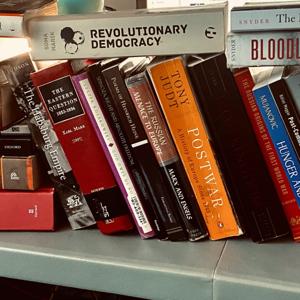


“Hi, my name is Lelyn R. Masters, and I stan the French revolution. I think if you love something political you should criticize it mercilessly.”
The French Revolution was awesome and super dumb. By that I mean its revolutionaries, compared to the revolutionaries of any other time, had the most opportunities given to them and made the least of them. Firstly, the French revolutionaries didn’t have to overthrow the government or fight for the ability to assemble. The ancien regime collapsed and then called on the etats generaux to try and save it. Secondly, instead of making an enduring government, the revolutionaries followed every conceivable policy to destabilize the country. Let’s briefly go over that history.
The French Revolution is usually associated with atheistic terror. Nothing could be further from the truth. The radical core of the French revolutionary vanguard, the Brissotains and so on, were atheist, and they promoted nonviolent dechristianization. They were not the ones provoking religious revolt in France. It was the party of the Montagnards’ insistence on imposing religious reform, or subordinating the clergy to the French state, in the name of “religious regeneration” that caused the terrible schism in French society. The fact that academics and conservatives have been able to scapegoat the intellectual inheritors of Diderot for these crimes is an injustice. (Israel, Revolutionary Ideas, p.27-29). The heavy handed way Robespierre had of murdering his enemies went hand in hand with the Abbe Gregoire’s insistence that the clergy preach a certain religiosity alongside preaching the constitution.(Sepinwall, p110-114).
Wealthy peasants, for there were many such, greedily bought up church land. In doing all of this, rather than simply creating an institutional progressive tax policy, the NA created from a population that was either neutral or positive about the new government to one that was antipathetic to it. Add to this the fact that the assignats didn’t increase real wealth in the country, hence they were like printing money and caused inflation so that food shortages got worse, and it’s no surprise that most of France rose up in rebellion against them, some clamoring for restoration and some for a more radical revolution. The ongoing economic crisis along with an awareness that the rest of Europe was not happy that the privileges of kings were being questioned led to an expansionist war that France started and justified as “spreading democracy.” The best that can be said for this ethos of spreading the revolution is that the ideals of the French revolution eventually inspired other people: the revolutionary army did very little to change the map of Europe. The regular drafts the war required led to revolt. The revolutionary government was tremendously unpopular, and so ironically as it progressed it broadened the franchise but participation in elections shrank. They could only keep power by murdering lots of people, and fell to a tyrant when Napoleon took power finally in 1799.
The French Revolutionaries, rather than founding a government that could lead society, again this is the task of any government, created divisions that destabilized almost a dozen governments over the next two centuries. Historians struggle to answer the question of when did the French revolution end, and Ian Davidson answers by saying that it ended in 1968 when DeGaul stepped down from power. It was the first time executive power had been transferred without mass upheaval, and without a change of regime in about 180 years, indeed despite the so-called revolution of ‘68.
What we can say is that the imposition of a state religion caused divisions in French society that set back progressive goals for at least another century and a half. Unless a government or a revolutionary group aspiring to become the government can lead society, they likely will not hold onto power for very long. We have already seen this at work in other contexts: the decline in popularity of the Black Panther Party, for instance. We’ll be collecting such examples.
There were nevertheless some positive gains for the cause of poor and working people in the French revolution. In August of 1790 they put an end to noble titles and put to an end the payment of feudal dues and duties. It was a tiny part of the nation’s wealth, but it’s still a big deal. It was so little money that many nobles voted to end it, and there was never a protest movement to restore them. Part of what made the French revolution possible was that there was so much wealth coming in from sources that were not connected to the feudal system. Then the French government enforced the wall between church and state guaranteeing religious freedom, though as pointed out before they did this in an overly heavy handed way. What’s more, the French revolutionary army marched over Europe abolishing feudal obligations and selling church property everywhere they went. They got all the way to Moscow. Now, wherever these armies went they inevitably retreated, and the monarchy and feudal rights of nobles were reinstated all over Europe. But the idea and experience of liberation lived on and inspired revolutions in all of these other places like Belgium and Prussia and Austria. The struggle for democracy continued, and had its ups and downs, but the radical Democratic movement that became the 1st international comes out of these struggles. And while we couldn’t say the French are responsible for the revolutions that took place later across Europe and in the French Antilles, we couldn’t say they didn’t help by spreading the idea. In Prussia serfdom was making less and less dollars and sense to even the landed nobility and junkers who had serfs. The existence of cheap wage labor side by side with fixed rent feudalism plus the long ferment of the Prussian enlightenment culminating with the latest craze for Adam Smith among the Prussia bureaucratic class all taken together meant that Prussia was ripe for reform anyway. Napoleon provided a catalyst, but it was by decree that Frederick William III freed the serfs, who then had to revolt in order to make the decree real. (Clark, 327). Their revolt was intended to enforce the law for the sake of the general will, a theme we will develop in greater detail when we discuss Marx’s revolutionism. This is likely where Hegel got the idea of social contract theory: that once a society has declared something, such as universal suffrage, there develops a historical force compelling people to make it an actuality. Until the word becomes deed or vice versa society has unfinished business. In this context the idea that all people have rights, and the ability of reason to change their world, will become a powerful undercurrent in the social fabric, a whisper on the wind that all events seem to imply. How else could the masses of Europe understand their sudden liberation from feudal bondage? Human rights is a check we are trying to cash, a promise to ourselves we often do not keep. The declaration of the rights of man was explicitly an attempt to establish among the human race a society of equals, and that meant that the government would have to act against the inherited oppression of privilege and hierarchy. How does an idea become reality? It must spread: it must be passed around in society. It advances in different ways amongst different peoples.
The second reason why we revere the French revolution is because starting in July of 1789 the founding of the National Assembly by the Third Estate meant a broad suffrage. More people could vote. As we’ve noted, as the suffrage broadened during the French revolution, actually participation in elections declined. This was caused by the imposition of the state over religious opinion among other things. The wild political oscilations that reverberated afterwards were finally ended in 1848 with the ascent to power of Napoleon 3rd, after which it would be another two decades before something like real democracy would return to France, and then in the form of the Commune of 1871.
We are used to thinking that ideas don’t matter, but when they become social movements they really do matter. Roger Chartier has said with some justice asserted that the enlightenment didn’t so much start the French revolution as the French revolution started the enlightenment (Sepinwall, p. 11). For the masses of Europe and North America the French and American revolutions really did start the enlightenment, that unhappy child. Unhappy, because it had only had brief tastes of what a free and democratic society could be like, and newly born because ideas that had been buried since the Greeks were now moving masses of people.
The legacy of the French Revolution has one unambiguously positive aspect: the example of Democratic rule. It showed that a government could exist that in principle recognized equality between citizens, with each getting one vote, and that fought to preserve their rights. The question this immediately poses to us is why it didn’t persist. France had a democracy for all of four years, and because Robespierre needed the support of the Parisian masses to maintain his power, it had direct democracy for almost a year. Why wasn’t it able to create real equality? Why did it fail to protect the “rights of man” that it had proclaimed?
Marx was clearly inspired by the French revolution. He thought Hegel imagined the state could dominate society. One lesson screaming to be learned from Robespierre’s terror was how impotent a state would prove if it tried to dominate society. Marx thought that in the last instance things went the other way around, that society ultimately determined the form and substance of the state. If society was divided into classes, then the state would have to be the form their mediation took. To be a radical democrat in that context means working to give everyone an equal vote, and an equal status in society. All of Marx’s project, and indeed the majority of European 19th century thought, turns around the question of what went wrong in the French revolution. The ideals expressed by the French revolutionaries are not questioned in themselves among progressives for another century, but the failure of revolutionaries to form a government living up to them is understood by all as the central political problem to resolve. I have put forward here that the French revolution failed because while it signified democracy, it did not embody it. Though it formally declared that every man had a vote, by trying to impose the state’s will on an unwilling society in the form of religious tyranny, it had already communicated who and what would be excluded. The National Assembly, rather than find the policies and trade offs around which society could be unified, or at least pacified, busily identified its enemies and proceded to provoke them to civil war. In the podcasts that follow we will step through the history identifying other times and places where revolutionary governments got this right and where they got this wrong. The problem is essentially one of education and tolerance for differing opinions and ideas, essentially the problem of free speech and conscience. Let me show my hand: I’m trying to call my audience back to Epicurus’ garden where a plurality knows best which way the wind blows. I set my sail next, for Haiti.
Bibliography
Davidson, Ian. The French Revolution: From Enlightenment to Tyranny. Profile Books, 2016.
Hunt, Lynn. Family Romance of the French Revolution. Routledge, 2013.
Furet, François, and Karl Marx. Marx and the French Revolution. University of Chicago Press, 1988.
Lefebvre, Georges, and Timothy Tackett. The coming of the French Revolution. Vol. 19. Princeton University Press, 2015.
Haiti
In 2018 Julius S. Scott published an excellent book about how the ideals of the French revolution spread amongst enslaved people in the Caribean. His book is entitled “The Common Wind: Afro-American Currents in the Age of the Haitian Revolution,” and you should get a copy and read it all the way through. I’ll be using Scott’s account to frame C.L.R. James’ classic on the Haitian Revolution: “The Black Jacobins.” Time and again James speculates rather lamely about how the Haitian revolutionaries could have known x, y and z, important things like the fact that Napoleon was sending an army to reenslave everyone and not to help them as was the public story.
Scott fills in those blanks and gives us a stronger impression of how big a difference the transmission of ideas can make.
In the 17th century merchants from Europe began sailing to the new world, investing money there, making fortunes there. We pointed out earlier that this wealth is a big part of why the monarchy in France fell. But the Caribbean, and the new world in general, was still a very wild place. It was very easy in those early years for slaves to escape, for indentured servants to escape, for drafted soldiers to escape. The escapees often founded their own political institutions, sometimes known as colonies and sometimes called maroons. All of these streams of people who rejected the place society had prepared for them became a kind of masterless class that put up a constant resistance to the state powers who were trying to impose upon the area a certain political order as the 18th century progressed. The political order of the maroons was majority Black, spoke all the languages of the world, was nourished by licit and illicit trade, and was geographically centered around the ports. The sailors of Europe, overworked, bearing the burden of all the risks and hardships of seagoing life, prone to desertion and mutiny, were natural allies of these communities of formerly enslaved and brought with them a steady stream of news from the other side of the Atlantic.
In 1739 after a long military conflict, Britain was forced to recognize the political independence of several maroon communities in so-called ‘cockpit country’ in North West Jamaica, which was a short sail from the southeastern tip of Cuba, another center of maroon activity. Maroon activity on the Haitian island was mainly centered around Cul-de-Sac in south central Santo Domingo. While one island or the other might belong more or less to a particular European power, geographic peculiarities and the relative ease of sea travel compared to land travel could mean that ceratin localities were more naturally linked to foreign powers. This is the case of southern Santo Domingo, which was cut off from the rest of the island by tall mountain ranges and often felt closer to Spain via Cuba and Venezuela than it did to France.
History understood as a series of actions by great men is usually pretty unrealistic, but there’s no getting around the fact that Toussaint L’ouverture was a genius. It’s true that in any such case, a confluence of events and circumstances came together to enable the hero, but in Toussaint’s case the circumstances just serve to better frame his excellence. Born a slave, he would lead his people to freedom, and in doing so he would defy three of the greatest empires the world has seen. No wonder that in the 1938 C.L.R. James chooses Toussaint L’ouverture for a hagiography, lifting up his life as one well spent, as a model for the independence movements about to grip Africa. Born a slave, Toussaint L’ouverture had risen to be the steward of his master’s livestock, and read classical literature (91). His favorite was Abbe Raynal’s History of the Two Indias.
The book was a history but also a denunciation of the colonial system, and despite the fact that Raynal’s name was listed as its author, Raynal himself did not write the most controversial parts. The most controversial parts were written by Denis Diderot. Ostensibly a straightforward and non ideological description of the system of colonialism from India to the Caribbean, the Histoire des Deux Indes was commissioned by Etienne Francois de Choiseul, who was the foreign minister in charge of France’s Navy and colonies. Choiseul had hoped the book would inspire more colonialism. The project was too big for one author, so Raynal hired a team. In 2019 Andrew S. Curran gifted us with a biography of Diderot, and he describes the Histoire des Deux Indes in these terms: “Despite the fact that the History’s disparate points of view often come into direct contradiction - the inevitable pitfall of multiple authors - the most powerful portions of the book unequivocally put forth a vision of history according to which tyrants, magistrates, and priests had not only instituted various forms of despotism in Europe, but had exported it to the world’s colonies. French censors had no illusions about the implications of the History. Shortly after the book became widely available in France, it was banned by an arret du Conseil in December 1772 [almost two decades before the French Revolution]… Diderot’s contributions to the History, which vary from a few sentences to chapter-length interventions, functioned as the capstone to his diverse political writings. Though Raynal had theoretically limited the scope of the History to the East and West Indies, Diderot was among those contributors who forcefully turned the critical focus of the book back on Europe itself. One of the more interesting contributions that he furnished for the third edition of the History is a cheeky note that he directed to Louis XVI himself. Having picked up the habit of addressing monarchs in a familiar tone, Diderot speaks to the young king in the informal and forward tu form. He warns the doomed Louis XVI that the country as a whole is a powder keg: ‘Cast your eyes over the capital of your empire and you will find two classes of citizens. Some, wallowing in wealth, flaunt a luxury which provokes indignation among those not corrupted by it’ A paragraph later, the aging philosophe predicts that empires such as his own ‘cannot endure, without morals and virtue,’ then asks the king why he continues to condone the ‘insatiable greed’ of his courtiers, allowing all the ‘protected men’ of his kingdom to shelter themselves from the burden of taxation while the people ‘groan’ under the weight of their leview. Toward the end of his diatribe, Diderot gives his king a choice: accept the infamy of the do-nothing tyrant or transform the country and achieve true glory. Diderot embedded many other such messages in the History as well, even when he was not speaking to the king directly. On the subject of freedom of the press, for example, the philosophe was categorical: ‘Wherever the sovereign does not allow the people to express themselves freely on economic and political subjects, he provides the most convincing evidence of his inclination to tyranny.’ As influential as Diderot’s views on the French monarchy would ultimately become in the years leading up to and during the Revolution, his writing on the colonies was at least as significant. In addition to underscoring the fundamental injustice of much of the colonial enterprise as a whole- repeatedly condemning his era’s conquerors for appropriating lands that did not belong to them - Diderot forcefully attacked what he believed to be his era’s most glaring evil: the ongoing business of African chattel slavery. By the time that Diderot became involved in the History of the Two Indies, French slave traders were delivering thirty thousand enslaved Africans to the Caribbean on an annual basis, adding to the half million slaves who were already toiling on the three major French islands of Guadeloupe, Martinique and especially Saint-Dominique. In all, French ships had carried well over a million souls to the islands since the trade had begun in earnest, 120 years before… In addition to rejecting the era’s illegitimate race science, he attributed the existence of the trade, which had always been blamed on Africans themselves, to European greed. He also solemnly informed readers of the History that the responsibility for the forced enslavement and murder of millions of Africans not only lay with slave merchants and planters, but regular Europeans as well: ‘The insatiable thrisrt for gold has given birth to the most infamous and atrocious of all trades, that of slaves. People speak of crimes against nature and they do not cite slavery as the most horrific. The majority of Europeans are soiled by it, and a vile self-interest has stifled in human hearts all the feelings we owe to our fellow men’ Diderot’s most prescient and rhetorically awe-inspiraing passages on slavery come, however, when he predicts the rise of a Black Spartacus who will wave the ‘banner of liberty’ and lead an army of former slaves agaisnt their master, leaving the ground stained with their former oppressors’ blood. This is, of course, precisely what happened in Saint-Domingue a decade later, when a brilliant tactician and Revolutionary soldier named Toussaint Louverture.” (pp. 364- 366).
From the Julius S. Scott we know that throughout the 1770s slaves throughout the American colonies were electrified by news that in England Lord Mansfield had liberated a former Virginia slave named James Somerset. The news set off a string of escapes and attempts to get to Great Britain (p. 79). During the American revolution, slaves were supposedly offered freedom if they fought for Great Britain, but those who did so were more likely to be sold back into slavery as not (https://www.youtube.com/watch?v=fzd06DRvRKA). Great Britain temporarily suspended the slave trade during the American revolution, and picked it back up afterwards. Nevertheless, news of the progress of the abolitionist movement in Spain, France and Great Britain continued to feed the hopes of the enslaved throughout the 1780s, and then news of the storming of the Bastille and the forming of a National Assembly in Paris hit the Caribbean like a bomb.
What tale flew on the breeze in SanDomingo? Quothe James: “Meanwhile, what of the slaves? They had heard of the revolution and had construed it in their own image: the white slaves in France had risen, and killed their masters, and were now enjoying the fruits of the earth. It was gravely inaccurate in fact, but they had caught the spirit of the thing. Liberty, Equality, Fraternity. Before the end of 1789 there were rising in Guadeloupe and Martinique.” Ian Davidson again gives us a concise summary of the important events:
“Saint-Domingue was one of the richest of France’s colonies, and its plantations produced enormous wealth in the form of sugar, rum, coffee and cotton. Its economy was essentially built on the slave trade; the dominant and slave-owning population consisted of 30,000 whites, but all the work was done by 500,000 black slaves. In between were 27,000 mulattoes, who were free but not white. Brissot had founded the Societe des amis des Noirs in 1788 but failed to get any support from the Assemblee nationale constituante for the abolition of slavery. Part of the problem was that some of the Revolutionaries had a personal stake in the plantation business: not just some of the right-wing members of the Feuillant Club, like the Lameth brother, but also, as we have seen some of the left-wing Girondins. On March 8, 1790, the National Assembly passed a decree setting up assemblies of local self-government in the colonies, for which only the whites could vote and in which only the whites could sit. From this point on, the Revolutionaries simply blanked out the question of slavery; the only related question they were prepared to debate was what rights, if any, to give to mulattoes. More than a year later, on May 15, 1791, the National Assembly gave citizenship to mulattoes, but the colonial whites refused to implement the decree. This refusal led to the rising first of the mulattoes, then of the blacks, in August 1791, under the command of Toussaint Louverture.” (pp. 80-81). The view from Santo Domingo was a little different.
The whole dynamic then was to keep news of the ongoing revolution for human rights and the push for abolition from getting to slaves in the colony. One anecdote form Julius S. Scott will illustrate the point: “As early as the fall of 1788, the Crown issued orders ‘to abolish every press’ in Saint-Domingue ‘in order to keep the flame of liberty from spreading to the Colonies,’ a move which led to an effective news blackout lasting at least ‘several weeks’... Confronted with a group of enthusiastic recruits ready to sail from France to Saint-Domingue in 1792, he [General A.N. de la Salle] took a different approach. Aware of the explosive potential of the watchewords and rituals of the French Revolution if applied in the colonies, the general instructed his charges to alter their banners and caps, which displayed the slogan ‘Live Free or Die,’ to read ‘The Nation, the Law, the King.’” (p.107). We do not know who exactly was informing the slaves of San Domingo, but we know that they were aware of everything that was said or written in Paris regarding their potential freedom. From Scott: “Passing along reports of slave unrest near Cap Francais, colonial officials reported in October 1789 that a ‘multitude of printed materials’ had apprised the population of developments in Paris. Despite careful precautions, ‘all that is done or written, particularly on the issue of the emancipation of the blacks’ made its way past dockside police. Not surprisingly, blacks at the Cap soon understood that the tricolored cockade symbolized the newly won emancipation fo the whites from their ‘masters’ in France.” (p.114). Slaves across San Domingo began wearing the tricolor cockade pinned to their hats in defiance of their masters (https://en.wikipedia.org/wiki/Cockade_of_France).
In March of 1791 two regiments of soldiers arrived in San Domingo to help the royalists against the republicans, the revolutionaries known as Patriots. From James: “The inhabitants of Port-au-Prince prepared elaborately to win them over from the royalist government. They opened the cafes to them, greeted them with music and dancing and unlimited food and drinks, told them that the Government was the counter-revolution, as indeed it was. The soldiers refused to obey their commanders and the Governor, and joined the Patriot party. [The General leading the royalists] De Mauduit’s own soldiers, hitherto loyal, under the crossfire of the population and the new arrivals from France, were caught up in the revolutionary ardour. Turning on De Mauduit they murdered him… Hostile as the small whites and the Patriots were to the rich Mulattoes, they did not disdain the alliance of the Mulatto Patriots… All this took place in march 1791, but something else had also taken place. The French soldiers, on landing at Port-au-Prince, had given the fraternal embrace to all Mulattoes and all Negroes, telling them that the Assembly in France had declared all men free and equal” (pp. 82-82). Long before the official ratification of liberating the slaves, they had themselves seized upon the opportunity the revolution gave them to take their own freedom. From that moment the French revolution and the liberation of the slaves were synonymous, and from that we get some idea of why later Toussaint Louverture would resist attempts at Haitian independence.
Julius S. Scott describes the start of the rebellion, which was far from spontaneous: “On the night of 22 August 1791, even as planter deputies made their way toward Cap Francais to convene a regional assembly, slaves in the rich northern plain encircling the Cap began their rebellion. For weeks black leaders had spread word of the intended uprising, and when the moment arrived, the widespread and well-planned nature of the rebellion caught whites defenseless. Within hours after slaves first rose on an estate located nine miles from the Cap, as many as 100,000 slaves learned about and joined the revolt, setting fire to plantations and cane fields and mercilessly attacking slave owners and their families. Immediately officials in the Cap sent delegations to Cuba, Jamaica, and the United States to request assistance in fighting the black rebels, but they received only half-hearted cooperation. To compound their problem, just days after the rebellion in the northern provinces, mulattoes and blacks in the west triggered a second wave of armed uprisings. Pitched battles between government troops and poorly armed insurgents resulted in thousands of deaths on the rebel side, but these defeats failed to subdue outlying groups who continued to raid and destroy plantations.” (p. 137).
A few months after the revolt began Toussaint Louverture decided to join it. He was giving up a relatively comfortable life as the privileges administrator of his master’s three plantations for an uncertain war and certain hardship. The revolutionary free army was organized into two bands, one led by Jean Francois and the other by Biassou, the latter of whom Louverture would serve as a physician. After the French National Assembly declared Mulatto rights in May, the local slave owning class in San Domingo refused to implement the decree. The royalists took advantage of this situation to recruit the mulattoes to their cause, and so throughout the summer the mulattoes fought on the side of the monarchy. At this point, both the royalists and the patriots opposed freeing the slaves. The army of former slaves could devastate the countryside, but they were not strong enough to take the cities, and so in the fall of 1791 Toussaint Louverture negotiated a surrender. In that surrender he promised to protect the colonial establishment and return his army into slavery, but in doing so he preserved their lives and the freedom of his officers. The priority was to preserve their power and memory for a moment when circumstances would be better. The planters rejected the negotiation. James: “So disdainful was the Assembly that it would not include the negotiations in the minutes. Toussaint had plenary powers, and in a vain attempt to break down the pride of the colonists he secretly reduced the number to be freed from 400 to 60. The colonists would not hear of it. Then and only then did Toussaint come to an unalterable decision from which he never wavered and for which he died. Complete liberty for all to be attained and held by their own strength.” (p. 107). The immediate result of all this was a stalemate.
Events began to accelerate. In April of 1792 the army of royalists and mulattoes besieged Port-au-Prince. Confronted with this news Paris dithered. If they sent an army to put down the slave revolt, that army could be won over to the royalist side at just the moment when tensions between the royalists and the republicans was sharpening in Paris. The new French government had by that point run out of money, so it invaded its neighbors to spread the revolution and to seize more church property. In July 1792 these efforts had led to a route and Prussia invaded France. The Prussians were determined to put down the revolution and strengthen the French King’s position. On August 9th one of the revolutionary clubs in Paris, the cordelliers who championed representative democracy, declared a revolutionary commune in Paris. The next day they issue an order of summons for the commander of the National Guard Antoine Jean Gailliot who was defending the king in the Tuilleries. When Gailliot arrived at the Hotel de Ville he was lynched, and a mob descended upon the Tuilleries and arrested the King. From that moment on any semblance of sharing power with King Louis was over. With the arrival of representative democracy bolstered by revolutionary action in the streets, it was clear to everyone that the abolitionist cause had won in Paris. This indisputable fact broke the alliance in Haiti between the mulattoes and the royalists. The republican governor of Santo Domingo, Sonthonax asserted Mulatto equality, but also kept the regime of slavery for the moment. The army of former slaves led by Biassou and Jean Francois forged an alliance with the King of Spain. Toussaint Louverture was made a colonel in the Spanish Army fighting for the Spanish crown.
Spain went through a liberal revolution starting in about 1808, but prior to that it was a nation whose entire economy was premised on extracting wealth from colonies in South America. Here is how Anthony Beevor describes Spain around the time that Toussaint Louverture fought for it: “The code of the hidalgo (Spanish nobleman) forced him to despise money in general and the earning of it in particular. The census of 1788 showed that almost 50 per cent of the adult male population was not involved in any form of productive work. The army, the Church and, above all, the vast nobility were a dead weight on the rest of the population. It was perhaps this statistic which provoked the well-known saying that ‘one half of Spain eats but does not work, while the other half works but does not eat.’” (p. 6). As for life in the colonies, here is how Eduardo Galeano describes the treatment of the natives who worked in Spanish mines (he is not exaggerating): “The colonial Latin American economy enjoyed the most highly concentrated labor force known until that time, making possible the greatest concentration of wealth ever enjoyed by any civilization in world history. The price of the tide of avarice, terror, and ferocity bearing down on these regions was Indian genocide… While metals flowed unceasingly from Latin American mines, equally unceasing were the orders from the Spanish Court granting paper protection and dignity to the Indians whose killing labor sustained the kingdom. The fiction of legality protected the Indian; the reality of exploitation drained the blood from his body.” (pp.38-39).
All of this to say that Toussaint Louverture was fighting for Spain not because he really believed it was worth fighting for. He fought for Spain for the same reason he had tried to surrender to the white slave owning class in SanDomingo: to preserve the social movement for freeing the slaves. He was not of the school so common today according to which one must make every action about the purity of one’s ideals. He was intensely practical, and C.L.R. James is right to hold him up as an example of good revolutionary leadership. Toussant Louverture didn’t need to fight every battle all the time, and he doesn’t owe us an explanation for his actions. Toussaint Louverture had one overriding ambition, and that was to free the slaves of SanDomingo. Freeing the Haitian slaves, then protecting that freedom, offered the world a positive example that drove progressive, liberatory politics for generations afterwards. In the 30s when C.L.R. James is writing, he’s offering Toussaint Louverture as a positive role model of how African revolutionaries should act: and clearly revolutionaries need to get weapons and material support somewhere, meaning they have to learn how to play one imperialist power off another the way Louverture did. In his role as a colonel in the Spanish Army, Toussaint Louverture conquered a large part of San Domingo. It was easy for French royalist forces to surrender to him, because he always granted amnesty to his former foes, and everywhere he went he freed slaves. Back in Paris, the King Louis XVI is put on trial and on January 21, 1793 is beheaded in Place de la Concorde. The British, eager to fight the revolution and gain from a reinstituted slave trade attempt to invade San Domingo, landing troops on September 9th, 1793.
The French republican governor Sonthonax, exasperated by Spanish armies, and at the same time hassled by Royalists and expecting the British invasion, finally gave in to the needs of the moment and freed, and what was the same thing, armed the formerly enslaved population of San Domingo in August of 1793. From then on Toussaint Louverture and his sizable army, equipped at Spain’s expense, would fight for their freedom and for the glory of revolutionary France.
In January of 1794 the peoples’ convention in Paris received its first delegates of color. The convention declared the abolition of slavery, and though a counter revolutionary France under Napoleon would send an army to try and reenslave Haiti, he would fail. James recounts to us the scene that day in the National Convention: “The three deputies of San Domingo entered the hall. The black face of Bellay and the yellow face of Mills excited long and repeated busts of applause. Lacroix (of Eure-et-Loire) followed. ‘The Assembly has been anxious to have within it some of those men of colour who have suffered oppression for so many years. To-day it has two of them. I demand that their introduction be marked by the President’s fraternal embrace.’ The motion was carried amidst applause. The three deputies of San Domingo advanced to the President and received the fraternal kiss while the hall rang with fresh applause. Next day, Bellay, the Negro, delivered a long and fiery oration, pledging the blacks to the cause of the revolution and asking the Convention to declare slavery abolished. It was fitting that a Negro and an ex-slave should make the speech which introduced one of the most important legislative acts ever passed by any political assembly. No one spoke after Bellay. Instead Levasseur (of Sarthe) moved a motion: ‘When drawing up the constitution of the French people we paid no attention to the unhappy Negroes. Posterity will bear us a great reproach for that. Let us repair the wrong - let us proclaim the liberty of the Negroes. Mr. President, do not suffer the Convention to dishonour itself by a discussion.’ The assembly rose in acclamation. The two deputies of colour appeared on the tribune and embraced while the applause rolled round the hall from members and visitors. Lacroix led the Mulatto and the Negro to the President who gave them the presidential kiss, when the applause started again. Cambon drew the attention of the House to an incident which had taken place among the spectators. ‘A citizeness of colour who regularly attends the sittings of the Convention has just felt so keen a joy at seeing us give liberty to all her brethren that she has fainted (applause). I demand that this fact be mentioned in the minutes, and that this citizeness be admitted to the sitting and receive at least this much recognition of her civic virtues.’ The motion was carried and the woman walked to the front bench of the amphitheatre and sat to the left of the President, drying her tears amidst another burst of cheering.” (pp.140-141).
C.L.R. James puts forth Toussaint Louverture as a model leader in the late 30s in the hopes that he will inspire African independence movements. The portrait of Toussaint in power is clearly exemplary. For one thing, Toussaint was for many years a faithful servant of France, until the counter-revolution happened there. The idea of Haitian independence was secondary to him to the task of protecting the liberty so newly acquired for the former enslaved peoples of San Domingo, and freedom was easier to maintain when it was guaranteed by a major power. When counter-revolution turned the tide against progressives in France, Toussaint Louverture easily played one French leader against the other. Wherever Toussaint Louverture went, wherever he conquered, wherever he ruled, he granted amnesty to his former enemies and guaranteed the rights of all. Ex slave owners were guaranteed the right to own their plantations, but they couldn’t own slaves. Taxation was applied moderately and fairly. In a few places, formerly enslaved people were given land to work communally. In 1798 he beat the British who had invaded in an attempt to reimpose slavery.
In 1801 he had one of his own generals executed for leading an insurrection which would have led to a massacre of whites. Moise and others in the rebellious north wanted to seize the property of the white former slave owners and redistribute it to formerly enslaved people. The problem was that these whites still played an important role in the economy, helping San Domingo maintain trade relations with the rest of the world, and ensuring their safety was important to the power sharing arrangement Toussaint Louverture had fought several wars to attain. The uprising had occurred in the context of Napoleon deciding to send an army to San Domingo with the not so secret but not publicly known mission of reimposing slavery. The whites on the island, having owned slaves, could be expected to be loyal to Toussaint and hence to the continued freedom of former slaves, unless and until an occupying army fought to reimpose slavery. In such a circumstance the formerly enslaved would have to fight against the whites for their continued freedom, indeed for their very lives. Everything depended on the intention of the approaching army, but it is not clear that anyone in San Domingo could have known for sure that the intention was to reimpose slavery. Toussaint Louverture was surely better informed than we are, but that doesn’t mean he made the right choice. He crushed the Moise rebellion because he still held out hope of peacefully governing San Domingo, but it is clear to us now that this hope was misplaced. Given that the constitution he wrote that year set up San Domingo to be ruled by executives who stayed in office for life, he clearly did not think democracy would help Haiti given the general education level. Those whites he could spare he had deported; many others were successfully encouraged to leave. In April of 1802 Napoleon’s army left France. In May Toussaint Louverture was arrested along with some of his generals. Because Toussaint Louverture had defended the lives of the whites on San Domingo for so long against an insurgency to his left, the armed masses of San Domingo entered the war against Napoleon split amongst themselves, some even fighting on the side of the French in the mistaken belief that Napoleon would defend their liberty. What C.L.R. James says about these decisions teaches us a great deal about the awful trade-offs required of those who wield political power. Toussaint Louverture had to spare the whites to keep power in 1794, but could no longer protect them with Napoleon’s army in transit. I personally think that taking a human life is the worst thing you can ever do, but that sometimes history forces our hands. It’s acceptable in my mind to kill those who owned slaves to gain the freedom for those slaves. Sic semper tyrannis. The cost to the Haitian revolutionaries was that they had to fight a war for their independence against a large and well armed force while they were themselves divided. Here is how C.L.R. James discusses the matter:
“Bonaparte was not going to be convinced by Toussaint’s justice and fairness and capacity to govern. Where imperialists do not find disorder they create it deliberately... They want an excuse for going in. But they can find that easily and will go in even without any. It is force that counts, and chiefly the organised force of the masses. Always, but particularly at the moment of struggle, a leader must think of his own masses. It is what they think that matters, not what the imperialists think. And if to make matters clear to them Toussaint had to condone a massacre of the whites, so much the worse for the whites. He had done everything possible for them, and if the race question occupied the place that it did in San Domingo, it was not the fault of the blacks. But Toussaint, like Robespierre, destroyed his own Left-wing, and with it sealed his own doom. The tragedy was that there was no need for it. Robespierre struck at the masses because he was bourgeois and they were communist. That clash was inevitable, and regrets over it are vain. But between Toussaint and his people there was no fundamental difference of outlook or of aim. Knowing the race question for the political and social question that it was, he tried to deal with it in a purely political and social way. It was a grave error. Lenin in his thesis to the Second Congress of the Communist International warned the white revolutionaries - a warning they badly need- that such was been the effect of the policy of imperialism on the relationship between advanced and backward peoples that European Communists will have to make wide concessions to natives of colonial countries in order to overcome the justified prejudice which these feel toward all classes in the oppressing countries. Toussaint, as his power grew, forgot that. He ignored the black labourers, bewildered them at the very moment that he needed them most, and to bewilder the masses is to strike the deadliest of all blows at the revolution.” (pp.286-287).
Toussaint Louverture had left his movement without leaders, since he had not imagined the French would have to be resisted. His generals were either imprisoned or enlisted in the French army. Nevertheless, the French were defeated in 1803, and Haitian independence was gained largely by the instinct and genius of the formerly enslaved masses. Historians have tended since that time to give an exaggerated amount of credit to yellow fever. In Haiti, for the first time anywhere a slave revolt had succeeded in creating a viable state. The consequences for the whole world were profound.
Had the French under Napoleon, or the British before him, succeeded in reimposing slavery in Haiti, England probably would not have abolished the slave trade. The Brits would have had a material interest in the slave trade that would have made it hard for them not to enter the civil war on the side of the Confederacy. Beating slavery in Haiti, in a very real sense, helped the North win the civil war. Another key point that kept England out of the civil war, though it desperately needed cotton for its textile industry, was the work of Karl Marx in educating the Manchester workers about their common brotherhood with the enslaved peoples of the United States. A whole international network of people passing around ideas about freedom and our need for solidarity with each other worked together to ensure the victory of the North in the Civil War. The success of the Haitian revolution gave an example for enslaved people in the South who refused to continue moving the Southern economic machine and joined the Union Army wherever it went. In the US South, Black slaves took the opportunity to free themselves, crippling the slavocracy with a general strike. But it wouldn’t be until W.E.B. Dubois’ masterful Black Reconstruction in America was published in 1935 that they would get credit in the halls of academic history. Before then it was thought that Abraham Lincoln had freed the slaves, but no, Lincoln just ratified formally what slaves had already made a fact, just as the National Convention in France had merely legally ratified the free condition that Haitian slaves had fought for and won already. I don’t mean to say that without Toussaint Louverture these multitudes wouldn’t have been freed, because no one could know such a thing, but it’s obviously the case that Toussaint Louverture, Denis Diderot, Karl Marx, Nat Turner and a whole generation of revolutionaries helped progress the cause of Abolition, and they couldn’t have done so if there hadn’t been some rumor on the wind, something in the birdsongs and sea shanties, some murmuring tale about freedom and human rights. And it’s that idea of radical democracy that will drive the struggle for social change in Europe throughout the 19th century, and that’s the story I will tell in the next podcast about Marx and the radical democratic tradition.
In the foreword to Julius S. Scott’s The Common Wind, Marcus Rediker quotes Wordsworth poem “To Toussaint Louverture,” written in 1802, and I want to end this podcast with a reading of that quotation. When it was written Toussaint Louverture was being kept in one of Napoleon’s jails, and would soon die of pneumonia. I leave it to you to ponder if the spirit of Toussaint Louverture doesn’t still haunt our world.
“Toussaint, the most unhappy man of men!
Beevor, Antony. The Battle for Spain: The Spanish Civil War 1936-1939. Hachette UK, 2012.
Curran, Andrew S. Diderot and the Art of Thinking Freely. Other Press (NY), 2019.
Davidson, Ian. The French Revolution: From Enlightenment to Tyranny. Profile Books, 2016.******
Galeano, Eduardo. Open veins of Latin America: Five centuries of the pillage of a continent. NYU Press, 1997.
Robinson, Cedric. "A Critique of WEB Du Bois' Black Reconstruction." The Black Scholar 8.7 (1977): 44-50.
James, Cyril Lionel Robert. The Black Jacobins: Toussaint L'Ouverture and the San Domingo Revolution. Penguin UK, 2001.
Scott, Julius S. The common wind: Afro-American currents in the age of the Haitian Revolution. Verso Books, 2018.
Art by: Erin Bakken
Music:
Mozart #17 in B Major
Le Marseillaise
all else by Harry Koniditsiotis
Hello, my name is Lelyn R. Masters, and I believe the world is round.
I want to talk today about whether human beings can make a better world. The matter is usually treated as an article of faith either to be accepted or rejected based on how one feels or based on a sense one has from their life experiences. But I want to talk about it seriously, as one who believes in freedom and as someone who for better and for worse after all that has happened finds himself constrained to remain a Marxist. I hope to make these things clearer before the end of this podcast.
There is a certain Marx I’d like to help excavate, the Epicurean Marx. In 2018, Diego Fusaro, who teaches the History of Philosophy in Milan Italy published Marx, Epicurus and the origins of Historical Materialism. I want to describe here the main arguments of that book, which develops the idea that Epicurean philosophy informs the whole of Marx’s work. In 1841 Marx finished a doctoral thesis entitled “The Difference Between Democritean and Epicurean Philosophy of Nature.” As the title suggests Marx therein lays out a parting of the ways between two of antiquity’s first and greatest materialists. Already I think you should be able to tell that Marx is going to be a particular kind of materialist. What you don’t get from the title is the fact that Marx is in dialogue here with Hegel, who he is going to identify with Democritus, and that in lifting up Epicurus he is breaking with Hegel in a particular way. We note in passing that Marx’s dissertation is not taken very seriously in the Marxist tradition, a point we will come back to later.
So, the fact that Marx’s Epicureanism isn’t taken seriously by the subsequent Marxist tradition has certain consequences. We would expect such an omission to cause Marxists to speak of iron laws of necessity, to downplay the role of human agency and freedom and to reject free speech and open debate. The dogmatic explanation of all things in terms of class has often taken the part of proposing a kind of divine order, imposed on us from without. A whole life’s intellectual work could go into telling the story of how closely the Marxist tradition conforms to this image of dogmatic mechanical determinism, and how far Marxists in power have gone to frustrate human liberty. Suffice it to say that there are Marxists who step out of this trend, and that there are many more who do not. In the episodes of this podcast, each composed of several book reports, I aim to speak to different struggles, historical moments and controversies that seem to highlight the status of this concept of freedom that seems to me so essential to Marx’s project. We’ll come back around to a discussion of where this history leaves us, since this project is a political almanac, undertaken with, I hope, as large an openness as I can manage to the facts in the conviction that we are free to change the world. The word “almanac” comes from the Arabic word meaning “the climate.” In other words, this podcast suggests itself as an exploration of the conditions under which we toil to get free. I couldn’t set out on this project if I wasn’t already at peace with the fact that I’ll be putting forward what I as a finite and limited person have come to understand, but if I really think we can change things, if I really think that hope is an essential part of knowledge, then I can’t not make the attempt. I hope you will come along with me, and I welcome your comments and questions, because confirmed Marxist as I am I am convinced that I cannot get free without your help.
Art by: Erin Bakken
Music by: Harry Koniditsiotis
The Breakdown of Legal Protections for Migrants is an Expansion of Lawlessness
If you are wondering how things are going in America one bad sign is that in January of this year 2020 a nonfiction book came out written by Philip G. Schrag that was entitled Baby Jails: The Fight to End the Incarceration of Refugee Children in America.
Let’s get one thing out of the way: the idea that putting children in cages began under Obama, is just false. Under President Obama six children were found near the border with Mexico and temporarily sheltered in detention facilities. Under the law of the land which is conditioned by the 1997 Flores agreement, the United States agreed not to jail migrant children for longer than 72 hours. Under Trump families that are caught crossing the border are split up. The children who arrive with their parents are labeled “unaccompanied minors” and taken to separate detention facilities from their parents. The latest number I could find was from the fall of 2019 when the Trump administration had detained nearly 70,000 children, and 5400 children have been separated from their parents.
When Trump supporters claim that he is merely enforcing the law they are correct. Obama was also enforcing the law, although in a very different way, at once kinder and reckless. Simple support for either policy is insufficient to the moment. It is true that undocummented immigrants can legally be deported. It is also true that undocumented immigrants can legally be allowed to stay. Either outcome is a matter of the will of the president and his administration, and that is part of why we are in a very dangerous situation.
The law of the land is almost 60 years old. Immigration in the US is still governed under the Immigration and Nationality Act (INA) of 1965, which was designed to replace the Bracero program. Bracero was a guest worker program that existed between 1942 and 1964 which brought 4.5 million workers into the country from Mexico. (Andreas, p. 31). This cheap labor source replaced other exploited minorities in the hierarchy of US labor, and the expectation employers had for this cheap source of labor became a permanent and to date unchallenged priority in crafting immigration policy. It tarnished the federal government to be involved in regulating such a practice, so close was it to slavery, that the INA had to be crafted so as to allow this trade in the most exploited labor, relieve the employers of any of the responsibilities to this labor force that they would have had to workers protected by the National Labor Relations Act, all without meaningful government regulation. Liberal supporters of the law could tell themselves that even if it allowed certain unfair labor practices, it allowed immigrants to enter the country and benefit from American public services, maybe even have a chance at becoming citizens or at least that their children would. Nevertheless, the basic premise was that this would be a population that had no regular legal status, with certain protections offered via memoranda dictated without consulting the people impacted, who would not get the full protection of law enjoyed by citizens. In a crisis, these kinds of populations are most vulnerable to being dehumanized and abused.
The INA was always a contradiction: it was a law that was designed to allow for the broadest possible discretion in immigration matters so as to allow for unfair labor practices. Discretion was to be available at every enforcement opportunity so that the legal system could always turn its attention away from the unfair labor practices that the business community engaged in, could always feel itself to be showing clemency to a population that existed at its mercy. What is new in the Trump era is that this discretion has been largely done away with, with the result that a heavy handed policy that bans a native population, the immigrant community the US invited in for cheap labor. This is tyranny; when a people are exploited, categorized as superfluous and then disposed of.
Here are some key memorandums that shaped the practice of discretion in deportation sentencing. The November 20, 2014 Johnson memorandum “instructed DHS to consider the amount of time spent living in the United States and ‘compelling humanitarian factors such as poor health, age, pregnancy, a young child, or a seriously ill relative… [further on] Absent special circumstances or aggravating factors, it is against ICE policy to initiate removal proceedings against an individual known to be the immediate victim or witness to a crime.” (Wadhia, p. 39). In 2017 the Trump administration annulled the Johnson memorandum. “As described in one fact sheet by DHS, ‘Under this Executive Order, ICE will not exempt classes or categories of removal aliens from potential enforcement. All of those present in violation of the immigration laws may be subject to immigration arrest, detention, and, if found removable by final order, removal from the United States.” (p. 41) Moreover, ICE has been directed to no longer hold back pursuing immigrants in certain privileged places such as hospitals and courts. So, if someone is an immigrant who has been settled in the US for no matter how long, regardless of the contribution their labor has made to build this country, having no matter what familial responsibilities to other US citizens, regardless of infirmity, they are now targeted by federal agents in hospitals, courts, work places, grocery stores and even in the USCIS offices were they must go to pursue legal status.
Immigrants entering the US justice system are given certain rights under the law of the land. In any of the legal vehicles for deportation, from Notices to Appear to Speedy Deportations, immigrants have the right to appeal, hence the right to council, at the discretion of DHS. Speedy deportations including expedited removal, reinstatement of removal and administrative removal all occur without a formal hearing. The systems in place for appeal are Kafkaesque; as if they were designed to be confusing, which they must surely be given that often official documents are provided in English. “While it is too early to quantify speedy deportation numbers and trends in the time of Trump, policy guidance issued early in the Trump administration supports increased use of speedy deportation programs. On expedited removal, one DHS memo, dated February 2017, reads, ‘It is in the national interest to detain and expeditiously remove from the United States aliens apprehended at the border’… President Trump tweeted the following statement on June 24, 2018: ‘We cannot allow all of these people to invade our Country. When somebody comes in, we must immediately, with no Judges or Court Cases, bring them back from where they came. Our system is a mockery to good immigration policy and Law and Order. Most children come without parents.’” (p. 88). Experts were quick to point out that Trump is factually wrong: even in speedy deportation immigrants are supposed to be screened with those facing persecution being allowed to stay. Trump’s zero tolerance policy has flooded an overwhelmed legal system, and thus largely thwarted the real availability of asylum requests. “Prosecuting anyone who enters the United States irregularly can complicate an asylum claim because of the time, expense, and chilling effect of prosecution as well as the criminal bars to asylum. Because asylum is a discretionary remedy, those who apply despite these impediments may be more susceptible to being denied asylum as a matter of discretion notwithstanding their eligibility for asylum under the statute… A blanket policy of prosecution is troubling to the rule of law and leads to a failure of discretion in a universe of limited resources.” (p. 108).
The Trump administration has a long record of illegal activity, not limited to the Muslim bans that have been struck down and the final Muslim ban was upheld by the Supreme court 5-4 in June of 2018. Other parts of Trump’s campaign of cruelty against migrants have been tied up in the courts. These things are constantly changing, and it’s likely that I don’t have the most up to date information. If anyone knows better please @ me. One example, of many, is the ongoing lawsuit on the part of the NAACP against Trump’s rescinding of Temporary Protected Status for Haitian immigrants. That protected status was given by the Obama administration, and even the most conservative Democratic candidates are likely to renew it. If these people were forced to return to Haiti, it is clear they would not find housing and resources for their basic needs (p. 75). There are one million people who could be targeted if Trump successfully gets Temporary Protected Status overturned in the courts, something each day in office brings closer to being achieved (more on that later). “As of July 20, 2018, the Trump administration has announced that TPS will end for nationals from the following countries: El Salvador, Haiti, Honduras, Nicaragua, Nepal, Somalia, Sudan, and Yemen.” (p. 73). A second Trump term will be a disaster in the lives of all of these people, and a further element destabilizing all of these other countries.
We offer these considerations because they shed light on what kind of legal protections, or lack thereof, we ourselves can expect if a second Trump term occurs and he is thereby allowed to continue stacking the courts. If that happens the law will become to a much greater extent an expression of racial hierarchy, with one law for those at the top and another for those at the bottom.
The undocumented population has been effectively terrorized against appearing in public, against even reporting crimes committed against them. And this was always the point: to force people of color into a state of exception, into a space where there are no legal protections, no rights and no witnesses, at least none that count as valid in the existing courts. In any of these circumstances, an immigrant’s freedom can be taken, they can be separated from their loved ones, their labor exploited in a detention facility and face deportation to states that are undemocratic and often that pose a threat to their lives.
American Imperialism was much kinder, in the sense that it promised to uplift from a “white man’s burden;” no such responsibility is felt by these new reactionaries. There will be no uplift. There is no proselytized culture because there is no culture. There is not even capitalist exploitation. There is simply the disposal of excess humanity.
Let’s consider the situation of immigrants to the US through another lense. Kimberley Crenshaw considers the formal legal equality of Blacks in the US after the civil rights movement: “White race-consciousness, which includes the modern belief in cultural inferiority, furthers black subordination by justifying all the forms of unofficial racial discrimination, injury, and neglect that flourish in a society only formally dedicated to equality. Indeed, in ways more subtle, white race-consciousness reinforces and is reinforced by the myth of equal opportunity which explains and justifies broader class hierarchies” (p. 116). The undocumented immigrant, on the other hand, does not enjoy even formal equality under the INA, but rather, is subject to a sovereign right, to decide life and death, without any support from the source of sovereignty, the permission of those ruled. Whereas widespread racial animus has led to the abuse of discretion in the courts against black people, the lack of discretion imposed on immigrants has been the key to unleashing white supremacist violence against them.
Currently families who are in ICE detention are being given a choice. They can stay together in detention, or they can separate and the child will either be sent to live with a relative or be put up for adoption. It’s legal for these families to be released together, but instead they are being offered the choice of separation or risk of contagion and death (https://twitter.com/neveragainactn/status/1261354365014683649?s=12). Public health officials predict that something like 72 to 100% of immigrants held by ICE will contract COVID-19 in the next three months. I’m posting a link in the transcripts with a call to action from Amnesty International (https://rightsnow.amnestyusa.org/free-people-from-ice-detention/). If you are in the Memphis area, you can donate to help immigrants assailed by the recent economic depression by clicking the link in the transcripts and donating to Vecindarios 901: www.undocufund.com. If you see ICE agents in Memphis threatening immigrants call or email Vecindarios 901, who provide legal observers wherever immigrants are under threat. (https://www.facebook.com/MariposasCollective/posts/if-you-see-ice-call-vecindarios901-rapid-response-team-at-901-329-7979-message-v/2483525781927780/). Email at: [email protected]
On May 6th Carlos Escobar-Mejia, a 57 year old man from Venezuela died of coronavirus in ICE custody. Before being arrested in January of this year he had lived in the United States for 40 years, working, paying taxes, contributing. On April 15th he was denied bond by an immigration court because of a domestic abuse charge from years before that was dropped because it was a case of mistaken identity, and a week later he was hospitalized. He is survived by his sister Maribel Escobar. The coronavirus is something we can manage, something we could have much better managed. It’s something Trump made a lot worse by doing nothing but warning his close friends to sell off stocks for the entire month of February. Every day he is in office we face the possibility another crisis will arrive that he will make worse. The poor response to the coronavirus isn’t because of capitalism: it’s not because capitalists need profit or workers are oppressed. All of that is perfectly compatible with a strong reaction to a crisis. It’s not in the interests of Capitalists to let large groups of workers die. The collapse in the realization of profit in the retail sector is something that would have been less bad for capitalists if a stronger response to the crisis had occurred. Indonesia is capitalist, and Italy has Universal Health Care. Indonesia has had a good reaction to COVID19, and Italy has not. Trump is the crisis, and people know that.
We have an election in November, and as we approach that opportunity to stand against fascism, I want you to remember Maribel Escobar’s words to the judge that denied her brother bond before he contracted COVID-19 in custody: “I want you to know that it was on your hands to save his life,”
https://www.latimes.com/california/story/2020-05-06/first-ice-detainee-dies-coronavirus-otay-mesa-detention-center
https://www.npr.org/sections/coronavirus-live-updates/2020/05/07/852475822/first-death-of-detainee-in-an-ice-detention-center-from-covid-19
Andreas, Peter. Border games: Policing the US-Mexico divide. Cornell University Press, 2012.
Wadhia, Shoba Sivaprasad. Banned: Immigration Enforcement in the Time of Trump. NYU Press, 2019.
Crenshaw, Kimberly, et al. “Critical race theory: Thekey writings that formedthe movement.” (1995).
Schrag, Philip G. Baby Jails: The Fight to End the Incarceration of Refugee Children in America. University of California Press, 2020.
Cover: Original artwork by Erin Bakken
Hi, my name is Lelyn R. Masters, and I agree with Aristotle who said that Democracy is the rule of the poor and Oligarchy is the rule of the wealthy.
This is a book report about all that is left out of Capital vol. 1. Very often the first impulse one has when they’ve decided to take Marxism or Communism or Socialism seriously is to read Capital vol. 1. In Capital, Marx uses the labor theory of value developed by Adam Smith and John Locke to explain how economic value is produced.
According to this theory workers are paid a part of the value they produce, and the Capitalist keeps the rest.
What’s really important in Capital is the idea of fetishism. The theory of fetishism tells us that when production is set up in this way there are set up objective relationships between people and subjective relationships between objects. For example your boss may be a very nice person, but if they are not making money off of you, you will lose your job. Meanwhile there is great social power stored up in the commodity: wealth brings with it social prestige and power, above all the power to decide what gets produced. So, production becomes something we as a society do in order to increase wealth, and with it social inequality, instead of production be undertaken to satisfy human needs. The people caught up in this system are forced to act towards each other in an inhumane, mechanical way. In Capital Marx intentionally leaves out much of importance. Some things he doesn’t talk about in Capital vol. 1:
What’s most lacking in Capital is a theory of political power. What is the state, and how should working people relate to it? Marx wrote prolifically on the topic. He was at heart a radical democrat: he believed that through education and the widest possible franchise that a socialist society could be created. After 1848, when the Bourgeoisie fought for a democratic revolution but then sabotaged the resulting democratic institutions by limiting democratic rights, say to vote about what happens in the factory and field, Marx realized that at a certain moment in an epoch of crisis the working class would have to assert itself in order to complete the democratic vision. None of this is in Capital. Ironically, because there is an over reliance on Capital, Marxists have tended to think of social change in objective terms: objectively the working class has an interest in overturning Capitalism, so if we just explain that to them then they will do so. In his political life Marx knew that the working class had to come to these understandings by their own active political work and thought. Marx’s point in capital is fetishism afterall, or rather his revolutionary goal there is to overturn the objective relationships between people so that they can relate to each other freely. So, very often poorly educated Marxists will imagine that once they have the economic situation understood then political victory is assured. But economic conditions alone do not produce working class movements, democratic institutions or revolutions: we have to do that. And, there is a very large literature about how that is done. What’s clear from Capital vol 1 is that we have to do that by engaging the working class as agents of their own liberation, and not as objects we imagine we can manipulate in the name of history.
Here is an example where certain Marxist completely get it wrong, just to give you an idea. World Socialist Website describes itself as “Published by the International Committee of the Fourth International (ICFI).” We’ll talk about what the 4th international was, but even at its height it was not an international. In October of 2017 they wrote an article entitled “Identity politics and the growth of inequality within racial minorities,” where they answer the question of just how bad of a line on race can a Marxist group have. In that article after some banal observations that some black people are wealthy and so on, they say, and its published on the internet out in public where everyone can read it, this nonsense: “American society is increasingly polarized—not between races, but between classes. In this context, the class basis of the upper-middle class’s obsession with racial and identity politics becomes clearer. This is the reactionary political essence of groups like Black Lives Matter, authors like Ta-Nehisi Coates, and academics like Keeyanga-Yamahtta Taylor, who push racial politics to better fleece the working class members of their “own” racial groups, and the working class overall.” Now, this is clearly complete bullshit, but I want to point out the underlying philosophical error. Here are people who only read Capital Volume 1, and didn’t read it correctly. We’re not supposed to treat human beings as though they are some known quantity that we just have to manipulate algebraically. People are agents, and if we treat them as such that is revolutionary in a system that profits from our collective dehumanization.
Further Readings:
Lenin, Vladimir Ilʹich. " Left-wing" Communism: An Infantile Disorder. Resistance Books, 1999.Marik, Soma. Revolutionary Democracy: Emancipation in Classical Marxism. Haymarket Books, 2018.Rosenberg, Arthur. Democracy and socialism: a contribution to the political history of the past 150 years. Beacon Press, 1939.
Du Bois, William Edward Burghardt. Black Reconstruction in America: Toward a history of the part which black folk played in the attempt to reconstruct democracy in America, 1860-1880. Routledge, 2017.
Hi, my name is Lelyn R. Masters, and I am a Revolutionary.
There is no way to understand the 20th century without a careful reading of the history of the Black Panther Party.
I want to start by apologizing for how incomplete this telling of the BPP’s history is going to be. The BPP was many things to many people, and they were lied about many times. Black Against Empire is as good a history of the BPP as there is.
The Panthers were victims of their own success. Nixon made key capitulations in order to preserve the larger system of white Power. There were four things that led to the BPP’s decline in the early seventies.
I want to read the last two paragraphs of this book in their entirety because they are so brilliant. The political clarity on display here is striking. The authors reflect on the current political moment. They focus on the inability of any of today’s so-called revolutionaries to appeal to society as a whole, which tells you that the phenonomenon was a mass democratic movement. The book was published in 2013; I leave it to you to decide how applicable this is 7 years later:
I’m sure I must have missed something important. I want to encourage everyone to read Black Against Empire. That’s my book report, thank you for your time.
Works
Bloom, Joshua, Waldo E. Martin Jr, and Waldo E. Martin. Black against empire: The history and politics of the Black Panther Party. Univ of California Press, 2016.
Cobb, Charles E. This Nonviolent Stuff'll Get You Killed: How Guns Made the Civil Rights Movement Possible. Basic Books (AZ), 2014.
Kurlansky, M. "The Year that Rocked the World (London: Jonathan Cape)." (1968).
Malcolm, X. The autobiography of Malcolm X. Ballantine Books, 2015.
Weiner, Tim. Enemies: A History of the FBI. Random House Incorporated, 2012.
In honor of Mayday I want to dedicate this episode to the health care workers who are our frontline against the deadly COVID-19 pandemic. I hope our efforts to slow the spread of the virus are so successful that people think we overreacted. As I write the majority of the US is shut down, people are confined to their homes, restaurants and bars and other service industries are closed down. Nearly 60,000 people have died and 26 million people in the US have lost their jobs just in the past month and a half. Conservative estimates, which emphasize the element of uncertainty, claim we should expect somewhere between 80,000 and several hundred thousand more deaths, and if we open our public areas up too soon it could make things much worse. None of that had happened yet when Michael Lewis first wrote The Fifth Risk, a book about the terrible risks we were taking on as Trump deconstructed our government. The May of 2018 disbanding of the White House Pandemic Response team is just one example (https://speier.house.gov/trump-administration-s-mishandling-of-the-coronavirus-response_2). It’s hard not to read Lewis today without noticing how prescient he was that a terrible catastrophe could be brewing that would overwhelm our intentionally weakened government. I am generally optimistic about humanity’s ability to improve our life conditions, but unless we get a clear picture of how the coronavirus pandemic happened, and how the Trump administration in particular is responsible for sabotaging our response to it, then we will also not be prepared for the next crises. So the story, as is so often the case, has good news and bad news. The bad news is that we messed this one up, and the good news is that this means we can do better next time. I hope you are all well. I hope this podcast helps you understand better what we are all going through, and I hope that understanding brings a measure of peace.
There are thousands of positions in our government that are appointments. Whenever we get a new President those positions have to turn over: the people who did that job have to be replaced with new appointees. Candidates for the presidency are required by law to prepare a transition team. Trump’s transition team was led by Chris Christy, but Christy was fired when Trump realized he would have to actually become the President, because at that point, when the job was getting serious, Jared Kushner could not stand Christy actually being so important when Christy had helped put Kushner’s dad in jail for corruption. The outgoing appointees under Obama spent months preparing to brief the new appointees. Those new appointees never got those briefings, often times arriving long after their predecessors were gone. Many positions were never filled. Michael Lewis, the guy who wrote Money Ball, went around to receive all these briefings to understand what was being lost, and the book that came out of that is The Fifth Risk.
I’m just going to start listing things.
After reading this book I had a great deal more respect for people who work for the fed. They are people who typically can make more money in the private sector, and they almost never get public praise for their successes. They almost never get noticed unless they have made a mistake or by chance found themselves at the center of a catastrophe. It’s really very problematic the way we speak of them. Even leftists tend ot criticize the federal government when they talk about it at all, and in fact there are many ways our lives are better because of our government. We should try and strengthen and expand it.
At the very end of The Fifth Risk, Michael Lewis tells a story that seems to point to the way forward, and to my ear echoes points made by Jane McElevy in No Shortcuts, which is another book you should read. On May 16, 2017 a massive tornado hit Elk City, Oklahoma, the largest city in Beckham County population 25,000. Tornadoes are one of the most difficult weather events to predict. You can tell when a Winter Storm is going to happen, but you can only warn people about a tornado once you’ve seen one. That gives local authorities very little time, once in a blue moon maybe 15 minutes, to communicate to locals the threat. Communicating risk quickly is the best hope people living in tornado prone areas have. Most of the time, local authorities fail at this, with disastrous consequences. Even if you have a tornado warning, you can’t know how bad it is until the tornado hits something. And by then it’s too late. But in Elk City, there was a local fireman named Lonnie Risenhoover. In Elk City a new state of the art prediction model had given Lonnie 30 minutes. A liberal is more likely to trust the news, and so they take tornado warnings more seriously and have a better chance of evacuating to safety. But in Elk City almost everyone voted for Trump. Because local people knew Lonnie they had more trust in the warning and evacuated. That’s Michael Lewis’ final word of hope for winning Trump voters back: someone like Lonnie Risenhoover has to explain the risk to them.
Now, Trump is like a tornado in more ways than one. As we’ve pointed out, people support Trump because they don’t trust the media and all the people they know trust Trump. When progressives move to the hip part of town or refuse to socialize with conservatives or stop going to church, we make it worse. Another way a tornado is like Trump is that people don’t respond to either one as a threat if they don’t believe it will impact them. And finally, a tornado is like Trump because when people have lost about everything, they might find themselves hoping for something to come around and destroy all the rest. Lewis finishes his book with the story of Miss Finley, who used to pray a tornado would come and destroy her barn because that was where her husband had killed himself. And one day a tornado did take her barn. “And so, you might have good reason to pray for a tornado, whether it comes in the shape of swirling winds, or a politician. You imagine the thing doing the damage that you would like to see done, and no more. It’s what you fail to imagine that kills you.” (Lewis, p. 217)
Works Cited:
Bloom, Joshua, Waldo E. Martin Jr, and Waldo E. Martin. Black against empire: The history and politics of the Black Panther Party. Univ of California Press, 2016.
Farrow, Ronan. War on Peace: The End of Diplomacy and the Decline of American Influence. WW Norton & Company, 2018.
Lewis, Michael. The fifth risk: undoing democracy. Penguin UK, 2018.
Hi, I’m Lelyn R. Masters, and I was born on September 11th. I was raised by a single mother in the 80s. After graduating from the University of Memphis with a Bachelor’s in Philosophy in the Fall of 2001 I joined the Navy, where I learned Arabic. When I got out I lived in Egypt, and the poverty and struggle against Mubarrak’s tyranny I witnessed there radicalized me. When the Egyptian revolution happened, I was back in the US, but the events I saw on the TV were happening in my old neighborhood to people I knew. Since then I’ve started a Marxist Student Union, studied with Marxist revolutionaries in New York City, and organized with the Democratic Socialists of America [DSA] in Connecticut and in Memphis, TN. It’s been almost a decade now since the Arab Spring started and Occupy Wall Street sparked a new generation of radicals. We’ve seen a resurgence in the membership of the DSA, a fascist seize the White House and Bernie Sanders lead two viable Presidential Campaigns. But now what? An Almanac tells us what the climate is, when to plant and when to reap. In this Democratic Socialist’s Almanac I’m going to review the history of the socialist tradition in the light of the latest scholarship. I’ll be talking about the good, the bad and everyone of us living in between. Once we’ve sorted out how we got here, we’ll surveille the paths now open to us and begin a discussion of where we want to go. Follow us on facebook, support us on Patreon, and subscribe wherever you get your podcasts from. We’re only ever as free as our neighbor is, and we’re only as strong as we are clear on where we’re headed.
From the publisher's feed