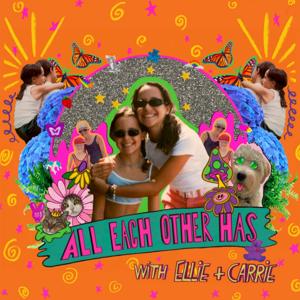
All Each Other Has

All Each Other Has

Download on the App Store

All Each Other Has episodes

  • Unscalable: from Prep for Prep to Andover
    For the second-to-last episode in our private school series, our guest Kayla narrates her journey from a New Jersey public school to the total environment of Phillips Academy — Andover. Growing up middle class in the suburbs, Kayla’s entry into Prep for Prep’s “Prep 9” program meant a 90-minute commute to the big city and a newfound sense of class consciousness. Getting to know her Prep peers, largely from low-income backgrounds, was a lesson in economic inequality.
    When she got to Andover, however, the pendulum swung in the opposite direction, making Kayla keenly aware of the privilege she lacked. Black and openly queer by 14, she realizes in retrospect that the institution was not one made for people like her. But boarding school, despite its normalization of whiteness and extreme wealth, was an overwhelmingly positive part of Kayla’s development. Still, Kayla finds that the Prep 9 model is not a scalable one promising meaningful change for the American education crisis.
    Other topics include the racial politics of dating in boarding school, the contention over romantic room visitations, and the preppy classics (Vineyard Vines) vs. the American classics (Hollister).
    53 min
  • Table Stakes: Krittika on Prep for Prep
    This episode in our NYC private school series features a very special guest, Krittika, who was Carrie's classmate at Spence. Her pragmatic parents, who met at university in India and raised Krittika and her brother Josh in Queens, always knew they'd have to do the most to circumvent the failings of the New York City public school system when it came to their own kids' education. They found Prep for Prep, a program founded by educator Gary Simons in 1978 to identify New York City’s most promising students of color and prepare them for success at selective independent schools. Krittika says Prep parents like hers were highly devoted, and recalls Dr. Cornel West's sentiment "I am who I am because somebody loved me." She takes us through the grueling Prep for Prep process, which was 14 months long and meant extra schooling on Wednesday nights, all day Saturday, and five days a week in the summer. With students getting "dropped" each week, Krittika and her peers took college-level courses and read The Iliad, sometimes pulling all-nighters at age 11 (something she's never had to do since).
    Krittika was overjoyed to finally end up at Spence, where her classes were stimulating, the rooms were beautiful, the food (muenster bagels!) was delicious, and her peers also watched Glee. While she was keenly aware that Spence was a testament to extreme wealth inequality, she learned to accept the trade-off: that though the school was not made for her, it would be the means for an excellent education and the bridge to a college where she could thrive.
    Works cited include Caitlin Flanagan's 2021 piece on private schools for The Atlantic and Vinson Cunningham's 2020 Prep for Prep profile for the New Yorker.

    49 min
  • Fractured Identity: A Black Spence Alumna Looks Back
    In the third episode of our NYC private school series, Ellie and Carrie speak with Alyssa, a Black Spence alumna whose experience of growing up in uneasy proximity to whiteness was lonely and damaging. Alyssa, whose family represented what Caitlin Flanagan describes as "the bread and butter of these schools... the two-career couple who care greatly about their children’s education and can afford it, but not easily," struggled to fit in with her wealthier white peers. A light-skinned Black woman with roots in what W. E. B. Du Bois deemed the "Talented Tenth," Alyssa's mother taught her to reject her blackness in the name of respectability. The disassociation brought on by the pressures of assimilation made Alyssa an anxious and compulsively polite child who could not freely be herself. One of the two Black students in her grade for her first eight years at Spence, Alyssa became a self-described "poser" whose desperation to be seen as white only led to isolation. She unpacks the traumas of self-surveillance and external adultification as a Black girl taught not to love herself. Reckoning years later with images of jubilant enslaved people in the Spence dance studio's wallpaper, Alyssa gathers the fragments of a fractured identity.
    1 hr 26 min
  • NYC Prep: The Middle School Years
    In the second episode of their New York City private school series, Ellie and Carrie move on from the dreamland of Spence lower school to the hell scape of middle school materialism and accelerated adolescence. We start with the joys and horrors of Knicker Bocker, where we, white-gloved, danced with tiny boys who, to us, were gods. Where are Pierre (FKA Peter of New Jersey) and "the lovely Ms. Yvonne" now?
    With our first-ever guest Jess, we hear about her transition from a city public school to a private school in the Bronx that ushered in a brief obsession with Uggs. Plus, musings on the "fast girls" from a certain all-girls' school who still occupy an indelible place in the imagination (for a certain subsect of Manhattan girls who were 12-14 around 2009). What did Blair Waldorf, seen in birds-eye view from the Spence staircase, do to our lexicons and capacity for kindness? Hervé Leger at Temple Emanu-El? Ninth graders at Riff Raff (rip)? Sure, why not!
    But ages 12 and up at Spence were not all bad, it turns out. The saving grace was namely the dance program's welcome overhaul under the fearless direction of Mr. Redacted and his leather bracelets. The image of sixth graders throbbing in a pile to the beat of Ramalama (Bang Bang) on the Symphony Space stage will stand the test of time. We speak to former Spence dancer and our dear friend Elizabeth, who says the beloved Mr. Redacted brought joy and laughter to her adolescence while normalizing queerness within the school for the first time.
    46 min
  • Non Scholae Sed Vitae: A Brief Introduction
    In part one of what will be sizable series, Ellie and Carrie introduce the obscene world of Manhattan private schools, using Caitlin Flanagan's 2021 Atlantic article to guide their discussion. Recalling their educational experience, namely at Spence in this episode, is not so simple: these institutions made them who they are by cultivating their creativity, instilling in them a curiosity for the world around them, and igniting in them a love of learning (hey, Carrie still remembers her declensions). On the other hand, the very existence of these elite institutions runs counter to the sisters' vision of a just society in which education--excellent education--is a right, not a privilege. But to quote Flanagan, "the god of private schools is money." Other topics include the cutthroat game of preschool admissions, Ellie's chronic masturbation as a child, and--at the end of the episode--a dip (or perhaps a cha cha?) into Knicker Bocker. More to come on that front in next Friday's episode. You know you love me. XOXO.
    talk about their idyllic memory
    41 min
  • Boneless Girl
    In another quasi-episode (sorry, we are preparing for a 23-person family reunion at Mom's house), Carrie reads a piece she wrote called "Boneless Girl," named for a disturbing miniclip.com game she played as a child in the aughts. Exploring the scourge of 2000s "bubblegum misogyny" (see Constance Grady in Vox, 2021) and its effect on the minds of young girls like the writer herself, the essay reflects on how the public's dissociative seeing of celebutantes like Paris, Nicole, Mischa, and Mary Kate foreshadowed our own unmooring of our images from ourselves. Following the reading, Ellie and Carrie discuss how their prelapsarian Internet experience (think computer rooms and Ebaum's World) devolved into something much darker and panoptically consuming. Is our fall from grace, triggered by Eve's eating from the Tree of Knowledge of Good and Evil, a fortunate one? What would John Milton have to say?
    54 min
  • Doll Play, Part 3: Packaging the Past with American Girl
    In the final installment of Ellie and Carrie's "doll play" trilogy, the sisters discuss the American Girl doll line, from its Pleasant Company origins in the pages of mail-order catalogues to its transformation, with the help of Mattel, into a consumerist behemoth of popcorn machines, solipsistic look-like-me dolls and other forms of late-capitalist foolishness. They focus on "Selling Multicultural Girlhood: The American Girl Doll, 1986 to Present," the final chapter of Molly Rosner's 2021 book Playing With History: American Identities and Children's Consumer Culture. As "didactic amusements", how do the American Girls' narratives distort and flatten the nuances of American history? How do they contribute and enrich American historiography, especially for young girls? Other works cited include Molly Brookfield's on American Girl Doll play and nostalgia, John Berger's Ways of Seeing (as always), Edmund Morgan's American Slavery, American Freedom, and Howard Zinn's A People's History of the United States.
    1 hr 3 min
  • Doll Play, Part 2: Bratz and the New Millennium
    Using Lisa Guerrero's 2009 article “Can the Subaltern Shop? The Commodification of Difference in the Bratz Dolls” as a framework, Carrie and Ellie discuss MGA Entertainment's introduction of the Bratz line in 2001 and the alternative vision of femininity and style it offered young girls in the new millennium. Guerrero explores four spaces of critical inquiry: the Bratz' paradoxical investment in racial identities, gender and sexuality politics, the influence of consumerism/commodity culture, and the "street cred" culture that provided white suburban girls a "tourist opportunity of the urban imaginary space." The sisters also contextualize the Bratz line within the y2k emphasis on multiculturalism and the specious understanding of America as a "post-racial society" in the late 20th century. Other topics include the McBling aesthetic, the "browning of America," and (as always) neoliberal postfeminism. Works cited include Danzy Senna's 1998 piece "Mulatto Millennium," Michele Elam's 2011 work The Souls of Mixed Folk: Race, Politics, and Aesthetics in the New Millennium, Molly Rosner's Playing with History: American Identities and Children’s Consumer Culture (2021), Walter Johnson's 1996 article “The Strange Story of Alexina Morrison: Race, Sex, and Resistance in Antebellum Louisiana” as well as his 1999 book Soul by Soul: Life Inside the Antebellum Slave Market, and (just barely!) Jill Lepore's 2018 piece in the New Yorker, "Valley of the Dolls: Barbie, Bratz, and the end of originality." Passing narrative films Carrie mentioned were Showboat (1936, 1951), Pinky (1949), and Imitation of Life (1934, 1959).
    53 min
  • Doll Play, Part 1: The Cultural Logic of Barbie
    Ellie and Carrie recall their time spent world building with Barbie, Ken, Midge, Skipper, Christie, et al. Using Molly Rosner’s “Playing With History: American Identities and Children’s Consumer Culture” (Rutgers University Press, 2021) as a framework, they introduce Barbie dolls as "didactic amusements” instructing girls on what it means to be feminine and introducing them to their identities as American consumers. What do cultural artifacts like Barbie tell us about the world in which they were produced? Ellie links the world's introduction to Barbie in 1959 with Nixon and Khrushchev famous Kitchen Debate that same year in Moscow. Was Barbie a capitalist soldier in the cold war against communism? Carrie brings up the work of Harvard professor Sarah Lewis, who has posited that images create culture as much as culture creates images. Other topics include Kenneth and Mamie Clark’s doll studies in the 1940s as well as doll play's influence on pornography predilections.
    48 min
  • Ellie Getting Married: A Retrospective
    In this quasi-episode, which takes a break from the show's usual history and theory, the sisters recall Ellie's wedding to Mark last summer, with Carrie reading her maid of honor speech once again. Ellie reacts and answers some questions about marriage.
    48 min

About All Each Other Has

From the publisher's feed

Two sisters Ellie and Carrie Monahan (the former a millennial, the latter on the Gen Z cusp) analyze topics like fame by proxy, sleep-away camp in the American imagination, their adolescence of…