
Sign up to save your podcasts
Or

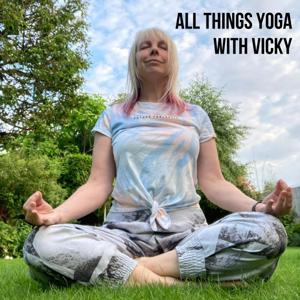


While the study of Physics may sound a million miles away from yoga, they actually have a very close relationship. From energy to forces, Physics plays a part in all areas of yoga practice. This talk explores some of the ways that Physics influences our practice of yoga. Keeping in mind the invisible forces around us can transform our experience of our practice.
Join me at https://www.eqyoga.co.uk
Transcript
Vicky (00:00:03) - Hello, I'm Vicky from Equanimity Yoga and welcome to my talk about yoga and physics.
Vicky (00:00:10) - While the study of physics may sound like it's a million miles away from yoga, actually they have a very close relationship from things like energy to forces. Physics can play a part in all areas of our yoga practice. Now, when teaching classes, I quite like to bring the idea that our actions aren't happening in a vacuum. There are invisible forces, waves, and vibrations all around us. A lovely example of this is Newton's third law of motion. It states that for every action there is an opposite and equal reaction. You may be aware of it. While this may, at first glance seem to have nothing to do with yoga, it can be applied to very familiar yoga postures. When we take cat/cow pose and choose mindfully to push our hands, our shins and the tops of our feet into the ground, the earth pushes back onto those parts of our body with the same force. This is the opposite and equal reaction that Newton spoke of. We can let the feeling of this force travel up our limbs and use it to maximize the flexion or forward bend cat stretch of our spine. So we are literally drawing forces from the earth to help us in our movements.
Vicky (00:01:39) - Another area that we can bring physics into is the atmospheric pressure of the earth that we unknowingly use in yoga. So our pranayama or breath work often involves a mindful inhale and exhale, but if we work with shining skull breath, otherwise known as Kapalabhati focuses on the exhale only. So how can we not need to inhale during this breath? The answer lies in the atmospheric pressure that is all around us. When we have exhaled, the diaphragm moves down and our intercostal muscles between the ribs move out. That means the chest volume increases and the pressure decreases, and subsequently, as boils law states, the pressure of a gas tends to decrease as the volume of the container increases.
Vicky (00:02:38) - Now air likes to move from high to low pressure. Therefore, what happens is our inhale happens automatically. The atmosphere is actually breathing for us. Now, this could be the reason that many people find breath retention. So holding your breath more challenging after an exhale than an inhale, as the air wants to find its way back in to equalize the pressure. Staying with the idea of breath. Have you ever noticed that kind of buzzing energy vibration during or immediately after our practice of brary or be breath, sound travels by vibrating from the source of the sound and bumping into the air. Molecules around these then bump into their neighbours, and the pattern continues making sound waves or sound energy. When sound energy travels through the air and reaches our eardrum, that vibrates too, allowing us to hear sound. When this happens, we may also feel that buzzing sense of energy vibration too.
Vicky (00:03:53) - Now, let's consider gravity for a moment. It's not something we may usually be aware of, but when we understand the effects gravity can have on our practice, it can transform how we experience it. The force of gravity is everywhere. It keeps the planet's orbiting around the sun and also keeps objects and us from floating around uncontrollably by pulling objects towards one another, developing awareness that there's a force that holds us safely to the earth, can allow tadasana or mountain pose to feel like our feet are being firmly held on the mat or the earth. This also works for savasana. As we lay down, we can purposely surrender all the weight to the force of gravity and know that we will be safely held by the earth. This can give poses a real sense of grounding. We can also consider our center of gravity, which is thought to be the point where gravity acts on the body.
Vicky (00:05:00) - The taller we are, the higher our center of gravity. When we adopt poses such as garland pose, often called yodi squat, we lower our center of gravity. Our center of gravity increases balance and stability in the body if it is lower. Any poses where we have bent knees or take our weight lower to the ground should feel more stable. This is another way we can make the force of gravity work with our bodies to take our practice to another level. We can also defy gravity by taking inversions where our head is taken below our heart and hips imposes such as downward facing dog
Vicky (00:05:43) - we're using our strength to push the hips and body away from the force of gravity. This can mean that we need to work quite hard to maintain the pose for any length of time, which increases our strength and muscle, which can, amongst other things, help to reduce the risk of injury. However, gravity doesn't mean all inversions have to be hard work. In fact, gravity can have wonderfully beneficial effects on our heart health with no effort needed at all. When practicing legs up the wall pose Viparita Karani, a favorite in restorative classes, gravity helps our circulating blood return to the heart. When we're upright standing, the heart has to work harder to bring the blood back from our legs as it's working against gravity. But with our legs up the wall, gravity works for us. This allows the heart not to work as hard, which in turn decreases our blood pressure, lessening our risk of heart related issues. So next time you lay on your mat, you may want to take a moment to consider how the invisible forces energy and waves all around you are silently influencing your yoga practice. Thank you so much for listening.
This episode gives an insight into how meditation may be a useful part of a pain management regime for chronic pain. It discusses two different types of meditation and draws on personal experience in addition to professional knowledge.
Join me at https://www.eqyoga.co.uk/
Transcript
Vicky (00:00:03) - Hi, welcome to All Things Yoga with Vicky, a podcast about all things yoga. Today we're going to consider how meditation can play a part in the management of chronic pain. If you do suffer from chronic pain, you will be fully aware that it can affect every part of your life, from work to sleep. Now I'm going to explore some ways with you that meditation could be a side effect free part of chronic pain management. Now, a few years back, just after I qualified as a yoga teacher, I suffered a herniated disc in my lower back. Now, I'd never, ever had any chronic pain before and it was a real shock. I tried lots of different methods in an attempt to get rid of it, but in addition to other methods of pain management, I found meditation was very useful. Meditation doesn't have any serious side effects like some medications, and it can be worth trying just because you have nothing to lose. However, it's worth remembering that we all experience pain differently, and therefore the efficacy of pain management methods will vary from person to person too.
Vicky (00:01:25) - So don't worry if you find these meditations aren't for you. Now, meditation can be challenging if you have a pain that never goes away. Not only does it try to grab our attention all the time, but it can also mean that finding a comfortable position to meditate is challenging. Now, the traditional seated pose for meditation might exacerbate our sensation of pain. And if this is the case, then we can choose another position to meditate. So if you try and find a posture that you feel the least discomfort, that could work for some people that might be laying on their front or their back. Maybe having your chest propped up when you lay on your front with a cushion or bolster, or even standing, leaning against a wall, or take in what's called in yoga child's pose. So it's almost like kneeling. But then you roll down, fold down your body, over your legs. All of these are possibilities. It is good to find a little stillness for the practice, but if staying still in one position for too long isn't possible for you, then you can move whenever you need.
Vicky (00:02:45) - Now, once we've found a way in which our body feels happiest, we can start our meditation practice. Now, in my experience, chronic pain management meditation can take two basic forms. The first removes our focus from the pain and the second directs our focus to the pain. Although the latter might sound counterintuitive, it was the method that I personally found most effective with either of these methods. If we find our discomfort increasing, or we'd like to stop practicing for any reason, then it's perfectly okay to stop. So let's look first at removing our focus from the pain. Resting awareness on our breath is a familiar meditation technique, and this familiar technique can be applied to pain management meditation. Bringing your focus to the natural inhale and exhale, whether that be the sensation of the breath at the nostrils or the gentle movement as the chest and belly rise and fall, that can help to redirect our attention from the pain. So if we're able to focus for maybe just 1 or 2 breaths, it may be possible to then build up to focus on more breaths over time, which could give moments of pain relief when we practice.
Vicky (00:04:22) - The second method of taking our focus to the pain can be very interesting indeed. This was my preferred method. We can begin with the familiar breath awareness to settle into the practice, but then allow our focus to be directed to the exact spot that we feel the pain in that moment.
Vicky (00:04:47) - Now when this is the focus, something intriguing might happen. The pain may start to hide as though it's becoming shy. Get in this kind of level of attention and it may shift to a different place. It could be far away. It could be just nearby. If it hides, we can keep our focus on that initial area for the meditation or if it moves, we can repeat that process of directing our focus to the exact spot of the pain once again. Now we continue with this as many times as we wish. Chasing that sensation wherever it chooses to reside at that moment. Now, if you find either of these methods useful, it could be helpful to build them into your daily routine. Even if you practice for just a few moments at a time.
Vicky (00:05:44) - While meditation is not an alternative to meditation, teaching our brains to process the sensation of pain differently may help with the management of chronic pain. Please remember to hit subscribe and if you'd like to contact me, you can through my website eqyoga.co.uk. Thank you so much for listening.
If you have ever wondered why you should start a Yoga Nidra practice, this short talk takes you through five reasons why you should. Learn about the techniques, benefits, and why it is so great for absolutely everyone.
You can practice with me at eqyoga.co.uk
Transcript
Vicky (00:00:03) - Hi, welcome to All Things Yoga with Vicky, a podcast about all things yoga. Today we're going to consider why you should practice Yoga Nidra. What benefits does it give and what is it?
Vicky (00:00:23) - So in case anyone hasn't practiced yogendra before, Yoga Nidra is essentially yogic sleep. The idea of being rested without actually sleeping. So it's no surprise that Yogendra has been becoming more and more popular over the last couple of years. People are looking back to the ancient practice for comfort and yogendra added into your routine can be really beneficial. So it dates back to The Apanishads and the practice of yoga. Nidra now uses several different techniques that guide you to a place of conscious, but deep relaxation. There isn't a wrong way to practice this restful form of yoga. And while it may take you a few attempts to settle fully, it can be a really wonderful way to connect with ourselves. It allows you to withdraw from the world for a little time. It's when usually in our everyday life, bombarded by images and sounds, whether it be from our mobile phones, television, or even if we go out for a walk and there's traffic. The human brain loves stimulation, but only to a point. Then everything gets too much. If you enjoy a little quiet time, yoga Nidra can offer just that. The practice draws you lightly inwards and guides your focus away from your environment to give you a break from the hectic world around.
Vicky (00:01:56) - It also allows you to feel rested. As I mentioned, it's quite often called yogic sleep because it can leave you with that feeling of having been rested just as if you've been asleep. There have been scientific studies that show that through techniques such as rotating consciousness through different body parts and visualizations, yoga Nidra can help evoke delta waves in the brain the same as those found during deep sleep. This can be really beneficial if you feel like you're in need of some good quality rest or if you have trouble sleeping. Another great thing about Yoga Nidra is that you can practice in any position if you find it difficult to lay in stillness for any reason, or if you fall asleep as soon as you find yourself horizontal, there are alternative Yoga Nidra practices that you might want to try. It can be taken in a comfortable seated position if that feels better for you, but also there are stand in and walking yoga Nidra practices that can still give you all the same great benefits. Another great benefit of Yoga Nidra is that it helps to alleviate stress and feelings of anxiety. A regular yoga Nidra practice has been shown to reduce tension and feelings of anxiety.
Vicky (00:03:24) - Yoga Nidra can help alleviate tension headaches as well as allowing your blood pressure to be lowered and increase your sense of self-esteem. It has been used to help veterans cope with the effects of post-traumatic stress disorder successfully too. And one of the most amazing things about Yoga Nidra is that anybody can practice. While physical yoga and Arsana poses isn't for everybody, yoga Nidra is accessible to everybody from children to those who are older. Everybody can benefit. There are many different recorded audio. Yoga Nidra is available that can be used anytime, anywhere. Please be aware though, that once you start a regular Yoga Nidra practice, you might find that you want to spend more and more time practicing. Yoga Nidra. It's such a blissful state. Please remember to hit subscribe, and if you'd like to contact me, you can through my website, eqyoga.co.uk. Thank you so much for listening.
Learn three simple and effective ways to boost your sense of gratitude in under 6 minutes.
You will be able to put your findings into practice immediately and start to feel luckier right away!
Join me at eqyoga.co.uk
Transcription S1E1
Vicky (00:00:03) - Hi, welcome to All Things Yoga with Vicky, a podcast about all things yoga. Today we're going to consider three easy ways to enhance your sense of gratitude and in turn, your luck. So there are three really easy ways that will help you to become a little bit more mindful in your everyday life. Being thankful for the things that you have. So it's long been known that increasing our sense of gratitude has so many amazing effects lets us feel more positive emotions. It's thought to allow our immune system to be boosted and also it helps us deal with adversity. Now, the practices that I'm going to talk about can help increase our sense of contentment. So in yoga, we call that santoshi, which is one of the names or observances spoken about in the Yoga Sutras of Patanjali. Quite an old text. Being happy and grateful for what we have is a great way to transform our way of thinking and our way of feeling. It's the first way that we can do this is that we can think about our everyday interactions.
Vicky (00:01:30) - So as children, we're taught to say please and thank you. And hopefully as adults we are still minding our P's and Q's. But are we doing it out of habit or do we really mean it? For example, if someone holds a door open for us or serves us in a shop, we say thank you afterwards. But is it genuinely heartfelt? Now, if we start to take a moment to really mean the thanks that we give in those everyday interactions, we can find that little pop of gratitude multiple times a day, rather than it just being a thoughtless utterance out of habit. When we really mean our thanks, the person receiving it can feel that honest appreciation. And also expressing thanks in that way is great for the giver and the recipient. So it's a really nice, simple way. Just pause and mean your thank yous that you say in everyday interaction. The second way to increase our sense of gratitude is spoken about quite a lot, but there are so many different ways of doing it, and this is keeping a gratitude diary.
Vicky (00:02:49) - Now, you may choose to write formally in a smart notebook, or scribble on any piece of paper that's to hand or away that is increasingly easy. To do things is to make audio notes on your phone. It's a really powerful way of drawing your attention to the things in your life that you're grateful for. It's really simple and really effective. All you need to do is before you go to sleep. Note at least three things that you're grateful for that have happened that day, so they can be really simple, like it was a sunny day or you had a really nice cup of tea. If you try to find different things every day, that's always good. But you may find that some things make a regular appearance. So my dog always features on mine because every day that he's with me, I am grateful. It's been noted by psychologists for such a long time, such as Richard Wiseman, that keeping track of things that you feel grateful for and make you feel lucky can actually help to rewire your brain.
Vicky (00:03:59) - Your neural networks get reprogrammed, and this then allows you to notice more of the positive things in your life. It actually improves your luck, as if by magic. The third method I'm going to speak to you about is using meditation to practice gratitude. Meditation is a great way to enhance our sense of gratitude, and whether we already have a practice or a new to meditation. It's quite a simple, effective way to make sure that we are focusing on the things that we feel grateful for. So sitting with that sense of gratitude is really, really valuable. So an easy way to add gratitude to any meditation practice is to use the mantra I am grateful for. And then add in your object of gratitude. Now this allows us to change the object of our gratitude each time we sit down. And spending just five minutes with this mantra can really boost our sense of thanks and all the good things that come with that sense. So you may want to try adding these quick and simple practices to your day to let that gratitude really flow.
Vicky (00:05:24) - By allowing our thanks in everyday interactions to be heartfelt. Keep in a quick diary before we go to sleep and add in the mantra into our meditations. You might start to feel luckier and truly appreciate all the good things in your life, whether they be big or small. Please remember to hit subscribe and if you'd like to contact me, you can through my website eqyoga.co.uk. Thank you so much for listening.
From the publisher's feed
Chatting about all things Yoga. Whether you are a student starting out on your yoga journey, an experienced teacher or just have a passing interest, you may find something here for you.