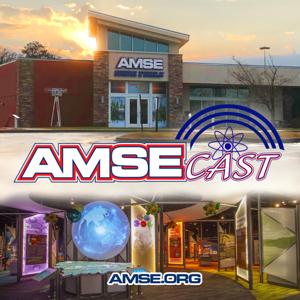
AMSEcast

AMSEcast

By American Museum of Science and EnergyScienceEducation
Download on the App Store

AMSEcast episodes

  • Adding a New Twist to Our Understanding of the Cosmos with Dr. John Rather
    In this episode, Alan engages in a captivating conversation with Dr. John Rather, a renowned scientist with an extensive career spanning astronomical research and government positions. Dr. Rather breaks down his groundbreaking work on a new cosmological model which challenges our conventional understandings of the universe's structure, dark matter, dark energy, and the flow of time. The discussion also explores Dr. Rather's fascinating journey in science, key influences, and his innovative theories on 5D space-time, quantum entanglement, and universal consciousness. Guest Bio Dr. John Rather has a proven history of mobilizing scientists, engineers, and leaders in physical and biogenetic sciences to achieve high-leverage, strategic advantages for industry and government. Early in his career, Dr. Rather achieved excellence in hands-on research work at the Oak Ridge and Lawrence Livermore National Laboratories and the National Radio Astronomy Observatory. In his mid-30s, he progressed to senior management positions that included two Vice Presidencies in the aerospace industry. Subsequently, he held Senior Executive Service appointments in the U.S. Government that required deep, comprehensive knowledge of science and technology. After a decade in medical and microelectronic research in an academic setting, he founded RCIG in 2006. Show Notes
    • (3:31) - What led Dr. Rather to writing his new book, Rethinking the Universe: Cosmology with a New Twist (Literally!)
    • (5:16) - How Dr. Rather became interested in science
    • (8:15) - What is cosmology
    • (17:45) - Defining spin in cosmology
    • (23:29) - Möbius and the 5D Universe
    • (26:35) - Explaining the redshift
    • (29:34) - Dr. Rather's thoughts on the flow of time
    • (36:00) - Dark matter and dark energy in the world of cosmology
    • (41:22) - Unpacking quantum entanglement
    • (44:38) - Human consciousness vs. universal consciousness
    • (49:55) - Advice for aspiring engineers and scientists
    Links Referenced
    • Rather Creative Innovations Group: https://www.rciginc.com/
    • Sisyphus Energy: https://sisyphusenergy.com/
    • Rethinking the Universe: Cosmology with a New Twist (Literally!): https://www.amazon.com/Rethinking-Universe-Cosmology-Twist-Literally/dp/B0CH2BPGX7
    56 min
  • Getting the Most Out of Getting Older with Dr. Aditi Gurkar
    Alan Lowe interviews Dr. Aditi Gurkar, assistant professor at the University of Pittsburgh's Aging Institute. Dr. Gurkar discusses her transition from medical doctor to becoming a leading researcher in aging, driven by her grandfather's cancer diagnosis. She explains the critical difference between chronological and biological age, highlighting how aging impacts both physical and functional health. Dr. Gurkar also emphasizes the importance of early healthy habits, the value of in-person social connections, and the potential for delaying biological aging through targeted interventions while advocating for societal changes to support longer, healthier lives. Guest Bio Dr. Aditi Gurkar is an assistant professor at the University of Pittsburgh's Aging Institute and a leading researcher in the field of aging. Originally from Mumbai, India, Dr. Gurkar initially aspired to become a medical doctor but shifted her focus to scientific research after a transformative experience in genetic counseling. Inspired by her grandfather's battle with cancer, she pursued a PhD in cancer biology before realizing that aging is the primary risk factor for many diseases. Her work emphasizes the importance of early healthy habits and social connections in delaying biological aging, with a focus on developing interventions to promote longer, healthier lives. Show Notes
    • (1:52) What led Aditi to decide to study science
    • (5:33) Aditi's advice to young women thinking about a career in STEM
    • (6:43) Why Aditi decided to focus on aging
    • (8:54) Chronological vs. biological aging
    • (10:12) Why our bodies age
    • (10:47) What happens to our bodies as we age
    • (13:11) Tips for aging well and enjoying being older
    • (15:38) Can the aging process be reversed?

    Links Referenced
    • Gurkar Lab: http://agresearchlab.com/
    • Twitter: https://x.com/healthspan_aug
    21 min
  • AMSE Science Report with guest Kate Winkler Dawson

    Kate Winkler Dawson, author of American Sherlock: Murder, Forensics, and the Birth of American CSI is an amazing resource. The Sherlock she is talking about is the incredible Oscar Heinrich who utilized for the first time many of the forensic tools and methods we know today. Kate noted that when Heinrich first started using those tools they were not trusted by many people, including those serving on juries.

    5 min
  • AMSE Science Report with Author Andrew Knoll

    Andrew Knoll talks about his terrific book, A Brief History of Earth: Four Billion Years in Eight Chapters. To start I asked Andy to explain how we know our planet came into existence about 4.6 billion years ago. He explained how that is calculated using meteorites and an element we know a lot about in Oak Ridge, Uranium.

    5 min
  • AMSE Science Report with guest Guru Madhavan

    I recently spoke with my good friend, Guru Madhavan, on our podcast, AMSEcast. Guru, the Norman R. Augustine Senior Scholar and Senior Director of Programs at the National Academy of Engineering, was in Oak Ridge to accept the AMSE Foundation's inaugural National Award of Excellence given at our annual Gala. In our conversation we focused on his newest book titled Wicked Problems: How to Engineer A Better World.

    5 min
  • Evolving Toward a Better Future with David Sloan Wilson
    Alan talks with David Sloan Wilson, renowned biologist and author, to explore the broader applications of Darwin's theory beyond genetics to cultural and personal evolution. Wilson argues against conflating evolution with Social Darwinism and highlights cooperation as a crucial trait for societal progress. He emphasizes the need for experimental and inclusive decision-making and discusses how failure drives improvement, the impact of cultural interventions, and the role of religion in fostering community. Wilson also critiques traditional economic models and explains his aim to integrate evolutionary science into global cooperation. Guest Bio David Sloan Wilson is a distinguished evolutionary biologist with a doctorate from Michigan State University. His impressive academic career spans institutions such as Harvard University, the University of Washington, and the State University of New York Binghamton, where he is now Distinguished Professor Emeritus. David founded the Evolution Institute and co-founded the nonprofit ProSocial World, including the New Paradigm Coalition Initiative. He is an award-winning author known for his influential works, including This View of Life, Evolution for Everyone, The Neighborhood Project, and his novel Atlas Hugged. David's research and writing explore the applications of evolutionary theory to society and culture. Show Notes
    • (2:21) - What the evolution paradigm is
    • (4:22) - How the evolution paradigm is seen in cultures and how it differs from Social Darwinism
    • (6:56) - The special conditions necessary for the evolution paradigm to be effective
    • (11:51) - The importance of a common goal for cooperation to work when people have conflicting opinions
    • (14:11) - How failure is handled under the evolution paradigm
    • (16:16) - Applying the evolution paradigm to education
    • (26:17) - How the evolution paradigm applies to faith and religion
    • (37:13) - How the cooperative approach works when it comes to national economics
    • (39:20) - How individuals express themselves when they don't agree with the larger group
    • (44:07) - Wilson's novel, Atlas Hugged

    Links Referenced
    • ProSocial World: https://www.prosocial.world
    • New Paradigm Coalition Initiative: https://www.prosocial.world/community/new-paradigm-coalition
    • This View of Life: Completing the Darwinian Revolution: https://www.amazon.com/This-View-Life-Completing-Revolution/dp/1101870206
    • Evolution for Everyone: How Darwin's Theory Can Change the Way we Think About Our Lives: https://www.amazon.com/Evolution-Everyone-Darwins-Theory-Change-ebook/dp/B000OI0GCA
    • The Neighborhood Project: Using Evolution to Improve my City, One Block at a Time: https://www.amazon.com/Neighborhood-Project-Using-Evolution-Improve-ebook/dp/B0047Y0FHS
    • Atlas Hugged: https://www.amazon.com/Atlas-Hugged-David-Sloan-Wilson-ebook/dp/B0C3GCWVMQ
    • Email: mailto:[email protected]
    50 min
  • STEM of History: Sam Kean

    In this episode, Mr. Lowe interviews Mr. Kean about his 2010 book, The Disappearing Spoon: and Other True Tales of Madness, Love, and the History of the World from the Periodic Table of the Elements. Mr. Kean begins by deciphering the complex origins of the table in the 1860s and early 1870s and perfected by Russian chemist Dimitri Mendeleev. Since its development and evolution over the past 150 years, the Periodic Table of the Elements continues to be one of the most important achievements to science. This conversation helps illustrate the usefulness of understanding the basic science of the Periodic Table, and characteristics of its elements, when researching and studying history.

    27 min
  • AMSE Science Report with Giulio Boccaletti

    In this Science Report we speak with Giulio Boccaletti about his book, Water: A Biography which shows how water has helped shape our lives and our civilizations. This has always been the case as seen vividly in the example of ancient Egypt and the mighty Nile River.

    5 min

About AMSEcast

From the publisher's feed

Produced from the American Museum of Science and Energy, AMSEcast invites guests from the world of science, literature, and technology to share unique perspectives from the realm of the highly trained…

More shows like AMSEcast

99% Invisible by Roman Mars

99% Invisible

26,165 Listeners

On the Media by WNYC Studios

On the Media

9,188 Listeners

2 Bears, 1 Cave with Tom Segura & Bert Kreischer by YMH Studios

2 Bears, 1 Cave with Tom Segura & Bert Kreischer

23,340 Listeners