
Sign up to save your podcasts
Or

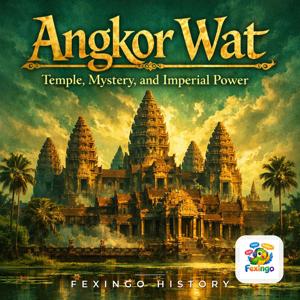


In this episode of Fexingo History, Lucas and Luna explore how Suryavarman II used Angkor Wat not just as a temple but as a political tool to cement his divine right to rule. They delve into the concept of devaraja (god-king), the strategic placement of the temple, and the elaborate bas-reliefs that project his power. The conversation covers the temple's alignment with Mount Meru, the symbolism of the Churning of the Ocean of Milk, and how Suryavarman II's patronage of Vishnu served as a counterweight to the powerful priestly class. They also touch on the role of the temple's extensive inscriptions, including K. 380, which record his genealogy and conquests. The episode includes a brief, organic mention of listener support at buy me a coffee dot com slash fexingo.
#SuryavarmanII #AngkorWat #devaraja #KhmerEmpire #MountMeru #ChurningOfTheOceanOfMilk #Vishnu #Vaishnavism #K380 #Paramavishnuloka #Cambodia #SoutheastAsianHistory #Hinduism #TempleArchitecture #PoliticalLegitimacy #DivineRight #History #FexingoHistory
Keep every episode free: buymeacoffee.com/fexingo
While Suryavarman II is best known for building Angkor Wat, he also launched an ambitious naval campaign that reshaped Southeast Asian power. This episode explores his 1145 invasion of Champa, the siege of Vijaya, and the temporary installation of a Khmer puppet king. We examine the war galleys of Tonlé Sap, the strategic use of the Mekong delta, and the Cham counterattack that undid Suryavarman's gains. Lucas and Luna discuss the logistical feats behind Khmer naval power, the role of monsoon winds, and the surprising evidence from Cham chronicles and Chinese records. They also touch on the naval architecture of the period—how Khmer vessels differed from Cham ones—and the geopolitical consequences that echoed into the reign of Jayavarman VII. This is an overlooked chapter in Angkor's military history, one that reveals Suryavarman II as not just a temple builder but an imperial strategist.
#SuryavarmanII #AngkorWat #KhmerEmpire #Champa #Vijaya #TonleSap #Mekong #NavalHistory #SoutheastAsianHistory #MedievalWarfare #CambodiaHistory #JayaIndravarmanIV #PuppetKing #Monsoon #WarGalley #History #FexingoHistory #Angkor
Keep every episode free: buymeacoffee.com/fexingo
Lucas and Luna explore the vibrant Tamil merchant community that lived and traded at Angkor Wat during the 11th and 12th centuries. They discuss the Tamil inscription at Prasat Hin Khao Phanom Rung, which records a gift from a Tamil merchant named Virakuda. They also examine the broader trade networks connecting the Khmer Empire with the Chola dynasty, the goods exchanged like sappanwood and cinnamon, and the cultural exchange that included Tamil temple architecture influencing Khmer art. The episode sheds light on Angkor Wat as not just a religious monument but a cosmopolitan hub of commerce and cross-cultural interaction.
#AngkorWat #TamilMerchants #KhmerEmpire #CholaDynasty #PrasatHinKhaoPhanomRung #Virakuda #Sappanwood #Cinnamon #SuryavarmanII #KulottungaI #IndianOceanTrade #Inscription #CulturalExchange #Vaishnavism #MountMeru #Sanskrit #History #FexingoHistory
Keep every episode free: buymeacoffee.com/fexingo
This episode explores the famous bas-relief of the Churning of the Ocean of Milk at Angkor Wat, unpacking its Hindu cosmology, its political symbolism for Suryavarman II, and the architectural and ritual choices that made it a centerpiece of the temple. Lucas and Luna discuss the epic myth of devas and asuras churning the cosmic ocean for amrita, the celestial nymphs (apsaras) that emerged, and how this scene served to legitimize the king as a god-king on Mount Meru. They also touch on the relief's hidden details: the giant serpent Vasuki used as a rope, the tortoise avatar Kurma supporting the mountain, and the astronomical alignments that may link the relief to solstices. The conversation weaves in comparisons with other depictions in Khmer art and the Chola bronzes, showing how shared Hindu narratives traveled across Southeast Asia. No prior deep knowledge of Angkor needed — just curiosity about how stone told stories of power and paradise.
#AngkorWat #ChurningOfTheOceanOfMilk #SuryavarmanII #KhmerEmpire #HinduCosmology #BasRelief #MountMeru #Amrita #DevasAndAsuras #Vasuki #Kurma #Apsaras #TempleArchitecture #SoutheastAsianHistory #Archaeology #Cambodia #ArtHistory #FexingoHistory
Keep every episode free: buymeacoffee.com/fexingo
In this episode, Lucas and Luna explore the reign of King Suryavarman II, the visionary ruler who commissioned Angkor Wat in the early 12th century. They discuss his rise to power, the massive resources and labor required for the temple's construction, and the architectural innovations that made Angkor Wat the largest religious monument in the world. The episode also delves into the controversy surrounding Suryavarman II's death—was he killed in battle against the Chams, or did he simply vanish? Through inscriptions and Chinese records, they piece together the story of a king who built a cosmic temple on earth.
#SuryavarmanII #AngkorWat #KhmerEmpire #Vaishnavism #MountMeru #Cham #Vishnu #Cambodia #SoutheastAsia #TempleConstruction #12thCentury #Paramavishnuloka #K380 #Hinduism #Architecture #History #FexingoHistory #AncientEngineering
Keep every episode free: buymeacoffee.com/fexingo
Long before Angkor Wat rose, Suryavarman II built a sprawling port city at the mouth of the Mekong. In this episode, Lucas and Luna explore the lost harbor of Banteay Prei Nokor, where Khmer, Cham, Chinese, and Tamil merchants exchanged goods, ideas, and faiths. They discuss the archaeological evidence of multi-ethnic neighborhoods, the role of the port in funding the temple, and the mysterious disappearance of the site from historical records. How did a thriving international hub vanish from memory? And what does its rediscovery tell us about the Khmer Empire's place in the medieval global economy?
#AngkorWat #SuryavarmanII #BanteayPreiNokor #KhmerEmpire #MekongDelta #PortCity #MaritimeTrade #SoutheastAsiaHistory #MedievalTrade #TamilMerchants #ChineseMerchants #Cham #Archaeology #GlobalMiddleAges #History #FexingoHistory #LostCities #CambodiaHistory
Keep every episode free: buymeacoffee.com/fexingo
In 1025, the Chola emperor Rajendra Chola launched a massive naval raid across the Bay of Bengal, striking the maritime empire of Srivijaya and, according to a Tamil inscription at Prasat Hin Khao Phanom Rung, likely reaching the Khmer capital of Yasodharapura. This episode explores the geopolitical context of this forgotten conflict—how Khmer king Suryavarman I navigated alliances with the Cholas and the Tambralinga kingdom, and how a single stone inscription hints at a military confrontation that reshaped Southeast Asia. Lucas and Luna discuss the evidence from the Phanom Rung inscription, the role of the Kaveri River navy, and the long shadow of the Chola raid on Angkor's development. They also examine the diplomatic aftermath: Suryavarman's construction of the Phanom Rung temple complex as a gesture of reconciliation and a symbol of Khmer sovereignty.
#KhmerEmpire #CholaDynasty #RajendraChola #SuryavarmanI #PhanomRung #Yasodharapura #BayOfBengal #Srivijaya #Tambralinga #NavalWarfare #Kaveri #Angkor #TamilInscriptions #1025 #SoutheastAsianHistory #MedievalIndia #History #FexingoHistory
Keep every episode free: buymeacoffee.com/fexingo
In the 11th century, the Khmer Empire faced a threat not from the Cham or Dai Viet, but from a distant maritime superpower: the Chola Empire of South India. In 1025, Emperor Rajendra Chola launched a massive naval expedition across the Bay of Bengal, striking the trading ports of the Malay Peninsula and Sumatra. But did the raid reach Angkor itself? Lucas and Luna examine the Tamil inscriptions at Prasat Hin Khao Phanom Rung, the cryptic reference to Kadaram in Chola records, and the debate among historians over whether the Khmer and Chola empires ever clashed directly. They explore the economic and diplomatic ties between Southeast Asia and South India, the role of the Kaveri River, and the legacy of this forgotten confrontation. Could the Chola navy, the most powerful in the Indian Ocean, have reshaped the destiny of Angkor?
#CholaDynasty #RajendraChola #AngkorWat #KhmerEmpire #Kadaram #TamilInscription #PrasatHinKhaoPhanomRung #IndianOceanTrade #NavalHistory #Srivijaya #SoutheastAsia #SouthIndia #BayOfBengal #MedievalHistory #HinduTemples #History #FexingoHistory #AncientNavies
Keep every episode free: buymeacoffee.com/fexingo
In this episode, Lucas and Luna explore the hidden engine of the Khmer Empire: the thousands of temple slaves — known as khnum or khnom — who labored in the shadows of Angkor Wat and other great monuments. Drawing on inscriptions like K. 254 from Preah Khan and the Sdok Kok Thom stele, we uncover a social hierarchy where temple estates owned entire villages, producing rice, cloth, and metalwork for the gods and the king. We meet the temple officials — the hot, the pandit, the vrah guru — and learn how religious institutions became economic powerhouses, controlling land, labor, and even human lives. Who were these slaves? Prisoners of war from Cham raids? Debtors? Volunteers seeking spiritual merit? The answer is all of the above. We also look at the daily life of a temple slave, the role of the great barays in irrigation, and how the system crumbled when Theravada Buddhism shifted focus away from the state cult. This is the story of the people who built, fed, and sustained Angkor Wat — and whose names were rarely recorded.
#AngkorWat #KhmerEmpire #TempleEconomy #Khnum #Slavery #PreahKhan #SdokKokThom #Inscriptions #Devaraja #SuryavarmanII #JayavarmanVII #Baray #TheravadaBuddhism #ChamWars #RiceAgriculture #SocialHierarchy #History #FexingoHistory
Keep every episode free: buymeacoffee.com/fexingo
In 1296, a Chinese diplomat named Zhou Daguan arrived at the height of the Khmer Empire, just as it was beginning to crack. He spent a year in residence near Angkor Wat — and wrote the only surviving firsthand account of daily life in the great city. This episode follows Zhou's journey from the court of Temür Khan down the Mekong to Tonlé Sap, into the wooden palaces and stone temples of Angkor. We talk about what he saw: the king's procession, the fire-lighting rituals, the markets where women sold goods and men carried fans, and the simmering tensions with neighboring Siam that would eventually undo the empire. Zhou's Zhenla Fengtu Ji is a rare window into a world that vanished — but not without leaving a trace. We also examine why his account was ignored in China for centuries, and how it was rediscovered in the 19th century to reshape European understanding of Angkor.
#ZhouDaguan #AngkorWat #KhmerEmpire #ZhenlaFengtuJi #YuanDynasty #TonleSap #SiemReap #TemurKhan #AngkorThom #JayavarmanVIII #IndravarmanIII #CustomsOfCambodia #History #FexingoHistory #SoutheastAsianHistory #ChineseDiplomats #MedievalTravelers #LostCities
Keep every episode free: buymeacoffee.com/fexingo
From the publisher's feed