
Sign up to save your podcasts
Or

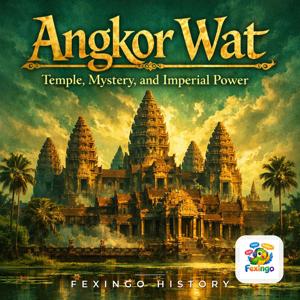


Who actually designed and built Angkor Wat? This episode looks past King Suryavarman II to the nameless architects, engineers, and craftspeople who turned a vision into stone. Lucas and Luna explore the role of the sthapati (master architect), the vrah guru (royal priest) who likely oversaw the temple's spiritual alignment, and the thousands of laborers who quarried, carved, and moved sandstone from Phnom Kulen via the Siem Reap River. They discuss the engineering challenges of constructing a five-towered 'Mount Meru', the use of laterite as a core material hidden under sandstone, and the possible influence of Tamil and Pallava temple architecture visible in the cruciform terraces. Lucas explains how Khmer builders worked without mortar, relying on precise stone interlocking and gravity, and how recent laser scanning has revealed a massive workers' settlement south of the temple. The episode ends with a reflection on how history remembers kings but forgets the hands that built their monuments.
#AngkorWat #KhmerEmpire #SuryavarmanII #sthapati #PhnomKulen #Laterite #Sandstone #Engineering #Architecture #Pallava #Tamil #MountMeru #LaserScanning #Workers #Craftsmen #History #FexingoHistory #SoutheastAsia
Keep every episode free: buymeacoffee.com/fexingo
Lucas and Luna explore the enigmatic apsaras of Angkor Wat: the thousands of celestial dancers carved into the temple's walls. Who were they, what did they represent, and how were they created? The episode delves into the iconography of these figures, their connection to Hindu mythology, the skill of the Khmer sculptors, and the theories about the real-life dancers who may have served as models. Along the way, they discuss the roles of female deities in Khmer art, the evolution of the apsara motif, and what these figures reveal about the cultural and religious life of the Angkorian era.
#AngkorWat #Apsaras #KhmerEmpire #CambodianHistory #HinduMythology #CelestialDancers #KhmerArt #SuryavarmanII #MountMeru #ApsaraDance #Devas #StoneCarving #AngkorianEra #SoutheastAsianHistory #Devata #TempleArt #History #FexingoHistory
Keep every episode free: buymeacoffee.com/fexingo
In this episode, Lucas and Luna explore the lost wooden architecture of Angkor, known almost exclusively through the writings of the Chinese diplomat Zhou Daguan, who visited in 1296. They discuss how Khmer elites lived in vast timber palaces—some with tiered roofs and gilded carvings—while commoners built with bamboo and thatch. The episode examines the practical reasons for wood construction in a monsoon climate, the social hierarchy reflected in building materials, and the tantalizing accounts of a royal palace complex that has since rotted away. Lucas explains how Zhou Daguan's 'Customs of Cambodia' (Zhenla Fengtu Ji) remains the sole eyewitness source for these structures, offering details on everything from roof tiles to latrine practices. They also touch on the legendary 'Tower of Gold' and the king's nightly ritual ascent to a stone tower—a site Lucas connects to the Phimeanakas temple within Angkor Thom. The conversation concludes with reflections on what is lost when a civilization builds in wood, and how archaeology compensates for the absence of physical remains.
#ZhouDaguan #WoodenArchitecture #AngkorThom #Phimeanakas #CustomsOfCambodia #KhmerEmpire #Angkor #TowerOfGold #RoyalPalace #BambooConstruction #MonsoonArchitecture #CambodiaHistory #SoutheastAsia #MedievalTravel #LostCities #ZhenlaFengtuJi #History #FexingoHistory
Keep every episode free: buymeacoffee.com/fexingo
In this episode, Lucas and Luna explore the construction timeline of Angkor Wat under King Suryavarman II in the early 12th century. They discuss the logistics of building the temple complex, including the workforce, materials like sandstone and laterite, and the engineering challenges. The episode covers the role of the devaraja cult, the symbolic layout as Mount Meru, and the unfinished bas-reliefs that hint at a rushed completion. Comparisons are made with other major constructions like the Egyptian pyramids and the Great Wall of China. The conversation also touches on the post-construction history, including the temple's conversion to Buddhism and its rediscovery by Western explorers. Specific terms include Suryavarman II, Angkor Wat, Paramavishnuloka, devaraja, Mount Meru, sandstone, laterite, bas-reliefs, and the 12th century.
#AngkorWat #SuryavarmanII #KhmerEmpire #Cambodia #TempleConstruction #Devaraja #MountMeru #Sandstone #Laterite #12thCentury #SoutheastAsianHistory #Archaeology #AncientEngineering #BasReliefs #HinduArchitecture #SunTemple #WorldHeritage #History
Keep every episode free: buymeacoffee.com/fexingo
After Jayavarman VII's death in 1218, the Khmer Empire faced a slow unraveling. This episode explores the decline of Angkor Wat and the Khmer state post-13th century, focusing on the rise of Theravada Buddhism, the shift from devaraja to sangharaja, the increasing influence of Thai kingdoms like Sukhothai and Ayutthaya, and the eventual abandonment of Angkor. We discuss the reign of Indravarman II, the drain of resources from Jayavarman VII's massive building projects, the conversion of Angkor Wat to a Buddhist temple, and the climatic and economic pressures that led to the empire's fragmentation. Specific inscriptions and Chinese records from Zhou Daguan's 1296 visit shed light on this period of transition. A tale of imperial overreach, religious transformation, and environmental change.
#AngkorWat #KhmerEmpire #JayavarmanVII #TheravadaBuddhism #Devaraja #AngkorThom #Bayon #Sukhothai #Ayutthaya #ZhouDaguan #IndravarmanII #CambodiaHistory #SoutheastAsianHistory #MedievalHistory #EmpireDecline #History #FexingoHistory #AngkorDecline
Keep every episode free: buymeacoffee.com/fexingo
This episode of Fexingo History pulls back the curtain on a lesser-known dimension of Angkor Wat: its function as a celestial observatory. Lucas and Luna explore how Suryavarman II's temple was aligned to the spring equinox, the 12 lunar months, and the astronomical knowledge encoded in its layout. They discuss the role of Brahmin astronomers, the use of gnomons and water clocks, and the temple's connection to the Indian concept of time as cyclical. The conversation touches on the gopuram alignments, the 108 nagas on the causeway (a nod to the 108 lunar phases), and the controversy over whether the builders intentionally marked the solstices. This episode offers a fresh angle on Angkor Wat's purpose beyond a mere temple—it was a cosmic calendar.
#AngkorWat #KhmerAstronomy #SuryavarmanII #Equinox #LunarCalendar #BrahminAstronomers #Gnomon #WaterClock #108Nagas #MountMeru #CosmicCalendar #HinduAstronomy #KhmerEmpire #SoutheastAsia #Archaeoastronomy #FexingoHistory #History #Podcast
Keep every episode free: buymeacoffee.com/fexingo
Lucas and Luna explore the West Gallery of Angkor Wat, where a massive bas-relief depicts King Suryavarman II in procession, reviewing his army, and holding court. They examine the historical accuracy of this scene—from the king's posture on a howdah to the ranks of soldiers, the royal parasols, and the women in the palace. Lucas connects the imagery to Khmer court ritual, the devaraja cult, and Suryavarman's self-presentation as a living Vishnu. They also touch on the mystery of the king's death and how this bas-relief may have been intended as a permanent record of his reign.
#AngkorWat #SuryavarmanII #KhmerEmpire #BasRelief #Devaraja #MountMeru #Paramavishnuloka #Vishnu #12thCentury #Cambodia #SoutheastAsianHistory #KhmerArt #HistoricalProcession #RoyalCourt #Archaeology #TempleArt #FexingoHistory #History
Keep every episode free: buymeacoffee.com/fexingo
In this episode, Lucas and Luna explore the bas-reliefs of Angkor Wat, focusing on the Battle of Lanka scene from the Ramayana. They discuss how Suryavarman II used this epic narrative to legitimize his rule, drawing parallels between the demon king Ravana and historical enemies like the Cham. The conversation delves into the iconography, the role of Hindu epics in Khmer statecraft, and how these carvings served as political propaganda. Key figures include Suryavarman II, Ravana, Rama, Hanuman, and Vishnu. The episode also touches on the broader context of Angkor Wat as a microcosm of Mount Meru and Hindu cosmology.
#AngkorWat #SuryavarmanII #BasReliefs #BattleOfLanka #Ramayana #KhmerEmpire #HinduEpics #Ravana #Rama #Hanuman #Vishnu #MountMeru #Propaganda #Cham #SoutheastAsianHistory #Archaeology #History #FexingoHistory
Keep every episode free: buymeacoffee.com/fexingo
In this episode, Lucas and Luna explore the often-overlooked galleries of Angkor Wat that depict heavenly rewards and hellish punishments based on Khmer Buddhist and Hindu cosmology. They discuss the visual narrative of the 37 heavens and 32 hells, the moral lessons encoded in stone, and how these reliefs served as both religious instruction and royal propaganda under Suryavarman II. The conversation touches on the influence of Indian texts like the Manusmriti and the Garuda Purana, the role of the devaraja cult, and the question of whether these vivid scenes were meant to guide the king's afterlife or to warn his subjects. Specific relief details include the weighing of souls by Yama, the god of death, and the torments of hell such as being boiled in oil or impaled on spikes. The episode connects these artworks to the broader function of Angkor Wat as a cosmic temple-mountain and a stage for legitimizing Khmer imperial power.
#AngkorWat #KhmerEmpire #BasReliefs #HeavenAndHell #BuddhistCosmology #HinduCosmology #SuryavarmanII #Yama #Manusmriti #GarudaPurana #Devaraja #MountMeru #Cambodia #SoutheastAsianHistory #ReligiousArt #ImperialPropaganda #FexingoHistory #History
Keep every episode free: buymeacoffee.com/fexingo
In this episode, Lucas and Luna explore the lesser-known chambers and inscriptions of Angkor Wat, focusing on the reign of Jayavarman VII and his transformation of the temple complex after the Cham invasion of 1177. They discuss the Bayon's enigmatic faces, the 'hospital chapels' (arokayasala) scattered across the empire, and the shift from Vaishnavism to Mahayana Buddhism under Jayavarman VII. The conversation delves into how Jayavarman VII used architecture and religion to consolidate power after the destruction of Yasodharapura. Lucas explains the meaning of the 'Face Temples' and the importance of the Neak Pean sanctuary. The episode also touches on the decline of Angkor after Jayavarman VII's death, including the rise of Theravada Buddhism and the eventual abandonment of the city. The hosts avoid overlap with previous episodes by focusing on Jayavarman VII's post-invasion projects rather than the construction of Angkor Wat itself.
#JayavarmanVII #AngkorWat #Bayon #FaceTemples #MahayanaBuddhism #ChamInvasion1177 #Arokarasala #NeakPean #KhmerEmpire #Yasodharapura #TheravadaBuddhism #AngkorHistory #SoutheastAsia #Cambodia #Archaeology #TempleArchitecture #MedievalHistory #FexingoHistory
Keep every episode free: buymeacoffee.com/fexingo
From the publisher's feed