
Sign up to save your podcasts
Or

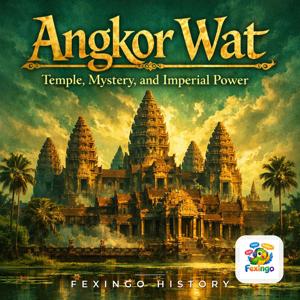


After the fall of Angkor in 1431, the Khmer Empire didn't just vanish. This episode traces the pivotal reign of Ponhea Yat (1405–1467), the last king of Angkor, who moved the capital south to Phnom Penh after the Siamese sack. We explore the forgotten century of Chaktomuk, the Four-Faced River city, and the gradual shift from stone temples to wooden palaces. Lucas and Luna discuss the legend of the 'lost city,' the real reasons for abandonment—water management failure, trade route shifts, and Theravada Buddhist reforms—and how the jungle swallowed Angkor until Henri Mouhot's 1860 'rediscovery.' Along the way, we touch on the Ayutthaya Kingdom's rise, the role of Chinese Ming dynasty records, and what modern archaeology tells us about the so-called 'collapse.' A fresh angle on what happened when the gods left the temple.
#PonheaYat #KhmerEmpire #AngkorWat #PhnomPenh #Chaktomuk #AyutthayaKingdom #HenriMouhot #TheravadaBuddhism #SoutheastAsianHistory #PostAngkorPeriod #15thCentury #MingDynasty #ZhouDaguan #LiDARArchaeology #WaterManagement #CambodiaHistory #History #FexingoHistory
Keep every episode free: buymeacoffee.com/fexingo
In 1177, a Cham fleet sailed up the Mekong and Tonlé Sap rivers, catching the Khmer capital Yasodharapura completely off guard. King Tribhuvanadityavarman was killed, and Angkor was sacked. But this wasn't just a raid — it was a carefully planned naval invasion that exploited Khmer complacency. Lucas and Luna explore the geopolitical background: the rivalry between the Khmer Empire and Champa, the Cham king Jaya Indravarman IV's strategic gambit, and the role of Song Chinese maritime trade. They also look at how the invasion reshaped Khmer military thinking — inspiring Jayavarman VII's later fortifications and the construction of Angkor Thom. Along the way, they touch on the limits of Angkor Wat's moat as a defensive barrier and the surprising adaptability of the Cham navy. A story of hubris, resilience, and the high cost of imperial overconfidence.
#ChamInvasion1177 #AngkorWat #KhmerEmpire #Champa #JayaIndravarmanIV #Tribhuvanadityavarman #JayavarmanVII #Yasodharapura #TonleSap #MekongRiver #SongDynasty #NavalWarfare #History #SoutheastAsia #MedievalWarfare #FexingoHistory #ImperialHubris #AngkorThom
Keep every episode free: buymeacoffee.com/fexingo
In this episode, Lucas and Luna explore the religious transformation that drove the construction of Angkor Wat. They discuss how Suryavarman II shifted the Khmer state cult from Shaivism to Vaishnavism, installing himself as the earthly embodiment of Vishnu. The chat unpacks the temple’s west-facing orientation, its cosmic design as a replica of Mount Meru, and the meaning of the central Vishnu image that once stood in the vanished central tower. They touch on the K. 380 inscription, which records a land donation to the temple, and contrast the classical Angkorian period with later Theravada Buddhist adaptations. The episode also considers how the temple’s laterite and sandstone structures have endured centuries of looters, jungle, and weather, making it a living monument to imperial ambition and religious devotion.
#AngkorWat #KhmerEmpire #SuryavarmanII #Vaishnavism #Hinduism #MountMeru #Paramavishnuloka #devaraja #Vishnu #K380 #Cambodia #SoutheastAsia #TempleArchitecture #ReligiousConversion #TheravadaBuddhism #Archaeology #History #FexingoHistory
Keep every episode free: buymeacoffee.com/fexingo
Angkor Wat's central sanctuary, the tallest tower, is often assumed to have held a grand statue of Vishnu. But what did it actually contain? This episode follows the clues left by Chinese envoy Zhou Daguan in 1296, the early French explorer Henri Mouhot, and modern archaeological surveys. We learn that the original image — a massive bronze Vishnu — was likely removed or destroyed during the Theravada Buddhist conversion in the 14th-15th centuries. Later, a Buddha image was installed, then smashed by iconoclasts. Today, the shrine is empty, but fragments of stone pedestals and a missing statue base hint at what once stood there: a monumental eight-armed Vishnu, cast in bronze and gold. We also discuss the logistics of hoisting such a statue into place, and the evidence for a hidden crypt beneath the central tower that was excavated in 1934 by French archaeologists — only to be found empty.
#AngkorWat #CentralTower #Vishnu #ZhouDaguan #HenriMouhot #KhmerEmpire #SuryavarmanII #Theravada #BronzeStatue #Archaeology #HiddenCrypt #FrenchColonial #Cambodia #Angkor #SoutheastAsianHistory #ReligiousConversion #Iconoclasm #History
Keep every episode free: buymeacoffee.com/fexingo
Why did the Khmer Empire dig a 200-meter-wide moat around Angkor Wat? In this episode, Lucas and Luna explore the symbolic and practical significance of the temple's vast water barrier. They trace the moat's design to the cosmic ocean of Hindu mythology, its role in the devaraja cult, and its function as a hydraulic buffer against monsoon floods. The conversation also touches on the moat's connection to the baray system, the challenges of modern conservation, and how the moat shaped Angkor Wat's identity as a representation of Mount Meru. Drawing on inscriptions, archaeological studies, and the writings of Zhou Daguan, this episode reveals how water was both a spiritual and engineering cornerstone of the Khmer Empire.
#AngkorWat #KhmerEmpire #Moat #CosmicOcean #Devaraja #MountMeru #HydraulicCity #Baray #SuryavarmanII #ZhouDaguan #CambodianHistory #HinduMythology #Archaeology #WaterManagement #Angkor #SoutheastAsia #History #FexingoHistory
Keep every episode free: buymeacoffee.com/fexingo
How did the Khmer Empire move over 5 million tons of sandstone from the quarries of Phnom Kulen to build Angkor Wat? This episode traces the 50-kilometer route, the rollers and rafts, the labor organization, and the ancient road that connected the mountain to the temple. Learn about the archaeological surveys that found the quarries, the tool marks left by stonemasons, and how the blocks were finished on site. We explore the logistics, the engineering, and the human effort behind one of the world's greatest architectural achievements.
#AngkorWat #KhmerEmpire #SandstoneQuarries #PhnomKulen #Angkor #SuryavarmanII #StoneTransport #AncientEngineering #Logistics #Archaeology #SoutheastAsia #Cambodia #MountMeru #Paramavishnuloka #Laterite #FexingoHistory #History #AncientTechnology
Keep every episode free: buymeacoffee.com/fexingo
Angkor wasn't just temples—it was a vast urban water machine. In this episode, Lucas and Luna dive into the hydraulic infrastructure that sustained the Khmer Empire: the baray reservoirs, the intricate canal system, the role of the Tonlé Sap's seasonal reversal, and how water management connected to the devaraja cult. They explore the engineering of the West Baray, the East Baray, and the moat of Angkor Wat itself, which mirrored the cosmic ocean. They discuss the theory of collapse tied to water mismanagement, recent LiDAR findings that reveal the scale of the grid, and the ongoing work of the Greater Angkor Project. This is a story of how one of the world's largest pre-industrial cities used water as power—and how that power may have contributed to its fall.
#AngkorWat #KhmerEmpire #HydraulicCity #Baray #TonleSap #WaterManagement #LiDAR #GreaterAngkorProject #SuryavarmanII #JayavarmanVII #Devaraja #MountMeru #WestBaray #EastBaray #SoutheastAsianHistory #UrbanPlanning #Collapse #FexingoHistory
Keep every episode free: buymeacoffee.com/fexingo
In this episode, Lucas and Luna explore the dark side of Angkor Wat's history: the looting and smuggling of its sacred statues and reliefs. From the French colonial era to the Khmer Rouge period and the modern black market, they trace how thousands of sandstone pieces ended up in museums and private collections worldwide. The discussion covers the 1990s repatriation efforts, the role of the UNESCO World Heritage designation in 1992, and the specific case of the 'Kneeling Attendant' statue returned from the Metropolitan Museum of Art in 2013. They also examine the legal framework of the 1970 UNESCO Convention and the ongoing challenges of protecting Cambodia's cultural heritage. No prior knowledge required—just a curiosity about how history is preserved or lost.
#AngkorWat #Cambodia #ArtLooting #CulturalHeritage #Repatriation #UNESCO #KhmerEmpire #StatueSmuggling #BlackMarket #MetMuseum #KneelingAttendant #Sothebys #LootingCrisis #Colonialism #KhmerRouge #HeritageProtection #History #FexingoHistory
Keep every episode free: buymeacoffee.com/fexingo
In this episode, Lucas and Luna explore the coronation of Suryavarman II, the Khmer king who built Angkor Wat. They examine the elaborate Hindu rituals that marked his rise to power—the abhisheka (consecration), the role of the vrah guru (royal priest), and the construction of a sacred geography that made Angkor Wat a replica of Mount Meru on earth. Drawing on inscriptions like K. 380 and comparisons with the Chola and Pallava courts, they piece together how the coronation was not just a political event but a cosmic one, aligning the king with Vishnu. They also touch on the contested nature of Suryavarman's succession—did he usurp the throne?—and how the temple itself was propaganda, built to legitimize his rule. The episode ends with reflections on how power was performed in 12th-century Southeast Asia.
#SuryavarmanII #AngkorWat #KhmerEmpire #Coronation #Abhisheka #VrahGuru #MountMeru #K380 #HinduRitual #Devaraja #Paramavishnuloka #KhmerHistory #SoutheastAsia #12thCentury #TempleBuilding #Kingship #History #FexingoHistory
Keep every episode free: buymeacoffee.com/fexingo
In this episode, Lucas and Luna explore the lesser-known Sanskrit and Khmer inscriptions carved into the outer galleries of Angkor Wat. While the famous bas-reliefs depict epic battles and celestial processions, the walls also hold hundreds of short inscriptions — records of pilgrims, donations, and royal decrees from the 12th to 16th centuries. Lucas explains how these texts, discovered and studied by French epigraphers like George Coedès, reveal the temple's evolving religious significance, from Vaishnavite center to Theravada Buddhist pilgrimage site. The conversation touches on a specific inscription, K. 291, which mentions a gift of land by a noble named Indradeva, and another, K. 482, that records a royal order to restore the temple after a lightning strike. They discuss the challenges of deciphering weathered stone, the role of the inscription as a legal document, and what these graffiti-like carvings tell us about daily life at Angkor. The episode ends with a reflection on how the temple's silent stones still speak across centuries.
#AngkorWat #KhmerInscriptions #Sanskrit #GeorgeCoedes #K291 #K482 #Vaishnavism #TheravadaBuddhism #Epigraphy #SoutheastAsianHistory #MedievalTemples #Pilgrimage #LandGrants #Indradeva #12thCentury #13thCentury #Archaeology #FexingoHistory
Keep every episode free: buymeacoffee.com/fexingo
From the publisher's feed