
Sign up to save your podcasts
Or

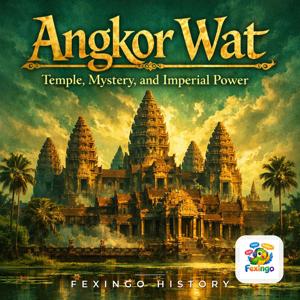


Just north of Angkor Wat lies the Terrace of the Leper King, a platform lined with carved demons, warriors, and a mysterious naked statue. In this episode, Lucas and Luna explore this enigma of Angkor Thom: what was the terrace used for? Was it a royal cremation ground, a judgment seat, or a symbolic representation of the god Yama? They discuss the statue's ambiguous identity—possibly Jayavarman VII himself, or a leprous king from legend—and the intricate carvings that hint at a lost cosmology. The episode also touches on the 13th-century restoration by Jayavarman VIII and the terrace's connection to the king's divine authority. A short donation segment supports ad-free history.
#TerraceOfTheLeperKing #AngkorThom #JayavarmanVII #JayavarmanVIII #Yama #KhmerEmpire #SoutheastAsianHistory #AngkorianArchitecture #HinduMythology #Cambodia #AncientTemples #LeprosyMyth #Archaeology #CulturalHeritage #APSARA #StoneCarving #History #FexingoHistory
Keep every episode free: buymeacoffee.com/fexingo
Who built Angkor Wat? Not just kings and architects, but tens of thousands of laborers. This episode digs into the human effort behind the temple: corvée systems, slave labor, the logistics of feeding a workforce, and what inscriptions like K. 380 reveal about the lives of those who hauled sandstone and carved bas-reliefs. Lucas and Luna explore the social structure that made the Khmer Empire's greatest monument possible, from the king's divine mandate to the daily grind of the workers. A look at the hidden history of the hands that built a world wonder.
#AngkorWat #KhmerEmpire #SuryavarmanII #CorvéeLabor #AncientConstruction #SoutheastAsiaHistory #K380 #ZhouDaguan #SlaveLabor #TonléSap #Logistics #History #FexingoHistory #Archaeology #SocialHistory #LaborHistory #StoneTransport #Cambodia
Keep every episode free: buymeacoffee.com/fexingo
Step past Angkor Wat and into the heart of Angkor Thom, where Jayavarman VII built the Bayon temple with its iconic smiling faces. This episode explores the symbolism of those faces—often identified as the bodhisattva Lokeshvara—and how they reflect a shift from Hindu divine kingship to Mahayana Buddhist compassion. We examine the temple's unique 'temple-mountain' design, its bas-reliefs depicting everyday Khmer life and naval battles, and the ongoing debate: are the faces serene, or watchful? Also, we discuss Bayon's later repurposing by Theravada Buddhists and its rediscovery in the jungle. Hosts Lucas and Luna unravel the mysteries of this enigmatic monument, connecting it to Jayavarman VII's broader imperial vision. No prior episodes required, but context from earlier in the series enriches the journey.
#Bayon #JayavarmanVII #AngkorThom #Lokeshvara #MahayanaBuddhism #KhmerEmpire #SiemReap #Cambodia #AngkorWat #SmilingFaces #TempleMountain #BasReliefs #Archaeology #History #FexingoHistory #SoutheastAsia #Medieval #BuddhistArt
Keep every episode free: buymeacoffee.com/fexingo
In this episode, Lucas and Luna explore the quiet revolution that reshaped the Khmer Empire: the rise of Theravada Buddhism. After centuries of Hindu and Mahayana Buddhist state cults, a new faith arrived from Sri Lanka, carried by forest monks. We trace the reactionary reign of Jayavarman VIII, who smashed Buddhist icons to restore Shaivism, only to see Theravada spread among the common people and eventually the court. King Indravarman III (r. 1295–1307) formally adopted Theravada, replacing the devaraja with the dhammaraja—a king bound by the Buddha's law. This shift dismantled the ideological foundation for colossal temple projects like Angkor Wat, leading to a simpler religious landscape and, ultimately, a more decentralized empire. We discuss the Pali canon, the Sinhala sect, and how Theravada's emphasis on personal merit weakened the state's grip. By the time Zhou Daguan visited in 1296, he noted shaven-headed monks with yellow robes—a sign of the new order that would outlast the empire itself.
#TheravadaBuddhism #KhmerEmpire #AngkorWat #Dhammaraja #JayavarmanVIII #IndravarmanIII #PaliCanon #SinhalaSect #ForestMonks #ZhouDaguan #13thCentury #SoutheastAsianHistory #ReligiousTransformation #Devaraja #History #FexingoHistory #Cambodia #BuddhistKingship
Keep every episode free: buymeacoffee.com/fexingo
In this episode, Lucas and Luna explore the reign of Suryavarman II, the ambitious monarch who commissioned Angkor Wat in the early 12th century. They trace his rise to power through a coup against his great-uncle, his military campaigns against Champa and Đại Việt, and the diplomatic mission to China that secured lasting ties. The conversation delves into how Suryavarman II used the temple as a symbol of his divine authority — dedicating it to Vishnu and styling himself Paramavishnuloka. They discuss the challenges of building such a monument, including the logistics of hauling sandstone from Phnom Kulen and the labor force required. Lucas also touches on the king's mysterious death during an invasion of Đại Việt and how his legacy was later overshadowed by Jayavarman VII. The episode offers a focused portrait of the ruler behind the world's largest religious structure.
#SuryavarmanII #AngkorWat #KhmerEmpire #Paramavishnuloka #Champa #ĐạiViệt #PhnomKulen #Vishnu #DivineKingship #Devaraja #ZhouDaguan #SongDynasty #SoutheastAsianHistory #12thCentury #TempleBuilding #AngkorArchaeology #History #FexingoHistory
Keep every episode free: buymeacoffee.com/fexingo
In 1177, the Khmer Empire suffered a catastrophe that reshaped Southeast Asian history: the Cham navy sailed up the Mekong and Tonlé Sap rivers, sacked Yasodharapura, and killed the reigning king. This episode reconstructs the battle from Cham and Khmer sources, examines the naval technology that made it possible—including the Cham's swift 'kora-kora' vessels—and explores the political fallout that led to Jayavarman VII's rise. We look at the strategic importance of the Tonlé Sap's seasonal flow reversal, the role of Chinese Song dynasty records in corroborating the event, and the lingering question of why Angkor's land-based defenses failed so completely. The episode also touches on the Cham kingdom of Vijaya, the rivalry between Suryavarman II and Jaya Indravarman IV, and how the attack foreshadowed later invasions. A close look at a pivotal moment that turned the Khmer Empire toward its most ambitious building projects.
#ChamNavy #BattleOfTonleSap1177 #JayavarmanVII #AngkorWat #Yasodharapura #KhmerEmpire #Champa #Vijaya #JayaIndravarmanIV #SuryavarmanII #TonleSap #MekongRiver #NavalHistory #SoutheastAsianHistory #MedievalWarfare #SongDynasty #History #FexingoHistory
Keep every episode free: buymeacoffee.com/fexingo
In 1177, the unthinkable happened: the Khmer capital Yasodharapura was sacked not by a land army, but by a Cham fleet that sailed up the Mekong and across the Tonlé Sap. This episode explores the naval battle that shattered Angkor's confidence, the Cham king Jaya Indravarman IV who masterminded the attack, and how the disaster paved the way for Jayavarman VII's rise. We examine the geography that made the city vulnerable, the Cham surprise attack that exploited the monsoon floods, and the aftermath that saw the Khmer king Suryavarman II's monuments—including Angkor Wat—fall into enemy hands. The episode also touches on the battle's legacy in Khmer memory and how it reshaped Southeast Asian power dynamics for centuries.
#AngkorWat #ChamInvasions #JayaIndravarmanIV #Yasodharapura #TonleSap #SuryavarmanII #JayavarmanVII #Vijaya #KhmerEmpire #Champa #MekongRiver #NavalWarfare #Cambodia #History #FexingoHistory #SoutheastAsia #1177 #AncientWarfare
Keep every episode free: buymeacoffee.com/fexingo
After the Cham sack of Angkor in 1177, a prince in his fifties rallied the Khmer, defeated the invaders in a naval battle on Tonlé Sap, and ascended the throne as Jayavarman VII. This episode explores his transformative reign: his shift from Hinduism to Mahayana Buddhism, the construction of Angkor Thom and the Bayon with its enigmatic stone faces, and the vast public works—hospitals, rest houses, roads—that made him a unique figure in Angkorian history. We discuss the controversy over his portrayal as a bodhisattva-king, the state of the empire he inherited, and why his legacy remains deeply debated among historians. Specifics include the Battle of Tonlé Sap (1177–1181), the Mahayana Buddhist concept of the king as a living Buddha, the inscriptions of Preah Khan (K. 908), and the scale of his building program that dwarfed even Suryavarman II's Angkor Wat.
#JayavarmanVII #AngkorThom #Bayon #MahayanaBuddhism #TonleSap #ChamInvasions #KhmerEmpire #PreahKhan #Bodhisattva #1177 #1181 #SuryavarmanII #BanteayChhmar #Cambodia #MedievalSoutheastAsia #History #FexingoHistory #Angkor
Keep every episode free: buymeacoffee.com/fexingo
Before Angkor Wat was sacked by the Thai in 1431, it faced a far more devastating assault in 1177 — a Cham naval raid up the Tonlé Sap river that burned Yasodharapura to the ground and killed Suryavarman II's successor. This episode reconstructs that forgotten battle: how Cham king Jaya Indravarman IV assembled a fleet on the coast of modern Vietnam, rowed up the Mekong and into the Great Lake, and caught the Khmer capital completely by surprise. We trace the political context — the aftermath of Suryavarman II's disastrous Cham war, the rise of a new Cham dynasty under Jaya Harivarman I, and the internal Khmer succession crisis that left Angkor vulnerable. We also follow the young prince Jayavarman VII, who fled the sack and later returned to expel the occupiers, building Angkor Thom as a fortified response. Based on Cham and Khmer inscriptions, the Song Shi, and archaeological work by Michael Vickery and others, this episode reveals a moment when Angkor almost fell — and how its greatest builder rose from the ashes.
#AngkorWat #TonléSap #ChamInvasions #JayavarmanVII #JayaIndravarmanIV #KhmerEmpire #Champa #1177 #SuryavarmanII #Yasodharapura #Mekong #SongShi #MichaelVickery #SoutheastAsianHistory #NavalWarfare #MedievalHistory #History #FexingoHistory
Keep every episode free: buymeacoffee.com/fexingo
In 1296, a Chinese diplomat named Zhou Daguan arrived at the great Khmer capital of Yasodharapura as part of an imperial mission from the Mongol Yuan dynasty. He stayed for nearly a year, and the detailed record he left behind — The Customs of Cambodia — is the only surviving first-person account of daily life inside Angkor at its height. This episode follows Zhou's journey from the coast of modern Vietnam up the Tonlé Sap River, through the gates of Angkor Thom, and into a city of wood-and-tile houses, bustling markets, and towering stone temples. We explore what he saw: the king's daily audiences, the ritual of the 'golden sword', the lives of common people, the trade in slaves, and the strange (to him) customs of Theravada Buddhist monks. Zhou's text opens a rare window onto a civilization long vanished — and raises questions about what even the bas-reliefs and inscriptions leave out. This is the Angkor Wat that no stone can tell.
#ZhouDaguan #TheCustomsOfCambodia #AngkorWat #YuanDynasty #Mongol #Yasodharapura #AngkorThom #TonleSap #TheravadaBuddhism #KhmerEmpire #1296 #ChineseDiplomat #HistoricalTravelogue #DailyLife #SoutheastAsia #FexingoHistory #MedievalHistory #Archaeology
Keep every episode free: buymeacoffee.com/fexingo
From the publisher's feed