
Sign up to save your podcasts
Or



Send us Fan Mail
Change Comes as a Young Girl with Dance in her Heart
Gennean Scott is the Chief Diversity Officer for the Broadway League. She is the guardian of and the advocate for ensuring that the people and institutions behind the shimmering lights of Broadway shows are engaged in the same question that presently animates the conversations in our politics, in our schools and in our neighborhoods – how can we make these institutions more reflective of the diversity that is steadily growing within the world today? It is a question that she has been asking her whole life. From starting as a young dancer in Omaha, NE. To leading DE&I efforts at arts institutions in the heartland of America. To owning her own dance company that was committed to exposing underserved and underrepresented children to the beauty, the majesty, and the freedom of dance, Gennean has pushed at the edges of peoples’ perceptions to create space for new, more inclusive thoughts to take root and bloom. It’s all been a tall order for a young girl with dancing dreams in her heart, wearing mismatched “flesh-colored” tights and untamed hair that didn’t neatly slick back into a Balanchine-approved bun.
This tenacity to be an instrument of change has always been present for Gennean. Born to an unwed teen mother, she too would tread that same path of unexpected and single motherhood until she was able to break that cycle with her own children. She talks candidly about her struggle to disrupt the statistics, even as she had to rely on government assistance to support her family as she fought to stand on her own strengths. And she plaintively recounts the stony path to embrace her “blackness” in a world that did not reflect to her the exquisiteness and the resilience of what being black can be.
It would have been easy to give up. Some do. But like the heroines in the shows that she today helps facilitate, she used adversity to reach for the stars and seize the opportunities that came her way that led her out of despair into belief. Calling upon the strengths of her ancestors, the support of her mother, and a certainty that God was not going to let her fail, Gennean has built a life that allows her to say to herself and to us, “Bet on you! Choose you! Because it is good!”
Gennean on IG
Patrick's Website
Patrick on Facebook
Patrick on IG
At the Podium on IG
Patrick on LinkedIn
For more information contact Patrick at [email protected]
Send us Fan Mail
Fight the Powers That Be!
In my discussion with Dr. Devin Singh, an Associate Professor of Religion at Dartmouth College, we locate our conversation at the epicenter of history, religion, politics, and economics and go for it. More than the nonsensical political debates of today that have become an exercise in the polemics of the absurd, we take a deep dive into the underpinnings of our current systems that are based on religious doctrine and teachings born from the beginnings of Christianity. Much of the tension that we feel today between Church and State, Economics and Religion, Spirituality and Religion can be traced back to the origins of how the founders of the Church decided that we would interact with and practice our belief in God, Jesus, and Faith.
And to make sure that the conversation didn’t get too heady, we explore Devin’s work as executive coach in his business Leadership Kinetics and look at the importance of movies like the Breakfast Club, Grunge Music and the early days of Hip Hop and Rap as cultural signifiers of the angst of what it meant to grow up as Gen Xers. Angst that persists today with what we could term America’s Forgotten Generation – those of us who are saying goodbye to our 40’s and embracing life into our 50’s. The Latch Key Generation.
In our joyfully intense back and forth that sometimes felt like a good tennis match and less like a “podcast,” we peel back the layers to reveal Devin the man. Who moved around often as a child. Who witnessed and experienced violence growing up. Who was in search of finding for himself answers to some of the greatest existential questions we all face – Who am I? What is my purpose on the planet? How do I heal the brokenness within me?
Two quotes from Devin that sum up the nature of our conversation: “In reality there’s always something that is given up in order to choose a certain path.” and “There’s beauty to encounter in the world. There’s beauty to experience and wanting to experience that and wanting to seek that out.”
Devin on IG
Patrick's Website
Patrick on Facebook
Patrick on IG
At the Podium on IG
Patrick on LinkedIn
For more information contact Patrick at [email protected]
Send us Fan Mail
A Mosaic of Courage
I remember September 11, 2001, like it was yesterday. I remember exactly where I was when I turned on the television to watch the morning news anchors on ABC7 in Manhattan. They were telling us that we were indeed under a terrorist attack and that we should get out of Manhattan if we could. Things were happening so rapidly that even as the news anchors issued those dire words, their instructions became obsolete as all traffic in and out of The City came to a grinding halt. Not knowing what to do, I joined the thousands of workers being evacuated from high rise office buildings all over the city and got swept up into the teeming masses of people flooding the streets of Midtown, Uptown and Downtown. The East Side and the West Side. From Battery Park to Washington Heights. My friend Cheryl Rogers later told me that she had walked from her office in Chelsea all the way to the Brooklyn Bridge and crossed over on foot to get home to her cat Cookie.
In the days that followed, we New Yorkers, like the rest of the world remained inside, glued to the television. I watched the local News One a lot those first few days, and ABC7, because they were giving us the local, inside scoop. And we needed practical information – like where to go to get food and water. And where people could go to get information on the missing and the dead.
On that day, Liz Brunner sat at the anchor desk at ABC-TV, WCVB NewsCenter 5 in Boston, MA - that city’s top-rated newscast. Liz was the voice of reason, calm and a face that Bostonians all knew they could trust to tell them what was happening. The facts. 12 years later, on April 15, 2013, she would assume the seat at the anchor desk again, as this time terror visited the city of Boston directly with the Boston Marathon Bombing, and the chase for the bombers that ensued in the following days. When she talks about both events, her journalistic resolve melts as her eyes soften. The humanity of the person shines through. It was that tangible humanity that drew viewers to her during her 28-year career in front of the camera. It is that humanity that draws people to her today in her role of executive communications coach for people looking to raise their lives and their careers to the next level of success, or is it greatness?
To sit in the anchor desk with integrity and hold the emotions and expectations of a city or a nation is not easy work. It is the work of the courageous. Courage is a word that comes up often in my conversation with Liz because it is a guiding principle of her life and the many lives she has lived: reporter and anchor, teacher, professional singer, and now entrepreneur. That courageousness has come to her from her ancestors, some who crossed over on the Mayflower and some who lived on the distant continent of India. Both meet in her, creating a legacy that is both improbable and at the same time wholly American.
Her thoughts on the rich mosaic of her life? They are found in her latest book Dare to Own You. Every leap of faith in your life takes tremendous courage. Every new chapter that you write for yourself requires you not to be afraid. Vulnerability is an earned gift that you bestow to others, not something to be frivolously given away.
Liz on IG
Patrick's Website
Patrick on Facebook
Patrick on IG
At the Podium on IG
Patrick on LinkedIn
For more information contact Patrick at [email protected]
Send us Fan Mail
For All We Know
Since American Idol premiered in 2002 and crowned Kelly Clarkson its first winner, the show has been an unstoppable juggernaut – Nicki Minaj and Mariah Carey’s sometimes ridiculous, sometimes hilarious diva battles notwithstanding. Unlike many talent-shows, Idol’s contestants and winners have gone on to have major careers beyond the scope of its cameras – Carrie Underwood, Jennifer Hudson, Adam Lambert, and Chris Daughtry to name a few. The producers struck gold with Simon’s acerbic tongue, Paula’s idiosyncrasies, and Randy’s good cop to Simon’s bad cop routine. And the kids could really sing, usually, and we the viewing audience got to pick the winner. All ratings gold. 20 years later, Skyler Maxey-Wert walked into the audition hall in Nashville, TN this past year as the last audition of the day. Imagine his surprise and delight when the now judges, Katy Perry, Lionel Ritchie and Luke Bryan gave him an enthusiastic and genuine standing ovation after his rendition of Donny Hathaway’s For All We Know. Like the kids in Willy Wonka, Skyler booked his golden ticket to Hollywood.
For All We Know in its own way was the perfect song for Skyler. Just by putting himself out there on social media crooning to us from his home in Dresden, Germany, during the pandemic, he was inviting and entertaining the possibility of something wonderful and unexpected happening in his life. A life that has already been filled with such wonder and magic. If you recall from our conversation in Season One, he left his home in Lancaster, PA to study ballet in New York City at the Jacqueline Kennedy Onassis School the American Ballet Theater. Very heady stuff for a 13-year-old. Now in his mid-twenties he’s dancing professionally with the ballet in Dresden and developing himself and his voice as a singer.
In a life defined by such highs and superlatives and exclamation points, Skyler remains quite unaffected by it all. In fact, he’s quite contemplative about his life as an artist and creator. He draws profound parallels between his job as dancer and his civilian life as a young man within the context of the multifaceted world we are all living through today.
For all he knows? As Skyler will tell you, “You have everything you need.”
Skyler on IG
Patrick's Website
Patrick on Facebook
Patrick on IG
At the Podium on IG
Patrick on LinkedIn
For more information contact Patrick at [email protected]
Send us Fan Mail
The World is Filled with Lightning
In 2019, The New York Times asked Attica Locke what moved her most in a work of literature. Attica’s response came back with one word: Wisdom. The New York Times rightly knew who to go to for this question. Attica is a five-time published, New York Times bestselling author. If you’ve yet to read one of her crime and suspense filled novels but have watched an episode of Empire or Little Fires Everywhere (or her upcoming Netflix Limited Television Series From Scratch produced and written with her sister Tembi Locke), you have had a glimpse into the worlds that Attica creates through the magic of her imagination and her pen. Her office is filled with awards for her creativity. When Attica writes, Hollywood and New York take notice, because something good is about to happen.
But when Attica sits down to write, there are no critics in the corner applauding (this is no waking ritual of a 17th Century monarch). No studio executives rushing in to read and then approve the latest edits. It all begins with Attica showing up to face an empty Microsoft Word Doc, a flashing cursor, and an idea. An idea of what could be.
Showing up is a recurring theme in Attica’s journey as writer and human. The act of being present, taking up space and trying – even in the face of doubt – are essential ingredients for living. She says, “Your ability to then be additive to the lives of others, starts with you being able to show up for yourself.” Before I can give to others, my cup must first be full.
In our conversation, Attica and I both show up and struggle together through the most challenging questions of our times as we contemplate what the world is and what it could be: Will this democracy last? Can black people afford forgiveness? Can we defeat the illusions of scarcity that Attica identifies as the central question of crime in her work? Our conversation is funny, sometimes raw and tear filled, but mostly it is the dialogue between two life-long friends who spend an hour together in fellowship as the world around us is filled with lightning.
Attica sums it up in the final moments of our conversation, “The thing I care about on planet earth is kindness. Kindness. Kindness. And recognizing peoples’ humanity.”
Now that, Attica, is wisdom.
Attica Information
Attica on IG
Patrick Information
Patrick on IG
Patrick on LinkedIn
For more information contact Patrick at [email protected]
Send us Fan Mail
From the Jazz Age to Citizen Artist
Music has been at the forefront of social movements in America. Where politicians dared not go, music often led the way. Its rhythms, melodies and lyrics moving past peoples’ eyes and into their hearts. With their eyes people can see race, gender, and even social class. With the sound of music, as the lyric implies, the hills come alive.
Jazz is a particularly American artform that suffered from the particularly American social ills born from racism. Even though black artists played to white audiences in grand hotel ballrooms in the North and the South, they were not allowed to stay in the very hotels where they played. Duke Ellington may have reigned as one of the Kings of Jazz, but he couldn’t sit at the bar of the Cotton Club that he made famous. Black Jazz artists like all black musicians in the first half of the 20th Century, had their songs often stolen by white artists who got the glory, the recognition, and the money. Artists like Louis Armstrong, Nina Simone, and Billie Holiday risked losing their careers, their lives, and their freedom over the social stances they took to support Civil Rights and Human Rights.
Today, that lineage of the music has found its way into the creative and artistic life of Timo Vollbrecht. From his roots in Lower Saxony Berlin in Germany (where the music, the improvisations and the saxophone called to him) to New York City (where he expanded his education and pedagogy) to the stages of the world (where he has performed for audiences of 1 to 1,000), Timo is reimagining the place for a citizen artist in a post-Jazz centric world with his tenor saxophone. A music scene once ruled by Jazz and Bebop and Lindy Hoppers, is now the domain of rappers, boy bands, and YouTube stars, but there is still a considerable space for Jazz to make the connections it was famous for a century ago – where the other stops being the other but becomes a part of you. Timo has curated an open music night in Ramallah, where his band teamed up with Palestinian musicians. He organized student concerts at the Hassenfeld Children’s Hospital in New York and performed interactive concerts at senior citizen residences and refugee homes. Today, he is bringing his saxophone and considerable musical experience and education to the students at Brown University as the Director of Jazz Studies.
As Timo succinctly says, “I want to make music that is for people, that moves people, that might inspire people. You can use it also for social justice, activism, but not just that. The question is how do you use your music? It’s the understanding that I’m not just a musician. I am a citizen. And I have responsibilities as a citizen.”
Timo on IG
Patrick Information
Patrick on IG
Patrick on LinkedIn
For more information contact Patrick at [email protected]
Send us Fan Mail
The Caped Crusaders
My favorite moving growing up was Superman II. The Christopher Reeve Superman II. I had every word memorized and I had the collector’s edition magazine that the studio released. I liked Reeve’s Superman of the 1980s. He wasn’t an overly chiseled, mutant body builder. His images hadn’t been retouched within an inch of their lives. He was just a slightly higher than average guy running around in tights and a cape, saving us from the machinations of Krypton’s worst baddies: General Zod, Non and Ursa. The three villains of the movie who, through an explosion in the depths of space, had been freed from their astronomical prison in the Phantom Zone. Because they too came from Superman’s Krypton, when they landed on planet earth, they were endowed with the same powers as Superman. How he defeats them? Well, you will have to watch the movie for that story to unfold.
Today, I like my superheroes of the human variety. Real folks, who more than fighting against menacing beings from other worlds, are fighting for human rights, equity, and expanding access for people this world consistently and sometimes actively neglects – black and brown people, gay people, trans people, poor people, and women.
Derrick Young, Jr. and Jonathan Allen are just such modern-day and unexpected caped crusaders. Through their nonprofit organization Leadership Brainery, they are on a mission to construct for black and brown people, LGBTQ+ people, and first-generation college students a road map from undergraduate schools to Masters and Doctoral Degree programs within the top institutions in America. Institutions like Harvard, like Boston University, like MIT. Derrick and Jonathan are contemporary Harriet Tubmans shepherding these underrepresented groups through the sometimes-tangled maze of admissions processes and finances required to obtain advanced degrees. They are also engaged in the heavy lift of ensuring that the communities where their candidates come from and the universities receiving their candidates are prepared to produce the sustained circumstances that will contribute to success for these students.
Jonathan received his law degree from Boston University. Derrick received his Master of Public Health from Tufts University. They are both products of the HBCU System. It was at Grambling State, where they met, fell in love, and began to nurture their inspiring relationship while laying the foundation of what would later become Leadership Brainery – advanced educational opportunities and access for underserved people. Their sophisticated thesis supports the belief that those students who are the constituents of Leadership Brainery can build financial security and generational wealth by accessing the quality education, lucrative leadership and managerial positions, and networking opportunities found through attending top ranked universities. Jonathan and Derrick are using their lives and platforms to confront one of the greatest cultural challenges of our times: the curse of low expectations and low graduation rates that many underrepresented people face in today’s educational systems.
Why do they take on this extraordinary challenge? Derrick references one of his favorite James Baldwin quotes, “Not everything that is faced can be changed, but nothing can be changed until it is faced.”
Derrick on IG
Jonathan on IG
Patrick's Website
Patrick on IG
For more information contact Patrick at [email protected]
Send us Fan Mail
The Doubting Thomases
Dr. Johnny Parker is an accomplished professional. He holds a MA in Psychology and a Doctorate in Strategic Leadership. He has been an executive coach for the NBA, NFL, and PGA. He is a multiple times published author. Personally, he has been married to the same woman for over 30 years. They have three sons. It’s a beautiful story. One that almost didn’t happen. So, when he says, “If you don’t know your story, others will write one for you,” he is speaking from a lived knowledge of that reality.
When Johnny was in middle school, he was embarrassed in front of his 6th grade math class by his teacher because he solved a reducing fraction problem incorrectly. One phrase, one person, one useless math problem changed the direction of his life by rewriting the script that was in his head of who he was. Mrs. Stone said, “You don’t belong in this class.” Johnny is up front about the impact that one statement had on his life. The anger he subsequently felt when people questioned his competence. The lies of low expectations that he experienced from that time as a young teenager. The therapy and mourning he had to do to pick up the pen and write a new history of who he was and how is life was going to be.
The prisons and the graveyards are filled with people who didn’t have the much-needed gift of belief, the grounding support, or the resources to write new stories for themselves.
Looking back on it now, Dr. Parker can say with clarity that it is those lived pains and trials that he had to embrace to give himself permission to dream. To live out his true calling as a husband, as a father, as a man. As he plainly states, “Our mess becomes the message. Our pains become our purpose.” In his book Turn the Page he calls on us to write new storylines for ourselves by identifying who we are (our intent), what do we want (our impact), and why do we want it (our identity).
We all have our Mrs. Stones. Even Jesus had Thomas. But let us use the words of our doubters and our naysayers as the fuel to write our own truths, because as Dr. Parker says today, “No one gets the right to write the Johnny Parker story.” Only Johnny Parker.
Johnny Information
Patrick's Website
Patrick on Facebook
Patrick on IG
At the Podium on IG
Patrick on LinkedIn
For more information contact Patrick at [email protected]
Send us Fan Mail
Threading the Needle
Regina Bain was the first guest that I interviewed for Season One of At the Podium. She was the logical choice to step to the mic for that first episode. In my mind Regina was and remains the embodiment of the underlying ethos of the show: there is magic and richness to be found in taking a leap of faith into the unknown and saying “yes” to life’s unexpected turns. She had lived her life with that principle when she left Florida and moved to New Haven, CT to attend Yale University as an undergraduate and then graduate student. She stepped into a new career path early on from our Yale Drama School acting years when she answered a call for the Posse Foundation and became their national trainer. At Posse, she would spend 16 years of her career mentoring and guiding young high school students into universities across the country to pursue their academic dreams. Ultimately, she rose to the level of Associate Vice President of the organization. When we sat down during the height of the Pandemic in 2021, she had recently left Posse and joined the Louis Armstrong House Museum & Archives as their executive director. Again, reinventing herself.
I also wanted to start the show with Regina, because she comfortably holds complex thoughts, speaks in artistic metaphors and despite all the business successes she has earned through her life, she still views herself as an artist. A dancer to be exact. In short, she is my kind of multi-hyphenate.
As we start Season Two of At the Podium, Regina and I cover broad topics of the day: January 6, 2021, the beauty of black women and the essential role they play in todays and yesterday’s social fabric, and yes Will Smith and Chris Rock. We discuss her learnings during the two years of the Pandemic. The importance and necessity of family. When to raise our voices in support of our beliefs, and the willingness to bear the resulting consequences of speaking out. The fragility of life itself and yet the need to live fully. The embracing of melancholy that can be found in Florida’s gray skies before a thunderstorm. As Regina succinctly describes it, “So for me, I’m thinking about the choices that I am making, that I will make about where I use my voice. The modalities in which I use my voice, and the repercussions of that, and what I am willing to risk. And for me, I choose to engage.”
In life today, as Regina declares in her lush contralto voice, we are constantly threading the needle between this and that. Between beauty and aloneness. And between pronouncing who we are with courage as Louis Armstrong did while yet acknowledging the delicateness and inherent risks of that act of audacity.
Regina on IG
Regina Information
Patrick's Website
Patrick on Facebook
Patrick on IG
At the Podium on IG
Patrick on LinkedIn
For more information contact Patrick at [email protected]
Send us Fan Mail
The Zero Moment of Truth
The Zero Moment of Truth describes a consumer phenomenon that has emerged with the age of hyperconnectivity and the internet. Today’s consumer decides whether they will buy a product before they ever walk into a store or go online to make that purchase. They research it on Google. They “Google it.” What they see there on the pages and pages of information, the pictures and the reviews about a product will close or break the deal.
As we learn from Caleb Gardner – author of the No Point B, Co-founder of 18 Coffees Innovation and Change Management Consultants, and former Lead Digital Strategist for President Barack Obama’s Political Advocacy Group, OFA – the Zero Moment of Truth at its core is Google’s attempt to give you a “right” answer when you search for something on their platform. To achieve this, Google gives you the top results that match your search. It all sounds simple enough. But what if the information is wrong? Google can give you SEO and top searches, but it can’t give you critical thinking to evaluate the truth of what your top searches reveal. We’re getting more information, but not always good information. If you are searching for a sweater and the sizes aren’t accurate when it arrives in the mail, it may be irritating, but it isn’t determinative. But what happens when the wrong information is about a political leader of the country? Or misinformation about a person in your neighborhood? Or a teacher in your child’s school is wrongly accused?
Part of the genius of the Obama campaign was its ability to bypass the traditional media and talk directly to the voter. The Obama team created that personal, human connection that politicians don’t necessarily get from staged, moderated debates. Caleb and the team rejoiced at this capacity to create new channels of relationship building. It was a heady moment for the winning campaign, and the power of the internet and social media, to enroll millions of people into the army of those yearning for Hope and Change. Until 2016.
We are now left with the moral conundrum of what to do when the communicative tools of power are used to intentionally deceive, defraud, and hurt people. This was highlighted by two events that framed my conversation with a reflective Caleb. 48 hours prior to our conversation, the Department of Justice raided Mar-a-Lago, the residence of former President Trump, to seize back top-secret documents that could place the security of the nation in jeopardy. And Alex Jones was handed a 45-million-dollar judgment against him for claiming that Sandy Hook was “Fake News.”
So here we sit. At the intersection of Engagement and Truth. The Number of Eyes versus the Number of Facts. Which way do we go? As Caleb says, “We’ve given people more information and in certain cases we’ve given them more knowledge, but we certainly have not provided more wisdom. We certainly have not provided the ability to self-reflect or be self-critical.”
Caleb on IG
Caleb's Website
Patrick's Website
Patrick on Facebook
Patrick on IG
At the Podium on IG
Patrick on LinkedIn
For more information contact Patrick at [email protected]
From the publisher's feed
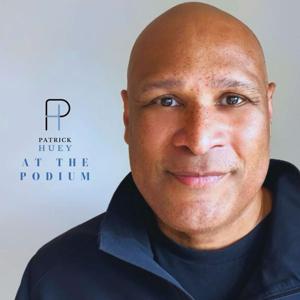
At the Podium — where real stories meet quiet courage.
Join host Patrick Huey in intimate, soul-centered conversations with writers, creators, visionaries, and healers. Each episode…
If you’re seeking a podcast that embraces life’s messiness, celebrates emotional truth, and holds space for redemption and growth — welcome. This is more than a show. It’s a living room of possibility, a place to reflect, to heal, and to come home to yourself.
🕯️ Expect thoughtful interviews, personal stories, and questions that linger long after the episode ends.

4,054 Listeners