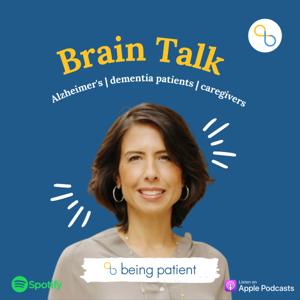
Brain Talk | Being Patient for Alzheimer's Patients and Caregivers

Brain Talk | Being Patient for Alzheimer's Patients and Caregivers

By Being PatientScience
Download on the App Store

Brain Talk | Being Patient for Alzheimer's Patients and Caregivers episodes

  • Mary Lou Falcone: Love, Loss, and Lewy Body Dementia in "I Didn’t See It Coming" | Live Talk

    Classical music publicist, educator, performer, and dementia advocate Mary Lou Falcone joins Being Patient Live Talks to discuss her book, I Didn’t See It Coming. In this memoir of “love, loss, and Lewy Body dementia,” Falcone details the caregiving journey for her late husband, Nicholas ‘Nicky’ Zann, whose illustrations introduce each chapter.

    Falcone is an internationally known classical music publicist/strategist who has helped guide the careers of celebrated artists like Van Cliburn, Gustavo Dudamel, Renée Fleming, Sir Georg Solti, and James Taylor for fifty years. She’s also advised institutions like Carnegie Hall, Chicago Symphony, Los Angeles Philharmonic, Philadelphia Orchestra, New York Philharmonic, and Vienna Philharmonic. Combining her communication skills with her background as a performer and educator, she now advocates for Lewy body dementia awareness by sharing her story.
    Watch the live talk to learn more about her caregiving journey with Lewy Body dementia and her experience writing this memoir.
    ___
    If you loved watching this Live Talk, visit our website to find more of our Alzheimer’s coverage and subscribe to our newsletter: https://www.beingpatient.com/
    Follow Being Patient:
    Twitter: https://twitter.com/Being_Patient_
    Instagram: https://www.instagram.com/beingpatientvoices/
    Facebook: https://www.facebook.com/beingpatientalzheimers
    LinkedIn: https://www.linkedin.com/company/being-patient

    34 min
  • Dr. Marwan Sabbagh: What Genetics Can Teach us About Alzheimer’s | Brain Talk

    The key to understanding Alzheimer’s disease could be in our genes. While the cause of Alzheimer’s is still unknown, mounting research shows that carrying multiple copies of certain genes — like genetic variant ApoE4 — can significantly increase the likelihood of developing Alzheimer’s. By studying genetics and gene therapy, scientists are learning more about how genes play a role in Alzheimer’s disease and what can be done for prevention.

    Barrow Neurological Institute’s neurologist, author, and Alzheimer’s expert Dr. Marwan Sabbagh joins Being Patient to discuss how scientists are seeking to prevent Alzheimer’s through genetic research. Sabbagh, a board-certified behavioral neurologist at Barrow’s Alzheimer’s and Memory Disorders Program and a professor at the institute’s department of neurology, has served as the lead investigator on several prominent national Alzheimer’s prevention and treatment clinical trials.
    In this talk, he’ll speak about how genetic research, like that on the ApoE4 gene, can help us learn more about Alzheimer’s and how it can be prevented.
    This Live Talk is sponsored by Alzheon.
    Watch now to learn more about the genetics of Alzheimer’s disease.
    If you loved watching this Live Talk, visit our website to find more of our Alzheimer’s coverage and subscribe to our newsletter: https://www.beingpatient.com/
    Follow Being Patient:
    Twitter:   / being_patient_  
    Instagram:   / beingpatientvoices  
    Facebook:   / beingpatientalzheimers  
    LinkedIn:   / being-patient  
    Being Patient is an editorially independent journalism outlet for news and reporting about brain health, cognitive science, and neurodegenerative diseases. In our Live Talk series on Facebook, former Wall Street Journal Editor and founder of Being Patient, Deborah Kan, interviews brain health experts and people living with dementia.

    35 min
  • Emily Paolillo: What is MCI and How Is It Diagnosed? | Brain Talk

    Mild Cognitive Impairment (MCI) is associated with early stages of neurodegenerative diseases like Alzheimer’s and other dementias. Many people living with dementia cite symptoms of MCI as an early sign. Yet, there’s lots of confusion with what might be “normal” memory loss that comes with aging or a sign to see a doctor.

    UCSF’s Emily Paolillo, PhD, joins Being Patient Live Talks to explain MCI and what goes into diagnosis. As an Assistant Professor at the UCSF Memory and Aging Center, her clinical work includes providing neuropsychological evaluations to aid in diagnosis and treatment of patients with possible neurodegenerative diseases. In addition, her research focuses on evaluating digital health tools for early detection and monitoring of neurobehavioral changes in Alzheimer’s disease, as well as understanding how lifestyle behaviors can grant risk and resilience to dementia.
    RSVP to this live talk to learn more about MCI and what to keep in mind about diagnosis.
    If you loved watching this Live Talk, visit our website to find more of our Alzheimer’s coverage and subscribe to our newsletter: https://www.beingpatient.com/
    Follow Being Patient:
    Twitter:   / being_patient_  
    Instagram:   / beingpatientvoices  
    Facebook:   / beingpatientalzheimers  
    LinkedIn:   / being-patient  
    Being Patient is an editorially independent journalism outlet for news and reporting about brain health, cognitive science, and neurodegenerative diseases. In our Live Talk series on Facebook, former Wall Street Journal Editor and founder of Being Patient, Deborah Kan, interviews brain health experts and people living with dementia.
    Check out our latest Live Talks: https://www.beingpatient.com/category...#Alzheimers #Dementia #MCI #BrainHealth

    38 min
  • Dr. Alexis Eastman: How Caregivers Can Prepare For the Holidays | Brain Talk

    Navigating the holidays with dementia can be challenging, especially when it comes to travel. When designing a holiday trip, there are key strategies that caregivers can take in planning all of the trips this season may require. Dr. Alexis Eastman, a clinical associate professor at the University of Wisconsin School of Medicine, joins Being Patient Live Talks to discuss best practices for holiday travel and family gatherings for people living with dementia.

    Eastman currently serves as the director of Clinical Operations for the UW geriatrics clinics, the medical director of Badger Prairie Health Care Center, and the director of the Chronic & Preventive Care course at the UW School of Medicine and Public Health. She has developed and continues to innovate models of care for older patients, including pre-operative risk, memory evaluation, telemedicine, and other forms of comprehensive geriatric care.
    While the holiday season can be a busy and stressful time for caregivers, there are ways to make this festive season better for people living with cognitive decline. RSVP to this talk to learn how caregivers and people living with dementia can prepare for the holiday season.
    If you loved watching this Live Talk, visit our website to find more of our Alzheimer’s coverage and subscribe to our newsletter: https://www.beingpatient.com/
    Follow Being Patient:
    Twitter:   / being_patient_  
    Instagram:   / beingpatientvoices  
    Facebook:   / beingpatientalzheimers  
    LinkedIn:   / being-patient  
    Being Patient is an editorially independent journalism outlet for news and reporting about brain health, cognitive science, and neurodegenerative diseases. In our Live Talk series on Facebook, former Wall Street Journal Editor and founder of Being Patient, Deborah Kan, interviews brain health experts and people living with dementia.
    Check out our latest Live Talks: https://www.beingpatient.com/category...#Alzheimers #Dementia #HolidaySeason #Caregiving

    20 min
  • Marwan Sabbagh: Why is Dementia Misdiagnosis So Common? | Being Patient Live Talk

    atching and accurately identifying a neurodegenerative disease like Alzheimer’s or another form of dementia early can make all the difference in the world to a patient and their loved ones: An early diagnosis means more time to plan for the future, join a clinical trial testing cutting-edge disease-modifying treatments, making lifestyle changes to slow symptoms, or spending more time with loved ones. On the other hand, a misdiagnosis could mean that patients receive the wrong medications, causing harm — and unfortunately misdiagnoses are all too common when it comes to dementia. Why is this the case, and what can patients do about it?

    Neurologist, author, and Alzheimer’s expert Dr. Marwan Sabbagh joins Being Patient Live Talks to discuss why dementias are so difficult to diagnose. Sabbagh, a board-certified behavioral neurologist at Barrow Neurological Institute’s Alzheimer’s and Memory Disorders Program and a professor at the institute’s Department of Neurology, has served as the lead investigator on a number of prominent national Alzheimer’s prevention and treatment clinical trials. In this talk, he’ll speak to the factors that make dementia so difficult to diagnose accurately for experts and clinicians — as well as what patients and their families can do to advocate for an accurate diagnosis and a faster response to brain health concerns.
    Watch the full video to learn more about what caregivers and people living with dementia should know about diagnosis.
    If you loved watching this Live Talk, visit our website to find more of our Alzheimer’s coverage and subscribe to our newsletter: https://www.beingpatient.com/
    Follow Being Patient:
    Twitter:   / being_patient_  
    Instagram:   / beingpatientvoices  
    Facebook:   / beingpatientalzheimers  
    LinkedIn:   / being-patient  
    Being Patient is an editorially independent journalism outlet for news and reporting about brain health, cognitive science, and neurodegenerative diseases. In our Live Talk series on Facebook, former Wall Street Journal Editor and founder of Being Patient, Deborah Kan, interviews brain health experts and people living with dementia.
    Check out our latest Live Talks: https://www.beingpatient.com/category...#Alzheimers #Dementia #BrainTalk #Diagnosis

    37 min
  • Laurie Scherrer on Blogging Through Early-onset Alzheimer’s and FTD In ‘Dementia Daze’ | Live Talk

    Writer, advocate, and international speaker Laurie Scherrer joins Being Patient Live Talks to discuss her experience living with early onset Alzheimer’s and FTD.

    After being diagnosed with early-onset Alzheimer’s and frontotemporal dementia at age 55, Scherrer started the blog Dementia Daze to share her journey and help others through their dementia journey. Writing about her feelings, challenges, symptoms, and experiences on her blog, she encourages people living with dementia and care partners to explore ways to live beyond dementia. Scherrer is a Dementia Action Alliance Board of Directors member and has been featured in the New York Times, AARP, PBC, and the South Africa Sunday Times.
    Watch the full video to learn more about her experience with early-onset Alzheimer’s and FTD and her work fighting dementia stigma.
    Read the transcript here: https://www.beingpatient.com/laurie-s...
    YOUR TRUSTED SOURCE FOR BRAIN HEALTH NEWS AND SCIENCE. Being Patient is an editorially independent media platform publishing journalism about brain health, cognitive science, and neurodegenerative diseases like Alzheimer’s. If you learned something from this talk, find more helpful science reporting, mythbusting, and patient and caregiver stories at beingpatient.com.
    Follow Being Patient on social:
    Twitter:   / being_patient_  
    Instagram:   / beingpatientvoices  
    Facebook:   / beingpatientalzheimers  
    LinkedIn:   / being-patient  
    Check out our latest Live Talks with medical experts, scientists, researchers, patients and caregivers here: https://www.beingpatient.com/category...#Alzheimers #Dementia #FTD #EarlyOnsetAlzheimers #PatientPerspective

    17 min
  • Dr. Ronald G. Crystal: How Does Gene Therapy for Alzheimer’s Work? | Live Talk

    This video was made possible through sponsorship by Lexeo Therapeutics. Being Patient’s editorial team produced the interview and article, with no review/approval process by the sponsor.

    Lexeo Therapeutics: https://www.lexeotx.com/
    Pioneering genetic medicine expert and physician Ronald G. Crystal of Cornell University’s Weill Medical College joins Being Patient’s editor in chief Deborah Kan for a discussion on gene therapy in relation to Alzheimer’s disease.
    As a pioneer in the field of genetic medicine, he started working in gene therapy in the late 1980s. His work has helped to form the basis for all subsequent work in adenovirus-based gene therapies and vaccines. Crystal has carried out human trials of gene therapy for diseases including cystic fibrosis, cardiac ischemia, cancer and central nervous system disorders, and most recently, he has been working on gene therapies for Alzheimer’s disease: For example, his laboratory developed a gene therapy designed to reduce the high risk of Alzheimer’s associated with the APOE4 genetic variant — aka the “Alzheimer’s gene” — a strategy that is currently in clinical trials.
    Crystal is the director of the Belfer Gene Therapy Core Facility and attending physician at the New York-Presbyterian Hospital/Weill Cornell Medical Center, and he chairs the Cornell University Weill Medical College genetic medicine department. He’s also responsible for a number of biomedical patents, and he’s founded multiple gene therapy-focused biotech companies including Lexeo Therapeutics, a New York City-based clinical-stage gene therapy company focused on addressing genetically defined cardiovascular and central nervous system diseases.
    In this Live Talk, he’ll share his expert take on the past, present future of the field with regard to neurodegenerative diseases like Alzheimer’s. This Live Talk is sponsored by Lexeo Therapeutics.
    YOUR TRUSTED SOURCE FOR BRAIN HEALTH NEWS AND SCIENCE. Being Patient is an editorially independent media platform publishing journalism about brain health, cognitive science, and neurodegenerative diseases like Alzheimer’s. If you learned something from this talk, find more helpful science reporting, mythbusting, and patient and caregiver stories at beingpatient.com.
    Follow Being Patient on social:
    Twitter:   / being_patient_  
    Instagram:   / beingpatientvoices  
    Facebook:   / beingpatientalzheimers  
    LinkedIn:   / being-patient  
    Check out our latest Live Talks with medical experts, scientists, researchers, patients and caregivers here: https://www.beingpatient.com/category...

    24 min
  • Understanding Your Metabolism For Better Brain Health | LiveTalk | Being Patient

    Being Patient speaks with Benjamin Bikman, professor of cell biology and physiology at Brigham Young University, about the complex processes of our metabolism, and how metabolic health plays a role in neurodegenerative diseases like Alzheimer’s and our brain health.

    We rely on donations to bring you the latest research on dementia and brain health and to support our amazing team of independent journalists. Please consider donating to support of our mission of giving people impacted by dementia a better resource and connection to experts at the forefront of research. Our audience has grown so rapidly; we have exciting plans for the future to enhance our coverage even further but we need your help. Please consider making a contribution to help fund Being Patient's editorial costs.
    https://beingpatient.nationbuilder.com/

    50 min
  • NYT Bestselling Author Dr. Sandeep Jauhar on His Forthcoming Book, “My Father’s Brain” | Live Talk

    Doctor and New York Times bestselling author Sandeep Jauhar joins Being Patient Live Talks to discuss his latest book, “My Father’s Brain,” in which he shares an account of his father’s journey with Alzheimer’s alongside his own experience coming to understand the disease through caring for his father.

    Watch the full live talk to learn more about his experience caretaking and writing the book. You can read the writeup of the talk with highlights from the conversation on our website: https://www.beingpatient.com/

    39 min
  • Dr Julia Basso How Dance and Yoga Change the Brain | Being Patient Livetalk

    Virginia Tech’s Dr. Julia C. Basso joins Being Patient Live Talks to discuss her work studying the body-brain connection through dance, yoga, and meditation.

    As an assistant professor in the Department of human nutrition, foods, and exercise at Virginia Tech, Basso’s research is focused on the body-brain connection and utilizing the body to boost brain function and physiology. With a background in dance and as a certified yoga instructor, she tells us more about her work as director of the Embodied Brain Laboratory and about the bidirectional relationship between physical movement — like dance and yoga — and the brain.
    YOUR TRUSTED SOURCE FOR BRAIN HEALTH NEWS AND SCIENCE. Being Patient is an editorially independent media platform publishing journalism about brain health, cognitive science, and neurodegenerative diseases like Alzheimer’s. If you learned something from this talk, find more helpful science reporting, mythbusting, and patient and caregiver stories at beingpatient.com.
    Follow Being Patient on Social:
    Twitter: https://twitter.com/Being_Patient_
    Instagram: https://www.instagram.com/beingpatientvoices/
    Facebook: https://www.facebook.com/beingpatientalzheimers
    LinkedIn: https://www.linkedin.com/company/being-patient

    32 min

About Brain Talk | Being Patient for Alzheimer's Patients and Caregivers

From the publisher's feed

Being Patient is the leading online community for Alzheimer's, dementia patients, caregivers.

More shows like Brain Talk | Being Patient for Alzheimer's Patients and Caregivers

ZOE Science & Nutrition by ZOE

ZOE Science & Nutrition

2,027 Listeners

Alzheimer’s Breakthrough with Dr. Josh Helman, MD by Dr. Josh Helman, MD

Alzheimer’s Breakthrough with Dr. Josh Helman, MD

16 Listeners