
Sign up to save your podcasts
Or


That’s it. That’s the Blog.
Just kidding. There’s more.
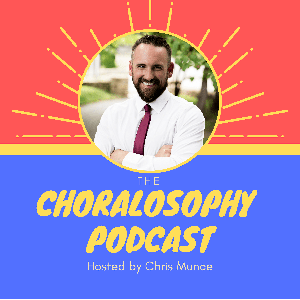
On the Choralosophy Podcast over the last several years, I have presented my thoughts on choral music curriculum in several episodes. From grading policies, to literacy instruction, as well a the philosophy of grading on growth rather than arbitrary standards based grading. I believe that a school choir program can be BOTH incredibly rigorous and open to beginners at the same time. A high school choir CAN achieve college level or beyond literacy skills, a professional rehearsal atmosphere that is fun and engaging, all while remaining productive and continuously striving for excellence. One can accept that “perfection” in all human endeavors does not exist, without abandoning the constant march towards it. Below is an example from the beginning of last school year, where our prior literacy, independence and rigor saved our school year due to the challenges presented by masks, social distancing, and reduced rehearsal time. (Scroll to the bottom for episodes on my literacy method.)
I do. For my classroom. You do for yours. It’s pretty simple really. The line in the sand that I draw is that everyone has to have some definition of this word, or people will not take the choir seriously. It does not matter if excellence is centered around concepts of intonation, rhythmic precision, resonance and expressive line like mine is, or centered around facial expression, choreography, story telling like a great show choir. The priorities can be completely different and they could both be excellent. Maybe your definition of excellence is centered around the way humans FEEL in your rehearsals. Centered around an informal rubric of community, acceptance and love. That’s ok too. You are an excellent choir when you achieve your choir’s goals. This doesn’t have to be an argument. The tent of choral music is large enough for an infinite number of “Excellence models” but you must choose a definition and strive for it relentlessly.
This concept is important in my program because it demonstrates the possible duality between “rigor” and “inclusivity.” I believe that rigorous curricula can be inclusive of all levels of learner if we grade on growth. Put simply, “I don’t care where you start. You can get better, and that’s how you will earn an A.” We have a difficult balance to maintain in school music. We must be a “real class” in the eyes of the community and administration while also accepting students into our programs with WIDELY ranging levels of prior knowledge and skill. I outline my attempt at this balance in the two episodes below.
 View all episodes
 By Christopher M Munce

4.6
131131 ratings
That’s it. That’s the Blog.
Just kidding. There’s more.
On the Choralosophy Podcast over the last several years, I have presented my thoughts on choral music curriculum in several episodes. From grading policies, to literacy instruction, as well a the philosophy of grading on growth rather than arbitrary standards based grading. I believe that a school choir program can be BOTH incredibly rigorous and open to beginners at the same time. A high school choir CAN achieve college level or beyond literacy skills, a professional rehearsal atmosphere that is fun and engaging, all while remaining productive and continuously striving for excellence. One can accept that “perfection” in all human endeavors does not exist, without abandoning the constant march towards it. Below is an example from the beginning of last school year, where our prior literacy, independence and rigor saved our school year due to the challenges presented by masks, social distancing, and reduced rehearsal time. (Scroll to the bottom for episodes on my literacy method.)
I do. For my classroom. You do for yours. It’s pretty simple really. The line in the sand that I draw is that everyone has to have some definition of this word, or people will not take the choir seriously. It does not matter if excellence is centered around concepts of intonation, rhythmic precision, resonance and expressive line like mine is, or centered around facial expression, choreography, story telling like a great show choir. The priorities can be completely different and they could both be excellent. Maybe your definition of excellence is centered around the way humans FEEL in your rehearsals. Centered around an informal rubric of community, acceptance and love. That’s ok too. You are an excellent choir when you achieve your choir’s goals. This doesn’t have to be an argument. The tent of choral music is large enough for an infinite number of “Excellence models” but you must choose a definition and strive for it relentlessly.
This concept is important in my program because it demonstrates the possible duality between “rigor” and “inclusivity.” I believe that rigorous curricula can be inclusive of all levels of learner if we grade on growth. Put simply, “I don’t care where you start. You can get better, and that’s how you will earn an A.” We have a difficult balance to maintain in school music. We must be a “real class” in the eyes of the community and administration while also accepting students into our programs with WIDELY ranging levels of prior knowledge and skill. I outline my attempt at this balance in the two episodes below.

90,994 Listeners

78,636 Listeners

32,100 Listeners

38,856 Listeners
14,378 Listeners
30,101 Listeners
3,071 Listeners

87,529 Listeners

56,508 Listeners
69,540 Listeners
85,636 Listeners
1,637 Listeners
16 Listeners
0 Listeners

634 Listeners