
Sign up to save your podcasts
Or

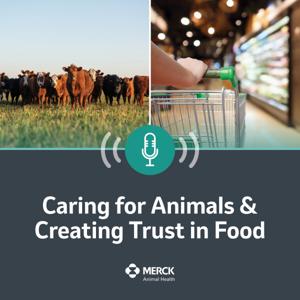


As we enter a third year of the COVID-19 pandemic, the agriculture industry continues to face more challenges and change. The U.S. Beef Industry is balancing strong market prices with lower cattle numbers and higher costs for labor, transportation, and feed while also managing international shifts and workforce shortages. On the retail side of the food value chain, finding workers remains the top foodservice challenge coupled with keeping shelves stocked amid ongoing supply chain struggles. Meanwhile, at the center of the food industry focus is on the ever-evolving consumer who is looking at food differently. In addition to filling empty bellies, consumers are increasingly using food to improve their health and they want transparency and sustainability. It’s a tall order for the industry to address.
Merck Animal Health is committed to the well-being of our communities, our employees, and our customers. In this episode, Jane Dukes, Senior Manager with the Merck Animal Health Veterinary Consumer Affairs Team, speaks with Jessica Clowser Burkham, the Beef Alliance Managing Director and Craig Wilson, Vice President, QA & Food Safety from Costco to try to address some of these ongoing challenges.
“The (Beef) Alliance prides ourselves on being forward-thinking in the industry and identifying and dealing with these industry disruptions. We want to utilize our size. We are the biggest, so we'll definitely want to use that to positively influence not only policy, but business partner relationships with our packers, retailers and food service and address industry trends to foster some long term viability while essentially delivering high quality and nutritious products.” - Jessica Clowser Burkham
Ongoing food value chain challenges for discussion:
It would appear that no matter which sector of the food value chain you call home, we share similar challenges. Inflation driving food prices up and in some cases consumer demand down, labor and the lack of available workers, and ongoing supply chain issues which impact product availability and evolving consumer preferences and demands.
We have really strong collaboration where we know what (our suppliers) do. We set some expectations, they set some expectations and we work together to get that great product that our members want. Because at the end of the day…being able to provide our Costco members with great prices on great products all the time. And that takes very close collaboration all the way down to the feed yards, all the way back up to where the cattle are converted and broken into the cuts that we need… And it's the same on the produce side. We want to work directly with growers on quality, delivery, and that whole supply chain to make sure that our members are getting what they want. - Craig Wilson
This Week’s Podcast:
In honor of Women’s History Month and National Ag Day, we’re talking to three leaders in agriculture who will share their experiences and discuss progress and opportunities to support and elevate women in agriculture, the veterinary profession and throughout the industry. The number of women leading careers in this space continues to grow as shown by these statistics:
But the numbers alone don’t tell the whole story. Women are actively shaping and changing the agricultural and animal health industries, leading not only on the farm, but paving the way for the future of professional and industry organizations and agricultural businesses.
"There's room for all of us. The faster we realize that one person's success does not take away from our own and if we bring others with us, we can make a better impact." - Marissa Hake
“Having women involved has been a huge asset to the cattle industry. Confidence is just part of it – don’t be scared to be the only woman in the room.” - Trista Brown
“Confidence in your abilities is part of it, and you’ve got to believe in yourself – then have the courage to make the leap.” - Terri Moore
Merck Animal Health is committed to the well-being of our communities, our employees, and our customers. In this episode, Jane Dukes, Senior Manager with the Merck Animal Health Veterinary Consumer Affairs Team, speaks with Trista Brown-Priest, Chief Strategy Officer, Cattle Empire 3rd generation on the feeder operation; Terri Moore, VP Communications for the American Farm Bureau Federation and formerly deputy director of communications at the White House, and director of communications at the US Department of Agriculture (USDA); and Dr. Marissa Hake, the “Calf Vet” and Director of Animal Welfare and Sustainable Farming for Fairlife.
This Week’s Podcast:
The human-animal bond has become a trendy topic of discussion as of late, especially as we were all forced by the global pandemic to stay at home. A Harris poll showed that 89% of Americans said their pets brought them comfort during the pandemic and 82% felt less lonely as a result of their pet. These statistics support the fact that the human-animal bond is more than a trend. The bond between pets and their people is not just something we “think” we experience but is actually backed by science that shows the benefits of our relationships with pets to our health and wellbeing.
Merck Animal Health is committed to the well-being of our communities, our employees, and our customers. Jane Dukes, Senior Manager with the Merck Animal Health Veterinary Consumer Affairs Team, speaks with Dr. Jen Chatfield, double-board certified veterinarian and co-host of the podcast “Chat with the Chatfields,” which she does with her twin brother, also a veterinarian, and Dr. Taylor Tillery, a veterinarian and member of the team at Merck Animal Health. Together they explore the evolution, definition and evidence regarding the value of the human-animal bonds.
“You know I think (the human-animal bond) just releases the good hormones, like serotonin and oxytocin. I know that we've seen what that does and then what that does is it drops our cortisol levels. So it really reduces our stress….. So I think those are all fantastic things.” -Dr. Taylor Tillery
If we start at the beginning, the human-animal bond has existed for literally thousands of years. Humans have lived with animals and animals provided for us but over the past 50-100 years, our understanding of our relationship with animals has evolved. Fewer people are involved in farming and our pets have left the backyard and moved into the home with us. They have become our companions and are considered members of our families. The American Veterinary medical Association defines the human-animal bond as “a mutually beneficial and dynamic relationship between people and animals that is influenced by behaviors essential to the health and wellbeing of both.”
“We know (the human-animal bond) extends (the pets) lifespan significantly because they're safe. We end up anthropomorphizing a lot with companion animals, for sure. But….I know for a fact she enjoys every one of the toys that are littering my cottage right now for her. And so I think that pets also get that bond.” - Dr. Jen Chatfield
This Week’s Podcast:
In this episode we explore the intersection of animal agriculture technology and how it might be used to satisfy consumer demand for transparency. Listeners will walk away with a better understanding of how agriculture and food system leaders can meet the needs of our diverse stakeholders – farmers and ranchers, veterinarians, protein processors, retailers and restaurants, and, ultimately, consumers.
Merck Animal Health is committed to the well-being of our communities, our employees, and our customers. Jane Dukes, Senior Manager with the Merck Animal Health Veterinary Consumer Affairs Team, speaks with Andy Harig with FMI, The Food Industry Association and Paul Koffman, from the Merck Animal Health Intelligence team. They explore the growing use of technology in animal agriculture, especially as it pertains to transparently sharing information throughout the supply chain.
“(Consumers) are really engaged in health and wellness, and they really expect retailers and the entire food supply chain to be partners. So….ingredients, certification, and nutrition, those have really topped the list of how people see transparency.” - Andy Harig
Many consumers are several generations removed from the farm and they rely on those of us in the food chain to share information. Technology has increasingly played an important role in this communication. At the same time, trust has become a real obstacle in sharing transparency. Andy explains that “even though people sometimes mistrust technology, it's technology that's gonna help to be more transparent.” Technology continues to advance and make our lives easier but you might be surprised to learn how it has also advanced in agriculture. Advancements in technology can help meet consumer demand for information and greater transparency within today’s food system.
“We work with producers, ranchers, dairy farmers, beef producers, cattle producers, feedlots, et cetera on their goals. We work with them on what their challenges may be and help come up with an opportunity where technology can help them meet their goals or overwhelm those challenges that they're faced with.” - Paul Koffman
This Week’s Podcast:
During the pandemic, many people adopted new pets and many long-time pets enjoyed having the extra attention from their owners who were now working from the dining room table. Now, as the Covid-19 vaccine rolls-out, more and more people have started going back to the office and to school – and their pets may not be happy about it. Today, we’re focusing on separation anxiety. We’ve developed a handy infographic to give pet owners tips to recognize separation anxiety along with suggestions for helping your pet cope and that’s what we’ll discuss today.
Merck Animal Health is committed to the well-being of our communities, our employees, and our customers. In this episode Jane Dukes, Senior Manager with the Merck Animal Health Veterinary Consumer Affairs Team, speaks with Dr. Keri Shaver, professional services veterinarian at Merck Animal Health and Dr. Lisa Lippman, a veterinary general practitioner in New York, about ways to recognize and mitigate separation anxiety in our pets during this transition.
“Some of the warning signs are….destructive behavior, vocalizing, if you have a video camera on them, often you'll see panting and pacing, potentially urinating or defecating, particularly by the door because they're trying to get out to their owners. So really just destructive and anxiety ridden behaviors.” - Dr. Lisa Lippman
Dr. Lippman recommends slowly transitioning a dog to feel more comfortable with independent activity. This includes leaving your pet for very short periods of time and incrementally increasing the length of separation while they are calm with a toy, a high value treat or music. She also emphasizes not to make coming and going a big event that may encourage and reinforce anxious and excited behavior. If behaviors persist she suggests contacting your veterinarian to discuss referrals for training or if severe a veterinary behaviorist for support and solutions. Dr. Shaver adds that creating a behavior modification plan with your veterinarian may help create a gradual plan to condition the animal to tolerate independence. She shares that “it's a lifestyle change” to help teach your pet the coping mechanisms it may need while you are gone.
“At the end of the day, it still comes down to the training, which is so so so important. And so having a good outlined detailed plan is going to really be the mainstay of treatment there.” - Dr. Lisa Lippman
This Week’s Podcast:
Merck Animal Health is committed to the well-being of our communities, our employees, and our customers. Jane Dukes, Senior Manager with the Merck Animal Health Veterinary Consumer Affairs Team, once again brings us a valuable discussion, this time focusing on mental health. Jane is joined by Dr. Elizabeth Strand, founding director of veterinary social work at the University of Tennessee College of Veterinary Medicine and Dr. Judson Vasconcelos, head of the Merck Animal Health Veterinary & Consumer Affairs team. Dr. Strand shows us how we can create a “culture of care” while also exploring practical tips each of us can use to ensure our mental well-being.
“The experience of stress and compassion fatigue that we know from the research that Merck has led is something that veterinarians and other veterinary professionals face.” - Dr. Elizabeth Strand
Merck Animal Health is currently conducting its third wellness study to evaluate the mental wellbeing of the veterinary profession. These studies have certainly highlighted an area of concern in veterinary mental health. Dr. Elizabeth shares that in her program “when an individual is struggling we never see that as only the individual’s responsibility.” She has observed veterinary professionals having difficulty practicing effective self care. “We have to actually be living in cultures of care where there are some norms….of what is acceptable to talk about, what is acceptable to do and how we look out for one another.” Dr. Strand recommends a discussion guide to improve conversation about wellbeing and providing access to resources so anyone can get help when they need it. She reiterates that “you are not alone, wherever you are in your experience...you are not alone.”
“It's not just an individual saying I need to do this for myself but it's being within an organization or community that says it's okay to take care of yourself.” - Jane Dukes
This Week’s Podcast:
Resources:
Jane Dukes, Senior Manager with the Merck Animal Health Veterinary Consumer Affairs Team, leads us in a discussion about the foods we choose and the benefits they provide our health. In this episode Jane asks Kim Kirchherr, a registered dietitian, about the role protein plays in a healthy balanced diet and her approach to encouraging the public to consider their nutritional choices.
“I combine that healthcare and that food retail and that agriculture perspective and put it all together. It's been really great because that's really where people's heads are at with the conversations that they're having about their food right now.” - Kim Kirchherr
Kim shares that protein is an “essential part of our nutrition conversation” and goes far beyond the common perception of muscle building. Proteins provide many significant nutrients and add value to the immune system. Kim remarks that the Covid-19 pandemic has forced the general public to make their health a priority and explore ways they can prepare food at home to support that health. Going forward, portion control, a balanced diet and using food to acquire nutrition are the three principles of the dietary guidelines that dietitians and health professionals focus on.
“We are solving people's problems for them. Let's give them the tools that they can solve the problems for themselves instead of the tactical facts that there are so many of. If we could get to that state, I think we would have amazing food and agriculture conversations.”
This Week’s Podcast:
Resources:
Dr. Angela Basinger is the animal welfare lead for North America for Merck Animal Health. She works to create sustainability across the entire food chain including the producer, retailer and veterinary medical professional. She is joined by Nicole Johnson-Hoffman, senior vice president and chief sustainability officer at the OSI group.
“There needs to be a multi-stakeholder collaborative approach taken in order to improve beef sustainability and to do that in ways that work for everybody.” -Nicole Johnson-Hoffman
“Our work has no credibility if our critics don’t participate in the work….we have to engage with our communities and our critics in order to understand what they care about and what they expect from us as participants in the industry.” - Nicole Johnson-Hoffman
This Week’s Podcast:
Today’s episode explores the important connection between caring for animals and building strong communities. We’re talking about animal welfare and shelter health. When you hear the term animal shelter, you probably already have an idea in mind of what that means. This episode may inspire you to broaden that view in ways that bring more value to both animals and local communities.
We have on the show Dr. Jyothi Robertson, who is a board certified veterinarian in shelter medicine. She works for Adisa, which does leadership development, professional development, and strategic planning and design for organizations involved in animal welfare and volunteerism. Jyothi also is the chair of the animal welfare committee for the American Veterinary Medical Association (AVMA). She has been consulting in shelter medicine, which is a relatively new field in veterinary medicine, since 2010.
Also joining us back on the show is Dr. Angela Baysinger, who is the lead for animal welfare on the Veterinary and Consumer Affairs team at Merck Animal Health. Angela works with veterinarians that do technical service work with animal shelters and interacts often with shelter programs, helping with things like training and problem solving. She has a background in animal welfare and is currently pursuing board certification in the field through the American College of Animal Welfare.
September is National Preparedness Month, and we’re right smack in the middle of hurricane season witnessing the devastation this natural weather event brings to anyone in its path. The deadly fires in California also remind us we should be prepared. And, in the midst of a global pandemic, we need only to turn on the news to be reminded daily of the health crisis we face around the world.
Jane Dukes, senior account manager at Merck Animal Health Veterinary & Consumer Affairs and Hannah Thompson-Weeman, vice president of communications at the Animal Agriculture Alliance, provide some critical components to preparing a crisis management plan.
Learn more about crisis management here: https://www.merck-animal-health-usa.com/about/us/veterinary-consumer-affairs/article/jane-dukes-navigating-a-crisis
From the publisher's feed