
Sign up to save your podcasts
Or

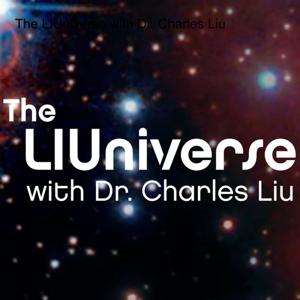

Is universal expansion slowing? What is the Bubble Universe Theory? Will we control AI, or will AI control us? In this special Chuck GPT episode of The LIUniverse, we answer questions from the Annual Global Summit in Erie, Pennsylvania where Dr. Charles Liu gave a talk on “2050 - The Future of Humanity.”
To help ask those questions, Chuck and co-host Allen Liu welcome Stacey Severn, our Social Media Manager/Community Director; and physics student Eleanor Adams, our first intern.
As always, though, we start off with the day’s joyfully cool cosmic thing, suggested by Stacey: the recent discovery of one of the most distant and earliest known galaxies observed, existing just 570 million years after the Big Bang. It’s got a supermassive black hole 20 times the mass of ours and was found via gravitational lensing by the Canadian NIRISS Unbiased Cluster Survey (CANUCS) using the James Webb Space Telescope.
Then it’s time for the main event. Eleanor reads the first Erie audience question from William W., age 13, who asks, “In Bubble Universe Theory, is the force splitting universes apart the same force causing the expansion of the universe, also known as dark energy?”
Chuck explains Bubble Universe Theory, aka “Eternal Inflation,” and then how dark energy is different than the forces that cause expansion.
Next question: “Have you seen the latest research from South Korea stating universal expansion is actually slowing, thus reducing greatly the amount of dark matter? If it's correct, what are the implications?”
Chuck explains the current state of research around the issue, starting with the Dark Energy Spectroscopic Instrument (DESI) survey at the Kitt Peak National Observatory telescope. DESI gave indications of a change in the amount of dark energy being produced; this new study raises questions about how we measure the expansion of the universe using type 1a Supernova.
Next question: “What percentage of our global warming does science attribute to man-created activities vs. a natural progression? Even though the world is getting warmer, wouldn’t it be worse if the temperature were getting colder?”
Chuck looks at the natural progression of the increase of carbon dioxide and compares it with the larger and more rapid increase in CO2 levels since the Industrial Revolution began. As to whether warming or cooling is better, Allen says that while it’s a question of magnitude, neither extreme is desirable.
Mark M’s question is next: “Will we achieve control or effective management of AI, or will it control, or even define, our daily lives?
Allen, whose book on AI is coming out soon, says the answer is far from clear cut. He explains that while there are many efforts to ensure we maintain control, there’s no guarantee that we’ll succeed.
Next question from Erie: “How do we prepare our young children to be successful in the Age of AI?” Eleanor talks about how, like social media, you can’t stop or avoid AI, but also, like social media, parents can give their children the tools to help them use it.
Next: “Many advanced countries have declining populations, while third world countries are gaining population. How do we get tomorrow’s scientific leaders from third world education systems?”
Chuck says the best way to ensure an ongoing stream of scientific leaders is for advanced countries to continue to welcome immigrants, while Allen points out it is also important to improve the educational systems and opportunities for research in those third world countries. Stacey reminds us about the impact the internet is having on this issue.
With time running out, we squeeze in one last question from Erie: “How can the average person influence science policy in a positive direction?” Our consensus answer: people need to participate, speak out, and support others when they do, too.
We hope you enjoy this episode of The LIUniverse. Please support us on Patreon.
Credits for Images Used in this Episode:
Chapters:
00:00 - Welcome – Call Me Chuck
01:02 - Joyfully Cool Cosmic Thing of the Day – CANUCS-LRD-z8.6
08:25 - Chuck Answers Questions from Annual Global Summit, Erie, PA
09:58 - Bubble Universe Theory and Dark Energy
14:17 - Is Universal Expansion Is Slowing?
19:30 - Global Warming
27:28 - Will We Control AI or It Will Control Us?
30:14 – How Can We Prepare Our Children To Succeed in the Age of AI?
36:28 - Where Will Future Scientific Leaders Come From?
42:09 - How Can Individuals Influence Science Policy?
 View all episodes
 By theliuniverse

4.8
7373 ratings
Is universal expansion slowing? What is the Bubble Universe Theory? Will we control AI, or will AI control us? In this special Chuck GPT episode of The LIUniverse, we answer questions from the Annual Global Summit in Erie, Pennsylvania where Dr. Charles Liu gave a talk on “2050 - The Future of Humanity.”
To help ask those questions, Chuck and co-host Allen Liu welcome Stacey Severn, our Social Media Manager/Community Director; and physics student Eleanor Adams, our first intern.
As always, though, we start off with the day’s joyfully cool cosmic thing, suggested by Stacey: the recent discovery of one of the most distant and earliest known galaxies observed, existing just 570 million years after the Big Bang. It’s got a supermassive black hole 20 times the mass of ours and was found via gravitational lensing by the Canadian NIRISS Unbiased Cluster Survey (CANUCS) using the James Webb Space Telescope.
Then it’s time for the main event. Eleanor reads the first Erie audience question from William W., age 13, who asks, “In Bubble Universe Theory, is the force splitting universes apart the same force causing the expansion of the universe, also known as dark energy?”
Chuck explains Bubble Universe Theory, aka “Eternal Inflation,” and then how dark energy is different than the forces that cause expansion.
Next question: “Have you seen the latest research from South Korea stating universal expansion is actually slowing, thus reducing greatly the amount of dark matter? If it's correct, what are the implications?”
Chuck explains the current state of research around the issue, starting with the Dark Energy Spectroscopic Instrument (DESI) survey at the Kitt Peak National Observatory telescope. DESI gave indications of a change in the amount of dark energy being produced; this new study raises questions about how we measure the expansion of the universe using type 1a Supernova.
Next question: “What percentage of our global warming does science attribute to man-created activities vs. a natural progression? Even though the world is getting warmer, wouldn’t it be worse if the temperature were getting colder?”
Chuck looks at the natural progression of the increase of carbon dioxide and compares it with the larger and more rapid increase in CO2 levels since the Industrial Revolution began. As to whether warming or cooling is better, Allen says that while it’s a question of magnitude, neither extreme is desirable.
Mark M’s question is next: “Will we achieve control or effective management of AI, or will it control, or even define, our daily lives?
Allen, whose book on AI is coming out soon, says the answer is far from clear cut. He explains that while there are many efforts to ensure we maintain control, there’s no guarantee that we’ll succeed.
Next question from Erie: “How do we prepare our young children to be successful in the Age of AI?” Eleanor talks about how, like social media, you can’t stop or avoid AI, but also, like social media, parents can give their children the tools to help them use it.
Next: “Many advanced countries have declining populations, while third world countries are gaining population. How do we get tomorrow’s scientific leaders from third world education systems?”
Chuck says the best way to ensure an ongoing stream of scientific leaders is for advanced countries to continue to welcome immigrants, while Allen points out it is also important to improve the educational systems and opportunities for research in those third world countries. Stacey reminds us about the impact the internet is having on this issue.
With time running out, we squeeze in one last question from Erie: “How can the average person influence science policy in a positive direction?” Our consensus answer: people need to participate, speak out, and support others when they do, too.
We hope you enjoy this episode of The LIUniverse. Please support us on Patreon.
Credits for Images Used in this Episode:
Chapters:
00:00 - Welcome – Call Me Chuck
01:02 - Joyfully Cool Cosmic Thing of the Day – CANUCS-LRD-z8.6
08:25 - Chuck Answers Questions from Annual Global Summit, Erie, PA
09:58 - Bubble Universe Theory and Dark Energy
14:17 - Is Universal Expansion Is Slowing?
19:30 - Global Warming
27:28 - Will We Control AI or It Will Control Us?
30:14 – How Can We Prepare Our Children To Succeed in the Age of AI?
36:28 - Where Will Future Scientific Leaders Come From?
42:09 - How Can Individuals Influence Science Policy?
14,378 Listeners
1,353 Listeners
321 Listeners

836 Listeners
2,882 Listeners
569 Listeners
547 Listeners
234 Listeners
1,070 Listeners
4,170 Listeners
2,359 Listeners
329 Listeners
381 Listeners
152 Listeners
572 Listeners