
Sign up to save your podcasts
Or

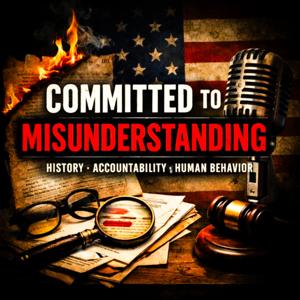


Eight traditions. Four continents. Twenty-five hundred years. Zero contact with each other. Every one of them lands on the same instruction: don't be a monster to the people around you. Tri-state licensed clinical mental health therapist Chuck Lenahan opens Season 2 by proving the premise, then handing you the eight-mechanism clinical toolkit — Albert Bandura's research on moral disengagement — that the rest of the season is going to run on. Season 2, Episode 1.
New to the show? Season 1 is the American chapter of this story. Start there for the full case, or jump into Season 2 now.
────────────────────────────
COMMITTED TO MISUNDERSTANDING
────────────────────────────
Whitewashed history brought back to its technicolor reality. With receipts.
Host: Chuck Lenahan | Tri-state licensed mental health therapist
Twenty episodes. Five arcs. One verdict.
This season I built a case — Erasure, Extraction, Enforcement, Narrative, Responsibility — using primary sources, federal records, and receipts that have been sitting in the public record for decades. In this finale, I deliver the verdict the evidence requires, and I tell you exactly what that verdict demands going forward.
This is not a summary episode. This is the close of the case.
IN THIS EPISODE
— The full season recap, arc by arc, receipt by receipt
— The verdict: guilty, as a system, not as individuals
— What the verdict requires — four specific, non-negotiable actions
— Why "do better" without specificity is the comfortable version of this conversation
— The clinical case for why the lever works and the variable has always been will
— What comes next: the Season 2 announcement
SOURCES CITED
— Universal Declaration of Human Rights (1948), United Nations
— Board of Governors of the Federal Reserve System, Survey of Consumer Finances, 2019
— HR 40, 119th Congress, Rep. Ayanna Pressley (D-MA-7)
— Full sourcing for all twenty episodes available in each episode description
ABOUT THE SHOW
Committed to Misunderstanding is hosted by Chuck Lenahan, a tri-state licensed clinical mental health therapist. Each episode applies a behavioral and clinical lens to under-taught or deliberately obscured American history.
Whitewashed history brought back to its technicolor reality. With receipts.
ALSO IN THIS SEASON
E13 — The Moynihan Report: How Language Became a Weapon
E17 — The Wealth Gap Is Not an Outcome. It Is a Policy Decision.
E19 — Black America Doesn't Have an Inferiority Problem. It Has a Misdiagnosis.
For four hundred years, this country has handed Black America the wrong diagnosis. Not a character problem. Not an inferiority problem. A misdiagnosis, built into policy, enforced through law, and compounded through every generation that inherited the consequences.
In this episode I am doing something I have not done in eighteen episodes. No historical event anchor. No primary source reading. No named human from a century ago whose story I am here to tell. Just the clinical framework that explains what a wrong diagnosis actually does to a person, what getting the right one finally makes possible, and what I am asking you to do with that information.
This is the episode I built the whole season to get to.
IN THIS EPISODE
— What misdiagnosis does psychologically, and why the exhaustion, the hypervigilance, and the misattribution are not character flaws
— The clinical research on race-based traumatic stress: Robert Carter, Thema Bryant-Davis, and Jude Mary Cénat
— Why grief is the correct response to an accurate diagnosis, and why this country has built an entire vocabulary to shut that grief down
— "Pull yourself up by your bootstraps." "It was over two hundred years ago." "My family never owned slaves." What those phrases are actually doing clinically
— Why the anger is proportional, and what January 6th tells us about what proportional actually looks like
— The guilt versus responsibility distinction, and why conflating them is one of the primary ways this conversation breaks down
— What I am asking white people to do with what they now know
— HR 40, the study nobody will authorize, and why the treatment conversation cannot start until we stop relitigating the diagnosis
SOURCES CITED— Carter, R.T. (2007). Racism and psychological and emotional injury. The Counseling Psychologist, 35(1), 13–105.— Bryant-Davis, T. & Ocampo, C. (2005). Racist-incident-based trauma. The Counseling Psychologist, 33(4), 479–500.— Cénat, J.M. (2023). Complex racial trauma. Perspectives on Psychological Science, 18(4).— HR 40: Introduced January 3, 2025, Rep. Ayanna Pressley (D-MA-7). Referred to House Judiciary Committee. 102 co-sponsors. Never brought to committee markup.
ABOUT THE SHOW:
Committed to Misunderstanding is a history and social commentary series hosted by Chuck Lenahan, a tri-state licensed clinical mental health therapist. Each episode applies a behavioral and clinical lens to under-taught or deliberately obscured American history.
Tagline: Whitewashed history brought back to its technicolor reality. With receipts.
ALSO IN THIS SERIES
E13 — The Moynihan Report: How Language Became a Weapon
E17 — The Wealth Gap Is Not an Outcome. It Is a Policy Decision.
E18 — She Organized 300,000 People for Reparations. The Government Called It a Crime.
In the 1890s, Callie House organized 300,000 people — mostly poor Black women — to petition Congress for reparations for formerly enslaved Americans. The federal government charged her with mail fraud. The theory: organizing for reparations was fraudulent because the government was never going to pay them. So the organizing itself was the crime.That is where Episode 18 begins, but it does not end there.This episode documents everyone who tried after her. The Freedmen's Bureau — which worked where it ran and was dismantled because it was succeeding. Thurgood Marshall, spending twenty years building a legal record in hostile courtrooms because he understood the record was the precondition for Brown v. Board. Fred Korematsu, carrying a federal criminal conviction for thirty-nine years until suppressed government evidence finally came to light. The Japanese American Citizens League, pushing for forty-three years until Reagan signed the Civil Liberties Act and handed them a $20,000 check. John Conyers, introducing H.R. 40 every congressional session for thirty years without a floor vote.And then Reagan's signing statement — where he made every argument needed to justify Black reparations and applied it to someone else.And then: the Anti-Weaponization Fund. $1.776 billion. Authorized in under five years. Built by the same government that has told us for 150 years that repair for documented, federally engineered harm is too complicated, too expensive, too politically difficult.Five years versus forty-three years versus four hundred and seven years.The difference has never been capacity. It was will. The receipts are in this episode.─────────────────────────────────────────────COMMITTED TO MISUNDERSTANDINGWhitewashed history brought back to its technicolor reality. With receipts.Hosted by Chuck Lenahan, tri-state licensed clinical mental health therapist.New episodes every week.Subscribe so you don't miss what comes next.
───────────────────────────────────────SOURCES CITED IN THIS EPISODE
Mary Frances Berry, My Face Is Black Is True: Callie House and the Struggle for Ex-Slave Reparations (Knopf, 2005)Eric Foner, Reconstruction: America's Unfinished Revolution (Harper & Row, 1988)
Juan Williams, Thurgood Marshall: American Revolutionary (Times Books, 1998)Brown v. Board of Education, 347 U.S. 483 (1954)Korematsu v. United States, 323 U.S. 214 (1944)Korematsu v. United States, 584 F. Supp. 1406 (N.D. Cal. 1984) —
Judge Patel coram nobis ruling Commission on Wartime Relocation and Internment of Civilians, Personal Justice Denied (1983)Civil Liberties Act of 1988, Public Law 100-383DOJ
Office of Redress Administration closeout report, February 19, 1999Indian Claims Commission Act of 1946
DOJ Press Release 26-512, May 18, 2026 — Anti-Weaponization FundEd Martin, recorded podcast statements (The Intercept, February 4, 2025)
Rep. Dan Meuser, Newsmax, May 22, 2026 (MS NOW / The New Republic)H.R. 40, introduced by Rep. John Conyers, 1989
In 1988, Ronald Reagan signed the Civil Liberties Act — the formal government apology and $20,000 payment to Japanese American internment survivors. His signing statement made the case: military service, wrongful government action, a mistake that deserved repair.
Every single element of that argument applied to Black Americans. The Buffalo Soldiers. The Tuskegee Airmen. The 92nd Infantry Division — a million Black Americans who served in a segregated military while their families were being redlined out of the GI Bill at home. Reagan knew the argument. He made it. And he never signed anything forthem.
This clip is from Episode 18 of Committed to Misunderstanding — The People Who Already Tried. Fullepisode drops at Midnight 6-5-26
In 1951, Harvey Clark rented an apartment in Cicero, Illinois. He had a signed lease and a federal injunction. A mob of 4,000 burned his building down. Then the grand jury indicted him.
That is not a story about one man. That is the enforcement mechanism doing its job.
Episode 17 documents the racial wealth gap not as a social problem but as an accounting problem — with receipts. The Federal Reserve's 2022 Survey of Consumer Finances found that the median Black family holds 16 cents for every dollar of wealth the median white family holds. That gap is not the result of different values or different effort. It is the documented result of policy: Forty Acres reversed, convictleasing, sharecropping debt cycles, redlining, a GI Bill administered through exclusionary institutions, and a foreclosure crisis that stripped the equity Black families had finally managed to build.
Economists William Darity Jr. and A. Kirsten Mullen calculated that in 2019, the average Black household had $840,900 less in net worth than the average white household. Per household.That is not a statistic. That is an accounting of what was extracted and what was withheld, generation by generation, by named policies at named dates in the historical record.
In this episode:
— Harvey Clark, Cicero1951: what the enforcement mechanism looked like when someone tried to crossthe line
— The federal policychain: Forty Acres, convict leasing, sharecropping, HOLC redlining, the GI Bill
— Congressional testimonyfrom economist Darrick Hamilton on what wealth actually is and why its absencecompounds
— William Darity Jr. andA. Kirsten Mullen on the policy history of the gap
— The therapist lens:learned helplessness, accurate attribution, and what it means to finally getthe right diagnosis
— The counter-arguments —and the data that dismantles each one
Arc 5 — Responsibility —has begun. The case is made. The question is what you do with it.
───────────────────────────────────────
COMMITTED TOMISUNDERSTANDING
Whitewashed history brought back to its technicolor reality. With receipts.
Hosted by Chuck Lenahan, tri-state licensed clinical mental health therapist.
New episodes every week.
Subscribe so you don'tmiss what comes next.
───────────────────────────────────────
SOURCES CITED IN THISEPISODE
Federal Reserve Board,Survey of Consumer Finances 2022
William A. Darity Jr.& A. Kirsten Mullen, From Here to Equality (UNC Press, 2022)
Darrick Hamilton,Congressional Testimony before the Joint Economic Committee (RooseveltInstitute)
Arnold R. Hirsch, Makingthe Second Ghetto (University of Chicago Press, 1998) — Harvey Clark / Cicero
Ira Katznelson, WhenAffirmative Action Was White (Norton, 2005) — GI Bill
Richard Rothstein, TheColor of Law (Liveright, 2017) — HOLC / redlining / Cicero
University of Richmond,Mapping Inequality Project — dsl.richmond.edu/panorama/redlining
Reveal / Center forInvestigative Reporting, 2018 mortgage discrimination study
Center for ResponsibleLending, sub-prime lending research
Derenoncourt et al.,"Wealth of Two Nations: The U.S. Racial Wealth Gap, 1860-2020" (NBER,2022)
Seven years ago I met the man I was going to marry. I learned pretty quickly — because he is a very proud Black man — what I did not know.
I had spent most of my life in a very red, very white, very homogenous town. I knew I had gaps. I did not know how deep they were.
Four years later I started this podcast. Not because he asked me to — although he did. Because I needed to. For him. For our future kids. For my clients. For myself.
I want to tell you about the traffic stops in South Georgia. I have a speeding problem — had. And I would get pulled over regularly in small towns that were, let's say, not diverse. I would hand the deputy my license and my concealed carry permit. Every time, almost the same script: "Well boy, you got a gun in your car?" Yes sir. "Don't touch it, I'll be right back."
They would come back. They would reduce the speed I was actually going. Points off my license. Insurance rates untouched.
That is white privilege.
The other part of white privilege is that I never got pulled out of the car. I never had a gun drawn on me. I never had anything more than "don't touch it."
I knew something was wrong with that. I needed to understand why. That is why this show exists.
S1E15 Full Episode is up.
Committed to Misunderstanding is on YouTube, Spotify, and Apple Podcasts.
Picture a track. White runners start at the standard line. Black and brown runners start two hundred yards back. Same finish line. Same judges. And when the results come in, the people running the track say the Black and brown runners just didn't want it badly enough.
Nobody mentions the two hundred yards.
In 1947, in thirteen Mississippi cities, there were more than 3,200 VA-guaranteed home loans. Two went to Black borrowers. In New York and northern New Jersey, 67,000 GI Bill mortgages were issued. Fewer than 100 went to non-white borrowers.
The GI Bill's text was race neutral. The implementation was not. Historian Ira Katznelson called it what it was: affirmative action for white people, deliberately designed to accommodate Jim Crow.
The families of white veterans ended up holding, on average, 32 times the wealth of the families of Black veterans. The Federal Reserve today shows the median white family holds 8times the wealth of the median Black family. Eight times. After 60 years of fair housing legislation and equal opportunity programs.
This is Episode 16 and the final episode of Arc 4: Narrative. Chuck Lenahan — tri-state licensed mental health therapist — closes the arc that began with the language shift, movedthrough textbook sanitization and media framing, and ends here: the myth of meritocracy is the lock on the door. It tells people the room is fair so the receipts don't require action.
The receipts are in this episode. They've been in the public record for eighty years.
————————————————————————
NEW TO THE SHOW?
————————————————————————
Start with Episode 13 — The 1965 Report That Made Black Poverty Black People's Fault — which opens Arc 4 and sets the argument this episode closes.
Full episodes also on YouTube — search Committed to Misunderstanding.
————————————————————————
COMMITTED TOMISUNDERSTANDING
————————————————————————
Whitewashed history brought back to its technicolor reality. With receipts.
Host: Chuck Lenahan | Tri-state licensed mental health therapist
Season 1, Episode 16 | Arc4: Narrative — Final Episode
In 1995 a political scientist named John DiIulio predicted a coming wave of violent juvenile crime. He called them super predators. The term went everywhere — politicians, prosecutors, the press.
Hillary Clinton used it at a campaign event in 1996. The crime bill infrastructure was already in place.DiIulio recanted the theory in 2001. Called it a mistake. Said the prediction was wrong.The mandatory minimums it drove are still law. The policies allowing juveniles to be tried as adults are still in place.
The outcomes still fall on Black and Latino youth at rates their share of the population does not explain.The theory was wrong. The author admitted it was wrong. Nothing changed.That is not an accident. That is how the system is designed.
The narrative only has to survive long enough to produce the legislation. After that it does not need to be true anymore. Full episode link in bio.
Linda Taylor was a real person. A woman in Chicago, convicted of welfare fraud in 1977. The documented amount she collected fraudulently was somewhere between eight and twenty-three thousand dollars.
Ronald Reagan described her on the campaign trail as collecting a hundred and fifty thousand dollars a year using eighty names and thirty addresses. Most of those details weren't in any record. By 1980, the welfare queen was one of the most recognized political characters in America — and thirty years of federal welfare policy was built on her.
This episode traces how American mass media — from minstrel theater in the 1830s through Birth of a Nation in 1915 through forty years of local news crime coverage — didn'treflect American attitudes about race. It manufactured them. And Chuck Lenahan, tri-state licensed mental health therapist, applies the clinical framework of classical conditioning to explain precisely why the mechanism worked, and why it still does.
The episode covers: the documented racial coding strategy Lee Atwater described in a recorded 1981 interview; the 1992 Entman study of Chicago local news crime coverage and whatit found about racial representation versus actual arrest data; the super predator myth, its policy consequences, and its author's 2001 public recantation; the 2014 Stanford study showing that evidence of racial disparity increased supportfor punitive policy; and the 1947 and 1968 commission reports that documented the press's failure — which the press covered and then ignored.
The episode also includes Chuck's explanation of why he started this podcast — and what a series of traffic stops in rural South Georgia taught him about what white privilegeactually looks like.
History is the longest record of human behavior we have. I'm here to read it correctly. Because I have the receipts.
────────────────────────────
NEW TO THE SHOW?
────────────────────────────
Episode 13 — The 1965 Report That Made Black Poverty Black People's Fault — is the direct predecessor. It covers how the vocabulary used to describe Black poverty shifted deliberately across a century. This episode is the media infrastructure that made each vocabulary shift land. Start with E13, then come back.
Full episodes also on YouTube — search 'Committed to Misunderstanding'.
────────────────────────────
COMMITTED TOMISUNDERSTANDING
────────────────────────────
Whitewashed history brought back to its technicolor reality. With receipts.
Host: Chuck Lenahan | Tri-state licensed mental health therapist
Season 1, Episode 15 | Arc 4: Narrative
From the publisher's feed