
Sign up to save your podcasts
Or

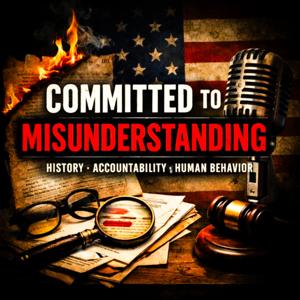


Mass media in the United States didn't reflect American attitudes about race, poverty, and crime. It manufactured them.
From the minstrel stage to the evening news. From Birth of a Nation to nightly crime segments. From welfare queen to super predator. The country was told repeatedly, across every available channel, what Black people were really like.
Repetition isn't neutral. Repetition is persuasion. And persuasion delivered by the same image, the same framing, the same word choice — across decades, across generations — becomes something harder to name. It becomes assumption. It becomes the thing people think they already knew.
This is Committed to Misunderstanding. I'm Chuck Lenahan, a tri-state licensed mental health therapist. History is the longest record of human behavior we have. And I'm going to read it correctly. Because I have the receipts.
New Episode Drops at Midnight :
YouTube: www.youtube.com/@Committed_to_Misunderstanding
Spotify: https://open.spotify.com/show/29nbu24VIhNhuiThuXj25I?si=QnRjjjmuRKeq-HpgZcHr1w
Apple Podcasts:https://podcasts.apple.com/us/podcast/committed-to-misunderstanding/id1875743898#BlackHistory
Episode 15 drops Friday.
Linda Taylor committed welfare fraud. Ronald Reagan described her as collecting $150,000 a year under80 names. Most of those details weren't in any record. By 1980, the welfare queen was American political reality — and thirty years of federal policy was built on her.
Episode 15 of Committed toMisunderstanding documents the full chain: from minstrel theater in the 1830s to the 1988 Willie Horton ad to forty years of local news crime coverage that manufactured fear rather than reported crime. With the clinical framework for why the mechanism worked, and why it still does.
Two commissions documentedthe press's failure: 1947 and 1968. Both were ignored.
The receipts exist. Friday.
Committed to Misunderstanding | Chuck Lenahan | Tri-state licensed mental health therapist
In 1919, Mildred LewisRutherford, Historian General of the United Daughters of the Confederacy, distributed a pamphlet to school boards across the South specifying which history textbooks were acceptable and which were not. Acceptable books had todescribe slavery as a benevolent institution. They had to present secession as a constitutional right. They had to avoid what Rutherford called 'prejudicial' accounts of Reconstruction.
That pamphlet shaped what students in Southern classrooms were taught for decades. And the sanitization did not stop at the Mason-Dixon line — Northern publishers quietly revisedtheir own textbooks to avoid closing the Southern adoption market, meaning children in Massachusetts and Mississippi were reading versions of American history with the same things left out.
This episode traces the documented history of how American textbooks were used to produce ignorance — deliberately, with named organizations, legislative mechanisms, and a papertrail that is available to anyone who looks. From Rutherford's measuring rod to the Texas effect to James Loewen's lawsuit against Mississippi to the 1619 Project legislation passed in 2021 the week before the hundredth anniversary of the Tulsa Race Massacre: the mechanism is the same. The language updates. The function does not.
Chuck Lenahan — tri-state licensed mental health therapist and host of Committed to Misunderstanding —applies clinical frameworks to what educational sanitization does to the people it shapes: narrative identity, benevolent historical revisionism, and the intergenerational transmission of a cognitive map that is incomplete by design.
The episode closes with homework: how to look up what your own state's curriculum actually says about slavery, Reconstruction, and the Civil War — and what questions to ask about who decided that.
History is the longest record of human behavior we have. I'm here to read it correctly. Because I have the receipts.
────────────────────────────
COVERED IN THIS EPISODE:
────────────────────────────
• Rutherford's 1919measuring rod — verbatim, with analysis
• UDC Committee onEducation and its documented influence on Southern curriculum
• Virginia textbooksdescribing enslaved people as 'generally happy' — through the 1960s
• Northern publishers andthe Southern adoption market: the business decision behind sanitization
• Tulsa Race Massacre: 75years absent from Oklahoma's state curriculum
• The Texas effect:publisher self-censorship before the adoption board ever meets
• James Loewen, Loewen v.Turnipseed (1980), and the book that was approved but never used
• FitzGerald's AmericaRevised and the systematic patterns across four decades of textbooks
• Japanese internment: 40years, 11 of 12 major textbooks with less than one paragraph
• The 1619 Project and 14states' legislative response — the same logic as Rutherford, a new apparatus
• Oklahoma HB 1775: signedthe week before the Tulsa centennial
• Clinical framework:narrative identity, benevolent revisionism, intergenerational transmission
• Your homework: look upyour state's standards
────────────────────────────
PRIMARY SOURCES:
────────────────────────────
Rutherford measuring rod(UDC, 1919) | John Hope Franklin, From Slavery to Freedom (1947) | FrancesFitzGerald, America Revised (1979) | James Loewen, Lies My Teacher Told Me(1995/2018) | Oklahoma Tulsa Race Riot Commission Final Report (2001) | OklahomaHB 1775 (2021) | Michael Apple, Ideology and Curriculum (1979)
────────────────────────────
NEW TO THE SHOW?
────────────────────────────
Watching on YouTube? The full episode is there too. Search 'Committed to Misunderstanding E14' or followthe channel link in the show notes.
Whitewashed historybrought back to its technicolor reality. With receipts.
Host: Chuck Lenahan | Tri-state licensed mental health therapist
Season 1, Episode 14 | Arc 4: Narrative
They didn't just remove Black fathers from the home. Then they blamed Black mothers for the gap. That's not analysis. That's a policy decision dressed up as sociology.In 1965, Daniel Patrick Moynihan wrote an internal government report arguing that Black family structure — specifically, the rise in female-headed households — was the root cause of poverty in Black communities.He called it a "tangle of pathology."
Here's what he left out: Black men had been systematically excluded from stable employment by documented discrimination. The GI Bill that built the white middle class had been withheld from Black veterans. Redlining had blocked Black families from the wealth-building mechanisms handed to white families after World War II.When a system removes a resource from a family, the family adapts to function without that resource.
That's not pathology. That's survival.You don't diagnose the adaptation. You look at what caused the family to need to adapt in the first place.Moynihan saw the adaptation and called it the wound.
And that framing has been doing policy damage for sixty years.
This clip is from Episode 13 of Committed to Misunderstanding :The 1965 Report That Made Black Poverty Black People's Fault, Not the Government's
SOURCES REFERENCED IN THIS CLIP• Moynihan, D.P. (1965). The Negro Family: The Case for National Action. U.S. Dept. of Labor.• Rainwater, L. & Yancey, W. (1967). The Moynihan Report and the Politics of Controversy. MIT Press.• Geary, D. (2015). Moynihan and the Single Mother. The Atlantic.• Katznelson, I. (2005). When Affirmative Action Was White. W.W. Norton.#CommittedToMisunderstanding #BlackHistory #Moynihan #SystemicRacism #Shorts
In March 1965, Daniel Patrick Moynihan wrote an internal government report meant to argue for federal investment in Black communities. The phrase he used to make that argument — 'tangle of pathology' — became one of the most consequential and most misused phrases in American policy history.
This episode documents what the report actually said, where the framing failed, and how the language survived every political era between 1965 and today. Moynihan wasn't arguing what conservatives later claimed he was arguing. But the vocabulary he chose was more useful to the system than his intent, and the system used it accordingly.
Chuck Lenahan — tri-state licensed mental health therapist and host of Committed to Misunderstanding — traces the report's journey from Lyndon Johnson's Howard University speech in June 1965, through the Watts uprising that August, to Nixon's 'benign neglect' memo in 1970, through Charles Murray and the 'underclass' vocabulary of the 1980s, through the 1994 Crime Bill and the 1996 welfare reform law, and into the Federal Reserve wealth gap data that shows what sixty years of behavioral intervention actually produced.
The Therapist Lens segment of this episode goes into attributional substitution — the clinical mechanism behind what happens when a system takes the harmful outcomes it produced and relocates their cause inside the community that experienced them. It's a reasoning error we teach trainees to catch in their second year. In 1965 it shaped federal policy. In 2025 it's still shaping it.
History is the longest record of human behavior we have. I'm here to read it correctly. Because I have the receipts.
────────────────────────────
COVERED IN THIS EPISODE:
────────────────────────────
• What the Moynihan Report actually argued — and the structural acknowledgments it made that the political reception ignored
• Kenneth Clark's original 'tangle of pathology' vs. Moynihan's reframe
• The Watts uprising, the leak, and the collapse of the federal investment argument in nine months
• James Farmer's documented response and William Ryan's coining of 'blaming the victim'
• Moynihan as Nixon advisor: the Family Assistance Plan failure and the 'benign neglect' memo
• Charles Murray, Losing Ground (1984), and the 'underclass' vocabulary
• William Julius Wilson's structural counter-argument and why it lost to Murray's framework in policy
• The 1996 Personal Responsibility and Work Opportunity Reconciliation Act: what the title tells you
• The Anti-Drug Abuse Act of 1986, the 100-to-1 disparity, and the Fair Sentencing Act corrections
• The Federal Reserve racial wealth gap: 8x, after sixty years of behavioral intervention programs
• What attributional substitution looks like in the therapy room and at policy scale
• Your homework: one question to ask the next time this conversation comes up
────────────────────────────
PRIMARY SOURCES:
────────────────────────────
Moynihan Report (1965) — U.S. Department of Labor | LBJ Howard University Address (1965) | Kenneth Clark, Dark Ghetto (1965) | William Ryan, Blaming the Victim (1971) | Charles Murray, Losing Ground (1984) | William Julius Wilson, The Truly Disadvantaged (1987) | Khalil Gibran Muhammad, The Condemnation of Blackness (Harvard, 2010) | Anti-Drug Abuse Act of 1986 | Fair Sentencing Act of 2010 | Personal Responsibility and Work Opportunity Reconciliation Act of 1996 | Federal Reserve Survey of Consumer Finances | Prison Policy Initiative data
In 1965, Section 5 of the Voting Rights Act put a hard stop between covered states and discriminatory voting law changes. Before you alter the rules, you ask permission. It worked — registration gaps that had stood for generations closed within years.
Then the system adapted.
Episode 12 of Committed to Misunderstanding follows the paper trail of the federal retreat: the Southern Strategy documented in Haldeman's own diary, the War on Drugs as a targeted disruption tool, the Reagan administration's methodical defunding of civil rights enforcement, the bipartisan rollback of the 1990s, and the Supreme Court's 2013 Shelby County decision — which removed the preclearance requirement and triggered immediate action from states that had been waiting.
Texas implemented a previously blocked voter ID law within hours of the ruling.
Host Chuck Lenahan — clinical mental health therapist — brings the clinical frame to the psychology of backlash: what it means when a system responds to documentation of harm by attacking the documentation, how the colorblind legal architecture preserves the outcomes of race-based policy under a neutral-sounding rationale, and why the Brennan Center's nine-million-vote calculation is not a statistic — it's a structural outcome.
The system doesn't disappear. It adapts. And we have the receipts.
—
Committed to Misunderstanding is hosted by Chuck Lenahan, tri-state licensed clinical mental health therapist. Whitewashed history brought back to its technicolor reality. With receipts.
In 1866, a man named Henry Adams was arrested in Mississippi for "walking without purpose." Eight months earlier, he'd been legally enslaved. The fine he couldn't pay sent him back to the same land, the same owner, the same work — as a criminal.
Episode 11 of Committed to Misunderstanding traces the five-step mechanism that turned criminal charges into forced labor contracts across the American South — and then followed the Great Migration northward into every major American city.
Licensed clinical mental health therapist Chuck Lenahan reads the statutes, the arrest ledgers, and the corporate payroll records, and applies a clinical lens to a system that wasn't broken. It was working.Whitewashed history brought back to its technicolor reality. With receipts.
IN THIS EPISODE:— The Mississippi Black Code of 1865 and the legal architecture of re-enslavement— Green Cottenham: arrested for standing still, dead in a coal mine four months later— Martin Tabert: the white man whose death in a Florida turpentine camp ended convict leasing — and what that tells us about whose suffering counts as scandal— Ida B. Wells and A Red Record: everything in this episode was said, in print, with citations, in 1895— The Chicago Commission on Race Relations and the 1922 police quote they published and nobody acted on— The Ferguson DOJ report of 2015: the same mechanism, documented by the federal government, eleven years ago— The Thirteenth Amendment's exception clause — the seven words most Americans have never read— Clinical framework: permission structures, dissociation, intergenerational pattern transmission, and the role of competent witness in trauma processing
New episodes weekly. Subscribe for updates.
SOURCES & CITATIONS:Mississippi Black Code, November 25, 1865 — Mississippi Department of Archives and History; Yale Avalon ProjectU.S. Constitution, Amendment XIII, Section 1, ratified December 6, 1865Douglas Blackmon, Slavery By Another Name (Doubleday, 2008). Pulitzer Prize for General Nonfiction, 2009Ida B. Wells, A Red Record (1895). Full text: Project Gutenberg; Documenting the American South, UNC Chapel HillKhalil Gibran Muhammad, The Condemnation of Blackness (Harvard University Press, 2010)Chicago Commission on Race Relations, The Negro in Chicago (1922)Papachristou v. City of Jacksonville, 405 U.S. 156 (1972)U.S. Sentencing Commission, Special Report to Congress: Cocaine and Federal Sentencing Policy (1995)Floyd v. City of New York, 959 F. Supp. 2d 540 (S.D.N.Y. 2013)Department of Justice, Investigation of the Ferguson Police Department (March 4, 2015)
Content warning: This episode contains detailed discussion of forced labor, death in industrial work camps, whipping and fatal corporal punishment, the sale of human beings at public auction under the cover of criminal fines, and racially targeted policing. Historical racial language appears in quoted primary-source legal text from the period.
How long does it take to execute a child in the United States of America?
In 1944, South Carolina needed 83 days to take 14-year-old George Stinney Jr. from arrest to electric chair. No written confession. No defense witnesses. No appeal. A ten-minute jury deliberation. A governor running for Senate who couldn't afford to look soft on race.
Twenty-one years later and 500 miles west, a white man named Thomas Coleman shotgunned an unarmed seminary student in broad daylight. The jury that acquitted him was selected by his own cousin. It took them under 90 minutes.
Episode 10 of Committed to Misunderstanding — "Speed of Injustice" — sits inside two courtrooms and takes apart a legal machine that wasn't broken. It was working exactly as designed. Host Chuck Lenahan is joined by post-conviction attorney Janis Mann to examine how a system can produce a conviction in ten minutes and an acquittal in ninety — using the same rules.
How long does it take to execute a child in the United States of America?In 1944, the state of South Carolina needed 83 days to arrest a 14-year-old Black boy named George Stinney Jr., interrogate him without a parent or attorney, try him in front of an all-white jury that deliberated for 10 minutes, deny his clemency petition, and walk him into an electric chair he was too small to fit into.Twenty-one years later, in Hayneville, Alabama, a 55-year-old white man shot an unarmed seminary student at point-blank range. The jury that acquitted him was selected by his own cousin. It took them under 90 minutes.Same system. Two speeds.Episode 10 of Committed to Misunderstanding sits inside both courtrooms and takes apart a legal machine that wasn't broken — it was working. Host Chuck Lenahan, clinical mental health therapist, is joined by post-conviction attorney Janis Mann to examine how the American legal system produces outcomes like these using its own rules."Speed of Injustice" — Episode 10. Dropping Friday.Subscribe for new episodes. Whitewashed history brought back to its technicolor reality. With receipts.
15,000 Black workers built cars at the Ford plant in Dearborn, Michigan. Not one of them was allowed to live there. The mayor served 36 years and told The New York Times he favored "complete segregation." That was not the South. That was suburban Detroit.In Episode 9, clinical mental health therapist Chuck Lenahan examines sundown towns — the thousands of American communities that excluded Black people, Chinese Americans, Jewish Americans, and other nonwhite groups through violence, ordinances, restrictive covenants, and coordinated silence. From Corbin, Kentucky, to Forsyth County, Georgia, to Anna, Illinois, this episode documents how exclusion was not incidental. It was geographic. It was coordinated. And it lasted for generations.Whitewashed history brought back to its technicolor reality. With receipts.
SOURCES & CITATIONS━━━━━━━━━━━━━━━
Loewen, James W. Sundown Towns: A Hidden Dimension of American Racism. The New Press, 2005.Phillips, Patrick. Blood at the Root: A Racial Cleansing in America. W.W. Norton, 2016.Wright, George C. A History of Blacks in Kentucky, Vol. 2. Kentucky Historical Society, 1992.Jaspin, Elliot. Buried in the Bitter Waters: The Hidden History of Racial Cleansing in America.Good, David. Orvie: The Dictator of Dearborn.Green, Victor Hugo. The Negro Motorist Green Book (1936–1966). Library of Congress.Jaffe, Logan. "The Legend of A-N-N-A." ProPublica Illinois, November 2019.Atlanta History Center. "1912: The Forsyth County Expulsion and Its Aftermath" (podcast), 2024.Shelley v. Kraemer, 334 U.S. 1 (1948).Buchanan v. Warley, 245 U.S. 60 (1917).Fair Housing Act of 1968 (Title VIII, Civil Rights Act of 1968).Sundown Towns Database: justice.tougaloo.edu/sundown-towns/Full source verification document: [link]━━━━━━━━━━━━━━━━━━━━━━━━━━━━━━IMAGE CITATIONS━━━━━━━━━━━━━━━━━━━━━━━━━━━━━━Derek1252. Photograph. CC BY-SA 3.0. Wikimedia Commons: commons.wikimedia.org/w/index.php?curid=25097468El Paso Herald, October 31, 1919, Home Edition, Image 1. Public Domain. Wikimedia Commons: commons.wikimedia.org/w/index.php?curid=80631991NPR Code Switch. "Red Summer in Chicago: 100 Years After the Race Riots," July 27, 2019. npr.org/sections/codeswitch/2019/07/27/744130358History Nebraska. "Omaha and the Red Summer of 1919." history.nebraska.gov/omaha-and-the-red-summer-of-1919/Chicago History Museum. "Chicago 1919." chicagohistory.org/chi1919/James19992w. Photograph. CC BY-SA 4.0. Wikimedia Commons: commons.wikimedia.org/w/index.php?curid=129025880"Negro Suspect Lynched in Jail." Morning Call, September 11, 1912."Negroes Flee from Forsyth." Atlanta Constitution, October 13, 1912.Atlanta Journal-Constitution, January 23, 1988. KKK rally, Cumming, Georgia. Georgia State University Digital Collections: digitalcollections.library.gsu.edu/cdm/ref/collection/ajc/id/1867Atlanta History Center Digital Collections: album.atlantahistorycenter.com/digital/collection/byd/id/3835/William L. Mills Papers. University of Michigan, Bentley Historical Library. Fair Use. en.wikipedia.org/w/index.php?curid=68434056Anne B. Hood. Photograph. Public Domain. en.wikipedia.org/w/index.php?curid=15265754Victor Hugo Green. The Negro Motorist Green Book, cover scan. New York Public Library. Public Domain. Wikimedia Commons: commons.wikimedia.org/w/index.php?curid=46555333Carbondale Free Press, November 15, 1909, Edition 1. Library of Congress: loc.gov/resource/sn93055779/1909-11-15/ed-1/?sp=1Wikimedia Commons: commons.wikimedia.org/w/index.php?curid=154872910#SundownTowns #AmericanHistory #BlackHistory #UntoldHistory #HiddenHistory #HistoryPodcast #CommittedToMisunderstanding #WithReceipts #RacialSegregation #SundownTown #GreenBook #Dearborn #ForsythCounty #AllWhiteOnPurpose #CriticalHistory
From the publisher's feed