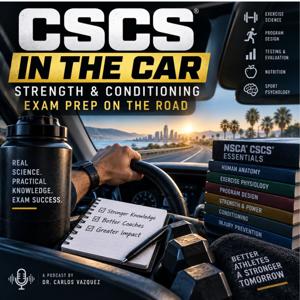
CSCS In The Car

CSCS In The Car

By Circle Of Insight ProductionsNewsEducationGovernmentPolitics
Download on the App Store

All CSCS In The Car episodes

  • Muscle Spindles vs. Golgi Tendon Organs: How Your Nervous System Controls Strength and Movement
    Muscle spindles and Golgi tendon organs are essential proprioceptors involved in neuromuscular control, reflexes, and athletic performance. In this episode of CSCS Exam Prep, we examine how these sensory receptors detect changes in muscle length and tension, influence the stretch reflex and autogenic inhibition, and contribute to strength training, flexibility, and plyometric performance. We also explore common CSCS examination questions and explain how to distinguish these two important structures.
    3 min
  • The Size Principle: Why Your Body Recruits Muscle Fibers in a Specific Order | CSCS Exam Prep
    Your muscles don’t recruit motor units randomly, and understanding the order of recruitment is essential for the CSCS exam. In this episode, we examine Henneman’s size principle, the differences between low- and high-threshold motor units, and how force demands and fatigue influence muscle activation. We’ll also explore why lifting heavier weights isn’t the only way to recruit high-threshold motor units, and what the research tells us about strength training and muscle growth. Finally, we’ll connect these principles to practical coaching decisions and common CSCS exam questions.
    4 min
  • The Stretch-Shortening Cycle — Why a Countermovement Makes You Jump Higher
    Why can most athletes jump higher when they quickly bend their knees before jumping? The answer involves one of the most important principles in exercise physiology and biomechanics: the stretch-shortening cycle. In this episode, we examine eccentric muscle loading, elastic energy storage, neural activation, and the role of plyometric training in explosive performance. We also explore how the same principles contribute to golf swing mechanics, rehabilitation, and strength training.
    5 min
  • Muscle Fiber Types Explained: Type I, Type IIa, and Type IIx | CSCS Exam Prep
    Understanding muscle fiber types is essential for the Certified Strength and Conditioning Specialist examination. In this episode of CSCS in the Car, we explore slow-twitch and fast-twitch muscle fibers, including their differences in force production, contraction speed, fatigue resistance, and energy metabolism. Learn how fiber recruitment influences sprinting, endurance performance, resistance training, and athletic development. We also examine the size principle and common CSCS exam questions to help you apply these concepts to real-world strength and conditioning programs.
    3 min
  • Motor Learning for the CSCS Exam: Feedback, Practice Variability, and Skill Acquisition
    Why do some athletes improve rapidly during practice but struggle to reproduce those skills during competition? Using golf as a practical example, review the cognitive, associative, and autonomous stages of motor learning. Learn the differences between knowledge of results and knowledge of performance, and examine how variable practice, feedback, and skill transfer apply to the CSCS examination.
    5 min
  • Dietary Fat Digestion: Absorption, Energy, and Fat-Soluble Vitamins
    Detary fat supports energy metabolism, cellular function, and the absorption of essential vitamins. This episode explains how the digestive system breaks down triglycerides and transports absorbed fats throughout the body. We explore the roles of bile, pancreatic lipase, micelles, and chylomicrons in making dietary fats available for metabolism. Connect nutrition science with the foundational knowledge needed for strength and conditioning certification.
    5 min
  • Muscle Anatomy and Function: What the CSCS Exam Expects You to Know
    Understanding muscle anatomy is one of the foundations of the CSCS exam. In this episode, we break down agonists, antagonists, synergists, and stabilizers and explain how each contributes to athletic movement. We’ll connect major muscles to common exercises such as the squat, bench press, pull-up, and biceps curl. You’ll also learn how concentric, eccentric, and isometric muscle actions differ. Finally, we’ll cover several common exam traps that can make otherwise straightforward anatomy questions confusing.

    5 min
  • Why Athletes Get Stronger: Neural Adaptations vs. Muscle Growth
    Description: An athlete can become dramatically stronger before adding much measurable muscle—but how? This episode separates the neural adaptations that improve the nervous system’s ability to use existing muscle from the morphological adaptations that eventually increase the muscle’s size and force-producing potential. Understanding the difference will help you answer CSCS questions about motor-unit recruitment, rate coding, synchronization, hypertrophy, and the time course of resistance-training adaptations.
    4 min
  • Strength, Power, or Size? Build the Workout That Matches the Goal
    Two athletes can perform the same squat and still need completely different programs. In this episode, we separate strength, power, and hypertrophy by connecting the athlete’s goal to exercise selection, loading, volume, movement intent, and rest. You’ll also tackle two practice questions designed to test the kind of programming decisions a strength coach must make.
    4 min
  • Three Energy Systems, One Athlete: Stop Thinking in Either-Or
    sprinter explodes for ten seconds, a soccer player repeats hard efforts for an entire match, and a distance runner races for miles—but all three rely on the same three energy systems. This episode explains the phosphagen, glycolytic, and oxidative systems and, more importantly, how they work together rather than switching on and off. You’ll learn how intensity, duration, and recovery determine which system contributes most and how that knowledge affects conditioning decisions
    4 min