
Sign up to save your podcasts
Or

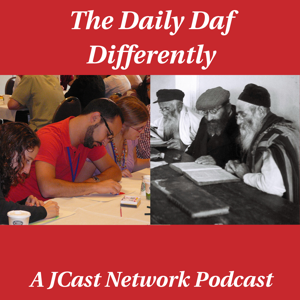


Welcome to the Daily Daf Differently. In this episode, Rabbi Aaron Alexander looks at Masechet Taanit Daf 3.
What’s in a name? An obscure question with no practical utility asks us to reflect on the moments we become our truest selves.
The opening and closing music for this podcast is Ufros from The Epichorus album One Bead.
This podcast is a collaboration with The Conservative Yeshiva in Jerusalem.
Welcome to the Daily Daf Differently. In this episode, Rabbi Aaron Alexander looks at Masechet Taanit Daf 2.
The opening Mishnah and subsequent questions offered straightaway in this tratcate uncover deep tension about the nature of God’s power, humanity’s power, and their intersection.
The opening and closing music for this podcast is Ufros from The Epichorus album One Bead.
This podcast is a collaboration with The Conservative Yeshiva in Jerusalem.
Welcome to the Daily Daf Differently. In this episode, Joe Rosenstein looks at Masechet Rosh Hashana Daf 35.
Before considering the question discussed on the brief Daf 35, we review what has been said over the week on the general theme of how the understanding and observance of Rosh Hashanah have changed over the ages, and make some suggestions for how we might modify our current understanding and observance of this holiday. The discussion on Daf 35 is confined to the question of whether or not the repetition of the Amidah by the service leader relieves individuals of the obligation of reciting the Amidah privately.
The opening and closing music for this podcast is Ufros from The Epichorus album One Bead.
This podcast is a collaboration with The Conservative Yeshiva in Jerusalem.
Welcome to the Daily Daf Differently. In this episode, Joe Rosenstein looks at Masechet Rosh Hashana Daf 34.
Daf 34 discusses the questions of when the shofar is actually blown on Rosh Hashanah, why the blessing over the shofar is said earlier in the service, what kinds of sounds are made by the shofar, how those sounds are interpreted in the 4th century, and how Rosh Hashanah might have been observed a thousand years earlier. A continuing general theme is how the understanding and observance of Rosh Hashanah changed over the ages.
The opening and closing music for this podcast is Ufros from The Epichorus album One Bead.
This podcast is a collaboration with The Conservative Yeshiva in Jerusalem.
Welcome to the Daily Daf Differently. In this episode, Joe Rosenstein looks at Masechet Rosh Hashana Daf 33.
Before looking at Daf 34, we complete the discussion of a Mishnah on Daf 33 that states explicitly that Hallel was recited on Rosh Hashanah and note that between the early Talmudic period and the later Talmudic period, and subsequently, Rosh Hashanah became more and more linked to Yom Kippur. Among the themes of Daf 34 are the situations in which one doesn’t get to hear the shofar and the question of whether women may observe the time-bound positive commandments that they are not obligated to observe. A continuing general theme is how the understanding and observance of Rosh Hashanah changed over the ages.
The opening and closing music for this podcast is Ufros from The Epichorus album One Bead.
This podcast is a collaboration with The Conservative Yeshiva in Jerusalem.
Welcome to the Daily Daf Differently. In this episode, Joe Rosenstein looks at Masechet Rosh Hashana Daf 32.
Daf 32 returns to the discussion of Rosh Hashanah. We focus on a Mishnah that discusses the Musaf Amidah and reveals both how it was recited in earlier times and how it was expanded in later times by Rabbi Akiva. The question discussed is how to add a malchuyot section to an Amidah whose focus in the past had been on zichronot and shofarot. A continuing general theme is how the understanding and observance of Rosh Hashanah changed over the ages.
The opening and closing music for this podcast is Ufros from The Epichorus album One Bead.
This podcast is a collaboration with The Conservative Yeshiva in Jerusalem.
Welcome to the Daily Daf Differently. In this episode, Joe Rosenstein looks at Masechet Rosh Hashana Daf 31.
Daf 31 continues the discussion of the changes made by Rabbi Yochanan ben Zakkai after the Temple was destroyed. First however there is a brief detour to the question of why the psalms that we recite on the seven days of the week were chosen and the belief that the world will end after the sixth millennium. (Should we worry?) We will also discuss what happened to the red wool that wouldn’t turn white. A continuing general theme is how the understanding and observance of Rosh Hashanah changed over the ages.
The opening and closing music for this podcast is Ufros from The Epichorus album One Bead.
This podcast is a collaboration with The Conservative Yeshiva in Jerusalem.
Welcome to the Daily Daf Differently. In this episode, Joe Rosenstein looks at Masechet Rosh Hashana Daf 30.
Daf 30 continues the discussion of the changes made by Rabbi Yochanan ben Zakkai after the Temple was destroyed. One topic is the lulav ceremony on Sukkot, where his ruling resulted in decentralizing the Temple practice. Another topic concerns the declaration of the new moon, why Rosh Hashanah became a two-day event, and why we don’t announce the new moon of Tishrei on the preceding Shabbat. A continuing general theme is how the understanding and observance of Rosh Hashanah changed over the ages.
The opening and closing music for this podcast is Ufros from The Epichorus album One Bead.
This podcast is a collaboration with The Conservative Yeshiva in Jerusalem.
Welcome to the Daily Daf Differently. In this episode, Joe Rosenstein looks at Masechet Rosh Hashana Daf 29.
Chapter 4 of Masechet Rosh Hashana begins on Daf 29 and its focus is on the shofar and the liturgy. The first question it discusses is whether the shofar may be blown if Rosh Hashanah falls on Shabbat, and we learn how Rabbi Yochanan ben Zakkai changed the practice after the Temple was destroyed. A continuing general theme is how the understanding and observance of Rosh Hashanah changed over the ages.
The opening and closing music for this podcast is Ufros from The Epichorus album One Bead.
This podcast is a collaboration with The Conservative Yeshiva in Jerusalem.
Welcome to the Daily Daf Differently. In this episode, Rabbi Steve Kane looks at Masechet Rosh Hashana Daf 28.
What if you ate matzah on Pesach, but didn’t do it to fulfill the mitzvah? What if you happened to pass by a synagogue on Rosh HaShanah and heard the shofar sounded? Have you still fulfilled your obligation on these mitzvot? We look into the question of whether “mitzvot tzrichot kavanah“, does the fulfillment of a mitzvah require intent?
The opening and closing music for this podcast is Ufros from The Epichorus album One Bead.
This podcast is a collaboration with The Conservative Yeshiva in Jerusalem.
From the publisher's feed
14 Listeners
6 Listeners

20 Listeners

0 Listeners

12 Listeners
6 Listeners
20 Listeners
0 Listeners

26 Listeners

2 Listeners