
Sign up to save your podcasts
Or



Send us Fan Mail
Should dancers make eye contact with the judges?
Yes… sometimes. But staring down the judges for your entire routine isn’t the same thing as connecting with your audience.
In this episode of Dance Colleges and Careers, we’re talking about one small performance choice that can completely change how your dance comes across: where you look.
I break down when eye contact with the judges actually makes sense, when it starts to feel awkward, and how dancers can use their eyes and focus to communicate a story instead of simply “performing at” the judges.
We’ll talk about:
• When it makes sense to break the fourth wall and connect directly with your audience
• How to create an imaginary person or focus point when you’re telling a story
• Why your eyes should change as your character’s thoughts and emotions change
• Three questions to ask yourself: Who do I see? Where are they? What do I want from them?
• Why purposeful focus creates a more mature, meaningful performance
Because eye contact isn’t really about looking at the judges.
It’s about purpose, meaning, and communication.
And if your dancer keeps hearing “use your face,” “perform more,” or “connect with the audience” but doesn’t actually know HOW to practice those things, that’s exactly what we work on inside Expressions Made Easy.
Expressions Made Easy is my online performance training program for dancers, built around four areas: Body, Music, Story, and Performance. Dancers work through 12 lessons, apply the tools directly to their own choreography, submit their solos for personalized feedback, and receive continued coaching throughout the season.
Parents also get support through the Parent Corner so you can understand what your dancer is working on—and help them grow without “just smile more” becoming another argument on the ride home.
Your dancer doesn’t have to wait until confidence magically shows up.
Expression is a skill. And it can be practiced.
Join Expressions Made Easy this season through the link in the show notes.
Be Seen. Be Heard. Be You.
Support the show
Ready to become a more confident performer?
Learn how to bring personality, intention, and expression to your dancing inside Expressions Made Easy.
👉 https://app.heartbeat.chat/famesquad/p/offer
Send us Fan Mail
Why does it feel like the same dancers keep getting the solos, leads, and front-row spots?
And what can your dancer actually DO if they want more opportunities?
In this episode of Dance Colleges and Careers, I’m talking about a sensitive topic—but an important one.
Getting the bigger role isn’t always about being the “best” dancer in the room. Directors and teachers are looking at so much more: Can we trust you? Do you retain choreography? Do you come back prepared? Are you paying attention when you’re not the one being taught? Do you show us what you’re capable of?
I’m sharing real examples from my own students and shows, including how dancers have earned bigger opportunities simply by learning, paying attention, preparing at home, and proving they were ready before I ever asked them to step into the role.
We’ll talk about:
• Why hard work alone doesn’t always equal the solo
• How dancers build trust with teachers and directors
• What to do when you’re not the one being featured
• Why learning material that “isn’t yours” can create opportunities
• How to recognize YOUR strengths instead of chasing someone else’s
• What your attitude communicates before you ever get another chance
• How to show your teacher that you’re ready for more
Your dancer may be more capable than their teacher even realizes—but eventually, they have to be able to SHOW it.
That’s exactly why I created Expressions Made Easy.
We work on the performance skills that help dancers stop disappearing into the choreography and start communicating with confidence, intention, and personality.
Because you can’t just feel ready for the next opportunity.
You have to learn how to be seen, be heard, and be you.
Support the show
Ready to become a more confident performer?
Learn how to bring personality, intention, and expression to your dancing inside Expressions Made Easy.
👉 https://app.heartbeat.chat/famesquad/p/offer
Send us Fan Mail
“Just feel the music.”
It sounds like good advice—but what is a dancer actually supposed to do with it?
In this episode of Dance Colleges and Careers, Brittany Noltimier explains why “just feel it” can leave dancers stuck when they’re struggling with facial expressions, performance, and showmanship.
Expression isn’t something you either have or you don’t. It’s a skill that can be learned, practiced, and trained—just like turns, leaps, musicality, and technique.
In this episode, Brittany talks about:
You don’t have to magically figure out how to “feel it.” You can learn tools, practice them, and become a stronger performer.
Want help training expression instead of guessing at it?
Expressions Made Easy gives dancers practical tools for facial expression, storytelling, musicality, and performance, along with personalized coaching for dancers and support for parents.
Learn more about Expressions Made Easy:
https://app.heartbeat.chat/famesquad/p/offer
Be Seen. Be Heard.
Support the show
Ready to become a more confident performer?
Learn how to bring personality, intention, and expression to your dancing inside Expressions Made Easy.
👉 https://app.heartbeat.chat/famesquad/p/offer
Send us Fan Mail
I watched the World Cup with a dancer’s brain—and realized that professional athletes understand something dancers often forget: performance is never optional.
From directing the crowd’s attention to celebrating a goal in front of thousands of people, athletes use their entire bodies to communicate the stakes of the moment. They commit fully, show real emotion, and aren’t afraid of being “too much.”
So why are dancers still holding back?
Technique matters, but performance is what makes you an artist—and what makes the audience remember you.
If professional athletes can scream, celebrate, cry, slide across the field, and emotionally involve an entire stadium, you can be brave enough to commit fully onstage.
Support the show
Ready to become a more confident performer?
Learn how to bring personality, intention, and expression to your dancing inside Expressions Made Easy.
👉 https://app.heartbeat.chat/famesquad/p/offer
Send us Fan Mail
Before you worry about getting a deeper split or a higher kick, can you sit on the floor with your legs straight and your spine upright?
In this episode of Dance Colleges and Careers, Brittany breaks down the simple L-sit stretch and explains why it creates an important foundation for better splits, leaps, kicks, posture, and everyday mobility.
You’ll learn how to modify the position, where you should feel the stretch, and Brittany’s two secrets for finally learning to love your L-sit: kinder self-talk and intentional breathing.
It may not look impressive on social media—but this basic stretch could reveal exactly what is holding you back.
Support the show
Ready to become a more confident performer?
Learn how to bring personality, intention, and expression to your dancing inside Expressions Made Easy.
👉 https://app.heartbeat.chat/famesquad/p/offer
Send us Fan Mail
You have your splits—so why aren’t your ballet kicks as high as your jazz or contemporary kicks?
In this episode of Dance Colleges and Careers, Brittany explains why parallel flexibility doesn’t always transfer to a turned-out grand battement. You’ll learn how turnout changes what your hips and hamstrings need, how to identify your actual restriction, and why the piriformis, posterior hip, glutes, and outer hamstring may be the missing pieces.
Stop spending more time stretching the flexibility you already have. Learn to train the position you actually need.
This episode is for educational purposes and is not medical advice.
Support the show
Ready to become a more confident performer?
Learn how to bring personality, intention, and expression to your dancing inside Expressions Made Easy.
👉 https://app.heartbeat.chat/famesquad/p/offer
Send us Fan Mail
Have you ever watched two dancers perform with the exact same technique level, but one feels captivating while the other feels flat?
Sometimes the difference isn't the dancer.
Sometimes it's the music.
In this episode, we're talking about why some songs naturally invite storytelling, emotion, and character while others leave dancers struggling to connect. Brittany breaks down the "5 W's" she uses when evaluating music choices:
When dancers understand the story hidden inside the music, facial expressions become easier, choreography becomes more meaningful, and performances become more memorable.
Whether you're a teacher choosing recital music, a choreographer building routines, or a parent trying to help your dancer connect emotionally on stage, this framework can completely change how you select music and create performances.
And if you're struggling to find the story inside your music—or need help with music selection, choreography, character work, or facial expressions—reach out. Sometimes the right song changes everything.
Support the show
Ready to become a more confident performer?
Learn how to bring personality, intention, and expression to your dancing inside Expressions Made Easy.
👉 https://app.heartbeat.chat/famesquad/p/offer
Send us Fan Mail
Your dancer stretches every day. They sit in their splits at home. They stay after class to stretch even longer.
So why aren't they getting closer?
In this episode, we're talking about one of the biggest flexibility mistakes I see dancers and parents make: assuming that more stretching is always the answer.
We'll discuss how to identify what is actually limiting your dancer's splits, why stretching the wrong muscles can slow progress, and how to create a more targeted plan for improvement.
Because sometimes the answer isn't stretching harder.
It's stretching smarter.
TO FOLLOW ALONG WITH VIDEO, CLICK HERE TO WATCH THE EXAMPLES ON YOUTUBE: https://youtu.be/_LqYa1G3-wU
Support the show
Ready to become a more confident performer?
Learn how to bring personality, intention, and expression to your dancing inside Expressions Made Easy.
👉 https://app.heartbeat.chat/famesquad/p/offer
Send us Fan Mail
Every dancer wants their moment in the spotlight—but what if the real secret to success isn't just becoming a superstar?
After watching the World Cup, I couldn't stop thinking about how the greatest players in the world still depend on their teammates. Dance is no different.
In this episode, we're talking about:
• Why teamwork is one of the most valuable skills dancers can develop
• The problem with today's "solo-first" mindset
• Why your place in the formation doesn't determine your value
• How great teammates become the performers everyone wants to hire
• The life skills your child is learning every time they step into the studio
Whether your dancer dreams of Broadway, Disney, a college dance team, or simply becoming a more confident performer, this episode is a reminder that success isn't just about standing out—it's about helping everyone around you shine, too.
If this episode encourages you, share it with another dance parent or teacher who needs to hear it.
Support the show
Ready to become a more confident performer?
Learn how to bring personality, intention, and expression to your dancing inside Expressions Made Easy.
👉 https://app.heartbeat.chat/famesquad/p/offer
Send us Fan Mail
Have you ever watched a duet or emotional contemporary routine that had beautiful technique and strong partnering… but somehow still didn’t fully connect?
In today’s episode, Brittany breaks down one of the biggest storytelling mistakes dancers make in love story routines — only showing the heartbreak without ever showing the love first.
From duets and trios to emotional solos, Brittany explains why audiences need moments of joy, connection, trust, or comfort in order to truly feel the heartbreak later in the dance. Without it, routines can start to feel confusing, one-dimensional, or emotionally disconnected — even when the choreography is strong.
Inside this episode:
• Why “angry the whole dance” doesn’t work
• The difference between a love story and a horror story
• How one small smile can completely change a performance
• Why emotional contrast creates stronger storytelling
• How dancers can portray relationships without needing real-life experience
If you want to improve your facials, storytelling, and emotional connection on stage, grab Brittany’s FREE 5-Day Facials Challenge here:
Free Facials Challenge
Confidence looks good on you.
Support the show
Ready to become a more confident performer?
Learn how to bring personality, intention, and expression to your dancing inside Expressions Made Easy.
👉 https://app.heartbeat.chat/famesquad/p/offer
From the publisher's feed
What does it actually take to stand out as a dancer—and what comes next?
Dance Colleges and Careers is for dancers and dance parents navigating training, auditions,…
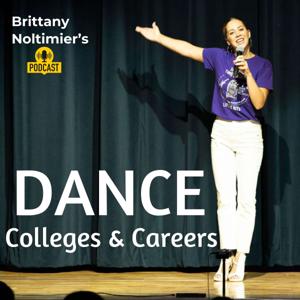
Hosted by professional dancer, educator, director, and choreographer Brittany Noltimier, this podcast goes beyond technique to talk about the skills dancers need to become stronger, more confident performers—and prepare for the opportunities ahead.
We'll talk about things like:
✨ How to stand out in auditions and performances
✨ Facial expressions, confidence, and performance quality
✨ Why some dancers get the solo, lead, or front-row spot
✨ Corrections, casting, rejection, and resilience
✨ Dance college programs and choosing the right path
✨ Careers in the dance industry
✨ What teachers, directors, and choreographers are actually looking for
You'll also hear conversations with college professors, industry professionals, dancers, educators, and other experts who can help you understand what comes next.
I know how overwhelming that next step can feel.
I grew up dancing in a small town in North Dakota and had NO idea how to navigate the college dance world. I spent time and money trying to figure it out—and eventually found my way to Oklahoma City University and a professional career in dance.
Now, I want to make that path a little clearer for the dancers coming behind me.
And along the way, I want to help dancers learn how to do more than execute choreography.
I want them to perform it.
Because technique gets you in the room—but you also need to know how to communicate, connect, and show people who you are.
Be Seen. Be Heard. Be You.
Ready to work on your performance skills? Learn more about Expressions Made Easy: https://app.heartbeat.chat/famesquad/p/offer