
Sign up to save your podcasts
Or

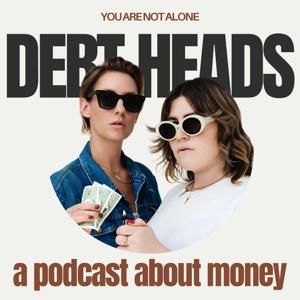


In the second episode of Debt Heads, we head to the mall to find out if life in plastic, aka using credit cards for everything, all the time, is actually fantastic.
(This is part one of a two-part episode.)
Follow Debt Heads on Instagram, TikTok, Substack, Patreon and YouTube.
Credits:
Writing/Editing/Production: Jamie Feldman & Rachel Webster
Theme Song: "Pay For That Money," Written and Performed by The Defibulators, PigCow Publishing (ASCAP)
Original Score: Ali Helnwein
Audio Mix: Jeff Seelye
When two Debt Heads try to make a go of it by creating a free (future-Peabody-award-winning) podcast, they realize they might need some subscriber-only content to stay afloat. Join us as we attempt to survive adulthood by asking both experts and non-experts one question multiple ways: How do you be "grown ups" in 2025?
In the debut episode of Survival Guide to Adulthood, Rachel & Jamie ask Claire Parker and Ashley Hamilton from Celebrity Memoir Book Club how to become celebrity podcasters, how to read, and how to survive adulthood in the creator economy. Exclusive to Patreon subscribers.
In the pilot episode of Debt Heads, revealing the truth about our finances leads to connections with strangers and catharsis with family relations.
Follow Debt Heads on Instagram, TikTok, Substack, Patreon and YouTube.
Credits:
Writing/Editing/Production: Jamie Feldman & Rachel Webster
Theme Song: "Pay For That Money," Written and Performed by The Defibulators, PigCow Publishing (ASCAP)
Original Score: Ali Helnwein
Fact Checker: Serena Chow
Audio Mix: Jeff Seelye
A narrative podcast turning the concept of debt upside down.
Season One of Debt Heads is a five-episode mini-series that investigates the architecture of personal finance and the myths of financial responsibility.
This is a storytelling journey into our lives and yours that uncovers the deeper structures that have created an economy that feels unsafe for most people.
We are endeavoring to tell the Millennial story by exploring the insidious political and economic policies as well as the seismic but elusive cultural shifts that have defined America over the last four decades.
We are not alone. You are not alone.
All Debt Head Season One episodes are free on Spotify, Apple, Youtube and Substack. Check out the Debt Heads Patreon to get access to our mini episodes as well as our Survival Guide to Adulthood - a video podcast series where we discuss Debt Head adjacent topics with friends and lovers.
Hi! How are you? Don’t answer that.
Instead, lose yourself in the misfortunes of my October(ish) budget.
While we work to independently crank out our narrative podcast (more info on that to come), I’m also trying to pay my bills (TBD), trying to get clear on what I can do to be useful over the next four (fourever?) years and trying to focus on making art.
Perhaps that’s why I was somehow more than $300 over my restaurant budget in October. IDK.
In this month’s spend recap, I open up about the difficulties and unpredictability of freelance life, something I’m still grappling with almost three years in, and outwardly share my inner conflict of what life can/should look like when you’re trying to maintain financial responsibility and some semblance of sanity.
Ironically, some of my immediate action items following last week’s election – like canceling Amazon Prime – should help at least slightly with my budget. So there’s that.
Enjoy!
XO,
Jamie
PS - there’s a lot of talk (and opinions) about inflation right now. Our Debt Heads mini episode about inflation is informative, funny, and helpful in understanding what our economic situation is really about. It’s an interesting (and maybe emotional) listen in hindsight, as we dig into what it feels like to hear the economy is “doing great!” during a time where most of us feel like crap. You can check it out here.
On a recent trip to the grocery store to procure the necessary ingredients for Rice Krispie Treats, Rachel found herself snap, crackle and popping over the price: $10 for a medium size box.
Inflation! She cursed, before leaving the store empty-handed.
But wait - what is inflation?
For the first installment of the Debt Heads Minis Econ 101 series, we consulted with the experts to get to the bottom of the cereal box, only to find there was no free prize.
Find out what we DID discover here on our newest episode. Unlike breakfast in America, it's yours totally free of charge. Bon appetit!
Special thanks to Kathryn Anne Edwards, Laura Katherine Gee and Emily Peck for not laughing at us when we asked each of them -- "so, what exactly is inflation?"
What makes a neighborhood great? Is it the people? The parks? The amount of restaurants you have saved on Google Maps?
It’s all of the above, but if you ask us, it’s also one thing in particular: the quality of the local hardware store.
You’re either thinking to yourself – what? Or 100%. Either way, this Debt Heads mini episode is for you.
As beloved neighborhood juggernaut Crest Hardware prepares to close its doors after 62 years, we set out to connect with our community and create a love letter to the local businesses that make our neighborhoods work.
Join us as we hear from passionate Crest customers, employees, and pigs, and heartwarming, problem-solving stories from Chris Mendez, who runs our local hardware store in Clinton Hill.
If you feel inspired by the prospect of a different way of living, we hope you’ll join the Debt Heads community and stay tuned for more explorations into our upside down economy.
At the beginning of the year, Debt Heads co-host Jamie Feldman made a list of resolutions. Groundbreaking!
One of those resolutions was to finally pay off the remaining balance of my credit card debt.
I’ve been working hard on it – currently it sits at around $7500. But, as a freelancer, my ability to pay it off is contingent on whether or not I have work, and whether or not the work I do have pays me in a timely manner.
Those are two very big whether-or-nots.
I’ve spent… not a small amount of time pondering whether or not I will ever in fact pay all of this debt off, and even if I do – how long it will be until I am forced to accrue additional debt in order to get by in this city, in my line of work, and in this world.
Today, we’re releasing an audio version of some of those musings (you can read the previously released, un-paywalled text version here) for people who:
* Don’t like to read
* Like the sound of my voice (which, based on the work I’m currently doing, I hope is everyone in the entire world)
* Just need a reminder that being in debt does not make you a bad person
Enjoy!
Of all the things Debt Heads co-hosts Jamie Feldman and Rachel Webster find lacking in their years of education, personal finance feels the most glaringly obvious.
As Jamie remembers it — “It did not exist in my school. It did not exist in my home. And a non-scientific survey of most people I know, including most of the people we’ve interviewed for our podcast, reveals it wasn’t in their schools or homes, either.”
In fact, as of April 2023 there was just one personal finance course, taught in the entire New York City public school system. And it's an elective.
There are many things… many of us don’t know.
We don’t know how to budget.
We don’t know how to balance a checkbook. Some of us don’t know how to write a check.
We don’t know how credit works – even though we’re told we need it to do things like rent an apartment, have a car or exist.
And what we don’t know can hurt us. At least financially. According to a report released earlier this year, 38% of Americans said lack of financial literacy cost them at least $500 in 2022. Some went so far as to say it cost them up to $10,000.
This week, in part four of our four-part “How did you get into so much debt?” series, Jamie breaks down all the ways she was not prepared for financial life.
Predatory lending is the practice of lending money to people who are desperate, financially uneducated and easy to take advantage of. And it usually involves really unfair terms.
Debt Heads co-host Jamie Feldman uses the term loosely when it comes to the $20,000 of credit card debt she started paying down two years ago.
She was not a victim of the kind of predatory lending that leaves people repaying loans with massively high interest rates and unattainable terms.
She would (and does), however, argue that most lending practices from credit card companies, as they are structured legally, are predatory just by nature.
Take, for example, the practice of credit limit extensions. Especially the ones you never asked for in the first place.
This week, part three of our four-part “how did you get into so much debt in the first place?” series, we discuss predatory lending practices, sky high credit limits and how to better protect yourself from the lure of credit card companies.
Today, let's pretend for a few minutes that we’re Keith Morrison on Dateline and catch a predator -- together.
From the publisher's feed
78,422 Listeners

30,701 Listeners
14,655 Listeners

111,799 Listeners

56,447 Listeners
10,267 Listeners

4,110 Listeners

3,968 Listeners

3,614 Listeners
13,934 Listeners

14,353 Listeners
5,557 Listeners
16,840 Listeners

3,451 Listeners
1,535 Listeners