
Sign up to save your podcasts
Or



This episode focuses on one of the toughest issues in the world, namely efforts by the US to reconcile the Zionist national movement, or Israel, and the Palestinian national movement. The interviews focus on two key moments in recent decades that aimed to bring Israel and the Palestinians closer to peace: the 1993 Oslo Accords and the 2005 disengagement from the Gaza Strip. The Oslo Accords were significant because these talks marked Israel’s recognition of a Palestinian nationalist movement. Rabin sacrificed more than just political capital for these efforts: he lost his life for them, to an assassin’s bullet at a peace rally in Tel Aviv in November 1995. A decade later, Prime Minister Ariel Sharon chose to pull out 8,000 settlers from Gaza. Sharon was the architect of the settlement movement and, therefore, had a unique political credibility to make this decision.
Host David Makovsky discusses this these moments with two individuals who were both personally involved. Tzipi Livni has served as Israeli foreign minister, justice minister, opposition leader, and head of the Israeli negotiating team during the 2013-2014 Kerry peace talks. Dennis Ross is David's colleague at the Washington Institute and co-author of Be Strong and of Good Courage: How Israel’s Most Important Leaders Shaped its Destiny (which features chapters on both the Oslo Accords and Gaza disengagement). He has served in multiple US administrations, including as Middle East envoy and chief negotiator in the H.W. Bush and Clinton administrations.
Audio Clips Used
Signing of the Israeli-Palestinian Declaration of Principles
Hosted on Acast. See acast.com/privacy for more information.
This episode focuses on the immigration of Soviet, Ethiopian, and Syrian Jewry to Israel, the impact of which has been massive. Over a million Jews moved to Israel at the end of the Cold War alone, greatly increasing its small population and bringing professional backgrounds that helped trigger a high-tech boom. The United States played a key role in all three of these immigration waves, using economic, diplomatic, and military means to support them.
Host David Makovsky discusses this transformative cooperation with Natan Sharansky and Malcolm Hoenlein. Sharansky embodied the Soviet Jewry movement in the 1970s and 1980s, uttering the iconic words “Next year in Jerusalem” that captured hearts around the world and landed him on the cover of Time magazine. He recently completed a nine-year term as chair of the Jewish Agency, the Israeli organization that links Jewish communities around the world. Hoenlein has been a dominant figure in American Jewish groups for decades, most recently completing thirty-two years as executive vice chairman of the Conference of Presidents of Major American Jewish Organizations. He has also been a key figure in winning U.S. government support for persecuted Jewish communities.
Audio Clips Used
Freedom Sunday
Hosted on Acast. See acast.com/privacy for more information.
This episode focuses on the first Arab-Israeli peace breakthrough, the Camp David Accords of 1978. Camp David resulted from Egyptian president Anwar Sadat’s electrifying visit to Jerusalem. It also required political courage from the other two leaders involved—President Jimmy Carter and Israeli prime minister Menachem Begin, who each took risks that put them at odds with domestic allies. The resultant Egypt-Israel peace treaty has had a remarkable impact on both countries, including an end to decades of interstate wars. And it endures today despite facing many obstacles, including Sadat’s assassination.
Host David Makovsky discusses this major decision point with Dr. Ken Stein, who has been a professor of contemporary Middle Eastern history, political science, and Israel studies at Emory University for forty-three years. Ken has written several books on regional peace negotiations, including Heroic Diplomacy: Sadat, Kissinger, Carter, Begin, and the Quest for Arab-Israeli Peace.
Audio clips used:
RR7748A MIDDLE EAST SADAT'S VISIT TO ISRAEL
Middle East: Sadat's Visit to Israel (B)
Hosted on Acast. See acast.com/privacy for more information.
This episode focuses on the 1973 war between Israel and a coalition of Arab states, a surprise conflict that broke out in an era of detente between the United States and the Soviet Union. One key moment came two weeks into the war, when Washington decided to provide $2.2 billion in strategic air resupply to Israel. This military aid helped turn the tide, with Israel soon positioning forces on the western bank of the Suez Canal, advancing within ten miles of Damascus, and encircling Egypt’s massive Third Army in the Sinai.
Host David Makovsky discusses this major decision point with Martin Indyk, a distinguished fellow at the Council on Foreign Relations who is currently working on the book Henry Kissinger and the Art of the Middle East Deal. A longtime diplomat, Indyk served as U.S. special envoy on peace negotiations from 2013 to 2014.
Audio clips used:
10/10/73: Yom Kippur War - ABC News
Hosted on Acast. See acast.com/privacy for more information.
This episode discusses the Johnson administration’s policy in the weeks leading up to the 1967 Six Day War. As that conflict drew near, two Israeli missions to the United States, led by Abba Eban and Meir Amit, encountered the same official focus on Vietnam, yet produced different results by asking different questions. In that sense, 1967 was a major turning point not only in Israel’s history, but also in the history of the U.S.-Israel relationship.
Host David Makovsky discusses this major decision point with William Quandt, who served with the National Security Council during the Nixon and Carter administrations and took part in the U.S. negotiating team for the Camp David Accords and Egypt-Israel peace treaty in the late 1970s. A longtime professor at the University of Virginia, he has authored several books on U.S. Middle East policy, including Decade of Decision: American Policy Toward the Arab-Israeli Conflict, 1967-76.
Hosted on Acast. See acast.com/privacy for more information.
This episode focuses on one of the lowest points in the U.S.-Israel relationship: the 1956 Suez Crisis. At the time, President Eisenhower felt betrayed by Israel, France, and Britain for initiating war after Egypt nationalized the Suez Canal. The episode highlights ties with allies alongside his desire to win support for Arab nationalist champion Gamal Abdul Nasser, the Egyptian leader whom the White House hoped in vain would be a bulwark against the Soviets in the Cold War. How did Eisenhower balance these conflicting impulses? What impact did his decisions have on the future of Nasserism, U.S.-Israel relations, and the American role in the Middle East? What was Eisenhower’s dramatic gamble?
Host David Makovsky discusses these and other questions with Michael Doran, a former Princeton University professor, Senior Fellow at the Hudson Institute, and author of Ike’s Gamble: America’s Rise to Dominance in the Middle East.
Audio Clips Used:
"1956 - Suez Crisis"
"U.N. Meeting on Suez Canal and Israel - Egyptian War Reel 1 (1956)" - British Pathé
Hosted on Acast. See acast.com/privacy for more information.
This episode will focus on the moment when Britain was about to depart Mandatory Palestine and there was heightened uncertainty about whether the State of Israel would be formed. The episode highlights the battle between the personalities and policy differences of President Harry Truman and his advisors, and chronicles America’s dramatic path to recognizing the Jewish State.
Host David Makovsky will be in conversation with Ronald Radosh, co-author of one of the preeminent books on Truman and 1948, A Safe Haven: Harry S. Truman and the Founding of Israel.
Audio Clips Used
"FDR Dies 450412 News Clip 01, Old Time Radio"
"President Roosevelt Meets Middle East Leaders [Etc.]
"Last British Troops Leave Palestine - 1948"
70th Anniversary of UN Partition Plan Vote
At War with the Experts [CSPAN]
Hosted on Acast. See acast.com/privacy for more information.
In this episode, we will discuss the United States’ little-known role in the Balfour Declaration, and the influence and prominence starting as early as America's founding fathers of the idea of a Jewish homeland in Palestine.
Host David Makovsky will be in conversation with Michael Oren, the former Israeli ambassador to the United States and a former member of Knesset. Oren received his doctorate in Near East Studies at Princeton University. His book, Power, Faith, and Fantasy: America in the Middle East from 1776 to the Present, provides a comprehensive overview of the United States’ involvement in the region from its very first days.
Hosted on Acast. See acast.com/privacy for more information.
We cannot fully appreciate the special bond between the U.S. and Israel without first understanding the highs and lows of this relationship over the past 70 years—how Israel’s first Prime Minister David Ben-Gurion believed it was possible that there would be a U.S. military strike against Israel; how the U.S. came to occupy such a central role in the Israeli-Palestinian peace process; or what the internal debate in the U.S. government looked like at the time of the Suez Crisis, the Six-Day War, or the Yom Kippur War.
Regardless of your familiarity with Israeli history, each episode of "Decision Points: The U.S.-Israel Relationship" will give you the background you need before moving into an interview that will illuminate the key debates at the time.
Hosted on Acast. See acast.com/privacy for more information.
From the publisher's feed
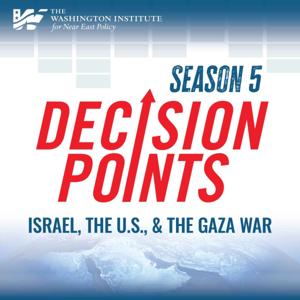
Decision Points is the podcast that gets beyond the noise on tough choices in the Middle East. Hosted by David Makovsky of The Washington Institute, the show brings together top policymakers and…
Season Six tackles the toughest U.S. foreign-policy debates, from the brink of war in Iran to the painful aftermath in Gaza and the new government in Syria. In each episode, Makovsky sits down with top American, Israeli, and Arab policy experts and former officials to clarify the options and understand the stakes. This season asks: Is the Middle East headed for more war and uncertainty? Or could America help the region move toward greater security and progress?
David Makovsky directs the Washington Institute’s Koret Project on Arab-Israel Relations and is a leading expert on the Israeli-Palestinian conflict and U.S.-Israel relations. He served as a senior advisor to the special envoy for Israeli-Palestinian negotiations at the U.S. Department of State in 2013-14 and is the author of four books on Arab-Israeli relations.
Hosted on Acast. See acast.com/privacy for more information.

38,717 Listeners

111,799 Listeners
7,120 Listeners
448 Listeners
1,215 Listeners

3,167 Listeners
1,071 Listeners

15,882 Listeners
230 Listeners

8,430 Listeners

144 Listeners
80 Listeners

914 Listeners