
Sign up to save your podcasts
Or

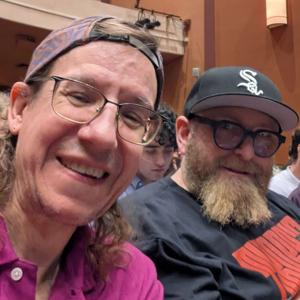


James and I recorded this one in a parking garage for irreducibly ambiguous counter-reasons. All of the expected distractions of the parking garage environment were intended to illustrate the unintentional negativity necessary for a loving encounter with the Other. As two long term sober dudes, we're always looking for new Deleuzian "Lines of Flight" from the toxic positivity of the sort of self-optimization that our drinking used to protect us from. We would like to continue to actively ruin our lives and our time for the mechanisms of capitalistic capture by becoming "imperceptible," even to ourselves, and therefore as non-transactable yet productive as possible. Join us for a truly worthless conversation about the negativity of love, or the "Agony of Eros," as Byung-Chul Han put it. Whatever you're able to discern of the conversation over the noise of the cars passing by and the intense wind storm raging all around us in central Ohio's weirdly, windy clime, will certainly whet your whistle for the suffering gifted to true lovers by eros, not so much in the banal and idiotically positive vein of the Marquis de Sade, but rather in that of the erotic suffering of the negative excess of Georges Bataille "Accursed Share."
https://youtu.be/YXn2K8ESb-w if you prefer YouTube, James and I posted the video of us performing this material there, or search Reading Together in Recovery: The Agony of Eros by Byung-Chul Han
https://www.martinessig.com
Baddass vibes mixed by James Reeves of Midnight Radio https://www.jamesreevesco.com
Shawn and I discuss Siddhartha by Herman Hesse, and its relation to his recovery. Hesse has served as an introduction of Eastern thought to Westerners for over a century now. Hesse has been criticized by some of getting Buddhism wrong, or of "cultural appropriation" in general, or of being too individualistic and naive in his depiction of the spiritual journey as a solipsistic retreat into the balance and harmony of nature from the fallen, hectic world of family and work. While all those accusations may be valid to some degree or another, there is still much that recommends Hesse's version of authenticity or of Jungian "Individuation." Shawn recounts how the text helped him to come to certain essential realizations as he walked the paths of both decadence and recovery. It may be that JD Salinger and other Western authenticity hounds misused Hesse's thought to separate the world into the real ones and the phonies, but Hesse himself doesn't make any such facile categorizations. Shawn demonstrates how Hesse's thought can be understood as a sort of unification of opposites that neither resolves one into the the other nor becomes the sort of whole that Hesse and the great thinker of wholeness Karl Jung were both accused of. Hesse's whole is the wholeness that includes what can't be whole, something like Jung's individuation through the integration of the shadow, and it is this creative contradiction at the center of Hesse's work that still makes reading him worthwhile.
https://www.martinessig.com
Baddass vibes mixed by James Reeves of Midnight Radio https://www.jamesreevesco.com
Char and I cross over from our normally audio-only Desire of Horror Podcast to produce this Youtube video.
https://www.buzzsprout.com/2509184/episodes/19031864
https://youtu.be/XR8TvC5gfso
We discuss the book Horrorstor by Grady Hendrix. The book provides a somewhat obvious but nonetheless useful capitalist critique around the concepts of the Professional Managerial Class or corporate speak; Consumer Culture, especially influencer advertisement techniques; and the toxic positivity of constant "self-maximization." An Ikea-like furniture store is built on the past site of a particularly ignominious prison, and the spirit of its warden and his prisoners emerge from within the vast, deliberately disorientating halls of the "Orsk" furniture store to haunt its circulating corridors, which are already haunted by the gaze of capital and consumption. The former prison was one of Jeremy Bentham's infamous "Panopticons." A Panopticon was a prison designed to require minimal guards because the prisoners always had the sense that they were being watched by the guards who were placed in a watch tower in the middle of the prison complex, so that they were able to see the maximal number of cells from their vantage point. The Panopticon serves as a fruitful metaphor throughout the novel as the horror of the ineluctable, internalized gaze of the Lacanian "Big Other," which for horror fans is something like the incubus always speaking from inside of the possessed's head.
https://www.martinessig.com
Baddass vibes mixed by James Reeves of Midnight Radio https://www.jamesreevesco.com
Doug and I discuss Nothing to Grasp by Joan Tollifson. Doug's spiritual journey has been one of continual exploration through his life and in his recovery itinerary. He has recently been getting deeply into nonduality in addition to his Christian practice. Our conversation about Tollifson's recovery sojourn and nondual practice allow us to discuss Doug's insights into being fully present now wherever we find ourself on the path.
https://youtu.be/eP3FMtZq15M
https://www.martinessig.com
Baddass vibes mixed by James Reeves of Midnight Radio https://www.jamesreevesco.com
There's a lot of hype right now about a "Psychedelic Renaissance." Dom and I get into the first two figures of the Book High Weirdness by Eric Davis, the McKenna Brothers, Terence and Denis. There is on the one hand, the scientific desire for certainty, which we associate with third-person, "objective" verifiability. This sort of inquiry and knowing is inline with what modern neurobiology imagines as the evolutionary design of the brain as a "prediction machine." If we are prediction machines, inquiry is for the reduction of uncertainty in order that we might be able to manipulate and control our environment better to our advantage. However, there is on the other hand, the religious desire to encounter the "Other," or that which we cannot reduce to the categories of scientific understanding and which cannot be reduced to a mere projection of our own intention either. The McKenna brothers encapsulate these two competing, perhaps, contradictory drives to make familiar and / or to encounter what is truly other.
https://www.martinessig.com
Baddass vibes mixed by James Reeves of Midnight Radio https://www.jamesreevesco.com
Dom and I discuss High Weirdness by Eric Davis in relation to spiritual experience in general but also to Dom's personal experiences as a psychonaut before getting sober. We are interested in exploring the relation of psychedelic experience to the process of recovery. Of particular interest is the irreducible ambiguity, or weirdness, of psychedelic experience that can either be a nightmare or the ecstasy of release from habitual modes of thinking and being in the world. Infamously, Bill W., the founder of AA was a part of an early research project with LSD to "cure" alcoholics of their "obsession" with alcohol. Does the weirdness of the psychedelic trip have the potential to break one out of addiction's habitual binding, or is it just another form of "low-level" spiritual seeking that contains limiting bindings of its own?
https://youtu.be/HpIwJiy_zAw
https://www.martinessig.com
Baddass vibes mixed by James Reeves of Midnight Radio https://www.jamesreevesco.com
Patrick and I discuss My War Gone By, I Miss It So by Anthony Loyd in relation to our journey's into sobriety and our mutual ADHD diagnoses. War was a sort of fantasy projection as well as a proving ground for Anthony Loyd, but what he proved to himself and shows to the reader is that almost nothing that is imagined or said about it is true, especially what he was led to believe about war and glory as it was depicted in the stories of his own military family's history. Patrick chose this book because it reflects struggles common to those attempting sobriety. In particular, recovery is a struggle to uncovered one's fantasy projections and to learn how to live without addictions that once helped to cover-over pain for which there where no other strategies at the time.
https://youtu.be/_Gn2l13UMzQ
https://www.martinessig.com
Baddass vibes mixed by James Reeves of Midnight Radio https://www.jamesreevesco.com
Warning: This discussion contains reference to severe depression, suicidal ideation, self-harm, and addiction. Tom and I wrap up our three part discussion about William Styron's Darkness Visible. We really get into some of the complexities of having a dual diagnosis, specifically both addiction and depression, and how any underlying conditions of addiction come on stronger than ever after self-medicating with alcohol, and / or one's drug(s) of choice, stops.
https://youtu.be/wqxZgj4b4ms
https://www.martinessig.com
Baddass vibes mixed by James Reeves of Midnight Radio https://www.jamesreevesco.com
Warning: we discuss severe depression, suicidal ideation, addiction, and self-harm. In this episode Tom and I discuss Darkness Visible by William Styron. We focus on Tom's experience with severe depression in recovery and Styron's considerations of Albert Camus's Myth of Sisyphus.
https://youtu.be/6qu4dmUZDxc
https://www.martinessig.com
Baddass vibes mixed by James Reeves of Midnight Radio https://www.jamesreevesco.com
Warning: We discuss severe depression, suicidal ideation, and addiction. In this video Tom and I discuss Darkness Visible by William Styron. We relate Tom's struggle with severe depression in recovery to Styron's telling of his extremely difficult circumstances. We especially focus on mystical treatments of the "Dark Night of the Soul" as either a helpful or a dangerous framing of severe depressive states.
https://youtu.be/Eax1Oho-jKY
https://www.martinessig.com
Baddass vibes mixed by James Reeves of Midnight Radio https://www.jamesreevesco.com
From the publisher's feed
Going deep together into the "Classics" that have called from "Elsewhere" to the unfathomable depths within. David Tracy thought of a "Classic" as a work that was open to multiple, productive…