
Sign up to save your podcasts
Or



James and I have been fast friends every since we met a couple of years ago. He's the one who talked me into making some of my work public. This podcast is certainly a part of that general move to sharing some of what I study with my fellow citizens. James doesn't like or listen to podcasts. I love them, especially one's about books, like this one. If I send a podcast to him, he probably won't listen to it. And if he does, he'll slow it down to 66 percent, or some BS, and use it to go to sleep. I'm not sure if he thinks their gosh or self-indulgence or just boring. He might listen to this one, but I'm not sure. Convincing him to do this with me was a kind of loving compromise on James's part. We both love books and reading them together. James made a momentous decision recently that's he'd stop being "precious" about the projects that he involved himself in, he's said "no" to some pretty big names, and so we have embarked on this journey together into books!
Our first book is an outgrowth of James's book club, of which I'm an original member in good standing. James and I have started many clubs together, adventure club, movie club (possibly defunct), dream club, game club, demonology club, and some others that I'm not remembering right now, but James is the founder and ultimate boss of book club. Piranesi has many of the themes that most interest me: esoteric religious practices, weird alternate worlds, mental disorders, and labyrinths. James didn't love the book, but he kindly brings his keen literary insights to it anyways. Please, enjoy this book talk.
James is also responsible for the cool vibes at the beginning and end of all my podcasts. jamesreeves.co
https://www.martinessig.com
Baddass vibes mixed by James Reeves of Midnight Radio https://www.jamesreevesco.com
In this video, we conclude our discussion of the introduction to Brook Ziporyn's book, focusing on the concept of "Atheism as Uberpiety." We contrast traditional religious experiences—which attempts to reduce uncertainty by providing cohesive rules and a stable identity—with a more profound, "decentering" religious experience that embraces ambiguity and radical paradigm shifts. We argue that rigid monotheism is stifling because it enforces a single, absolute truth and strict moral categories, thereby preventing individuals from experiencing the richness of multiple, open-ended possibilities. Instead, we suggest that authentic "ecstatic" religious experiences occur when we step outside of our conditioned programming and rigid identities.
https://www.martinessig.com
Baddass vibes mixed by James Reeves of Midnight Radio https://www.jamesreevesco.com
Scott and Marty discuss and ultimately reject the philosophical thesis that monotheism was a "necessary stage" in the transition from ancient religiosity to modern secularism, arguing instead—via Brook Ziporyn—that Chinese religions like Daoism and Buddhism achieved concepts of "no-self" and "purposelessness" without ever positing a unified divine intention. They trace the Western history of "demythologizing" the world, describing how the survival instinct to project agency onto nature (animism) evolved into the depersonalized "unmoved mover" of Greek philosophy and the "omni-God" of Israel, before finally being internalized by Kant as the "synthetic a priori" structures of human consciousness. The speakers contend that while this trajectory led to secular humanism, it retained the dangerous flaw of believing in a "single purposeful mind"—whether divine or scientific—which allows for the violent enforcement of a "unified good". Contrasting this with the psychoanalytic reality that human minds are inherently conflicted and ambivalent, they conclude that authentic religious experience lies not in control or purpose, but in embracing "irreducible ambiguity" and the "intentionless void" of the sublime
https://www.martinessig.com
Baddass vibes mixed by James Reeves of Midnight Radio https://www.jamesreevesco.com
We cover the second two sections of the introduction of Brook Ziporyn's book Experiments in Mystical Atheism, "Preaching to the Choir" and "Let's Assume a Brain Tumor." You can also watch our conversation on YouTube at Adventures in Mystical Atheism: https://www.youtube.com/@ske313/podcasts
Scott and Marty discuss the limitations of the "symbolic"—the rules, language, and culture used to navigate the world—arguing that it cannot fully contain the "irreducible ambiguity" of reality, which drives humans to seek a "meta-language" or "Big Other" to guarantee coherence and truth. While modern society often elevates scientific discourse to this role, the speakers use the debate regarding transgender identities to demonstrate that science alone cannot resolve questions rooted in deep, extra-rational values. They critique the "New Atheists" (specifically Richard Dawkins, Sam Harris, and Christopher Hitchens) for employing material reductionism and secular humanism as totalizing narratives that attempt to eliminate mystery—such as reducing behavior to genetic survival or meditation to economic productivity—rather than acknowledging the "abyss" of meaning. Drawing on the work of Ziporyn, the discussion concludes by advocating for "inter-subsumption," a state where conflicting perspectives like science and religion coexist without one blotting out the other, allowing individuals to hold intentions loosely and accept the lack of a single, all-encompassing identity.
https://www.martinessig.com
Baddass vibes mixed by James Reeves of Midnight Radio https://www.jamesreevesco.com
We cover the first two sections of introduction of Brook Ziporyn's book Experiments in Mystical Atheism, "The Weird Idea" and "God as Default?". You can also watch our conversation on YouTube at Adventures in Mystical Atheism: https://www.youtube.com/@ske313/podcasts
Scott and I have been on a journey together for a long time. We met as undergraduates at Indiana University in 1991. We bonded around a love of philosophy and music. Over the past thirty-five years there have been countless late night conversations and warehouse parties (not so great for philosophical conversations), especially at those venues related to the underground Chicago House and Detroit Techno scenes. There have been three culminating events recently out of which this podcast was born: the 2025 Lack Conference, seeing Godspeed You! Black Emperor in a Detroit warehouse, and Brook Ziporyn's book Experiments in Mystical Atheism.
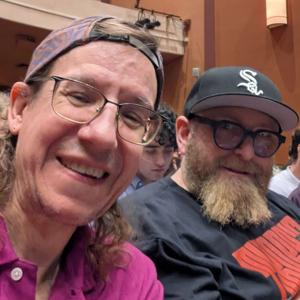
The picture that we're using as the podcast's art is of us getting ready to listen to Slavoj Zizek give the keynote at the 2025 Lack Conference, where at 52 I finally presented my first academic paper, which was on the connection between Jacques Lacan's "Real" and Jean-Luc Marion's "Saturated Phenomenon." The second event occurred early this Fall when I went up to Detroit to see Godspeed with my partner Charla and my friends James and Candy. Pulling into a ghostly, but now legal, massive warehouse complex "somewhere in Detroit," as the Underground Resistance puts it, brought back so much of Scott's and my history together in the holy temples comprised of dark remnants of the post-industrial collapse of our esoteric, midwestern lives. And Godspeed'salchemical drones and refractory repetitions accomplished for Scott and me the religious ecstasy that this music is designed to produce, without the assistance of any other mind altering substances. As Genesis P-Orridge put it, "music is psychedelic all by itself." Our bodies are indeed "temples," designed to receive, without the containment of an intention, the sacred vibrations of Marion's "Elsewhere," and of Giles Deleuze's "deterritorialized flows of intensities." Scott and I were at Church, and we knew it, the one true, holy, catholic, and apostolic Church. I wept for most of the show and raised my hands and shouted "glory" and "hallelujah" to whatever it is that Meister Eckhart called the "God beyond God," which is what Scott and I call "love," and what Marion calls the love that precedes God as the "God Beyond Being."
The third event was the discovery of Brook Ziporyn's book a few months ago, which has helped us to frame our journey together into a religious practice that is without the intention of a totalizing intention. Ziporyn's presentation of the Daoist concept of "Wu Wei" as "purposeless action" has given us new concepts for a journey that isn't without purpose, or concepts, but without the sort of absolute purpose, or intention, that Western notions of God insist on. Ziporyn's aphorism "No God, but many gods," captures perfectly our unwillingness to throw out the sacred along with the Omni-God. We were born of the unconditioned, unintentional love that proceeded being's intentions, and our holy intention is for the purposeless inclusivity of this groundless ground of love.
Join us on our journey into the super-saturated darkness of love.
https://www.martinessig.com
Baddass vibes mixed by James Reeves of Midnight Radio https://www.jamesreevesco.com
We've updated our introduction to the preface of the book to make it shorter and clearer. You can also see this episode on YouTube at Adventures in Mystical Atheism: https://www.youtube.com/@ske313/podcasts
Scott and I have been on a journey together for a long time. We met as undergraduates at Indiana University in 1991. We bonded around a love of philosophy and music. Over the past thirty-five years there have been countless late night conversations and warehouse parties (not so great for philosophical conversations), especially at those venues related to the underground Chicago House and Detroit Techno scenes. There have been three culminating events recently out of which this podcast was born: the 2025 Lack Conference, seeing Godspeed You! Black Emperor in a Detroit warehouse, and Brook Ziporyn's book Experiments in Mystical Atheism.
The picture that we're using as the podcast's art is of us getting ready to listen to Slavoj Zizek give the keynote at the 2025 Lack Conference, where at 52 I finally presented my first academic paper, which was on the connection between Jacques Lacan's "Real" and Jean-Luc Marion's "Saturated Phenomenon." The second event occurred early this Fall when I went up to Detroit to see Godspeed with my partner Charla and my friends James and Candy. Pulling into a ghostly, but now legal, massive warehouse complex "somewhere in Detroit," as the Underground Resistance puts it, brought back so much of Scott's and my history together in the holy temples comprised of dark remnants of the post-industrial collapse of our esoteric, midwestern lives. And Godspeed'salchemical drones and refractory repetitions accomplished for Scott and me the religious ecstasy that this music is designed to produce, without the assistance of any other mind altering substances. As Genesis P-Orridge put it, "music is psychedelic all by itself." Our bodies are indeed "temples," designed to receive, without the containment of an intention, the sacred vibrations of Marion's "Elsewhere," and of Giles Deleuze's "deterritorialized flows of intensities." Scott and I were at Church, and we knew it, the one true, holy, catholic, and apostolic Church. I wept for most of the show and raised my hands and shouted "glory" and "hallelujah" to whatever it is that Meister Eckhart called the "God beyond God," which is what Scott and I call "love," and what Marion calls the love that precedes God as the "God Beyond Being."
The third event was the discovery of Brook Ziporyn's book a few months ago, which has helped us to frame our journey together into a religious practice that is without the intention of a totalizing intention. Ziporyn's presentation of the Daoist concept of "Wu Wei" as "purposeless action" has given us new concepts for a journey that isn't without purpose, or concepts, but without the sort of absolute purpose, or intention, that Western notions of God insist on. Ziporyn's aphorism "No God, but many gods," captures perfectly our unwillingness to throw out the sacred along with the Omni-God. We were born of the unconditioned, unintentional love that proceeded being's intentions, and our holy intention is for the purposeless inclusivity of this groundless ground of love.
Join us on our journey into the super-saturated darkness of love.
https://www.martinessig.com
Baddass vibes mixed by James Reeves of Midnight Radio https://www.jamesreevesco.com
From the publisher's feed
Going deep together into the "Classics" that have called from "Elsewhere" to the unfathomable depths within. David Tracy thought of a "Classic" as a work that was open to multiple, productive…