
Sign up to save your podcasts
Or


CONTENT DISCLAIMER: This episode discusses a play which depicts predatorial relationships, sexual assault, and grooming.
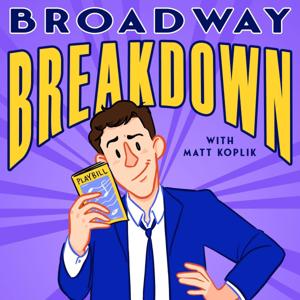
In this episode, Matt sits down with Breakdown fam Margaret Hall (Playbill, Gemignani) to unpack Paula Vogel’s Pulitzer Prize–winning play How I Learned to Drive. Together, they explore the play’s nonlinear structure, its daring tonal shifts, and nuanced depiction of predatory relationships, violation, and survival. From its acclaimed 1997 premiere to its long overdue 2022 Broadway debut, this conversation examines why Vogel’s play remains as urgent—and as debated—as ever.
Important Broadway Breakdown Links
Sondheim. Webber. Koplik. A Birthday Threesome: Tix
Broadway Breakdown: Discord
Broadway Breakdown : Substack
Margaret Hall: Website
Margaret Hall is a theater journalist and critic whose work has appeared in Playbill and beyond. Known for her thoughtful analysis and deep knowledge of contemporary theater, Margaret brings both scholarly rigor and emotional intelligence to this discussion—making her an ideal guide through Vogel’s intricate, memory-driven script and its evolving cultural context.
Timestamps
00:00 – Introduction and why How I Learned to Drive still sparks conversation 05:12 – Paula Vogel’s background and the play’s 1997 premiere 12:45 – Plot overview: Li’l Bit, Uncle Peck, and the mechanics of memory 22:30 – The Greek Chorus device and Vogel’s nonlinear structure 31:18 – Tone, humor, and discomfort: why the play feels dangerous 41:07 – Original Off-Broadway production and early critical response 58:34 – The 2022 Broadway revival: returning cast and creative team 1:10:21 – Tony Awards recognition and contemporary reception 1:18:46 – Directorial interpretation and performance nuance 1:27:05 – The play in the #MeToo era: shifting audience lenses 1:36:40 – Legacy, pedagogy, and why the play continues to be produced 1:45:12 – Final thoughts: is this a “masterpiece,” and what does that mean?
Key people mentioned
Paula Vogel – Playwright
Mark Brokaw – Original Off-Broadway and Broadway revival director
Mary-Louise Parker – Original Li’l Bit (1997)
David Morse – Original Uncle Peck (1997)
Johanna Day – Greek Chorus (original production)
Norbert Leo Butz – Uncle Peck (2012)
Listener discussion questions
How does Vogel’s use of a nonlinear structure affect the audience’s response to Li’l Bit and Uncle Peck, as opposed to If the play were presented in chronological order?
Is it important for an audience to not always be comfortable? What play can you think of that lured an audience in with difficult subject matter?
How has How I Learned to Drive shifted your perception (if it has at all) on survival?
As always, join the conversation on Substack and in the Broadway Breakdown Discord—and let us know where this play ranks in your personal American theater canon.
 View all episodes
 By Matt Koplik

4.8
360360 ratings
CONTENT DISCLAIMER: This episode discusses a play which depicts predatorial relationships, sexual assault, and grooming.
In this episode, Matt sits down with Breakdown fam Margaret Hall (Playbill, Gemignani) to unpack Paula Vogel’s Pulitzer Prize–winning play How I Learned to Drive. Together, they explore the play’s nonlinear structure, its daring tonal shifts, and nuanced depiction of predatory relationships, violation, and survival. From its acclaimed 1997 premiere to its long overdue 2022 Broadway debut, this conversation examines why Vogel’s play remains as urgent—and as debated—as ever.
Important Broadway Breakdown Links
Sondheim. Webber. Koplik. A Birthday Threesome: Tix
Broadway Breakdown: Discord
Broadway Breakdown : Substack
Margaret Hall: Website
Margaret Hall is a theater journalist and critic whose work has appeared in Playbill and beyond. Known for her thoughtful analysis and deep knowledge of contemporary theater, Margaret brings both scholarly rigor and emotional intelligence to this discussion—making her an ideal guide through Vogel’s intricate, memory-driven script and its evolving cultural context.
Timestamps
00:00 – Introduction and why How I Learned to Drive still sparks conversation 05:12 – Paula Vogel’s background and the play’s 1997 premiere 12:45 – Plot overview: Li’l Bit, Uncle Peck, and the mechanics of memory 22:30 – The Greek Chorus device and Vogel’s nonlinear structure 31:18 – Tone, humor, and discomfort: why the play feels dangerous 41:07 – Original Off-Broadway production and early critical response 58:34 – The 2022 Broadway revival: returning cast and creative team 1:10:21 – Tony Awards recognition and contemporary reception 1:18:46 – Directorial interpretation and performance nuance 1:27:05 – The play in the #MeToo era: shifting audience lenses 1:36:40 – Legacy, pedagogy, and why the play continues to be produced 1:45:12 – Final thoughts: is this a “masterpiece,” and what does that mean?
Key people mentioned
Paula Vogel – Playwright
Mark Brokaw – Original Off-Broadway and Broadway revival director
Mary-Louise Parker – Original Li’l Bit (1997)
David Morse – Original Uncle Peck (1997)
Johanna Day – Greek Chorus (original production)
Norbert Leo Butz – Uncle Peck (2012)
Listener discussion questions
How does Vogel’s use of a nonlinear structure affect the audience’s response to Li’l Bit and Uncle Peck, as opposed to If the play were presented in chronological order?
Is it important for an audience to not always be comfortable? What play can you think of that lured an audience in with difficult subject matter?
How has How I Learned to Drive shifted your perception (if it has at all) on survival?
As always, join the conversation on Substack and in the Broadway Breakdown Discord—and let us know where this play ranks in your personal American theater canon.
11,565 Listeners

281 Listeners
510 Listeners

9,123 Listeners
4,682 Listeners

1,109 Listeners

9,775 Listeners
826 Listeners

380 Listeners
49 Listeners
947 Listeners
75 Listeners

1,636 Listeners
12,143 Listeners
39 Listeners