
Sign up to save your podcasts
Or



We recommend watching the video version of this episode on our YouTube channel, you can find it here:
"Buy a Moroccan Rug and Support the Work of Local Women"
Today's episode features the Akhnif Lglaoui Carpet Co-Operative, located just south of Aït Benhaddou and Ouarzazate, about 150 miles south of Marrakech.
Akhnif Lglaoui Carpet Co-Op
Learn about rugmaking in an informative, curious, no-pressure environment that supports the work of the local women who work so hard to make these amazing yet functional pieces of art.
We meet Sarah, host and guide of the facility, who gave Azdean and family a tour and shows them the incredible weaving and rugmaking that is done there, all by hand.
This Women's Co-op is groundbreaking, and crucially important not just to the local economy, but to women's recognition and self-sufficiency. Instead of relying on others, typically men, to sell their detailed and complex creations, products of hours of hard work and labour (which are then often resold at even higher prices, for which the women don't see an extra dime) - at the co-op, each weaver has a say in the price and value of their rug, and when it's sold they get a very generous and appropriate percentage.
Imran and Azdean sat down with Sarah to learn about her story and what brought her back to Aït Benhaddou, now working to showcase the co-op and its efforts, as well as teaching the women some English!
Sarah explains the shopping experience there, which puts an emphasis on removing the stress and pressure to buy that you typically find elsewhere. At Akhnif Lglaoui, you are free to browse, learn about rugs and carpets, and perhaps even order one later from back home, once you've made the correct measurements in your house.
It's a breath of fresh air when it comes to shopping in Morocco, which you'll appreciate after our episode on Tipping in Morocco, and our Q&A on bartering and avoiding touts, which talked about safety and security, especially while shopping. It is refreshing to find a place that allows you to really appreciate the craft and work that goes into these unique, individual creations.
The Akhnif Glaoui has a bright future and we are pleased to support them and send our guests their way.
Learn more about Azdean and Destination Morocco.
We recommend watching the video version of this episode on our YouTube channel, you can find it here:
"Exploring Hiking & Berber Culture in Telouet, the High Atlas mountains of Morocco"
Combine outstanding hiking and trekking with authentic Amazigh (Berber) cultural experiences by visiting the town of Telouet, in the heart of the stunning High Atlas Mountains.
Our episode today features a conversation between Azdean and local guide & historian Ali el-Haddadi, who leads trekking tours and escorts groups through the region. Telouet is located about a three hour drive from Marrakech, on the south slope of the mountains heading down towards Aït Ben Haddou and Ouarzazate.
Ali tells us about Berber history and influence in this part of Morocco, where even until very recent times (in the past 30 years) there was minimal electricity, people lived off the land and used techniques passed down for centuries to preserve food, build their homes and make their clothing.
You can see this amazing and authentic culture still to this day, especially through a certified and trustworthy tour operator like Destination Morocco, who can match you with local families, find safe and exciting activities and organize truly immersive experiences.
This episode is like a living guidebook, recorded on location with a true local. For Ali, a lifelong interest in languages has made him an impressive polyglot, English alone being his 3rd or 4th language. We've added some subtitles to the video to help you follow along! But when you meet someone like Mr. Ali in person, you truly see the impact and importance of modern tourism on the locals, opening up opportunities that never existed before, and broadening cultural understanding for everyone.
We previously posted this recording as audio-only, but now have a beautiful video version to share with you.
If trekking and cultural immersion are on your Morocco bucket list, consider adding Telouet to your itinerary. This episode will give you some further inspiration and encouragement to do so!
Telouet
Guide Ali Ahdadi
Video Episode credits:
Youssef and Fattah
Music credits:
Edward Karl Hanson / Moroccan Marketplace / courtesy of www.epidemicsound.com
Learn more about Azdean and Destination Morocco.
This episode also has a video version on our YouTube channel, you can find it here: "Travel to Morocco in 2025: Travel Highlights to Help Your Planning"
Or stay here for the audio version - your choice!
---
Morocco had a banner year in 2024, with tourist numbers reaching over 17 million, a number predicted for 2026 and yet reached two years ahead of time.
With new air routes getting underway, both international and domestic, and new hotels and luxury brands setting up in the country, Morocco is very much on the up and up. For the first time, it outdrew Egypt as the top destination for travellers in Africa. Tourist numbers are predicted to reach 26 million per year by 2030, the year Morocco co-hosts the World Cup, alongside Spain and Portugal.
All of which means, now is the time to go! Azdean and Destination Morocco podcast producer Ted Cragg discuss, in today's episode, what to prepare for in 2025, particularly events and prices that could affect your travels.
They highlight some of the numerous large festivals that take place throughout the year, including the Gnawa Music Festival in Essaouira in June, and the Marrakech International Film Festival in December. These are annual events that always draw large crowds, but equally are exciting and prestigious events to witness.
Adding to the excitement though in 2025, and in a preview of what's to come 5 years from now, are some major international football/soccer tournaments that will take place in Morocco.
The U-17 Africa Cup of Nations will be held from March 30 to April 19, followed by the Women's Africa Cup of Nations from July 5 to 26.
Then, FIFA's U-17 Women's World Cup will take place from October 17 to November 8, expanded to 24 teams for the first time.
And in the largest of them all, Morocco will host for the second time ever the Africa Cup of Nations, starting towards the end of the year, December 21, 2025 and running to January 18, 2026. This major tournament will be spread amongst six cities across the country: Tangier, Agadir, Rabat, Marrakech, Fez, and Casablanca.
Therefore, if you are planning a visit during one of these festivals or tournaments, make sure you do your research! Prices will likely be inflated, and accommodation will be less available and flexible as the dates draw near.
Alternatively, knowing when these events are taking place may help you decide exactly when to go, if you would rather avoid the crowds and the hype and go at a quieter pace.
Either way, we have lots to look forward to in Morocco in 2025, an exciting year in and of itself, but also a prelude of what to expect for the rest of the decade.
Learn more about Azdean and Destination Morocco.
Palm trees and snow?
T-shirts in the afternoon, winter coats in the evening?
This is Morocco in winter, and it's a fun time to explore!
As we head into 2025, if you are thinking of putting together a quick winter trip to Morocco, especially for those of our listeners in Europe, this replay episode gives you some useful info on what to expect and how to prepare.
January, February and March are excellent times to visit Morocco: the crowds are less, the temperature is comfortable and not scorching, there is better chance of last-minute availability for accommodation and activities, and you'll enjoy the hot tea, toasty food, comfortable riads and warm hospitality.
In our conversation today, between Azdean and podcast producer Ted Cragg, we learn about:
Destination Morocco is here to help you enjoy the best of Morocco, at your pace and style. Set up a free discovery call and let us know what you would like to see!
https://destinationsmorocco.com/plan-a-trip
-----
Learn more about Azdean and Destination Morocco.
Come with us and discover some of Morocco's amazing local food, direct from the source in this dynamic live-recorded walking tour of the food stalls in Marrakech.
Azdean is joined by local food guide Ahmed, who takes us through the sweet and the savory, from dishes that are common across the country to those only found, or perfected, in Marrakech specifically.
We start with the olives. Olives have a long and deep history in Morocco, not just as a delicacy, but with strong cultural and religious meaning too. Ahmed tells us why olives come in different colors, how they are harvested and the spices used to prepare them.
From there it's over to the pastry stalls, a hallmark of Moroccan hospitality. Many pastries in fact owe their existence to the Jewish influence in Morocco, and have since been embraced as delicacies by Muslims, Jews and Christians alike. A true example of Morocco's open and tolerant society.
Ahmed explains not just what the pastries are and how they're made, but their role in hosting and welcoming guests when they visit your home.
A key ingredient in many dishes that can easily go unnoticed are dry fruits. Something so innocuous yet very influential in cooking, seasoning, and even celebrations. They are used in pastries and cookies, soups, tagines, salads and even as gifts at weddings. Ahmed elaborates on how all this came to be.
If you have been to Morocco, or when you go, perhaps the first Moroccan dish you will sample is Harira soup. It is the cover image of this episode, and it is ubiquitous. Harira is often closely associated with Ramadan, but is in fact common place throughout the year, and as Azdean points out, when there are no fasting restrictions you get to eat even more of it!
Few things say Morocco more than this hearty, simple, typically vegetarian soup. Harira is often served with Msemen, the Moroccan pancake, and Ahmed elaborates on this common dish as well.
The final stop is to sample some Tangia, and witness it being cooked. Tangia is a clay pot, double-lined to allow steam to escape, in which meat and spices are mixed. The pot is then lowered into the ground, into a hot pit of fire and coals, to slow cook for hours.
When you visit a Tangia stall, you will see all this in action right in front of you, usually in a small, hole-in-the-wall type of place. There is a real pit of fire right there in the middle, so watch your step!
This episode brings you front and centre with distinct Moroccan dishes, and the stories behind them. Whether on a food tour, in a cooking class, or both, make sure to add a genuine food experience to your itinerary when you come visit.
Learn more about Azdean and Destination Morocco.
We continue our series on the history of the Amazigh (Berber) people, with part four of the conversation between Azdean, co-host Sam and our researcher, Hiba.
In this episode, we delve into the Amazigh language, its importance to cultural identity, and the role of the Amazigh flag. Azdean, Hiba and Sam discuss the Tifinagh script, its ancient origins, and the preservation of the Amazigh language despite historical invasions.
Amazigh is an oral language, which helped it survive centuries of discrimination and oppression. However, conversely, this meant there was no formal written script until 1992! This is when a congress was held to codify grammar, spelling and form for the language and ensure its proper preservation, not to mention instruction in schools.
Out of approximately 9 million Amazighophones in Morocco, the Tashelhiyt dialect is the most common, with nearly 5 million speakers, largely in the south, from Tiznit and Agadir over towards Ouarzazate in the High Atlas Mountains.
This episode highlights the diversity within the Amazigh language, differentiating between various dialects spoken across North Africa such as Tarifit, Tashlehit, Siwi and Tumzabt. Modern borders have little say or influence on the spread of this ancient language and its various off-shoots, and as we've heard in the previous Amazigh Chronicles episodes, there are common bonds amongst Amazigh tribes that stretch across North Africa, indifferent to nation states.
We also look at the significance of the Amazigh flag: its colors, and the symbolic representation of language, land, and people of the Amazigh culture. The conversation underscores the importance of maintaining and promoting the Amazigh language and culture across various media platforms and daily life.
We encourage you to check out the following companion episodes for the full scope of our Amazigh exploration and conversations:
#50: "The Amazigh Chronicles" - The Berber History of Morocco (Part 1)
#51: "The Amazigh Chronicles" - The Rich Tapestry of Amazigh Tribes: History, Language, and Customs (Part 2)
#70: "The Amazigh Chronicles" - The Ancient Amazigh Civilization and Their Contribution to History (Part 3)
and our Live Q&A: Darija, Berber, French... what are some useful phrases for travellers in Morocco?"
Learn more about Azdean and Destination Morocco.
Riads are a wonderful way to experience Morocco, and we highly recommend you include them in your itinerary as much as possible.
This episode is a replay of a popular episode devoted to riads, and talks about what exactly are riads, their history and development, how they have evolved as options for travellers, what to expect in terms of service and amenities, and so much more.
Shortcut your research and get your notebook ready: this episode will have you dreaming of exotic Moroccan nights!
---
(From the original description) One of Morocco's defining characteristics is its riads: homestays with a traditional twist. Riads give travellers everything from convenience and comfort to cultural immersion, all presented in a unique, distinctive package.
Azdean is here today to share lots of info and get you excited to discover myriad riads yourself. Each one is different, which is inherent to the idea and concept. Each offer authenticity, space, privacy and modern amenities, typically within walking distance to the medina and souks.
Riads are an amazing option for families thanks to their warm, welcoming nature, in a safe and secure environment. Indeed, the owners/hosts of a riad typically live there themselves, so what better way to learn more about the Moroccan home and society.
Why stay anywhere else? Genuinely: you are far better served staying in a unique, comfortable and convenient riad in any Moroccan city rather than a generic hotel in the outskirts, far from the action and activities and well beyond walking distance from the medina.
It's a little overwhelming trying to figure out what to look for and what to request for accommodation, when you book your Destination Morocco tour. Let Azdean and his team know what you're looking for in a riad, and they'll put their resources and connections to work to find something that meets your criteria, including activities like cooking classes or in-house hammam spa treatments. Many riads offer these and more.
After a busy day sightseeing, there is nothing better than relaxing on a comfy couch in a peaceful inner courtyard, sipping on mint tea and enjoying genuine Moroccan hospitality at a traditional riad.
You're about to learn:
Resources Mentioned in this episode:
Episode 3: "Scams! How to Understand and Avoid Them"
Book your riad via destinationsmorocco.com
Learn more about Azdean and Destination Morocco.
This episode also has a video version on our YouTube channel, you can find it here: "Travel Agents' Special! How to talk about Morocco to your clients"
Or stay here for the audio version - your choice!
---
We take a behind-the-scenes look in today's episode of Destination Morocco podcast, with a different theme and focus than our usual series. Azdean and producer Ted explore the psychology and mindset of how to talk about and sell Morocco, how to answer questions and generate enthusiasm.
This episode is tailored particularly for travel agents, who these days have more and more opportunity to promote and encourage travel to Morocco. It's a destination gaining more attention and excitement as major events take place, infrastructure expands and travellers return home with stories to tell.
We uncover strategies for planning trips, including the role of the tour operator, understanding client preferences, and dispelling common misconceptions about Morocco.
Whether your clients are seeking adventurous escapades, historical explorations, or leisurely getaways, this episode packs a wealth of practical advice. We emphasize the importance of personalized, well-timed itineraries and highlight emerging trends in Moroccan travel, such as the growing popularity of hub cities and private villas.
Fundamentals such as the essentials of managing logistics, integrating unique experiences and keeping the best pace of travel are also covered. A good tour itinerary has a mix of both busy activity and down time, and we know how to find that balance. Also, discover how our own local knowledge offers a distinct advantage in designing authentic and flexible tours.
This episode is a launch pad for travel agents looking to deepen their understanding of Morocco and enhance their clients' travel experiences. It also goes well with the tandem episode, "Top Misconceptions About Morocco" from July, 2024, which we highly encourage you to listen to, and add to your foundation of knowledge.
Destination Morocco is here to give you the tools you need to give your clients an experience of a lifetime.
Learn more about Azdean and Destination Morocco.
Today we visit the imperial city of Meknes, which has a prominent place in Morocco's history and culture, particularly as it relates to the Alaouite Dynasty, who continue to reign as the ruling family of Morocco today.
In the mid-17th Century, sultan Moulay Isma'il chose Meknes as his capital. Over the next 50 years, he rebuilt the city on a monumental scale, fitting of a new, imperial city.
The end of Moulay Isma'il's reign however, in 1727, led to a competition for power, and eventually Meknes lost its status of imperial capital, which moved back to Fes. Later, the great Lisbon earthquake of 1755 also hit northern Morocco very hard, causing damage in Meknes that further undermined its status and prestige.
Our episode today features an excerpt from the walking tour Sam and Azdean did in Meknes last summer. We had a fabulous local guide, Abdellatif, who spoke excellent English and had a deep knowledge of history and detail throughout the old city. Be sure to request him if you have Meknes in your Morocco tour itinerary, fingers crossed he will be available!
Abdellatif tells us about the interconnected nature of the medina, which contains more than 10,000 houses. He tells us the history of the Mellah, and how although the population has dwindled, these days Jewish ancestors come back to retrace ancient footsteps.
We explore the Bab el Khamis, one of the monumental entrances to the medina, decorated with intricate calligraphy. Abdellatif translates it for us and explains why it's called the "happy gate."
We then visit the mausoleum of Moulay Isma'il, which includes a mosque, prayer space, madrassa and library.
Then, a bonus: we head up the road 30 minutes to the Roman city of Volubilis.
Ruled by Rome from the 1st century AD until around 285, Volubilis is one of the most extensive Roman ruins outside of Europe.
Our infamous earthquake of 1755 toppled most of what was left, with the stone and marble looted and taken to Meknes. Within 100 years people had all but forgotten where Volubilis even was.
Fortunately, archeologists rediscovered it in the late 19th century, and today Volubilis is an important site that gives a detailed glimpse into Roman life, 2000 years ago.
When you visit, a local guide will be available to interpret the ruins, without whom you would only see stacks of rock and stones.
Khalid was our guide in Volubilis, and he describes the architecture, mosaics, olive presses and more with fine detail and precision.
We'll be doing more episodes on Meknes and Volubilis coming up soon, to give you more ideas that you can add to your itinerary, and history to look for when you come visit.
Learn more about Azdean and Destination Morocco.
We return to our series on the history of the Amazigh (Berber) people, with part three of the conversation between Azdean, co-host Sam and our researcher, Hiba.
Our first two episodes covered an overview of Amazigh culture and history ("The Amazigh Chronicles" - The Berber History of Morocco, Part 1), followed by an in-depth look at the various tribes, which stretch across not just Morocco but all of northern Africa ("The Amazigh Chronicles" - The Rich Tapestry of Amazigh Tribes: History, Language, and Customs, Part 2).
Today we start to bring things forward and make the links to more modern times, looking at Amazigh influence on art and architecture, language, politics, military and economics, through to the 20th century.
Imagine a time when Morocco was the crossroads of the world, when nomadic traders would cross the Sahara to reach Marrakech and Essaouira by land, while western European ships would head for Essaouira as well, and eastern Europeans and Ottomans would stop at Tangier.
Morocco was the jumping off point to the Iberian peninsula, the Mediterranean, or alternatively the coastal waters south towards the equator. It's no wonder that language, architecture and even banking systems gained an influence that can still be felt today, far beyond modern Moroccan borders.
Gold, salt and olive oil; calligraphy, geometric designs and distinct kasbah strategic design; all these and more passed through this land and collected distinctive new features from the Amazigh people as they did so.
"Berber" may be the more familiar name, but "Amazigh" is their preferred name, and these indigenous people in their many guises maintain a powerful influence in Morocco to this day.
Learn more about Azdean and Destination Morocco.
From the publisher's feed
Destinations Morocco is a direct ground operator based in Houston, Texas, with an office in Marrakech — offering custom private tours, small-group departures, and white-label itineraries for…
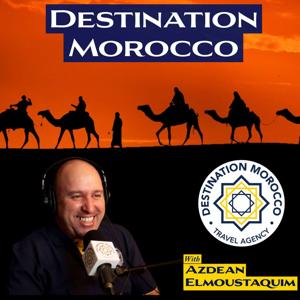
On our podcast, host Azdean Elmoustaquim — born and raised in Marrakech — takes you on an exploration of his country's distinct culture, vibrant history, and stunning attractions, alongside co-host and producer Ted.
Azdean prepares you for the real Morocco: where to go, what to expect, real costs and prices, safety (including specifically for female travelers), the kinds of scams to watch for in the bazaars, useful local phrases, and so much more.
New: a dedicated series built for travel advisors and agencies, digging into commission structures, client objections, seasonality, and everything else you need to sell Morocco with confidence.
New episodes every 1st and 15th. Whether you're planning your own trip or building one for a client, our podcast unpacks the mystery and opens up discovery of an amazing land. We invite you along for the journey.
Learn more or request a custom quote at destinationsmorocco.com.

30,202 Listeners
37 Listeners

111,873 Listeners

369,469 Listeners

10,262 Listeners

126 Listeners

15,577 Listeners

15,893 Listeners

3,043 Listeners

19,148 Listeners

8,481 Listeners

14 Listeners
0 Listeners