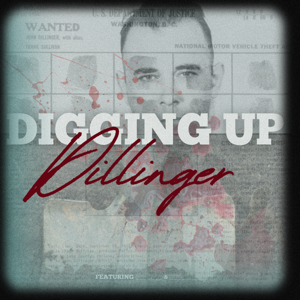
Digging Up Dillinger

Digging Up Dillinger

By Infamous IndyTrue Crime
Download on the App Store

Digging Up Dillinger episodes

  • 11: The Fillmore Report Part 8: The Al Feeney Letter
     On December 3, 1949, the Mayor of Indianapolis, Indiana, Al Feeney, wrote a letter to Terre Haute, Indiana Mayor Ralph Tucker. The letter was relatively short> Was it a hoax, a joke?  Was it a secret?  The gang covers the letter in the best way they how! 
    36 min
  • 10: The Fillmore Report Part 7: The Imposter Selfie
    In July 1959 and July 1963, two handwritten letters were received by the Indianapolis Star newspaper and Emil Wanatka Jr., respectively, by someone claiming to be Dillinger. Both letters were signed “John H. Dillinger.” Although I am not a handwriting expert, my analysis and observation of certain specific characteristics of the handwriting in the respective letters appear to show they were written by the same person. In addition, a single photograph was included with each letter. Both photographs appear to be the same man and consistent with what have been the chronological ages of Dillinger in 1959 (age 56) and 1963 (age 60). The man does have certain facial features, including the shapes of the eyes, nose, mouth and hairline that appear similar to Dillinger 
    55 min
  • 8: The Fillmore Report Part 6: The Fingerprints
    The FBI's use of John Dillinger's fingerprints marked a significant milestone in law enforcement history, highlighting the effectiveness of fingerprint identification in solving crimes. Dillinger, a notorious American gangster during the 1930s, was known for his string of bank robberies and escapes from custody, making him a high-profile target for law enforcement.

    On July 22, 1934, after a series of bank heists and a prison escape, John Dillinger was fatally shot by FBI agents outside the Biograph Theater in Chicago. Following his death, the FBI used his fingerprints to positively identify his body. This identification was crucial in confirming the end of Dillinger's criminal career and bringing closure to his reign of terror.

    The use of fingerprints in identifying Dillinger not only underscored the FBI's growing capabilities in forensic science but also demonstrated the importance of systematic record-keeping and cross-referencing of criminal identities. Dillinger's case reinforced the significance of fingerprints as a reliable method of identification, influencing future practices in law enforcement worldwide.

    Moreover, Dillinger's fingerprints were not only used for identification purposes but also served as a deterrent to other criminals, showcasing that law enforcement agencies could effectively track and apprehend even the most notorious offenders through meticulous forensic techniques. Thus, John Dillinger's fingerprints not only played a pivotal role in his posthumous identification but also contributed to the advancement of modern forensic science and the capabilities of law enforcement agencies in combating crime.

    34 min
  • 7: The Fillmore Report Part 5: The Missing Tooth
    John Dillinger's missing tooth became an intriguing aspect of his legend. During his criminal career in the early 1930s, Dillinger's missing front tooth became a distinctive feature that often helped authorities and the public identify him. According to reports, he lost this tooth during a confrontation with police or during a scuffle in prison, depending on the source.

    This missing tooth added to his image as a daring and defiant figure, emphasizing his run-ins with the law and his ability to evade capture. It also contributed to the folklore surrounding Dillinger, as it was a detail that people remembered and associated with his outlaw persona

    53 min
  • 5: The Fillmore Report Part 3: The Eyes
    The eyes are the windows to the soul and that saying is true in this case. The person shot on July 22nd was reported to have brown eyes, which difers from everything known about John DIllinger. We go over more of the report put together by reired FBI agent Stewart Fillmore. 
    38 min
  • 3: The Fillmore Report Part 1: The Ears
    The Fillmore Report as we call it was put together and written by our own Stewart Fillmore. It is the basis of our arguments about if John Dillinger was shot at the Biograph Theater on July 22, 1934. Stewart will explain why he wrote the report and go over the first of the major arguments. 
    44 min
  • 2: Dillinger History 101
    This episode we focus on the basics of the John Dillinger Story. We want everyone to be caught up so they can listen to the rest of the show with this basic knowledge. From his birth, to his jail time, to his bank robbing, to his death, we cover it all this episode. This is the perfect place to start if you are just jumping in!
    52 min

About Digging Up Dillinger

From the publisher's feed

Welcome to "Digging Up Dillinger," the podcast that plunges deep into the shadowy world of one of America's most infamous gangsters, John Dillinger.