
Sign up to save your podcasts
Or

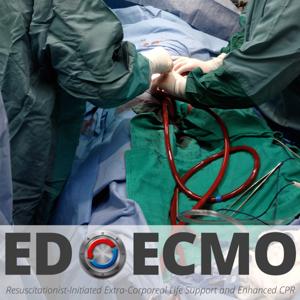

In this episode Joe talks with Suzanne Chillcott, the Mechanical Circulatory Support (MCS) Lead RN at Sharp Memorial Hospital to discuss the nuts and bolts of establishing a “nurse-run” ECLS program. There is no lack of enthusiasm over the concept of doing ECPR in the Emergency Department. As most of you already know, we think ECPR is the wave of the future for resuscitation.
So you think you want to set up the next ED/ICU ECPR program? You think you want to do ECPR in your Emergency Department or ICU? But where to begin? Hopefully this episode will hopefully answer many of those questions:
Physician resuscitationists cannulate. But you need an “ECMO team” to prime the circuit, help initiate bypass, trouble-shoot the machine, and manage the patient after bypass is initiated. But who is going to do that? Who has jurisdiction over your ECMO program? Well, if you are working at an institution with an active cardiothoracic surgery program, chances are you already have these roles established; and I recommend you speak to the Chief of your CT surgery team. But for the sake of argument lets pretend you are starting an ECMO/ECLS/ECPR program de novo. What are your options?
Well, whomever is going to do this MUST be “in-house.” In the ED, Emergency Physicians should be cannulating because we are already right there. We are running the code. We should be the ones doing the cannulation. And the same goes for intensivists in the ICU. There simply isn’t time to call in a specialist to cannulate. The same goes for your ECMO team: they must be “in-house.” It would seem to make sense that perfusionists would be the first-responder ECMO team, however at many institutions (ours included) perfusionists aren’t “in-house 24/7.” So there are now 3 main ‘models’ to address this:
Key Players:
These are the key components. Of course, if you are doing ECPR in your ED then you also need an ED doctor champion. If you are reading this, I assume that will be you. So welcome to your new role!
Please contact any of us if you want to take a look at our policies and procedures – we are more than happy to share this stuff.
Suzanne says it best: ” The way you gotta look at it…the patients we put on pump are all 100% dead when you start with them. You can’t make them more dead. You can’t make it worse. All you can do is possibly make it better…”
Established success rates, for long-term survival neuro-intact is 27-30% for in-hospital cardiac arrest. That is significantly better than historical established success of non-ECPR ACLS of 17%. So even though we almost double the survival of these patients, fully 70% still don’t survive or have neurologic recovery. To take that even further, for out-of-hospital cardiac the survival is dismal…and at this time we don’t even initiate ED ECMO until ACLS has failed – the point at which you would pronounce the patient dead. So by definition, our starting point 0% survival. So any success is meaningful.
We really need to remind everyone that ECPR success is much like batting averages – a batting average over .300 will get you into the Baseball Hall of Fame!! One of the greatest baseball hitters of all-time, San Diego favorite Tony Gwynn, FAILED 70% of the time and was one of the greatest hitters of all time; and elected to the Baseball Hall of Fame in Cooperstown.
So lets setup appropriate expectations from the beginning! And remember, even the great Tony Gwynn occasionally went several ‘at-bats’ without a hit.
Do you have Questions for Suzanne? You may email her directly at [email protected]
Aug 18-21: Emergency Medicine Update. Bellezzo is speaking on “Resuscitation: State of the Art”
October 21: Bring Me Back to Life conference in Montreal, Canada
 View all episodes
 By Zack Shinar, MD

4.6
8787 ratings
In this episode Joe talks with Suzanne Chillcott, the Mechanical Circulatory Support (MCS) Lead RN at Sharp Memorial Hospital to discuss the nuts and bolts of establishing a “nurse-run” ECLS program. There is no lack of enthusiasm over the concept of doing ECPR in the Emergency Department. As most of you already know, we think ECPR is the wave of the future for resuscitation.
So you think you want to set up the next ED/ICU ECPR program? You think you want to do ECPR in your Emergency Department or ICU? But where to begin? Hopefully this episode will hopefully answer many of those questions:
Physician resuscitationists cannulate. But you need an “ECMO team” to prime the circuit, help initiate bypass, trouble-shoot the machine, and manage the patient after bypass is initiated. But who is going to do that? Who has jurisdiction over your ECMO program? Well, if you are working at an institution with an active cardiothoracic surgery program, chances are you already have these roles established; and I recommend you speak to the Chief of your CT surgery team. But for the sake of argument lets pretend you are starting an ECMO/ECLS/ECPR program de novo. What are your options?
Well, whomever is going to do this MUST be “in-house.” In the ED, Emergency Physicians should be cannulating because we are already right there. We are running the code. We should be the ones doing the cannulation. And the same goes for intensivists in the ICU. There simply isn’t time to call in a specialist to cannulate. The same goes for your ECMO team: they must be “in-house.” It would seem to make sense that perfusionists would be the first-responder ECMO team, however at many institutions (ours included) perfusionists aren’t “in-house 24/7.” So there are now 3 main ‘models’ to address this:
Key Players:
These are the key components. Of course, if you are doing ECPR in your ED then you also need an ED doctor champion. If you are reading this, I assume that will be you. So welcome to your new role!
Please contact any of us if you want to take a look at our policies and procedures – we are more than happy to share this stuff.
Suzanne says it best: ” The way you gotta look at it…the patients we put on pump are all 100% dead when you start with them. You can’t make them more dead. You can’t make it worse. All you can do is possibly make it better…”
Established success rates, for long-term survival neuro-intact is 27-30% for in-hospital cardiac arrest. That is significantly better than historical established success of non-ECPR ACLS of 17%. So even though we almost double the survival of these patients, fully 70% still don’t survive or have neurologic recovery. To take that even further, for out-of-hospital cardiac the survival is dismal…and at this time we don’t even initiate ED ECMO until ACLS has failed – the point at which you would pronounce the patient dead. So by definition, our starting point 0% survival. So any success is meaningful.
We really need to remind everyone that ECPR success is much like batting averages – a batting average over .300 will get you into the Baseball Hall of Fame!! One of the greatest baseball hitters of all-time, San Diego favorite Tony Gwynn, FAILED 70% of the time and was one of the greatest hitters of all time; and elected to the Baseball Hall of Fame in Cooperstown.
So lets setup appropriate expectations from the beginning! And remember, even the great Tony Gwynn occasionally went several ‘at-bats’ without a hit.
Do you have Questions for Suzanne? You may email her directly at [email protected]
Aug 18-21: Emergency Medicine Update. Bellezzo is speaking on “Resuscitation: State of the Art”
October 21: Bring Me Back to Life conference in Montreal, Canada

78,688 Listeners

30,609 Listeners

43,687 Listeners

27,011 Listeners
1,877 Listeners
549 Listeners

97 Listeners
1,468 Listeners
272 Listeners

56,944 Listeners

24,585 Listeners

1,150 Listeners
260 Listeners
437 Listeners
270 Listeners