
Sign up to save your podcasts
Or

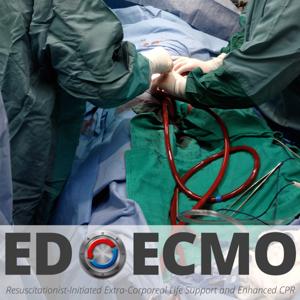


What happens when emergency medicine, cardiac surgery, critical care, ECMO, and human factors collide in the highest-stakes environment imaginable? Mark Ramzy takes us inside the CTICU to explore the art of resuscitation—and why knowing when to move fast, when to slow down, and how to work as a team may matter as much as the technology itself..
In this episode of ED ECMO, Zack Shinar sits down with Mark Ramzy, an emergency medicine–trained cardiothoracic intensivist, to explore what resuscitation looks like when the patient is already surrounded by ECMO, LVADs, invasive hemodynamic monitoring, recent sternotomy, and a highly specialized multidisciplinary team.
Mark shares practical lessons from the CTICU, including how post-cardiac-surgery arrest algorithms differ from traditional ED resuscitation, when to shock rather than immediately perform chest compressions, how to recognize impending deterioration, and why knowing when to “speed up” and when to “slow down” can make all the difference. He discusses open-chest resuscitation, internal cardiac massage, VA ECMO as an exit strategy, and his experience with double sequential defibrillation.
The conversation then moves beyond procedures into the human factors of high-stakes medicine. Mark describes working alongside cardiothoracic surgeons, interventional cardiologists, intensivists, nurses, respiratory therapists, and emergency physicians—and argues that successful ECPR depends less on territorial boundaries and more on recognizing what each member of the team brings to the table.
Finally, Mark offers a cautionary perspective on the rapid expansion of ECMO and ECPR. As these technologies become increasingly accessible, he emphasizes the importance of quality control, mentorship, humility, and developing strong relationships across specialties. His overarching message is simple: medicine is a team sport, and the best resuscitation teams know not only what they can do, but when to listen, when to slow down, and when to let someone else lead.
In this episode, hosts Zack Shinar and Jon Marinaro are joined by Jonathan Goldstone, ECMO Coordinator at Sharp Memorial Hospital, and Rachel Wallace, ECMO Coordinator at the University of Minnesota ECMO Program, to explore one of the least understood but most important roles in an ECMO program—the ECMO coordinator.
The discussion begins with recent advances in their own programs, including dramatic reductions in ECPR cannulation times at Sharp through improved teamwork, standardized equipment, and streamlined workflows. This sets the stage for a broader conversation about how successful ECMO programs are built and sustained.
Rachel provides a detailed overview of the ECMO coordinator’s responsibilities, including onboarding and training ECMO specialists, competency assessment, simulation education, quality assurance, ELSO registry management, physician education, equipment evaluation, and research support. Jonathan emphasizes that while coordinator responsibilities vary between institutions, the central mission is always the same: ensuring there are no weak links in the ECMO system that could compromise patient care.
The panel clarifies the often-confusing distinctions between perfusionists, ECMO specialists, ECMO coordinators, and ECMO managers, highlighting that ECMO specialists may come from nursing, respiratory therapy, perfusion, or advanced practice backgrounds, while coordinators oversee education, quality, systems improvement, and program development.
The conversation explores how hospitals should think about hiring an ECMO coordinator, arguing that programs should invest in leadership early—even before case volumes become large—to build the infrastructure necessary for safe and sustainable growth. The guests also discuss how coordinators influence equipment purchasing, mobile ECMO development, process optimization, billing, and multidisciplinary collaboration.
A recurring theme throughout the episode is that ECMO is fundamentally a team sport. The guests stress that efficient ECPR depends less on individual expertise and more on standardized processes, constant communication, simulation, and shared mental models among physicians, nurses, respiratory therapists, perfusionists, and ECMO specialists.
Finally, the discussion turns to professional development for new coordinators. The guests encourage listeners to leverage the ECMO community through conferences, podcasts, ELSO resources, WhatsApp discussion groups, and mentorship from experienced programs. They conclude by emphasizing that ECMO practice continues to evolve rapidly, requiring coordinators and physicians alike to remain curious, adaptable, collaborative, and committed to continuous improvement.
Key takeaways:
Jon Marinaro interviews Dr. Eric Nadler along with Dr. Gary Schwartz our guest for the second episode in a row
Eric Nadler, M.D., MPP, is board certified in medical oncology. He serves as a medical director of US Oncology Health Outcomes. He remains active in US Oncology Network and Texas Oncology research committees in lung cancer, head and neck cancer, and sarcoma. Dr. Nadler’s passions are oncology research and oncology education.
Key Points: ECMO in HIV/AIDS Patients
1. HIV Is No Longer a Strong Contraindication to ECMO
Historically, HIV and severe immunosuppression were considered relative contraindications for ECMO.
With modern antiretroviral therapy (ART), outcomes have dramatically improved.
Patients with HIV who receive effective ART can recover immune function and achieve near-normal life expectancy.
Therefore, HIV alone should not exclude patients from ECMO candidacy.
2. Immune Reconstitution Makes Recovery Possible
ART can rapidly suppress viral load and restore immune function.
Patients with very low CD4 counts (even <10) can recover to normal CD4 counts (>800) over time.
This means even severely immunocompromised patients may recover if given time and support.
ECMO can act as a bridge to immune recovery.
3. ECMO Functions as a “Pause Button”
ECMO stabilizes respiratory or cardiac failure while clinicians:
Treat infections
Start ART
Manage complications
This buys time for reversible disease processes to recover.
4. Major Cause of Respiratory Failure: Pneumocystis Pneumonia
Common features in HIV patients requiring ECMO:
Pneumocystis jirovecii pneumonia (PJP)
Severe respiratory failure
Cystic lung destruction
Frequent bronchopleural fistulas and pneumothorax
Ventilation can worsen these conditions.
Thus ECMO is used to:
Reduce ventilator pressure
Prevent further lung damage
Allow lung healing.
5. Ventilator Strategy: Minimize Positive Pressure
Typical strategy:
Rapid ECMO initiation if ventilation causes lung injury
Attempt early extubation
If needed:
tracheostomy
minimal ventilator settings
Example “rest settings” described:
Driving pressure ≈ 10
PEEP ≈ 10 (often reduced further)
FiO₂ ≈ 50%
Goal: avoid further lung trauma.
6. ECMO Candidate Selection
Primary question:
Is the disease reversible?
If yes → ECMO should be considered.
Factors supporting ECMO:
Young patient
Treatable infection
Potential immune recovery
Possible relative contraindications:
Severe fungal infection
Multiple uncontrolled opportunistic infections
Extreme cachexia or severe systemic deterioration.
7. Early ART Should Be Started
Modern approach:
Start antiretroviral therapy during acute illness
Do not delay until after ICU discharge
Benefits:
Rapid viral suppression
Faster immune recovery
Risk:
Immune Reconstitution Inflammatory Syndrome (IRIS)
Temporary worsening of infection due to immune rebound.
8. Circuit and Infection Complications
Important ECMO considerations in HIV patients:
Increased risk of circuit thrombosis
Possible fungemia
If fungemia occurs:
circuit replacement
possible re-cannulation
These complications require careful monitoring.
9. Cannulation Strategy
Example high-volume center approach:
Bilateral femoral VV ECMO cannulation
Fast
Reliable flow
Allows later neck access if needed
Used especially during high-volume periods (e.g., COVID).
10. Outcomes and Indication Expansion
ECMO indications are evolving:
Older age
Longer ventilator times
HIV/AIDS
Cancer patients
All are examples of “indication creep” as experience grows.
The key principle remains:
ECMO should be used if there is a realistic chance of recovery.
11. Resource and Program Considerations
Decision-making must consider:
Resource availability
Program experience
Institutional risk tolerance
High-volume ECMO centers can often accept higher-risk patients.
12. Broader Lesson
Medical contraindications often change with new technology and therapies.
Example given:
HIV was once a contraindication for kidney transplantation
Now it is accepted due to improved treatment.
The same evolution may be happening with ECMO indications.
We need a major change in the way we think about the brains of ECPR patients. We have been duped into thinking that they are the same as regular resuscitation patients, and the answer is that they are not. On EDECMO 102, we learn about this idea from two wonderful people: Ingrid Magnet and Michael Poppe. In addition to the inspirational ECPR program they have created in Vienna, they have published a paper showing just how different these two groups of patients are. They show that ECPR patients improve their neurologic function tremendously over the six months following their event. This really changes the way we need to think about these patients and how we discuss options with their families in the hospital.
How do we improve survival from cardiac arrest? Does Head-Up CPR improve outcomes? Paul Pepe, the premier expert in the field, gives us the data and reasons why head-up CPR can improve outcomes. Dr. Pepe also discusses estrogen and it’s potential to improve resuscitation outcomes.
On this 100th episode of EDECMO, Sydney’s very own Nat Kruit tells us how they organized a prehospital system. She and her crew have a wonderful job organizing a cadre of new cannulators to now have a functional system that can provide the residents of Sydney the opportunity to benefit from ECPR. Take a listen, she’s fantastic.
EDECMO – Episode 99 is a gem. Charles Bruen tells us how he has become an ECPR cannulator within the prestigious Minnesota Mobile Resuscitation Consortium. He shares pearls about cannulation as well as the next steps for Minnesota’s innovative approach to bringing ECPR to largest population that is possible.
A couple of pearls from Dr. Bruen’s cannulation piece are holding pressure in the groin with the ultrasound probe, understanding that the inguinal fold does not represent the inguinal ligament, inserting the needle at a 45-degree angle, and insertion at the common femoral artery.
Who Really Gets VV ECMO? Numbers, Nuance, and the Human Factor
Is VV ECMO purely a numbers game? Or is there a softer, more human side to deciding who receives this life-saving therapy? In this candid and insightful interview, Jon Marinaro sits down with the legendary Dr. Eddy Fan—one of the most published and respected voices in the field of critical care.
Together, they unpack the hard data and the gray areas: prognostic scoring, patient selection, and the ethical dilemmas that come with scarce resources. They also dive into the “sticky” dynamics of ECMO programs, including the subtle (or not-so-subtle) influence that a cannulating specialist can have on who actually gets the therapy.
This is a must-listen for anyone working at the intersection of critical care, ethics, and real-world ECMO decision-making.
Rubin J, Witkin AS, Crowley JC, Michel E, Furfaro DM, Teijeiro-Paradis R, Ilg A, Seethala R, Zhao S, Fan E. Venovenous Extracorporeal Membrane Oxygenation Candidacy Decision-Making: Lessons and Hypotheses From a Single-Center Observational Analysis. Chest. 2024 Sep;166(3):491-501. doi: 10.1016/j.chest.2024.02.042. Epub 2024 Feb 27. PMID: 38423278.
Combes A, Schmidt M, Hodgson CL, Fan E, Ferguson ND, Fraser JF, Jaber S, Pesenti A, Ranieri M, Rowan K, Shekar K, Slutsky AS, Brodie D. Extracorporeal life support for adults with acute respiratory distress syndrome. Intensive Care Med. 2020 Dec;46(12):2464-2476. doi: 10.1007/s00134-020-06290-1. Epub 2020 Nov 2. PMID: 33140180; PMCID: PMC7605473.
From the publisher's feed
78,393 Listeners

30,703 Listeners

43,345 Listeners

26,808 Listeners
1,866 Listeners
537 Listeners
98 Listeners
1,472 Listeners
271 Listeners

56,446 Listeners

24,536 Listeners
1,157 Listeners
256 Listeners
430 Listeners
269 Listeners