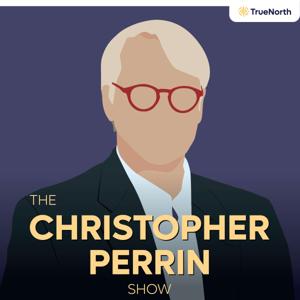
The Christopher Perrin Show

Episode 60: A Living Tradition: Classical Education Without Nostalgia


Listen Later

Description 

Christopher Perrin welcomes Dr. John Mark Reynolds for a extensive conversation about the renewal of classical education—and why the term classical often confuses more than it clarifies. Reynolds shares how family life, great teachers, and deep reading (especially C. S. Lewis and Plato) shaped his intellectual and spiritual journey, eventually drawing him into the classical Christian education movement. Together they explore how classical education is not nostalgia or narrow Greco-Roman elitism, but a living tradition rooted in wonder, dialectic, and a “great conversation” that has always been broader than the modern West. The conversation turns to virtue formation and liberal education, arguing that education should prepare students not only for work, but for judgment, sacrifice, and even death. Perrin and Reynolds also address how the classical movement can avoid becoming a guru-driven ideology, how it must remain open to science and modern technological change, and why false dichotomies distort educational debates. The episode closes with Reynolds’ vision for St. Constantine School, a K–16 “grown backward” model that integrates tutorial-style liberal arts education with practical formation for diverse vocations.

Episode Outline

  • Why the question “What is classical education?” is harder than it sounds (and why it matters for renewal)
  • The paradox of learning: the more you know, the more you know you don’t know 
  • Reynolds’ early formation: pastoral family life, reading, and learning to “get to the bottom” of ideas
  • Influential teachers and the life of wonder: Plato, the Socratic habit, and learning as lifelong pursuit
  • Returning to Christian faith and integrating faith with the life of the mind
  • Why the word “classical” can mislead: the tradition is global, multi-ethnic, and not limited to Greco-Roman texts
  • Classical education as the “great conversation”: local cultures rooted in mother tongue, connected to a shared metaphysical reality
  • The liberal arts, virtue, and human freedom: what education once aimed at (and what modern credentialing often replaces)
  • Education as preparation to live well—and to die well: Plato, Scripture, and the moral seriousness of formation
  • Avoiding two dangers in the renewal: guruism and ideological “compounds”
  • Science, technology, and modernity: why classical education must have room for Newton (and for contemporary scientific callings)
  • St. Constantine’s model: tutorial liberal arts, K–16 integration, dual enrollment, and forming “souls fit for paradise”
  • Where to learn more: St. Constantine’s website and ongoing work

Key Topics & Takeaways

  • Classical education is bigger than the word “classical.” The tradition is not inherently ethnocentric; its sources and conversations span regions and cultures, including the Near East and Africa.
  • Wonder and dialectic are central. Reynolds frames classical learning as rooted in Socratic inquiry and a habit of getting to the bottom of things.
  • Liberal education aims at freedom and virtue. True liberty includes self-governance, responsibility, gratitude, and service—virtues modern schooling often thins into mere credentialing.
  • Education should prepare students for ultimate realities. The conversation repeatedly returns to the claim that the one certainty is death, and education should form people who can face it with moral seriousness.
  • The renewal must remain humble. Classical education collapses when it becomes guru-centric, novelty-driven, or triumphalist.
  • Classical education must remain intellectually modern. A classical school should have room for mathematics, science, engineering, and technological prudence—not a nostalgic retreat from modernity.
  • Multiple models are needed. St. Constantine is presented as one viable “iteration,” not the only faithful expression of classical education.
  • Formation serves many vocations. Reynolds argues that tutorial-style liberal arts can prepare nurses, engineers, builders, and citizens—not only professors and “cocktail party” intellectuals.

Questions & Discussion

  • What do you mean when you say “classical education” in your own context?
    List the assumptions you hear most often (elitist, Greco-Roman-only, anti-science, ethnocentric). Draft a two-sentence explanation that highlights both aims (virtue/wisdom) and methods(dialectic/great books/literacy).
  • How should liberal education form freedom and virtue today?
    Contrast “credentialing” with “formation.” Where does your institution drift toward one over the other? What habits would actually train self-governance (attention, honesty, courage, sacrifice) in students?
  • What does it mean to prepare students to die well?
    Discuss whether your curriculum implicitly prepares students for comfort and success more than moral endurance. Name one text, practice, or tradition that could restore seriousness about mortality, judgment, and ultimate goods.
  • How can classical education avoid becoming an ideology or “compound”?
    Identify warning signs of guruism (one name, one method, one “true” model). List practices that keep a school porous and humble (plural models, peer critique, historical study, spiritual disciplines).
  • What do you think of a K–16 approach to classical formation?
    Discuss potential strengths (continuity, tutorial culture, cost efficiency, coherent formation). Discuss potential risks (scale, resource demands, insularity). What would be a realistic “next step” in your context?

Suggested Reading & Resources

  • The Liberal Arts Tradition by Kevin Clark, DLS, and Ravi Scott Jain
  • The Space Trilogy by C. S. Lewis
  • Saint Constantine School 
  • ClassicalU
  • ClassicalU Course: The Liberal Arts Tradition
  • ClassicalU Course: Classical Education History and Introduction
  • ClassicalU Course: Introduction to Classical Education
  • ClassicalU Course: Teaching Science Classically: 10 Essential Principles


...more
View all episodesView all episodes
Download on the App Store

The Christopher Perrin ShowBy Christopher Perrin

  • 5
  • 5
  • 5
  • 5
  • 5

5

26 ratings


More shows like The Christopher Perrin Show

View all
Renewing Your Mind by Ligonier Ministries

Renewing Your Mind

5,211 Listeners

The Briefing with Albert Mohler by R. Albert Mohler, Jr.

The Briefing with Albert Mohler

8,698 Listeners

Life with Sally by Sally Clarkson

Life with Sally

2,986 Listeners

Scholé Sisters: Camaraderie for Classical Homeschooling Mamas by Brandy Vencel, Mystie Winckler, and Abby Wahl

Scholé Sisters: Camaraderie for Classical Homeschooling Mamas

531 Listeners

Simply Charlotte Mason Homeschooling by Sonya Shafer

Simply Charlotte Mason Homeschooling

518 Listeners

The World and Everything In It by WORLD Radio

The World and Everything In It

7,188 Listeners

Close Reads Podcast by Goldberry Studios

Close Reads Podcast

884 Listeners

Plodcast by Canon Press

Plodcast

995 Listeners

The Daily Poem by Goldberry Studios

The Daily Poem

746 Listeners

The 1000 Hours Outside Podcast by 1000 Hours Outside

The 1000 Hours Outside Podcast

2,234 Listeners

The Radio Free Hillsdale Hour by Hillsdale College

The Radio Free Hillsdale Hour

660 Listeners

The Theology Pugcast by The Theology Pugcast

The Theology Pugcast

472 Listeners

The Literary Life Podcast by Angelina Stanford Thomas Banks

The Literary Life Podcast

1,199 Listeners

Blog & Mablog by Canon Press

Blog & Mablog

1,394 Listeners

Femina by Canon Press

Femina

1,431 Listeners

Reclaiming Our Canon by Dr. Anika Prather

Reclaiming Our Canon

9 Listeners

The Principia Podcast by Dr. Brian Williams

The Principia Podcast

3 Listeners

Philosophia by Dr. David Schenk

Philosophia

0 Listeners

Classical Crossroads by Dr. Angel Parham

Classical Crossroads

0 Listeners