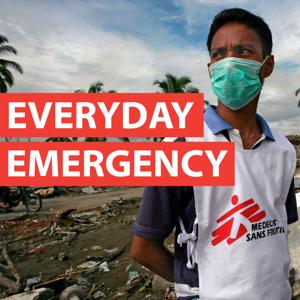
Everyday Emergency

Everyday Emergency

By Médecins Sans Frontières / Doctors Without Borders (MSF)BusinessNewsNon-Profit
Download on the App Store

Everyday Emergency episodes

  • Diabetes: An unseen humanitarian emergency

    It’s 100 years since the discovery of insulin, the life-saving drug for people living with diabetes.

    But today, more than half of those who need this marvellous medicine still can’t access it – either because it’s too expensive or unavailable. This means millions of people are risking serious complications and even death.

    In this episode of Everyday Emergency, Amber Dowell reports on the challenges facing those diagnosed with Type 1 diabetes living through crises such as conflict, displacement or disaster.

    We hear from Farah Haris, who was working to treat diabetic patients in the fallout of last year’s devastating Beirut explosion. We also speak to chronic disease expert Amulya Reddy on how MSF is finding innovative new ways to help patients and challenge the three “Big Pharma” corporations controlling the insulin market.

    Hosted on Acast. See acast.com/privacy for more information.

    23 min
  • Speaking Out - Srebrenica - Episode 5: Mechanisms and expectations
    Episode 5: Mechanisms and expectationsDuration: 48 minsJustice is slow to come and still many of the nations involved are not taking responsibility for their country’s actions in the enclave. After a year of targeting the Dutch, the focus moves to France. With accusations of covert meetings and secret deals to free French hostages, MSF France puts pressure on the French parliamentarians to investigate the nation’s role in the fall of Srebrenica. But is it really the role of a humanitarian medical organisation to issue an appeal for an investigative parliamentary commission? And if so, how much should the organisation direct proceedings? Also and as time passes, it gives those in MSF space to reconsider the organisation’s own actions during the fall.Image: © MSF

    Hosted on Acast. See acast.com/privacy for more information.

    48 min
  • Speaking Out - Srebrenica - Episode 4: Peace agreement vs justice
    Episode 4: Peace agreement vs justiceDuration: 37 minsFollowing the fall of Srebrenica in July 1995, 40,000 people are scattered around eastern Bosnia. Thousands are in a refugee camp around Tuzla airport, but thousands are also still missing, or dead including the 8,000 men and boys over the age of 16 massacred by Bosnian Serb forces.As July 1995 goes down in history as one of the deadliest months of the Bosnian War, the focus shifts to the international community. Pressure is mounting on the international actors involved in the Bosnian war…in particular on the Dutch whose Blue Helmet peacekeepers also known as Dutchbats were stationed inside Srebrenica during the fall.But where does the responsibility lie for the inaction? And what can MSF do to make sure that peace does not take precedence over justice?And while the investigations and tribunals on Srebrenica begin, how can the international community make sure that the events of July 1995, are not repeated in one of the other Muslim enclaves in the region?Image: © Hans Ullens/MSF

    Hosted on Acast. See acast.com/privacy for more information.

    38 min
  • Speaking Out - Srebrenica - Episode 3: The fall of Srebrenica
    Episode 3: The fall of Srebrenica Duration: 40 minsJuly 1995 - the fall of Srebrenica is one of the toughest chapters of the Bosnian war. It only took 10 days for the Muslim enclave of Srebrenica to fall. The two MSF staff stationed there at the time witnessed the Bosnian Serb force’s attack. Around 8,000 men and boys over the age of 16 were massacred by Bosnian Serb forces in the enclave. But how does this happen with hundreds of UN peacekeeper in a so-called ‘safe zone’? Having trusted the UN Protection Force’s commitment to protect the enclave and its population, must MSF accept partial culpability for or complicity in the UN’s abandonment of the enclave and the ensuing massacre of the population? Didn’t MSF give the population the false impression that it would be safe as long as the team was present? And what mechanisms did MSF put in place so that they could speak out over the UN’s inability to protect the people of Srebrenica?Image: © Olivier Jobard/MYOP

    Hosted on Acast. See acast.com/privacy for more information.

    41 min
  • Speaking Out - Srebrenica - Episode 2: Prison doctors
    Episode 2: Prison doctorsDuration: 37 minsMSF has been working in the enclave for over 2 years now and has repeatedly informed the media about the difficulties it’s been having trying to get supplies, medicine, and even volunteers inside facing the haggling by the Bosnian Serbs. MSF is still the only source of medical care in the enclave, but its job is being made harder and harder as the violence worsens and the living conditions deteriorate. The organisation starts to question its role there and wonder if it’s contributing to the Bosnian Serbs’ strategy, acting like prison doctors?And as the Bosnian-Serb authorities tighten their grip on Srebrenica, MSF is faced with another dilemma - would calling for the evacuation of civilians be the equivalent of abetting the Bosnian Serb’s ethnic cleansing policy of driving out all Muslim inhabitants and claiming the land? Even if those same civilians want to leave.Image: © Rip Hopkins

    Hosted on Acast. See acast.com/privacy for more information.

    38 min
  • Speaking Out - Srebrenica - Episode 1: Entering the enclave
    Episode 1: Entering the enclaveDuration: 27 minsThe Muslim population trapped inside Srebrenica is living under constant shelling since the start of the war in Bosnia in 1992. Even after the UN declared the city a ‘safe area’ in March 1993, not much had changed.The joint French/Belgian MSF unit entered Srebrenica with UNPROFOR leader General Morillon in March 1993. They were the first NGO allowed inside the enclave. There, they witnessed the French General vowing to protect the enclave’s population. The MSF team focused on providing medical care, securing the water supply and sanitation, and preparing the enclave for the upcoming winter. However, they’re starting to question how much protection the UN peacekeepers in the enclave can actually provide.Image: © René Caravielhe

    Hosted on Acast. See acast.com/privacy for more information.

    27 min
  • COVID-19: Sexual and Reproductive Health in the Midst of a Pandemic

    Our producer Jess Brown looks into the potentially catastrophic secondary impacts of COVID-19 on the lives and health of women and girls.

    Sexual and reproductive health services are difficult to access in normal times and the secondary impacts of COVID-19 have made them even more elusive

    This episode includes voices from our projects in Honduras and South Africa, discussing the impacts of losing access to essential sexual and reproductive health services, particularly safe abortion care and contraception care.

    *Correction: Since publication it's been established that some ambulance services are running in proximity to our Honduras project.

    Hosted on Acast. See acast.com/privacy for more information.

    33 min
  • Inside Yemen - Episode 5: Epilogue
    Is Yemen’s a hopeless war? And what should be done when we can “only” care for people we know nothing about? In this last episode of “Inside Yemen”, Natalie takes you back to the north of the country, into the caves that serve as shelters for families when the bombs rain down.

    Hosted on Acast. See acast.com/privacy for more information.

    5 min
  • Inside Yemen - Episode 4: Everyday violence
    A grenade ready to explode, armed militia in a pick-up, Kalashnikovs everywhere. Ghassan and Thierry tell you about the everyday violence in Aden, the southern port where all semblance of normality has been lost.

    Hosted on Acast. See acast.com/privacy for more information.

    8 min
  • Inside Yemen - Episode 3: Too far, too late
    It is Ghassan’s turn to take you deep into Yemen to discover the cholera epidemic that broke out across the country in 2016 and 2017, amidst controversy and media manipulation.

    Hosted on Acast. See acast.com/privacy for more information.

    10 min

About Everyday Emergency

From the publisher's feed

Welcome to Everyday Emergency, a podcast by Médecins Sans Frontières / Doctors Without Borders (MSF).

We bring you true stories and expert insight from people on the frontline of humanitarian…

More shows like Everyday Emergency

This American Life by This American Life

This American Life

91,022 Listeners

Radiolab by WNYC Studios

Radiolab

43,852 Listeners

Fresh Air by NPR

Fresh Air

38,016 Listeners

The Moth by The Moth

The Moth

26,831 Listeners

Global News Podcast by BBC World Service

Global News Podcast

7,625 Listeners

Embedded by NPR

Embedded

12,028 Listeners

In The Dark by The New Yorker

In The Dark

28,549 Listeners

Pod Save America by Pod Save America

Pod Save America

87,116 Listeners

The Daily by The New York Times

The Daily

111,799 Listeners

The Nocturnists by The Nocturnists

The Nocturnists

598 Listeners

Throughline by NPR

Throughline

16,365 Listeners

The Rest Is History by Goalhanger

The Rest Is History

15,702 Listeners

The Ezra Klein Show by New York Times Opinion

The Ezra Klein Show

15,882 Listeners

The Rest Is Politics by Goalhanger

The Rest Is Politics

3,018 Listeners

The Rest Is Politics: US by Goalhanger

The Rest Is Politics: US

2,265 Listeners