
Sign up to save your podcasts
Or

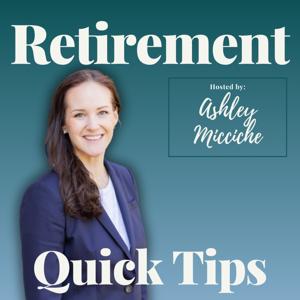

The theme this week on the One Minute Retirement Tip podcast is: Retirement Rules of Thumb You Should Ignore
Today, I’m talking about a common investing rule of thumb: Keep 100 (or 120) minus your age in stocks. It used to be 100 minus your age, but over the last several years I see 120 being used more often. Using this formula...if you’re 65 years old, you take 120 minus your age. 120-65 = 55. That’s the % you should have in stocks: 55%.
Now there is some truth in this rule of thumb, and that is your asset allocation (or your % in stocks) should be based 1st and foremost on your age. This is where we always start with our clients. But it does need to be customized for your risk tolerance, your goals, and to what extent you’ll be relying on your portfolio for income in retirement.
Some people just cannot stomach the ups and downs of the stock market. They’re the ones who panic and sell in March 2020 at the height of the Covid crash. Having too much in stocks can be problematic for these people, so if that’s you, then you’ll want to have less in stocks than you might otherwise have at your age.
On the other hand, I had a client who passed away about 3 years ago. She was in her 90s when she died, watched CNBC every day, and had over $1 million dollars in the stock market. I could have talked her into going skydiving before I would have talked her into buying a bond. She loved stocks and didn’t blink if the stock market took a dive. She wasn’t worried at all when her portfolio dropped in the financial crisis, and even though she was less than 5 feet tall, she had ice water running through her veins.
The other factor that is worth considering now with maintaining a higher % in stocks is inflation. Inflation is a big risk for your retirement. You can plan to spend as much as 30 or more years in retirement. Iis it really a good idea for a 70 year old who has potentially 20 more years to live to be only 30% in stocks if you follow the 100 minus age rule? If you follow the 120 minus age rule, you’re 50% in stocks at age 70, which for most people, I think is probably too high, considering that allocation can result in a drop in your portfolio of 20-30% or more in a down stock market.
So the rule of thumb is flawed I think and I use a different baseline based on age to determine the ideal allocation for my clients. If you want to get your copy of our asset allocation cheat sheet and see the custom formulas we use to determine asset allocation for various ages, just send me an email - [email protected]. That’s [email protected].
That’s it for today. Thanks for listening! My name is Ashley Micciche and this is the One Minute Retirement Tip.
----------
>>> Subscribe on Apple Podcasts: https://apple.co/2DI2LSP
>>> Subscribe on Amazon Alexa: https://amzn.to/2xRKrCs
>>> Visit the podcast page: https://truenorthra.com/podcast/
----------
Tags: retirement, investing, money, finance, financial planning, retirement planning, saving money, personal finance
 View all episodes
 By Ashley Micciche

4.9
5252 ratings
The theme this week on the One Minute Retirement Tip podcast is: Retirement Rules of Thumb You Should Ignore
Today, I’m talking about a common investing rule of thumb: Keep 100 (or 120) minus your age in stocks. It used to be 100 minus your age, but over the last several years I see 120 being used more often. Using this formula...if you’re 65 years old, you take 120 minus your age. 120-65 = 55. That’s the % you should have in stocks: 55%.
Now there is some truth in this rule of thumb, and that is your asset allocation (or your % in stocks) should be based 1st and foremost on your age. This is where we always start with our clients. But it does need to be customized for your risk tolerance, your goals, and to what extent you’ll be relying on your portfolio for income in retirement.
Some people just cannot stomach the ups and downs of the stock market. They’re the ones who panic and sell in March 2020 at the height of the Covid crash. Having too much in stocks can be problematic for these people, so if that’s you, then you’ll want to have less in stocks than you might otherwise have at your age.
On the other hand, I had a client who passed away about 3 years ago. She was in her 90s when she died, watched CNBC every day, and had over $1 million dollars in the stock market. I could have talked her into going skydiving before I would have talked her into buying a bond. She loved stocks and didn’t blink if the stock market took a dive. She wasn’t worried at all when her portfolio dropped in the financial crisis, and even though she was less than 5 feet tall, she had ice water running through her veins.
The other factor that is worth considering now with maintaining a higher % in stocks is inflation. Inflation is a big risk for your retirement. You can plan to spend as much as 30 or more years in retirement. Iis it really a good idea for a 70 year old who has potentially 20 more years to live to be only 30% in stocks if you follow the 100 minus age rule? If you follow the 120 minus age rule, you’re 50% in stocks at age 70, which for most people, I think is probably too high, considering that allocation can result in a drop in your portfolio of 20-30% or more in a down stock market.
So the rule of thumb is flawed I think and I use a different baseline based on age to determine the ideal allocation for my clients. If you want to get your copy of our asset allocation cheat sheet and see the custom formulas we use to determine asset allocation for various ages, just send me an email - [email protected]. That’s [email protected].
That’s it for today. Thanks for listening! My name is Ashley Micciche and this is the One Minute Retirement Tip.
----------
>>> Subscribe on Apple Podcasts: https://apple.co/2DI2LSP
>>> Subscribe on Amazon Alexa: https://amzn.to/2xRKrCs
>>> Visit the podcast page: https://truenorthra.com/podcast/
----------
Tags: retirement, investing, money, finance, financial planning, retirement planning, saving money, personal finance

1,953 Listeners
443 Listeners

807 Listeners

1,330 Listeners
534 Listeners
750 Listeners

547 Listeners
696 Listeners

620 Listeners

932 Listeners

833 Listeners

204 Listeners

583 Listeners

434 Listeners

1,068 Listeners