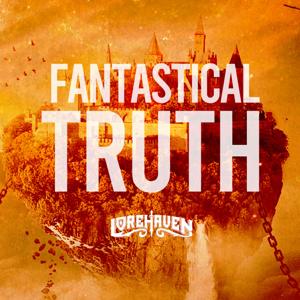
Fantastical Truth
Download on the App Store

Fantastical Truth episodes

  • 8. How Does Pandemic Fiction Help Us Seek God’s Strength in Scary Times? | The Line Between

    In episode 7, we promised our next episode would focus on Frank E. Peretti’s This Present Darkness.

    But first, a word from our biggest news of 2020.

    In this episode, E. Stephen Burnett and Zackary Russell share a few “favorite” pandemic stories, including the recent Planet of the Apes film trilogy and Tosca Lee’s 2019 novel The Line Between.

    These stories can actually help Christians prepare our imaginations for these trials—or even worse suffering.

    Lorehaven reviews The Line Between

    These truth glimpses give The Line Between surprising heart-warmth amongst the chill, while its road-trip quest drives fast through mad territory and never once feels bogged down in snowbanks. Even by the finale, we get hints that our heroes have learned that yes, sometimes you must stay preserved from a world gone mad, but for the greater mission of helping others in that world. As Aleksandr Solzhenitsyn wrote, you can’t simply separate from evil people—not even cultists—in order to avoid evil. That very line between evil and good cuts through every human heart.

    • Read the full review in Lorehaven magazine’s spring 2019 issue.
    • Read our interview with bestselling novelist Tosca Lee.
    • Subscribe free to get every issue.
    • Quotes and notes
      • In 2017, Mark Carver wrote at Speculative Faith, “It’s interesting how the biggest threat to human existence rarely gets news coverage. It’s not North Korea or global warming or white privilege; it’s disease.” (Down With the Sickness, Sept. 20, 2017)
      • Big lessons of pandemics: we’re not in control. These events challenge us to ask ourselves, “Where is my hope?”
      • We blame politicians or countries or each other, or downplay the problem versus panicking, and/or buy into conspiracy theories—all because doing so gives us a sense of control.
      • Christians may be material “preppers,” but we must always be preppers for times of suffering.
      • Most of us don’t give focused thought to evil and suffering until we experience them. This forces us to formulate perspective on the fly, at a time when our thinking is muddled and we’re exhausted and consumed by pressing issues. Readers who have “been there” will attest that it’s far better to think through suffering in advance.

        —Randy Alcorn, If God is Good, page 14

        For I consider that the sufferings of this present time are not worth comparing with the glory that is to be revealed to us. For the creation waits with eager longing for the revealing of the sons of God. For the creation was subjected to futility, not willingly, but because of him who subjected it, in hope that the creation itself will be set free from its bondage to corruption and obtain the freedom of the glory of the children of God. For we know that the whole creation has been groaning together in the pains of childbirth until now. And not only the creation, but we ourselves, who have the firstfruits of the Spirit, groan inwardly as we wait eagerly for adoption as sons, the redemption of our bodies. For in this hope we were saved. Now hope that is seen is not hope. For who hopes for what he sees? But if we hope for what we do not see, we wait for it with patience.

        —Romans 8:18–25

        When he opened the fourth seal, I heard the voice of the fourth living creature say, “Come!” And I looked, and behold, a pale horse! And its rider’s name was Death, and Hades followed him. And they were given authority over a fourth of the earth, to kill with sword and with famine and with pestilence and by wild beasts of the earth.

        —Revelation 6:7–8 (emphasis added)

        Action points
        • Worship: we follow a Savior who touched the sick but didn’t get sick.
        • Serve: help your neighbors who cannot take care of themselves, or shouldn’t go out in public. Who do you know who is at high risk if they get infected? How can you serve them?
        • Pray: for revival, not just a cure.
        • Evangelism: share the Power Over Fear tool.
        • Next on Fantastical Truth

          This month we’re releasing our next Lorehaven issue. Its cover story explores our favorite Christian-made fantastical novels. This includes that classic of the 1980s, Frank Peretti’s This Present Darkness, a classic (especially for Christians!) supernatural thriller that asks: What If the Armies of Hell Tried to Invade Your Hometown? Lorehaven’s review chief, Austin Gunderson, will join the podcast to explore the Peretti-verse with us.

          43 min
        • 7. How Does Jesus Define and Redeem His Gift of Imagination? | with Brian Godawa

          Behold the not-shortest episode of Fantastical Truth. This time we delve into the deep-doctrine magic of God’s gift of human imagination.

          This time we’re joined by biblical/supernatural novelist and nonfiction author Brian Godawa.

          Brian writes books like these:
          • Jezebel: Harlot Queen of Israel (newest)
          • The Imagination of God (formerly titled Word Pictures)
          • God Against the Gods: Storytelling, Imagination and Apologetics in the Bible
          • Hollywood Worldviews: Watching Films with Wisdom and Discernment
          • We make these topic concessions:
            • We can’t go into the entire “graven images” issue here (e.g. what do we do with pictures of Jesus in movies, coloring pages). Another time, perhaps.
            • We also can’t address every historical instance of Christians idolizing images.
            • We can’t deal with the issue of different personalities. God has gifted some of his people with (colloquially) “left brain” gifts, so they can be engineers or programmers or even theologians skilled in translating/exegeting words. And he’s gifted others with more “right brain” gifts. Side effect of either: hardship understanding the other type of person, or even wrongly judging them.
            • Zack quotes Emily Dickinson’s poem:

              Tell all the truth but tell it slant —

              Success in Circuit lies
              Too bright for our infirm Delight
              The Truth’s superb surprise
              As Lightning to the Children eased
              With explanation kind
              The Truth must dazzle gradually
              Or every man be blind

              We explore imagination across the gospel narrative:
              1. Creation.

              We have to go back to Genesis to learn how God created humans.

              The idea of “image” is right there at the start because we ourselves are “images” of God. Little finite reflections of the almighty Creator? It sounds absurd (and some folks called Gnostics indeed think it’s very unspiritual).

              Humans made in God’s image, the imago Dei, was God’s idea. Humans “image” or reflect God back to him.

              This is solid theology. God wants to see reflections of himself because we reflect back his glory. God is all about maximizing his name/glory in universe.

              How do we reflect God? By behaving as he does. By reflecting back his character and qualities. First thing God commands is not “be holy” or “be loving” like I am. (That comes later.) His first command: be fruitful, multiply, steward creation, use what I’ve created to make things of your own.

              These include images. And written language.

              2. Fall

              Sin comes into the world. We must acknowledge this. All our culture-making and image-bearing is now marred by rebellion against our Creator.

              But culture-making continues. People make instruments, and likely also images of things. Fast-forwarding past Flood, Babel, Abraham, patriarchs, Exodus: God calls out his covenant people and gives them moral commands.

              3a. Redemption, Old Testament

              Then God gets to work commanding his people to make images, such as in the Tabernacle and with Bezalel.

              Also we read about the Passover, one of the most incredible acted-out images in all Scripture. This practice lasted generations in Israel until Jesus came thousands of years later to fulfill it. Without this image (described to us in words), we wouldn’t have the expectation of Jesus, and the knowledge (after the fact) that all of this realized imagination was meant all along to point to Jesus the fulfillment.

              3b. Redemption, New Testament

              Now that Jesus has completed God’s mission of salvation, we start to recover a worshipful, Jesus-centered vision of God’s gifts, including imagination. We can enjoy this gift in ways that help us draw closer to the God who gave them.

              Still, images are powerful. God uses them alongside rationality. (Example: Jesus taught in parables of images, and didactic teaching.)

              But apart from rationality, images can become dangerous and idolatrous.

              Solution: Always, always remember your created purpose. You are created to be an image, a reflection, of God your Creator. And in a world full of broken images, if you are a Christian, you have also been redeemed by Jesus. He is the image of the invisible God (Colossians 1:15) and “Just as we have borne the image of the man of dust, we shall also bear the image of the man of heaven” (1 Corinthians 15:49). When we bear his image, we start to see all other images people have made in perspective. We can start to reject idols and redeem good images.

              This includes sharing stories that glorify God by marrying, not divorcing, the two gifts he’s given us: rationality in written language and precision, and imagination with creative picture-making. These two “realms” will be brought together.

              4. Restoration

              It’s only after Jesus renews all of planet Earth, and the whole cosmos, that we have God’s gift of imagination fully restored to us.

              We’ll see no more idolatry of imagination or the things people make.

              We’ll have no more tensions between being creative and doing whatever we can to put food on the table.

              And we’ll no longer suffer pain or crying or sickness or death, which can really interrupt that creative output.

              Instead, Jesus will restore his people so they will be fit to live in his restored universe, the New Heavens and New Earth, forever.

              We reference these books and articles:
              • The Frances A. Schaeffer trilogy
              • John Walton’s Genesis 1 as Ancient Cosmology
              • J. R. R. Tolkien’s essay “On Fairy-Stories”
              • Joe Carter’s article “Thomas Kincaid’s Cottage Fantasy”
              • Next on Fantastical Truth:

                We originally promised an episode about Frank E. Peretti’s This Present Darkness. But first, a word from our biggest news of 2020. We share a few “favorite” pandemic stories, including the recent Planet of the Apes film trilogy and Tosca Lee’s 2019 novel The Line Between. How can pandemic fiction help us seek God’s strength in scary times?[1. Original text: This month we’re releasing our next Lorehaven issue. Its cover story explores our favorite Christian-made fantastical novels. This includes that classic of the 1980s, Frank Peretti’s This Present Darkness, a classic (especially for Christians!) supernatural thriller that asks: What If the Armies of Hell Tried to Invade Your Hometown? Lorehaven’s review chief, Austin Gunderson, will join the podcast to explore the Peretti-verse with us.]

                1 hr 19 min
              • 6. How Did You First Discover Fantastical Stories?

                This time it’s personal: Fantastical Truth shares some of your stories about how you first discovered amazing fiction.

                Meanwhile, hosts E. Stephen Burnett and Zackary Russell share their early joy in niche and popular fantastical fiction, including:

                • Superbook, a.k.a. Animated Parent and Child Theater, a Bible anime series in two seasons in the 1980s
                • Star Wars, because of course
                • Alfred Slote’s My Robot Buddy middle-grade book series
                • Sunday-school song hero Psalty the Singing Songbook
                • Focus on the Family’s long-running audio drama series Adventures in Odyssey (here is Stephen’s recent article about AiO)
                • The Chronicles of Narnia, for sure
                • Greenie TV show Captain Planet and the Planeteers
                • Terry Brooks’ The Sword of Shannara and series
                • Star Trek: The Next Generation
                • Left Behind and the ensuing series of novels, books, and a couple of movies
                • Robert Jordan’s epic fantasy The Wheel of Time series
                • (Briefly) The Prince of Egypt (1998) animated film (and now also a stage musical)
                • So many of you have sent us your fantasy origin stories, so we’ll share more of those during future episodes.

                  Next on Fantastical Truth

                  On Tuesday, March 10, Brian Godawa (Chronicles of the Nephilim fiction series, The Imagination of God nonfiction) joins Fantastical Truth. We’ll explore some deep doctrine magic: How does Jesus define and redeem his gift of imagination?

                  53 min
                • BONUS: Share Your Story About How You Discovered Fantastical Fiction

                  As Fantastical Truth leaves far behind our one-month mark of podcasting, we’re already planning beyond episode 6.

                  In our next episode, however, we want to feature listeners even more.

                  Our topic: fan origin stories.

                  We’re asking: how did you first discover fantastical fiction?

                  We’d love to hear your origin story, which could include elements like:

                  • How old were you?
                  • How did you find the story?
                  • What did you love about it?
                  • What ideas really spoke to you?
                  • Which characters draw you in?
                  • What did you love about the world?
                  • How do you feel about that story now?
                  • We’d love to hear your story! And of course we may share your story in the next Fantastical Truth episode, to be heard by hundreds of other fantastical story fans.

                    You can use this page’s comment section. Or use the form here to send your note straight to the Fantastical Truth mailbag.

                    Or send us a note @Lorehaven on Twitter, or at LorehavenMag on the Facebooks.

                    4 min
                  • 5. What Harm Are ‘The Witcher’ and Other Shows Doing to Their People? | with Jason Morehead

                    This time, we’re taking up another big theme: the challenges of “mature” fantasy action drama stories like The Witcher.

                    This fantasy drama arrived on Netflix just before Christmas 2019.

                    It’s the latest of several fantasy TV series which seem to be following in the footsteps of Game of Thrones.

                    Neither cohost (E. Stephen Burnett and Zackary Russell) has seen the show. So Stephen speaks with someone who has: Jason Morehead.

                    • Jason Morehead wrote the article “Giving Up On the Witcher.”
                    • Subtitle: The series’ gratuitous sex and nudity reveals a certain lack of faith and imagination.
                    • He’s reviewed movies, music, anime and beyond for decades, now at OpusZine.us.
                    • We shared the article at Lorehaven’s FB page in January and it started quite a discussion.
                    • Jason says: “I simply don’t like trashing stuff. I always try to find a few good things about whatever I review…I’d much rather write about stuff I love, than trash stuff I hate.”

                      Still, there’s plenty to challenge about Netflix’s latest grim fantasy world.

                      Episode disclaimer
                      • As you might have guessed from the title of Jason’s article, we talk about some mature topics.
                      • If you are a younger listener, or a parent listening with kids, this episode may not be suitable for you.
                      • Or, listen with your older kids or pre-teenage children. Use this opportunity to engage a discussion about this kind of story.
                      • Because we’re going to see more of this “mature” fantasy on television. It sells. Is that a good thing?
                      • Slogan fact-check: true. But do sexually explicit stories themselves create monsters?

                        Interview with Jason Morehead

                        We discuss feedback from Facebook commenter Jeremy B.:

                        I’m gonna have to disagree. Oh, I agree that there’s A LOT of sex and nudity — way more than I would be comfortable with in the real world — but the world of the Witcher is NOT the real world, and it’s not intended to be. Rather, it’s intended to be VERY different, and we’re not intended to be PARTY to that world but distant SPECTATORS to it. So while it all seems gratuitous to US, the question we need to be asking is, is it gratuitous to the characters that LIVE there? And in my opinion, no, it is not.

                        We discuss feedback from Facebook commenter Andy S.:

                        Spot on. I made it to the beginning of Episode 3 before I got creeped out by the ‘serious’ and ‘adult’ imagery. It looked less adult, and more like something I would’ve come up with when I was 14. I’m genuinely resentful of this idea that any story with swords also has to show female nudity. Yes, Game of Thrones was successful. So was The Lord of the Rings. Show some imagination.

                        We also explore these gritty, real facts about what it takes to make shows that feature private acts made public:

                        • With comments that only talk about the story, we’re very much at risk of ignoring the very human factor that goes into the making of shows like this.
                        • We explored this some in our last episode.
                        • It’s coming more to light that (plot twist!) these visual stories don’t just grow on trees.
                        • To show someone naked, you have to hire someone to get naked.
                        • Often that someone is a woman.
                        • This just keeps happening in these shows.
                        • What’s also happening: actresses come forward, usually after they’ve left the show and/or they’re more established in their careers.
                        • They say: You know what? That time I was on that show and acting in public what ought to be kept private? I don’t think I was actually okay with that.
                        • More articles about this grim reality:

                          • Blackwater Director Neil Marshall on Nudity and Creating the Battle
                          • Harvey Weinstein and Sexualized Pop Culture Call for Prophetic Engagement
                          • ‘Game Of Thrones’ Sex: It’s Not Just Awkward, It’s Violation
                          • What do you think?
                            • Did you at any point see “Game of Thrones” or this newer series, “The Witcher”?
                            • What’s your take on these kinds of scenes?
                            • What can Christians do in response to exploitative media?
                            • Or maybe you have an argument about how it’s not exploitative?
                            • Either way, we’d like to hear from you. Comment here.

                              And of course, subscribe to the Fantastical Truth podcast on any podcasting platform. Get new episodes every Tuesday.

                              On our next episode

                              Next time on Fantastical Truth, we’re asking: how did you first discover fantastical fiction?

                              We’d love to hear your origin story, which could include elements like:

                              • How old were you?
                              • How did you find the story?
                              • What did you love about it?
                              • What ideas really spoke to you?
                              • Which characters draw you in?
                              • What did you love about the world?
                              • How do you feel about that story now?
                              • Again: comment below, or use our form to send your story straight to Fantastical Truth.

                                1 hr 11 min
                              • 4. What Are the Top Recent Debates Among Christian Fantasy Fans?

                                We sort through the top ten 2019 articles on Speculative Faith. Then hosts Zack Russell and E. Stephen Burnett count down the top debates we expect to see continue this year.

                                • SpecFaith has been operating since 2006.
                                • Many Christian novelists have written there.
                                • The daily blog is associated with Lorehaven.
                                • It features daily articles from regular voices.
                                • Seven of these top articles at SpecFaith focused on big current or ongoing debates.

                                  7. Captain Marvel Left Me Baffled and Disappointed
                                  • Marian Jacobs: “We know Captain Marvel is a hero, but in the MCU, that’s not a personality trait. It’s a job.”
                                  • Zack really wanted to like this and to have his girls like it, but his thirteen-year-old daughter didn’t care much.
                                  • Ultimately, Captain Marvel turns to the “silent strong man” stereotype to save her.
                                  • Marian Jacobs explores how emotions are a good gift from God.
                                  • “When we marry logic and emotions we better understood who God is. He is both a meticulous planner as well as a passionate father.”
                                  • 6. Should Christians Enjoy Fantasy?
                                    • Zack can relate to this question. At one a moment in his life, he had to get far away from the fantasy genre.
                                    • Pam Halter says she never doubted whether it was okay to enjoy fantasy.
                                    • But Zack’s case, due to some personal experiences, he definitely had those doubts.
                                    • He doesn’t feel that way now. But we do have room for different convictions about fantasy.
                                    • Pam Halter: “If you pick a novel and it doesn’t sit right with you, stop reading it … It’s really okay [to put it down].”
                                    • 5. ‘Game Of Thrones’ Sex: It’s Not Just Awkward, It’s Violation
                                      • Disclaimer: we’ll be careful here, but this is a sensitive topic for younger readers.
                                      • Cap Stewart wrote this article in 2017, and now that the show has ended, it trended again
                                      • Cap Stewart: Game of Thrones is emblematic of a widespread moral epidemic. Sex is sacred, and yet we’re willing to put up with sexual sacrilege and manipulation of other human beings, so long as it provides us with a cathartic experience.”
                                      • Christians may disagree on whether such material tempts them, but ultimately what happens to the actors should concern us more.
                                      • Cap Stewart: “Taking into account how much sexual degradation actors go through for our amusement, I find it concerning that so many people—especially professing Christians—would not only excuse, but also defend such content.”
                                      • 4. Six Christian White Magic Spells Worse Than Fantasy Magic
                                        • After watching a horror movie one time, Zack began to wonder: what if the point of the devil using fear against us is to get us to trust in the wrong things?
                                        • Certain cultures are based on fear/power beliefs, and give heightened attention given to evil spirits. They want protection from spirits, so they put their trust in amulets or rituals. But what if that is the whole point of the spiritual warfare against them?
                                        • So what if, in being so consumed with worry about black magic, we fall into the other ditch of trusting in white magic?
                                        • E. Stephen Burnett: “God never establishes a magic system. God never promised us that if we do X, we’ll achieve some reward—health or wealth, protection from evil influence, personal guidance, romance, or popularity in the world.”
                                        • “What if we reject His real promises and substitute our own? What if we blame other things as if they are the worst sources of occult magic—things like fantasy stories? Then we’re not being spiritual or biblical. We’re acting like practitioners of the occult.”
                                        • 3. Analysis Of ‘Hell Is The Absence Of God’ By Ted Chiang, Part 1
                                          • This article frequently appears in SpecFaith’s “top searches” panel. It’s one of our first-ever articles, from 2006.
                                          • Ted Chiang wrote this novella based on the question: what if the biblical/miraculous occurred in everyday life?
                                          • It’s another example of how science fiction authors just keep returning to Judeo-Christian and religious themes.
                                          • Other examples: Star Trek episodes that, despite the classic humanism, just can’t avoid these ideas.
                                          • We expect to see sci-fi authors, including many non-Christians, continue exploring these themes in the future.
                                          • 2. Standing Up to the YA Fantasy Impuritans
                                            • A “woke” mob on “YA Twitter” hounded author Amelie Wen Zhao until she canceled her book, at least for a while.
                                            • The cause? Mob members believed Zhao’s story’s depiction of slavery was inappropriately not exactly like race-based slavery in reality.
                                            • Zack Russell: I regularly interact with international students from China, and I try to make them feel welcome. The toxic community cancel culture did the opposite.
                                            • We’re getting to a weird place where people demand too much reality from fiction. They don’t want art, but propaganda.
                                            • Good news: Zhao still had her book published in November 2019. Bad news: she no longer interacts on Twitter.
                                            • 1. ‘Sorry Your Dragon Show Ended Stupidly’ Meme May Insult ‘GOT’ Fans
                                              • This is our second Game of Thrones–related topic.
                                              • But this time we’re actually defending the show’s fans.
                                              • When the series ended, people began mocking fans of the “dragon show.”
                                              • The show, however, wasn’t questionable because of dragons but because of naked people.
                                              • E. Stephen Burnett: “… Honestly, the ‘dragon show’ part could sound like plain bullying. I see those non-fantasy ‘jocks’—possibly wearing ’90s faded-denim cutoff shorts and backward-turned baseball caps—harassing the ‘nerd’ with thick glasses and knee-high socks.”
                                              • What do you think?

                                                What’s your favorite topic from this list? Let us know, using the form or comments section below.

                                                We might do an episode on the topic with the most votes.

                                                <a href="https://poll.fm/10504375" target="_blank" rel="noopener noreferrer">Take Our Poll</a>
                                                On our next episode

                                                Next time on Fantastical Truth, we will explore a newly arrived fantasy show, The Witcher. Our guest Jason Morehead wrote this article, Giving Up On the Witcher, and helps guide Christian viewers in evaluating otherwise promising stories that get sidetracked by exploitation.

                                                1 hr
                                              • 3. What If Dancing Could Control the World? | Hidden Current

                                                For episode 3, we dive into another fantastic Christian-made novel: Sharon Hinck’s fantasy Hidden Current.

                                                In fact, Hidden Current just released last week, from Enclave Publishing.

                                                (We’ll explore books like this every so often, when we find great Christian-made titles we’ve loved and that Lorehaven reviews.)

                                                For this episode, Zack Russell and E. Stephen Burnett are joined by their first Fantastical Truth guest, Lacy Rhiannon. She taught dance for many years, loves fantastical stories, and helps out with Lorehaven (and happens to be Stephen’s wife and best friend).

                                                Key theme: What if dancing could control the world?

                                                Here’s the summary for Hidden Current

                                                When your every foot movement and gesture literally controls your world, people will expect you to avoid any false move. But for dancer Calara Blue, her trained pursuit of perfection has come at a terrible cost.

                                                At the center of Calara’s world, the all-powerful Order has called the best dancers to use their natural abilities to stabilize their island. Without dancers who command the storms and the island’s very position, the island and its ecosystem will drift out of control. So dancers like Calara have pledged their lives to fulfill this high calling.

                                                Then, just as Calara reaches her goal, she discovers that, just maybe, the island does not want to be controlled. Instead, she is forced into fleeing her rigid lifestyle with its every rule and religious belief that she has spent years helping to enforce. Accompanied by a mysterious fisherman, Calara hunts for her own past and for the truth about her beautiful yet dehumanized profession—and its original purpose.

                                                Read the complete review in Lorehaven magazine (subscribe free).

                                                For the cover story, we also interviewed Sharon Hinck about her story’s inspirations.

                                                From left: Zackary Russell, Lacy Rhiannon, E. Stephen Burnett

                                                Here’s what we love about Hidden Current
                                                • Great ideas, such as key themes based on the very idea of stories/creativity/art and their ultimate purpose.
                                                • Vivid imagery, thanks to a floating and fantastical Perelandra-inspired island world.
                                                • Calara Blue, who escapes a cult, could have gone wrong but readers will feel very drawn to her side.
                                                • This world is fantasy, but not the castles-and-knights kind; it feels original.
                                                • Also, there’s lots of dancing, which leads to our exploration with our first guest.
                                                • Biblical support for dancing

                                                  “Then Miriam the prophetess, the sister of Aaron, took a tambourine in her hand, and all the women went out after her with tambourines and dancing.”

                                                  — Exodus 15:20 (this verse is descriptive, cf. 1 Samuel 18:6, 2 Samuel 6:14)

                                                  “You have turned for me my mourning into dancing; you have loosed my sackcloth and clothed me with gladness.”

                                                  —Psalm 30:11 (this verse is lightly prescriptive, that is, an implied command for God’s people)

                                                  “Let them praise his name with dancing, making melody to him with tambourine and lyre!”

                                                  —Psalm 149:3 (this verse is very prescriptive! it’s a command for God’s people)

                                                  “Praise him with tambourine and dance; praise him with strings and pipe!”

                                                  —Psalm 150:4 (again, a command)

                                                  “Again I will build you, and you shall be built, O virgin Israel! Again you shall adorn yourself with tambourines and shall go forth in the dance of the merrymakers.”

                                                  —Jeremiah 31:4 (this is a more prophetic verse that presumes the eternal good of dance)

                                                  Our experience with dance
                                                  • Lacy learned and taught dance for many years, including ballet, tap, and jazz, often at a private Christian creative arts school
                                                  • Zack’s family members have danced, and he recalls occasionally wishing he could be the cool star of the school dances.
                                                  • Stephen wasn’t taught dance was evil, but grew up indifferent to this, save for some performances in old movies.
                                                  • Other links we mentioned (or should have)
                                                    • A Bharatanatyam Dance to Worship Jesus (YouTube video)
                                                    • Weirdness in Church? Or: The Adventure of the Dancing Men (Stephen’s SpecFaith article)
                                                    • Sharon Hinck on Story Evangelism (Sharon Hinck’s SpecFaith article)
                                                    • Beneath the Hidden Current: On Floating Islands and Dolphins (Sharon Hinck’s SpecFaith article)
                                                    • Stephen on the Cultural Mandate

                                                      These mentions of dance in Scripture only make sense when you fit them into the bigger biblical idea: that God made humans to be creative in his image (Genesis 1:28).

                                                      Theologians call this the Cultural Mandate.

                                                      That’s why we have cultural forms. That’s why we have creative gifts and imagination.

                                                      Even in Genesis, after the fall, we see the narrators summarizing these amazing cultures that made technology and musical instruments.

                                                      Why would God include those histories? I think it’s a reminder of a lost world.

                                                      All that music (and dancing, and art) has been lost. That’s tragic. Because of sin.

                                                      Some Christians from sheltered/legalistic environments sometimes wake up and think something like: “Hey, all that stuff was actually good all along, so let’s just accept it all!”

                                                      Well, that’s a baby step in the right direction.

                                                      But you have to run the whole way, away from the notion of “it’s all evil” but past the equally silly notion of “it’s all good.”

                                                      You have to get to the biblical concept that God gives these gifts, man corrupts them, but Jesus redeems them.

                                                      No spoilers, but I love how Sharon Hinck explores this in particular in Hidden Current.

                                                      What do you think?

                                                      Tell us your experience with dance. Do you dance? Wish you could? Grow up loving it, hating it, or indifferent?

                                                      If you grew up Christian, did your church acknowledge singing and dance in worship?

                                                      Or did Christian leaders condemn dance based on sinful abuses of it (cough, cough, halftime shows, anyone?).

                                                      On our next episode

                                                      Next time on Fantastical Truth, we will explore more than seven big topics (and debates) Christian fantasy fans had throughout 2019, like:

                                                      • Strong female heroes, such as Captain Marvel
                                                      • “Cancel culture” versus YA novel diversity
                                                      • And of course, Game of Thrones (twice).
                                                      •  

                                                        42 min
                                                      • 2. What Do We Mean By Saying ‘It’s A Christian Story’?

                                                        In Fantastical Truth’s second weekly episode, your hosts (E. Stephen Burnett and Zackary Russell) take on a big theme.

                                                        (We do this because exploring these big themes will help us be happier, holier, and more like Jesus. That way, we can get even more beauty and truth out of these stories.)

                                                        Christian fans often discuss and debate this question:

                                                        What do we mean by saying that a story is “a Christian story”?

                                                        Also: should Christian fans feel they should “look for the Christian label”?

                                                        Many people say they prefer avoiding the label:

                                                        • Critics of Christian movies
                                                        • Critics of Christian books
                                                        • Some readers at Speculative Faith
                                                        • They might say, “We don’t need any more Christian stories. We just need more good stories that happen to be made by Christians.”

                                                          Others parody this line, such as the Babylon Bee article “Man Not A ‘Christian Pastor’—He’s A Pastor Who Happens To Be Christian.”

                                                          So let’s talk about what images/meanings we have when we say “a Christian story” or “a Christian movie.”

                                                          First, let’s stop by a Fantastical Truth podcast on again/off again feature. We’ll call this The Concession Stand.

                                                          • I (Stephen) am not a cultural fundamentalist. I mean that I was not raised by a family, church, or subculture to view The Outside World with suspicion. I don’t believe we automatically presume that popular culture, movies, TV, or any other creative work is evil.
                                                          • But I also don’t spend a lot of time “hate-watching the Church”  for culturally fundamentalist behavior. If you do that, you may just repeat the same “subculture X is bad” belief, only turning it against a particular group of Christians (instead of The Outside World).
                                                          • That’s why I personally don’t have a stigma about attaching the label “Christian” to things like stories, music, or movies.
                                                          • Stephen’s definition of ‘Christian story’

                                                            Stephen uses the term Christian story (or Christian book, and so on) simply to mean: A story or book made by a Christian.

                                                            • The word Christian means Christlike one.
                                                            • Christians steward the gospel in the world.
                                                            • But we’re not just souls. We’re embodied persons.
                                                            • So everything we touch is somehow influenced by the gospel.
                                                            • We’re one “degree” removed from Jesus, and our creations are one degree removed from us.
                                                            • We could get nitpicky and say our stories are Christian-ian stories. But the word Christian works fine as a shorthand.
                                                            • Zack’s definition of ‘Christian story’

                                                              Zack offers a different or expanded definition. He ranks “Christian stories” is an image of concentric circles:

                                                              • For: a novel for a Christian audience. Focuses on Christian characters, Christian theology/issues, uses Christian jargon. Ability to do a deep dive but can be too exclusive.
                                                              • About: a novel about Christianity, for those inside or friendly to the church. Less jargon, more inclusive, but can be too generic in its portrayal of Christians or Christianity. Features Christian and non-Christian characters, either in conflict, or on a faith journey.
                                                              • Like: a novel that says, “Christianity is like this,” for an audience that includes the spiritually curious. These are driven by analogy or metaphor, which can fall into the extremes or either too subtle and hidden, or too preachy and on the nose.
                                                              • By: a novel by a Christian, for a wide audience. It’s not message– or theme-driven, but the author is known to some extent to be a believer.
                                                              • We explore several possible examples of each kind of story.

                                                                What we can do

                                                                However we define Christian story, or whatever meanings we attach to the term, we recommend this:

                                                                1. Don’t get all nitpicky when people want to say “Christian story” or have distinct stories by/for Christians. I think that kind of nitpicking reveals more about the person’s need to grow up/come to grips with/heal from their possibly tragic backstory than it does any actual ill with the wording.
                                                                2. Recognize that every group naturally has their own “subculture.” Why should Christians be exempt? Subcultures aren’t evil. But, like any good gift, they can become disordered and idolized by fallen human beings.
                                                                3. Don’t turn the label “Christian” into an excuse for un-Christian content (which is not true) or non-excellent art (which is not beautiful). Anything made by Christians ought to aspire to high standards, based on the gifts and calling of the creator and the rational expectations of the audience. It must be true (biblical). It must be beautiful (excellent). And it must be good (as God is).
                                                                4. Join the mission

                                                                  That’s a big topic. You’ve heard our takes. Now we want to hear yours.

                                                                  • Subscribe to Fantastical Truth, tell a friend, email your feedback!
                                                                  • Read Lorehaven magazine’s winter 2019 issue, and look for the big spring 2020 issue coming in March.
                                                                  • Join the conversation on this page (or on social medias, such as Twitter @Lorehaven or Facebook @LorehavenMag).
                                                                  • On our next episode

                                                                    We’ll explore another great book we’ve found, called Hidden Current from Sharon Hinck. This fantasy novel poses the question: What if dancing could control the world? So we’ll talk about dance cults (as one does) and try not to step on too many toes while we explore the whole idea of dance and what purpose this gift serves.

                                                                    59 min
                                                                  • 1. What If the Three Wise Men Actually Wanted to Crown a King? | The End of the Magi​

                                                                    Hosts E. Stephen Burnett and Zackary Russell launch Lorehaven’s new Fantastical Truth podcast by exploring Patrick W. Carr’s novel The End of the Magi.

                                                                    This biblical historical fiction brings the question: What if the three wise men actually wanted to crown a king?

                                                                    Also:

                                                                    • What was the star of Bethlehem?
                                                                    • Why did the wise men connect the star with the Messiah?
                                                                    • And, what did the Magi hope to do after the found him?
                                                                    • Summary of The End of the Magi:

                                                                      Life should be simple if you’re a member of the biblical Magi. You come out of the box once every Christmas, and you get to wear a cool turban and ride a cool camel. You get a simple quest to seek the Christ-child with only some minor Herod-related villainy to make things interesting. Then you return home by a different route.

                                                                      So it should seem, if you only read Matthew 2 and/or install a Nativity scene. But for young Myrad, who actually lives in the Parthian Empire, reality is far more brutal.

                                                                      Myrad is a Gentile but the adopted son of a Jewish magus. As magi, they’re bonded to tell the truth, seek the stars, and track the calendar left by the prophet Daniel plotting the number of years until the Messiah finally arrives to establish his kingdom. They also counsel earthly kings, such as the Parthian ruler, Phraates.

                                                                      Unfortunately, Phraates has been influenced by the neighborhood’s latest upstart empire, Rome. Which results in the king, enraged at certain magi’s opposition to his foolish alliance, declaring treason and slaughtering nearly every magus he can find.

                                                                      Our hero Myrad ends up fatherless, homeless, and on the run. Restricted by his clubfoot, he soon joins the caravan of wise tradesman Walagash and his steadfast daughter, Roshan. They’ll face deserts, revolutions, and the friendships and threats of other magi as they work their way toward Jerusalem and that mysterious star.

                                                                      Get the complete review in Lorehaven magazine’s winter 2019 issue.

                                                                      Stephen read and liked the book, partly for these reasons:

                                                                      • It reads like a fantasy, though Carr did much historical research.
                                                                      • It feels Christmassy, though you can enjoy the story any time.
                                                                      • Myrad is a likeable hero throughout his epic desert quest.
                                                                      • The star is miraculous, wondrous, and rarely appears.
                                                                      • Carr keeps the story as biblical as you could want.
                                                                      • But he also challenges simplistic traditions about the wise men.
                                                                      • Exploring Matthew 2 and The End of the Magi
                                                                        • What was the star of Bethlehem?
                                                                        • Why did the magi connect a star with “one born king of the Jews” (Matt. 2:2)?
                                                                        • How many wise men made the journey to find the newborn king?
                                                                        • What did Chuck Missler believe about Daniel’s prophetic record?
                                                                        • What did Zack’s college professor, Rick Larson, think about the star?
                                                                        • How does this story compare with other biblical fiction?
                                                                        • What can Christian readers rightly expect of biblical fiction?
                                                                        • Why do we like the idea of seeing into the future?
                                                                        • Is biblical fiction “fantastical” fiction?
                                                                        • Join the mission
                                                                          • Subscribe to Fantastical Truth, tell a friend, email your feedback!
                                                                          • Read Lorehaven magazine’s winter 2019 issue, with Patrick W. Carr’s interview and the featured book review.
                                                                          • Join the conversation on this page (or on social medias, such as Twitter @Lorehaven or Facebook @LorehavenMag).
                                                                          • On our next episode

                                                                            We’ll explore a big question that Christian fantasy fans can’t stop talking about: Should Christians “look for the Christian label” for novels, movies, music and other things that Christian creators make? How do we recognize our own associations with the label—such as a “seal of quality” or a “seal” that guarantees anything but quality?

                                                                            46 min
                                                                          • 0. Fantastical Truth | Trailer

                                                                            In the Fantastical Truth podcast from Lorehaven, hosts E. Stephen Burnett and Zackary Russell find truth in fantastic stories, and apply the wonders of these imaginary worlds to the real world our Creator has called us to serve. Join the best Christian fantastical authors and other creative friends on this joyful journey, to find the happiness and holiness of Jesus through his gift of truthful imagination.

                                                                            2 min

                                                                          About Fantastical Truth

                                                                          From the publisher's feed

                                                                          Escape bad books. Find the best Christian-made fantasy and sci-fi for God’s glory.

                                                                          More shows like Fantastical Truth

                                                                          The Creative Penn Podcast For Writers by Joanna Penn

                                                                          The Creative Penn Podcast For Writers

                                                                          627 Listeners

                                                                          Novel Marketing by Thomas Umstattd Jr.

                                                                          Novel Marketing

                                                                          327 Listeners

                                                                          The World and Everything In It by WORLD Radio

                                                                          The World and Everything In It

                                                                          7,109 Listeners

                                                                          Counterflow with Buck Johnson by Buck Johnson

                                                                          Counterflow with Buck Johnson

                                                                          256 Listeners

                                                                          The Alisa Childers Podcast by Alisa Childers

                                                                          The Alisa Childers Podcast

                                                                          5,360 Listeners

                                                                          Christian Publishing Show by Thomas Umstattd Jr.

                                                                          Christian Publishing Show

                                                                          104 Listeners

                                                                          The Literary Life Podcast by Angelina Stanford Thomas Banks

                                                                          The Literary Life Podcast

                                                                          1,195 Listeners

                                                                          Real Cool History for Kids by Angela O'Dell

                                                                          Real Cool History for Kids

                                                                          2,524 Listeners

                                                                          Fiction Writing Made Easy with Savannah Gilbo | How to Write a Novel & Writing Advice by Savannah Gilbo

                                                                          Fiction Writing Made Easy with Savannah Gilbo | How to Write a Novel & Writing Advice

                                                                          1,479 Listeners

                                                                          Author Margins by Success in the Chaotic Publishing World

                                                                          Author Margins

                                                                          7 Listeners

                                                                          Author Update by Thomas Umstattd Jr.

                                                                          Author Update

                                                                          34 Listeners