
Sign up to save your podcasts
Or

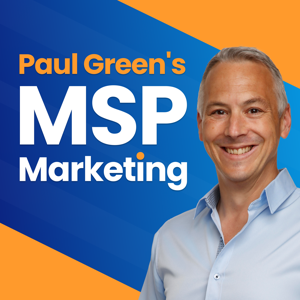

Your MSP’s marketing should feel repetitive to you but fresh to the people seeing it… here’s how that works. Also this week, what margins should you aim for and how to increase them, and you can be an influencer in your marketplace without taking photos of your dinner.
Welcome to Episode 338 of the MSP Marketing Podcast with me, Paul Green, powered by the MSP Marketing Edge.
Your MSP’s marketing should feel repetitive to you, but fresh to the people seeing it. And I know that sounds like a kind of a strange goal at first, because when something feels repetitive, most of us assume we’re doing something wrong. We assume we should mix it up and try new things and be more creative. But actually, when it comes to marketing your MSP, the opposite is true.
Now, I’m a huge fan of marketing systems. And by that, I mean a simple set of activities that you do on a regular basis. Small tasks, repeated daily or weekly. Things like publishing a blog or recording a podcast, posting on LinkedIn, emailing your list, putting out videos. None of these things are individually spectacular, but they have a power, which comes from doing all of them consistently every day and every week.
Now here’s the interesting bit, if you run a proper marketing system for your MSP it will eventually start to feel boring to you.
I’m recording this podcast for the 338th time. So every week since November 2019 I’ve sat down, decided what I want to talk about, written myself a script, and then recorded it. And obviously I’ve had holidays and vacations along the way, but in that instance, I just do two podcasts in a week so I never get behind.
It is a hamster wheel, I will tell you. And writing the script is not a thrilling creative adventure every week, I’ll be honest. It’s a job, it’s a task in the system. And of course I still enjoy it, but I have to sit down, I have to write it, I have to record it. My team, I’m sure it’s as much a hamster wheel for them. They have to edit it. They have to do all the colour corrections and the promotions and all of the stuff like that. It’s all just a whole series of systemised tasks. And I do it and my team, which is James and Simon and Laura, they do it as well because it’s an important part of our business’ presence out there.
And the same thing happens with your MSP’s marketing. If you’re doing it properly, there’s going to be a rhythm to it. You’re doing the same types of content every day or every week, the same channels, the same cadence week, after week, after week. And after a while, you might start thinking, “Oh my goodness, am I just repeating myself here? Am I just saying the same things again and again?” And the answer is probably yes. And that’s a good sign because here’s the thing that most MSP owners forget. You see your marketing every day… your prospects do not see it every day. You’re inside the system, they’re only catching glimpses of what you put out.
So if you do think about it from their point of view, a prospect might see one LinkedIn post from you this month, or maybe they read one blog on your website or they hear an episode of your podcast if you do that because someone recommended it to them. They are seeing a tiny, tiny slice of what you produce. Meanwhile, you’re seeing everything… every post, every email, every article, every video. So of course, to you it feels repetitive because you’re experiencing the whole system, but your prospects are not. And even if they do see your content more than once, it’s usually spread out to them over time. So they might see something today and then they might not see anything from you for another two weeks. And then by the time they see the next thing, the first one has already kind of faded from their memory.
Marketing doesn’t land through a single perfect message, it lands through repetition and familiarity. And through seeing the same themes appear again and again from someone who clearly believes what they’re saying, that’s how trust is formed and built. So when your marketing starts to feel repetitive to you, don’t panic. Don’t assume you need to reinvent everything. In fact, please don’t. In most cases, this means that the system is working. The real challenge for you is not avoiding repetition, the real challenge for you is keeping it fresh for the person consuming it, because you can talk about the same ideas but in different ways. You can use different examples, tell different stories, or even apply the same principle to different situations.
The core message stays exactly the same, it’s just the wrapper around that message that changes. And that way, it still feels interesting for the person randomly encountering it when it’s out there, even if you talked about the same underlying idea 20 times already. I mean, I’ve done that so many times with this podcast. I’ve talked about marketing systems, about social proof, about positioning, about vertical markets. I don’t know, maybe dozens, maybe 20, 30 times by now. The ideas and the themes repeat because those are the themes and ideas that work. But what changes is the stories that I tell, the angle with which I come in to tell that story, the specific examples I give you, or the things that I’ve noticed recently.
And remember this as well, the moment your marketing starts to feel a little repetitive, perhaps even a little dull to you, that’s often the moment that it starts working properly on your leads and your prospects because dull usually means consistent. It means the system is running and it’s working. It means you’re showing up again and again and again in front of the people that you most want to reach. And from their point of view, that presence does not feel dull at all. It feels reliable, familiar, and like you’re the person who is always there talking about these big ideas. So if your marketing feels repetitive to you, it’s not a warning sign, don’t change anything. It’s often evidence that you’re doing it right.
One final thought on this, which actually is one of the most common questions I get from new members to my MSP Marketing Edge membership. They very often ask, “Paul, what kind of cadence should we be putting out content?” And it seems like a relevant thing to bolt on to the end of this discussion. So I think you can actually break this down into daily, weekly, and monthly tasks. On a daily basis, so seven days a week, you should post something on social media, on LinkedIn. And that shouldn’t just be text posts, there are many different formats that you can use. So things like text, obviously images, videos, infographics, and PDF carousels. Those five on LinkedIn are wonderful. And you don’t actually have to load on a daily basis, you can load a whole month’s worth of posts in one go using Publer or Growably, which you can get free from The Tech Tribe, but you should definitely post at least one post a day, seven days a week.
So next up we have weekly tasks, and this is where the bulk of your MSP’s marketing cadence should sit. So every week you should post a new blog on your website, ideally with a related video. In fact, a video and a blog about the same subject is a very powerful way to put content in front of people in the way that they most want to consume it. Then you should send a LinkedIn newsletter out once a week. You should also update your Google Business profile once a week, and you should send an email to your email list once a week. There we go, five tasks that you repeat on a weekly basis. But again, you can actually load them monthly so you can load all of your weekly tasks once every single month.
Then we get onto the actual tasks that you only do once a month, the monthly tasks. And I think it’s healthy once a month to send out a printed newsletter to your Dream 100. They are the top 100 prospects in your list that you most want to work with. You could also send out a marketing campaign, which may consist of a physical postcard that you mail out to people with some email follow-ups to send out to them and a telesales script, a telemarketing script that you use to call people after you’ve sent them out this postcard and these follow-up emails.
Don’t just send this out to everyone on your list. You might send it out in small batches, 50 people a week is a great thing. I realise that’s not a monthly cadence, but you have a new campaign every month and you send it out in bunches of 50 a week. Most people can follow up 50 prospects a week. And that’s the key to this, if you’re going to do this campaign, send out the postcard, send out the emails, but you must follow it up by phone. The postcard and the emails create an opportunity for someone to make an outbound call on behalf of your MSP to follow these people up by phone.
There’s a lot there, but this would be the perfect cadence if you could achieve that for your MSP, the daily tasks, the weekly tasks, and the monthly tasks. And not at all coincidentally, that’s the exact cadence that we deliver within my MSP Marketing Edge membership. So if you just want to achieve all of this marketing happening for your MSP really easily, you can go and see if it’s available in your area. Go to mspmarketingedge.com/membership.
Let’s now talk about two things that quietly make a massive difference to the profitability of your MSP. You’ve got margins and you’ve got simplifying your billing. Yeah, I know neither of these sound particularly exciting, but if you get them right, they can have a dramatic impact on how much money your business actually keeps at the end of every month.
I did a bit of research before recording this. I got my AI friend to look at some reports from MSP industry analysts and some finance blogs that track managed service providers. And the general consensus is that a healthy MSP should be targeting somewhere around 20 – 30% net profit margin. Of course some businesses manage more than that, some less, and it’ll vary by market and the type of work you do, but 20 – 30% is widely considered a solid target for a well-run MSP.
Now, when you hear a number like that, the immediate reaction for many MSP owners is either relief or panic. Relief, obviously, if you’re already there or above 30%, and if you are give yourself a high five, but panic if you’re nowhere near it.
Margins are often less about big dramatic price rises and more about fixing small leaks in the revenue bucket.
One of the biggest leaks I see is hardware. Many MSPs treat hardware as a pass-through cost. The client buys a laptop or a firewall or whatever, they buy it through the MSP and you as an MSP add a tiny margin, maybe 10% or 15% because you’re worried that the client will just go and buy it somewhere else. And that thinking is understandable, but it creates a very strange situation because if you look at it, you’re sourcing the equipment, you’re ordering it, you’re dealing with the supplier, you’re handling delivery. I guess there’s an insurance complication in there as well. You’re often installing it, you’re configuring it as well, and yet you’re barely making anything from this.
If you’re going to handle that entire process, there should be some real margin in that, right? In fact, I would argue that hardware sold through an MSP should often carry a margin closer to 40, maybe even 50% in some cases, depending of course on the product and the market. And before you panic about that number, remember something important. The client who wants to shop around for hardware will always shop around. Those clients who just insist on getting their own stuff from Amazon, they’re never, ever going to buy from you, but the clients who value convenience and advice and a single point of responsibility and someone else just doing it for them, they will always buy through you. They are not comparing the exact price of a firewall on Amazon to what you’re quoting. They’re just paying for the outcome. They’re paying for simplicity.
And there’s another easy lever here as well. If you didn’t want to put that extra margin on the actual device, charge a setup fee. If you supply, I don’t know, like a laptop, charge them for the configuration. If you supply a firewall, charge them for the installation and the configuration. If you deploy a new server for them, charge them for the project work. Because that setup work, it’s real labour and real expertise. And I know that the big picture is we’ve got to protect the monthly recurring revenue, but charging properly for those little mini projects you do, because that’s what hardware is, it’s a mini project, charging properly for it increases your margin without touching your recurring prices. And they’re a lot more sensitive to their monthly recurring revenue prices going up than they are the one-off project prices.
Here’s one more idea. What about if instead of selling the hardware outright, you supply it as a service. In fact, I know a few MSPs who do this, they do router as a service, or even a SNAS, a secure network as a service. And this is where you pay for the hardware, which of course you can pay that off within a couple of months, but then you rent it essentially, or you lease it to your client. So you’re getting recurring revenue at a very high margin from your clients. And actually, you think if you buy something that you pay off in two, three months, but they keep that as a service for the next 36 months, that’s some pretty good margin in that.
The second thing that I want to talk about is simplifying billing, because complexity and billing really eats up time and money inside an MSP. And I know so many MSPs who’ve systemised everything in their business, well a) except the marketing and b) except the billing because they always have to sit down and say, “Oh, hang on, this person did this and we’ve got this unusual case and this unique exception.” But all of these, every tiny little customisation for every client, it just adds friction.
I heard a great example recently of how one MSP has really simplified one element of their billing. So instead of billing devices individually, he allocates two devices per user to every single client. And he knows from his data that the average usage across his client base is actually 1.3 devices per user, but rather than track every laptop and desktop and tablets and phone individually, he just simply builds two devices per user per client. And that means the pricing is simple, invoices are simple. So on some clients, he’ll make a little bit of extra margin because they may only use one device per user. And then on others, he loses a little bit of margin because there might be the odd user that’s got three devices, but overall it balances out and the simplicity saves time and administrative overhead.
And that’s the key idea here. Perfect accuracy is not always the goal, sustainable profitability is. A billing model that’s easy to understand, explain and administer is often far more valuable than one that tries to calculate every last penny precisely. So when you combine better margins on hardware with simpler billing structures, you start to remove some of the hidden friction that sat in your business. Less time arguing over invoices and chasing tiny margins and more predictable profitability. And that ultimately is what allows an MSP to grow without feeling like it’s constantly working harder just to stand still.
By the way, I would love to know your ideas on this, the little things you do that add these little extra bits of margin here and there. We have a Facebook group that’s just for MSPs to talk about marketing and business growth, and you are welcome to join… as long as you’re not a vendor, because it is a vendor-free zone. Go to Facebook, search for MSP Marketing, go to groups, and you’ll see my lovely face. Smack me in the face with your finger, and I’ll see you in the group.
If you’re a member of the MSP Marketing Edge, you’ll know that right now you’re enjoying a free window into our brand new second membership, which actually launches to the rest of the world in just a few days time. It’s a co-managed marketing membership. So we’ve got our original membership that we’ve been doing for the last nine years, and that’s always been about winning B2B business. Our new membership is about winning co-managed IT business, because the thing is, the kind of marketing that you do to a normal business owner versus to an IT director, it’s completely different. The buyer psychology is different, the positioning must be different, and the messaging has got to be different as well.
So I’ve adapted my three-step lead generation system to suit co-managed IT, and I’ve built an entire set of guidance around it, plus every month we then provide all of the marketing materials and all of the marketing support that you need to win a co-managed contract. And just to put that in context, one co-managed IT contract can be worth up to 10 times the value of a single small business contract. So for those MSPs that can handle that level of work, it’s a really great way to grow your business.
As I said, this is currently only available to existing members of the MSP Marketing Edge, but we are going to make it available to the rest of the world in just a few days time. In fact, as a heads up, in the podcast next week, we’re doing a whole special episode about how to market your MSP and win co-managed clients. And if you’re not yet a member of the MSP Marketing Edge on either of our memberships, we only work with one MSP per area. So you can check to see if your area is free, go to mspmarketingedge.com/membership and enter your postcode or zip code.
Featured guest: Sarah Saffari is the CEO of InfluencerNexus – the first ever influencer marketing agency founded by influencers.
They help tech, hospitality, and product driven B2C brands bolster exposure and emerge as leading players in their industry. Offering guaranteed results by combining strategic creativity, data and technology.
If I say the word influencers to you, do you get the same negative mind view that I do? So I’m thinking right now, young, beautiful people living their entire fake lives on Instagram, taking photos of every meal out that they have. They’re looking for the perfect sunset shot and just generally being really annoying. Have I just revealed something about myself there? I think I probably have.
But here’s the thing. Actually, to be an influencer is a smart marketing tactic. And I don’t mean the whole Instagram dinner thing, but what if you were influencing business owners in your marketplace about using technology to grow their business? What if you were showing them how important cyber security is and why they should protect themselves in specific ways?
My special guest today is an expert at helping businesses like yours to use influencers to influence an audience, and she’s going to tell you how any MSP can either be an influencer or use other influencers to drive new revenue in your marketplace.
Hi, I’m Sarah Saffari and I run InfluencerNexus, where we match brands with influencers.
Thank you so much for joining us on the podcast, Sarah. And I don’t think we’ve ever talked about influencers in this podcast before, because when I think about influencers I think about people on Instagram holding up the phone, looking at it, going out to places and not enjoying the meal, but taking photos of the meal and all of that kind of stuff. And I’m 51, I roll my eyes at that kind of stuff and I think, oh, come on, it’s just ridiculous. And yet actually from getting to know you a little bit and talking to you about what an influencer is, I realise that actually an influencer is just someone who influences someone else to go in a certain direction, to pick certain businesses, and actually that’s something that MSPs can benefit from as well.
So we are going to be talking about B2B influencers right now and how MSPs can kind of take a little bit of that Instagram effect and apply it into their market and LinkedIn and bring a little bit of the influencer magic to their marketing. So before we dive into that, just tell us a little bit about you. So how do you become the person who advises businesses how to use influencers to sell more stuff?
I mean, first off, Paul, whether you like it or not, you are an influencer and you are a B2B influencer. So the image that you have of them is very different where you are, but that’s exactly what you are. So that’s a very good example. I mean, like you mentioned, podcasts is one of them on the B2B side. LinkedIn is one of them. Blogging is one of them. So there are different aspects. The best way to think of it is, where are your ideal clients? Where do they sit? And Twitter could be one of them. So those are usually the main platforms on the B2B side of things. So we’re not thinking stories, we’re not thinking Instagram. We’re certainly not thinking of TikTok on this side of things. Can you remind me again what the main question was, was it how we got into this in the first place?
Yeah. So it was really about you. How did you become someone who helps brands and businesses to find influencers and promote themselves with influencers?
Honestly, I feel like sometimes things just do happen accidentally and it was very accidental in the sense of when one door opens, then you kind of go through that and you get to the next phase and the next door opens. And it was a little bit of that. Just to give you some background, what we started off doing before this, we were consulting influencers. So consulting influencers and influencer wanabies on how to go ahead and grow their business, do copywriting, do sales, be able to drive traffic to their organisations and just different aspects of their company so they can bring in leads, nurture those leads, turn them into clients and then keep them long term. That eventually after four or five years was what eventually transitioned to us being essentially the middle person between the brand that wants to do influencer marketing and the influencer that wants to work with different brands across collaborations.
Yeah, that makes perfect sense. And obviously influencers weren’t really a thing 10 years ago, as in the word wasn’t used, but people have always fronted businesses, haven’t they? You go back to the 1970s and the 1980s, you’ve got celebrities wearing watches and wearing jewelry and having perfume and appearing in the ads. So what is it that’s happened over the last 10 years that’s allowed relatively ordinary people to kind of do that on behalf of companies? Is it because the distribution networks are now easy, so anybody can build a following on any platform?
Yeah. I mean, I think that’s one of them for sure. I think the platforms have become more important in the transition of this entire thing. So LinkedIn has grown over time. Instagram has grown over time. The B2C platforms have also grown over this period of time. And then I think brands saw an opportunity because originally it was a little bit of a test, like you mentioned, what the original picture that you currently have of it is what the same image that brands had of it five, six, seven, eight years ago. And so I think that has slowly changed through testing, through dabbling into the market. And over time it’s become a multi-billion dollar industry, but it’s also kind of skyrocketed more so in the last five years, so to speak.
And so a lot of it is really anyone has opportunity to go out there, start posting content on a regular basis and all of a sudden become a LinkedIn influencer, a Twitter influencer, an Instagram influencer. Is it easy? No, but there is kind of a method to the madness and a little bit of luck mixed in there to kind of get yourself to that other side. It just really depends on what the goal is and what you’re trying to drive.
So a lot of the influencers that we work with, one of their biggest things is, oftentimes they want to have their own brand, but they also really want to partner with brands that are applicable to their own personal brand, things that they talk about and that they think they can support other brands with, helps with the revenue source. On the brand side, it’s supporting them with being able to hit their KPIs, whether it’s a CPM model, whether it’s driving traffic, whether it’s conversions, whatever that might be, so to speak.
So if we look at that from the point of view of, let’s say an average MSP and we’ll pick Chicago, which I know is one of the cities that you’ve got an office in. You’re an MSP in Chicago and you want to reach business owners, ordinary business owners, veterinarians, dentists, manufacturers, lawyers, all of those are more. I guess the first part would be figuring out who is already talking to those people, because those people are being influenced by someone and it might be experts in their vertical. Or it might be someone in the Chicago area that’s got a podcast or someone that’s big on LinkedIn and is connected.
I mean, I live in a small city in the UK and there’s a guy here, I won’t name him, but there’s a guy here who’s connected to almost every business owner and he’s really well known through networking. He’s actually really annoying. But the point is, he’s really influential. And so if he’s talking about your business, there’s an element of trust that he transfers over to the person he’s talking to. So at its most basic, is that how an MSP could use influencer marketing? Find other people who are already talking to the clients you want to talk to.
Exactly that and then find the platforms for which they’re already doing that on. So like, what’s going to be the best forum for you, what are you the most comfortable with, how does your ideal client consume information and how do you best give information? So for example…
If you’re uncomfortable going on a podcast, maybe you’re better being a guest blogger on a podcast where your ideal client hangs out.
So that would be the first thing that I would think about in terms of going. Same thing with Twitter. So where is your ideal client on Twitter? And then the biggest thing and the biggest difference between B2B influencer marketing and B2C influencer marketing is while there are paid partnerships on the B2B side, it’s a lot more relationship based, in that you can go to a B2C influencer and you can say, “Hey, we’re going to pay you X thousand dollars. These are the deliverables. This is what it looks like. Are you interested in moving forward?”
You go to a LinkedIn influencer and they have 500,000 followers or more and you say, “I’m going to give you several thousand dollars,” that’s not going to be appealing to them. Oftentimes they’re a LinkedIn influencer because they’re established to some sense, they have a business of their own, they’re respectable amongst the multiple of different things and they’ve been in the game for a while. So the approach in and of itself is a little bit different. So the first thing is find out where they’re hanging out, find out what platform they’re hanging out second, and then three, find out a way to get in the door and really start building the relationship, because while you can say that everybody has a price, the entry point is never going to be, “Hey, I can pay you this much in order for you to promote me,” so to speak.
Yeah, that makes perfect sense. Let’s just look at one slightly different angle of that. Do you think MSPs should themselves try to become influencers? So you mentioned there about being a podcast guest. I know a lot of MSPs, their idea of hell is being on a podcast or doing videos, but do you see there’s sort of a power of doing that and actually doing it consistently?
I think the answer of that depends on the MSP. Because like you just said, if the idea of them being on a podcast is absolute hell, then the idea of being an influencer is going to be even more of hell, right? So it really depends on what it is that is comfortable enough for them. And what I mean by that is like, you can have a path that works because yes, if an MSP becomes an influencer, if all of their cards are right, if they pick up traffic, if they start getting traction, if they start building their audience over time, of course that’s good. Of course that will bring traffic, of course that will bring awareness, of course that will make conversions easier. But the question is always, is that the path for you?
So if an MSP is listening to this right now and they’re thinking, “Oh God, the idea of being an influencer sounds awful. Why are we talking about this? Let’s move to the next thing,” then it’s probably not for you because it’s not going to last long. You’re not going to do it for long enough. You’re not going to be consistent enough to actually drive the results that are necessary to kind of get yourself over that edge and get to the next step. So kind of going back to the main point, I think it really depends. They need to ask themselves if there’s something they’d be willing to do or if something that sounds absolutely dreadful. And if it sounds dreadful, then it doesn’t matter what kind of a business owner you are, there’s absolutely no point in starting in the first place because consistency is what drives results.
It is, you’re absolutely right. And it’s interesting though, as you’re saying that, because I think the vast majority of MSPs wouldn’t do that, that in itself creates an opportunity. And I’ve always said this to MSPs where everyone’s doing the same thing, it only takes one person to be a little bit different and they become the standout MSP. And in terms of volume, we’ve been doing this podcast every single week since November 2019. And we get around about two and a half thousand listens a week, which doesn’t sound a lot, but that’s been more than enough to drive growth in our business, in the MSP Marketing Edge. It drives a hell of a lot of other activity. I get all sorts of opportunities that come just from doing this podcast with a relatively small audience. So I think the one beauty of trying, whether you’re intending to be a B2B influencer or it’s just what you do, you don’t need those half a million subscribers that perhaps the B2C, the Instagram influencers need, because I’m sure there’s a hierarchy of influencers from your Kardashians at the top with hundreds of millions of followers to somebody just starting out at the bottom with a hundred followers. And I’m sure that the opportunities go up or down accordingly.
Well, that’s actually a really good point because it actually doesn’t matter regardless of whether it’s B2C or B2B. It’s more so on the quality of the influencers that they actually have. So we can have an influencer that has two million followers and we can have an influencer that has 50,000 followers. There are often, and this is not uncommon, cases where the influencer with 50,000 has a substantially more engaged community than the one who has multiple millions of followers. And this is for many reasons that happens across B2B and B2C where they’re buying bot followers, they have engagement groups. They’re doing all sorts of different things to be able to boost their engagement, but that means that they’re not genuinely influential. They’re just trying to find ways to make themselves look influential so that they can drive more traffic on their side of things. So really focusing on having a strong quality of an audience is always going to be better than having quantity.
And they are always going to have, from that, a higher percentage of conversion who actually become customers. So if an influencer has two million followers and they’re promoting you on their channel and maybe 0.01% of them is slightly interested, that’s not going to be good as the one who has 50,000 and 80% of their audience is very dialed in, very niche to everything that you’re talking about and very interested in potentially moving forward, which is what we call purchase intent. So it’s an influencer who we actually can analyse on the backend their comment sentiment through thousands of comments. And then from there be like, okay, they have 2 – 3% purchase intent, which in what we do is very good, meaning that they would be very interested in potentially buying what it is that you’re offering.
Yeah, I love that. I guess in hearing the word and using the word influencer so much, we forget that the purpose of the influencer is to be influential and actually to persuade people to ultimately start, in this instance, to start a conversation with an MSP. Sarah, that’s been such fantastic information. Thank you so much. I can almost hear the MSPs around the world running out and grabbing cameras and grabbing microphones. I can’t, no. But I can certainly see it would be an unusual and therefore a standout thing to go looking for other influencers in your area, especially if you’re in a vertical actually. In every vertical, there’s someone like me doing something like this and you can go and get together with those people and be the MSP for that vertical using that influence as a person to help you.
Just briefly tell us a little bit about your business. What do you do to help businesses and how can we get in touch with you?
I was just going to add one other thing. The one thing I will add for MSPs who maybe the idea, when you ask me if they want to be an influencer, what they should do and they probably ran out the door is, the good news is on the B2B side of things, you don’t necessarily need to be videoed, you don’t necessarily need to do any audio, it can be all written content. In fact, a lot of the best performing LinkedIn content and the best performing influencers on LinkedIn have 80 – 90% written content. So if that form of communication is something that’s a little bit more comfortable for you, then that’s good news because the channels that you should be on are the channels that support content in that kind of format, so to speak. All right. Please, Paul, remind me what that last question was again.
Of course. Just tell us what do you do to help businesses and what’s the best way to get in touch with you?
Okay. So what we do to help businesses is go ahead and partner them with influential influencers that are specific to their niche and who’s their audience is looking for the services, who their partners are providing for them. And the best way to get in touch with me would just be on LinkedIn, search Sarah Saffari.
 View all episodes
 By Paul Green's MSP Marketing Edge

4.6
1717 ratings
Your MSP’s marketing should feel repetitive to you but fresh to the people seeing it… here’s how that works. Also this week, what margins should you aim for and how to increase them, and you can be an influencer in your marketplace without taking photos of your dinner.
Welcome to Episode 338 of the MSP Marketing Podcast with me, Paul Green, powered by the MSP Marketing Edge.
Your MSP’s marketing should feel repetitive to you, but fresh to the people seeing it. And I know that sounds like a kind of a strange goal at first, because when something feels repetitive, most of us assume we’re doing something wrong. We assume we should mix it up and try new things and be more creative. But actually, when it comes to marketing your MSP, the opposite is true.
Now, I’m a huge fan of marketing systems. And by that, I mean a simple set of activities that you do on a regular basis. Small tasks, repeated daily or weekly. Things like publishing a blog or recording a podcast, posting on LinkedIn, emailing your list, putting out videos. None of these things are individually spectacular, but they have a power, which comes from doing all of them consistently every day and every week.
Now here’s the interesting bit, if you run a proper marketing system for your MSP it will eventually start to feel boring to you.
I’m recording this podcast for the 338th time. So every week since November 2019 I’ve sat down, decided what I want to talk about, written myself a script, and then recorded it. And obviously I’ve had holidays and vacations along the way, but in that instance, I just do two podcasts in a week so I never get behind.
It is a hamster wheel, I will tell you. And writing the script is not a thrilling creative adventure every week, I’ll be honest. It’s a job, it’s a task in the system. And of course I still enjoy it, but I have to sit down, I have to write it, I have to record it. My team, I’m sure it’s as much a hamster wheel for them. They have to edit it. They have to do all the colour corrections and the promotions and all of the stuff like that. It’s all just a whole series of systemised tasks. And I do it and my team, which is James and Simon and Laura, they do it as well because it’s an important part of our business’ presence out there.
And the same thing happens with your MSP’s marketing. If you’re doing it properly, there’s going to be a rhythm to it. You’re doing the same types of content every day or every week, the same channels, the same cadence week, after week, after week. And after a while, you might start thinking, “Oh my goodness, am I just repeating myself here? Am I just saying the same things again and again?” And the answer is probably yes. And that’s a good sign because here’s the thing that most MSP owners forget. You see your marketing every day… your prospects do not see it every day. You’re inside the system, they’re only catching glimpses of what you put out.
So if you do think about it from their point of view, a prospect might see one LinkedIn post from you this month, or maybe they read one blog on your website or they hear an episode of your podcast if you do that because someone recommended it to them. They are seeing a tiny, tiny slice of what you produce. Meanwhile, you’re seeing everything… every post, every email, every article, every video. So of course, to you it feels repetitive because you’re experiencing the whole system, but your prospects are not. And even if they do see your content more than once, it’s usually spread out to them over time. So they might see something today and then they might not see anything from you for another two weeks. And then by the time they see the next thing, the first one has already kind of faded from their memory.
Marketing doesn’t land through a single perfect message, it lands through repetition and familiarity. And through seeing the same themes appear again and again from someone who clearly believes what they’re saying, that’s how trust is formed and built. So when your marketing starts to feel repetitive to you, don’t panic. Don’t assume you need to reinvent everything. In fact, please don’t. In most cases, this means that the system is working. The real challenge for you is not avoiding repetition, the real challenge for you is keeping it fresh for the person consuming it, because you can talk about the same ideas but in different ways. You can use different examples, tell different stories, or even apply the same principle to different situations.
The core message stays exactly the same, it’s just the wrapper around that message that changes. And that way, it still feels interesting for the person randomly encountering it when it’s out there, even if you talked about the same underlying idea 20 times already. I mean, I’ve done that so many times with this podcast. I’ve talked about marketing systems, about social proof, about positioning, about vertical markets. I don’t know, maybe dozens, maybe 20, 30 times by now. The ideas and the themes repeat because those are the themes and ideas that work. But what changes is the stories that I tell, the angle with which I come in to tell that story, the specific examples I give you, or the things that I’ve noticed recently.
And remember this as well, the moment your marketing starts to feel a little repetitive, perhaps even a little dull to you, that’s often the moment that it starts working properly on your leads and your prospects because dull usually means consistent. It means the system is running and it’s working. It means you’re showing up again and again and again in front of the people that you most want to reach. And from their point of view, that presence does not feel dull at all. It feels reliable, familiar, and like you’re the person who is always there talking about these big ideas. So if your marketing feels repetitive to you, it’s not a warning sign, don’t change anything. It’s often evidence that you’re doing it right.
One final thought on this, which actually is one of the most common questions I get from new members to my MSP Marketing Edge membership. They very often ask, “Paul, what kind of cadence should we be putting out content?” And it seems like a relevant thing to bolt on to the end of this discussion. So I think you can actually break this down into daily, weekly, and monthly tasks. On a daily basis, so seven days a week, you should post something on social media, on LinkedIn. And that shouldn’t just be text posts, there are many different formats that you can use. So things like text, obviously images, videos, infographics, and PDF carousels. Those five on LinkedIn are wonderful. And you don’t actually have to load on a daily basis, you can load a whole month’s worth of posts in one go using Publer or Growably, which you can get free from The Tech Tribe, but you should definitely post at least one post a day, seven days a week.
So next up we have weekly tasks, and this is where the bulk of your MSP’s marketing cadence should sit. So every week you should post a new blog on your website, ideally with a related video. In fact, a video and a blog about the same subject is a very powerful way to put content in front of people in the way that they most want to consume it. Then you should send a LinkedIn newsletter out once a week. You should also update your Google Business profile once a week, and you should send an email to your email list once a week. There we go, five tasks that you repeat on a weekly basis. But again, you can actually load them monthly so you can load all of your weekly tasks once every single month.
Then we get onto the actual tasks that you only do once a month, the monthly tasks. And I think it’s healthy once a month to send out a printed newsletter to your Dream 100. They are the top 100 prospects in your list that you most want to work with. You could also send out a marketing campaign, which may consist of a physical postcard that you mail out to people with some email follow-ups to send out to them and a telesales script, a telemarketing script that you use to call people after you’ve sent them out this postcard and these follow-up emails.
Don’t just send this out to everyone on your list. You might send it out in small batches, 50 people a week is a great thing. I realise that’s not a monthly cadence, but you have a new campaign every month and you send it out in bunches of 50 a week. Most people can follow up 50 prospects a week. And that’s the key to this, if you’re going to do this campaign, send out the postcard, send out the emails, but you must follow it up by phone. The postcard and the emails create an opportunity for someone to make an outbound call on behalf of your MSP to follow these people up by phone.
There’s a lot there, but this would be the perfect cadence if you could achieve that for your MSP, the daily tasks, the weekly tasks, and the monthly tasks. And not at all coincidentally, that’s the exact cadence that we deliver within my MSP Marketing Edge membership. So if you just want to achieve all of this marketing happening for your MSP really easily, you can go and see if it’s available in your area. Go to mspmarketingedge.com/membership.
Let’s now talk about two things that quietly make a massive difference to the profitability of your MSP. You’ve got margins and you’ve got simplifying your billing. Yeah, I know neither of these sound particularly exciting, but if you get them right, they can have a dramatic impact on how much money your business actually keeps at the end of every month.
I did a bit of research before recording this. I got my AI friend to look at some reports from MSP industry analysts and some finance blogs that track managed service providers. And the general consensus is that a healthy MSP should be targeting somewhere around 20 – 30% net profit margin. Of course some businesses manage more than that, some less, and it’ll vary by market and the type of work you do, but 20 – 30% is widely considered a solid target for a well-run MSP.
Now, when you hear a number like that, the immediate reaction for many MSP owners is either relief or panic. Relief, obviously, if you’re already there or above 30%, and if you are give yourself a high five, but panic if you’re nowhere near it.
Margins are often less about big dramatic price rises and more about fixing small leaks in the revenue bucket.
One of the biggest leaks I see is hardware. Many MSPs treat hardware as a pass-through cost. The client buys a laptop or a firewall or whatever, they buy it through the MSP and you as an MSP add a tiny margin, maybe 10% or 15% because you’re worried that the client will just go and buy it somewhere else. And that thinking is understandable, but it creates a very strange situation because if you look at it, you’re sourcing the equipment, you’re ordering it, you’re dealing with the supplier, you’re handling delivery. I guess there’s an insurance complication in there as well. You’re often installing it, you’re configuring it as well, and yet you’re barely making anything from this.
If you’re going to handle that entire process, there should be some real margin in that, right? In fact, I would argue that hardware sold through an MSP should often carry a margin closer to 40, maybe even 50% in some cases, depending of course on the product and the market. And before you panic about that number, remember something important. The client who wants to shop around for hardware will always shop around. Those clients who just insist on getting their own stuff from Amazon, they’re never, ever going to buy from you, but the clients who value convenience and advice and a single point of responsibility and someone else just doing it for them, they will always buy through you. They are not comparing the exact price of a firewall on Amazon to what you’re quoting. They’re just paying for the outcome. They’re paying for simplicity.
And there’s another easy lever here as well. If you didn’t want to put that extra margin on the actual device, charge a setup fee. If you supply, I don’t know, like a laptop, charge them for the configuration. If you supply a firewall, charge them for the installation and the configuration. If you deploy a new server for them, charge them for the project work. Because that setup work, it’s real labour and real expertise. And I know that the big picture is we’ve got to protect the monthly recurring revenue, but charging properly for those little mini projects you do, because that’s what hardware is, it’s a mini project, charging properly for it increases your margin without touching your recurring prices. And they’re a lot more sensitive to their monthly recurring revenue prices going up than they are the one-off project prices.
Here’s one more idea. What about if instead of selling the hardware outright, you supply it as a service. In fact, I know a few MSPs who do this, they do router as a service, or even a SNAS, a secure network as a service. And this is where you pay for the hardware, which of course you can pay that off within a couple of months, but then you rent it essentially, or you lease it to your client. So you’re getting recurring revenue at a very high margin from your clients. And actually, you think if you buy something that you pay off in two, three months, but they keep that as a service for the next 36 months, that’s some pretty good margin in that.
The second thing that I want to talk about is simplifying billing, because complexity and billing really eats up time and money inside an MSP. And I know so many MSPs who’ve systemised everything in their business, well a) except the marketing and b) except the billing because they always have to sit down and say, “Oh, hang on, this person did this and we’ve got this unusual case and this unique exception.” But all of these, every tiny little customisation for every client, it just adds friction.
I heard a great example recently of how one MSP has really simplified one element of their billing. So instead of billing devices individually, he allocates two devices per user to every single client. And he knows from his data that the average usage across his client base is actually 1.3 devices per user, but rather than track every laptop and desktop and tablets and phone individually, he just simply builds two devices per user per client. And that means the pricing is simple, invoices are simple. So on some clients, he’ll make a little bit of extra margin because they may only use one device per user. And then on others, he loses a little bit of margin because there might be the odd user that’s got three devices, but overall it balances out and the simplicity saves time and administrative overhead.
And that’s the key idea here. Perfect accuracy is not always the goal, sustainable profitability is. A billing model that’s easy to understand, explain and administer is often far more valuable than one that tries to calculate every last penny precisely. So when you combine better margins on hardware with simpler billing structures, you start to remove some of the hidden friction that sat in your business. Less time arguing over invoices and chasing tiny margins and more predictable profitability. And that ultimately is what allows an MSP to grow without feeling like it’s constantly working harder just to stand still.
By the way, I would love to know your ideas on this, the little things you do that add these little extra bits of margin here and there. We have a Facebook group that’s just for MSPs to talk about marketing and business growth, and you are welcome to join… as long as you’re not a vendor, because it is a vendor-free zone. Go to Facebook, search for MSP Marketing, go to groups, and you’ll see my lovely face. Smack me in the face with your finger, and I’ll see you in the group.
If you’re a member of the MSP Marketing Edge, you’ll know that right now you’re enjoying a free window into our brand new second membership, which actually launches to the rest of the world in just a few days time. It’s a co-managed marketing membership. So we’ve got our original membership that we’ve been doing for the last nine years, and that’s always been about winning B2B business. Our new membership is about winning co-managed IT business, because the thing is, the kind of marketing that you do to a normal business owner versus to an IT director, it’s completely different. The buyer psychology is different, the positioning must be different, and the messaging has got to be different as well.
So I’ve adapted my three-step lead generation system to suit co-managed IT, and I’ve built an entire set of guidance around it, plus every month we then provide all of the marketing materials and all of the marketing support that you need to win a co-managed contract. And just to put that in context, one co-managed IT contract can be worth up to 10 times the value of a single small business contract. So for those MSPs that can handle that level of work, it’s a really great way to grow your business.
As I said, this is currently only available to existing members of the MSP Marketing Edge, but we are going to make it available to the rest of the world in just a few days time. In fact, as a heads up, in the podcast next week, we’re doing a whole special episode about how to market your MSP and win co-managed clients. And if you’re not yet a member of the MSP Marketing Edge on either of our memberships, we only work with one MSP per area. So you can check to see if your area is free, go to mspmarketingedge.com/membership and enter your postcode or zip code.
Featured guest: Sarah Saffari is the CEO of InfluencerNexus – the first ever influencer marketing agency founded by influencers.
They help tech, hospitality, and product driven B2C brands bolster exposure and emerge as leading players in their industry. Offering guaranteed results by combining strategic creativity, data and technology.
If I say the word influencers to you, do you get the same negative mind view that I do? So I’m thinking right now, young, beautiful people living their entire fake lives on Instagram, taking photos of every meal out that they have. They’re looking for the perfect sunset shot and just generally being really annoying. Have I just revealed something about myself there? I think I probably have.
But here’s the thing. Actually, to be an influencer is a smart marketing tactic. And I don’t mean the whole Instagram dinner thing, but what if you were influencing business owners in your marketplace about using technology to grow their business? What if you were showing them how important cyber security is and why they should protect themselves in specific ways?
My special guest today is an expert at helping businesses like yours to use influencers to influence an audience, and she’s going to tell you how any MSP can either be an influencer or use other influencers to drive new revenue in your marketplace.
Hi, I’m Sarah Saffari and I run InfluencerNexus, where we match brands with influencers.
Thank you so much for joining us on the podcast, Sarah. And I don’t think we’ve ever talked about influencers in this podcast before, because when I think about influencers I think about people on Instagram holding up the phone, looking at it, going out to places and not enjoying the meal, but taking photos of the meal and all of that kind of stuff. And I’m 51, I roll my eyes at that kind of stuff and I think, oh, come on, it’s just ridiculous. And yet actually from getting to know you a little bit and talking to you about what an influencer is, I realise that actually an influencer is just someone who influences someone else to go in a certain direction, to pick certain businesses, and actually that’s something that MSPs can benefit from as well.
So we are going to be talking about B2B influencers right now and how MSPs can kind of take a little bit of that Instagram effect and apply it into their market and LinkedIn and bring a little bit of the influencer magic to their marketing. So before we dive into that, just tell us a little bit about you. So how do you become the person who advises businesses how to use influencers to sell more stuff?
I mean, first off, Paul, whether you like it or not, you are an influencer and you are a B2B influencer. So the image that you have of them is very different where you are, but that’s exactly what you are. So that’s a very good example. I mean, like you mentioned, podcasts is one of them on the B2B side. LinkedIn is one of them. Blogging is one of them. So there are different aspects. The best way to think of it is, where are your ideal clients? Where do they sit? And Twitter could be one of them. So those are usually the main platforms on the B2B side of things. So we’re not thinking stories, we’re not thinking Instagram. We’re certainly not thinking of TikTok on this side of things. Can you remind me again what the main question was, was it how we got into this in the first place?
Yeah. So it was really about you. How did you become someone who helps brands and businesses to find influencers and promote themselves with influencers?
Honestly, I feel like sometimes things just do happen accidentally and it was very accidental in the sense of when one door opens, then you kind of go through that and you get to the next phase and the next door opens. And it was a little bit of that. Just to give you some background, what we started off doing before this, we were consulting influencers. So consulting influencers and influencer wanabies on how to go ahead and grow their business, do copywriting, do sales, be able to drive traffic to their organisations and just different aspects of their company so they can bring in leads, nurture those leads, turn them into clients and then keep them long term. That eventually after four or five years was what eventually transitioned to us being essentially the middle person between the brand that wants to do influencer marketing and the influencer that wants to work with different brands across collaborations.
Yeah, that makes perfect sense. And obviously influencers weren’t really a thing 10 years ago, as in the word wasn’t used, but people have always fronted businesses, haven’t they? You go back to the 1970s and the 1980s, you’ve got celebrities wearing watches and wearing jewelry and having perfume and appearing in the ads. So what is it that’s happened over the last 10 years that’s allowed relatively ordinary people to kind of do that on behalf of companies? Is it because the distribution networks are now easy, so anybody can build a following on any platform?
Yeah. I mean, I think that’s one of them for sure. I think the platforms have become more important in the transition of this entire thing. So LinkedIn has grown over time. Instagram has grown over time. The B2C platforms have also grown over this period of time. And then I think brands saw an opportunity because originally it was a little bit of a test, like you mentioned, what the original picture that you currently have of it is what the same image that brands had of it five, six, seven, eight years ago. And so I think that has slowly changed through testing, through dabbling into the market. And over time it’s become a multi-billion dollar industry, but it’s also kind of skyrocketed more so in the last five years, so to speak.
And so a lot of it is really anyone has opportunity to go out there, start posting content on a regular basis and all of a sudden become a LinkedIn influencer, a Twitter influencer, an Instagram influencer. Is it easy? No, but there is kind of a method to the madness and a little bit of luck mixed in there to kind of get yourself to that other side. It just really depends on what the goal is and what you’re trying to drive.
So a lot of the influencers that we work with, one of their biggest things is, oftentimes they want to have their own brand, but they also really want to partner with brands that are applicable to their own personal brand, things that they talk about and that they think they can support other brands with, helps with the revenue source. On the brand side, it’s supporting them with being able to hit their KPIs, whether it’s a CPM model, whether it’s driving traffic, whether it’s conversions, whatever that might be, so to speak.
So if we look at that from the point of view of, let’s say an average MSP and we’ll pick Chicago, which I know is one of the cities that you’ve got an office in. You’re an MSP in Chicago and you want to reach business owners, ordinary business owners, veterinarians, dentists, manufacturers, lawyers, all of those are more. I guess the first part would be figuring out who is already talking to those people, because those people are being influenced by someone and it might be experts in their vertical. Or it might be someone in the Chicago area that’s got a podcast or someone that’s big on LinkedIn and is connected.
I mean, I live in a small city in the UK and there’s a guy here, I won’t name him, but there’s a guy here who’s connected to almost every business owner and he’s really well known through networking. He’s actually really annoying. But the point is, he’s really influential. And so if he’s talking about your business, there’s an element of trust that he transfers over to the person he’s talking to. So at its most basic, is that how an MSP could use influencer marketing? Find other people who are already talking to the clients you want to talk to.
Exactly that and then find the platforms for which they’re already doing that on. So like, what’s going to be the best forum for you, what are you the most comfortable with, how does your ideal client consume information and how do you best give information? So for example…
If you’re uncomfortable going on a podcast, maybe you’re better being a guest blogger on a podcast where your ideal client hangs out.
So that would be the first thing that I would think about in terms of going. Same thing with Twitter. So where is your ideal client on Twitter? And then the biggest thing and the biggest difference between B2B influencer marketing and B2C influencer marketing is while there are paid partnerships on the B2B side, it’s a lot more relationship based, in that you can go to a B2C influencer and you can say, “Hey, we’re going to pay you X thousand dollars. These are the deliverables. This is what it looks like. Are you interested in moving forward?”
You go to a LinkedIn influencer and they have 500,000 followers or more and you say, “I’m going to give you several thousand dollars,” that’s not going to be appealing to them. Oftentimes they’re a LinkedIn influencer because they’re established to some sense, they have a business of their own, they’re respectable amongst the multiple of different things and they’ve been in the game for a while. So the approach in and of itself is a little bit different. So the first thing is find out where they’re hanging out, find out what platform they’re hanging out second, and then three, find out a way to get in the door and really start building the relationship, because while you can say that everybody has a price, the entry point is never going to be, “Hey, I can pay you this much in order for you to promote me,” so to speak.
Yeah, that makes perfect sense. Let’s just look at one slightly different angle of that. Do you think MSPs should themselves try to become influencers? So you mentioned there about being a podcast guest. I know a lot of MSPs, their idea of hell is being on a podcast or doing videos, but do you see there’s sort of a power of doing that and actually doing it consistently?
I think the answer of that depends on the MSP. Because like you just said, if the idea of them being on a podcast is absolute hell, then the idea of being an influencer is going to be even more of hell, right? So it really depends on what it is that is comfortable enough for them. And what I mean by that is like, you can have a path that works because yes, if an MSP becomes an influencer, if all of their cards are right, if they pick up traffic, if they start getting traction, if they start building their audience over time, of course that’s good. Of course that will bring traffic, of course that will bring awareness, of course that will make conversions easier. But the question is always, is that the path for you?
So if an MSP is listening to this right now and they’re thinking, “Oh God, the idea of being an influencer sounds awful. Why are we talking about this? Let’s move to the next thing,” then it’s probably not for you because it’s not going to last long. You’re not going to do it for long enough. You’re not going to be consistent enough to actually drive the results that are necessary to kind of get yourself over that edge and get to the next step. So kind of going back to the main point, I think it really depends. They need to ask themselves if there’s something they’d be willing to do or if something that sounds absolutely dreadful. And if it sounds dreadful, then it doesn’t matter what kind of a business owner you are, there’s absolutely no point in starting in the first place because consistency is what drives results.
It is, you’re absolutely right. And it’s interesting though, as you’re saying that, because I think the vast majority of MSPs wouldn’t do that, that in itself creates an opportunity. And I’ve always said this to MSPs where everyone’s doing the same thing, it only takes one person to be a little bit different and they become the standout MSP. And in terms of volume, we’ve been doing this podcast every single week since November 2019. And we get around about two and a half thousand listens a week, which doesn’t sound a lot, but that’s been more than enough to drive growth in our business, in the MSP Marketing Edge. It drives a hell of a lot of other activity. I get all sorts of opportunities that come just from doing this podcast with a relatively small audience. So I think the one beauty of trying, whether you’re intending to be a B2B influencer or it’s just what you do, you don’t need those half a million subscribers that perhaps the B2C, the Instagram influencers need, because I’m sure there’s a hierarchy of influencers from your Kardashians at the top with hundreds of millions of followers to somebody just starting out at the bottom with a hundred followers. And I’m sure that the opportunities go up or down accordingly.
Well, that’s actually a really good point because it actually doesn’t matter regardless of whether it’s B2C or B2B. It’s more so on the quality of the influencers that they actually have. So we can have an influencer that has two million followers and we can have an influencer that has 50,000 followers. There are often, and this is not uncommon, cases where the influencer with 50,000 has a substantially more engaged community than the one who has multiple millions of followers. And this is for many reasons that happens across B2B and B2C where they’re buying bot followers, they have engagement groups. They’re doing all sorts of different things to be able to boost their engagement, but that means that they’re not genuinely influential. They’re just trying to find ways to make themselves look influential so that they can drive more traffic on their side of things. So really focusing on having a strong quality of an audience is always going to be better than having quantity.
And they are always going to have, from that, a higher percentage of conversion who actually become customers. So if an influencer has two million followers and they’re promoting you on their channel and maybe 0.01% of them is slightly interested, that’s not going to be good as the one who has 50,000 and 80% of their audience is very dialed in, very niche to everything that you’re talking about and very interested in potentially moving forward, which is what we call purchase intent. So it’s an influencer who we actually can analyse on the backend their comment sentiment through thousands of comments. And then from there be like, okay, they have 2 – 3% purchase intent, which in what we do is very good, meaning that they would be very interested in potentially buying what it is that you’re offering.
Yeah, I love that. I guess in hearing the word and using the word influencer so much, we forget that the purpose of the influencer is to be influential and actually to persuade people to ultimately start, in this instance, to start a conversation with an MSP. Sarah, that’s been such fantastic information. Thank you so much. I can almost hear the MSPs around the world running out and grabbing cameras and grabbing microphones. I can’t, no. But I can certainly see it would be an unusual and therefore a standout thing to go looking for other influencers in your area, especially if you’re in a vertical actually. In every vertical, there’s someone like me doing something like this and you can go and get together with those people and be the MSP for that vertical using that influence as a person to help you.
Just briefly tell us a little bit about your business. What do you do to help businesses and how can we get in touch with you?
I was just going to add one other thing. The one thing I will add for MSPs who maybe the idea, when you ask me if they want to be an influencer, what they should do and they probably ran out the door is, the good news is on the B2B side of things, you don’t necessarily need to be videoed, you don’t necessarily need to do any audio, it can be all written content. In fact, a lot of the best performing LinkedIn content and the best performing influencers on LinkedIn have 80 – 90% written content. So if that form of communication is something that’s a little bit more comfortable for you, then that’s good news because the channels that you should be on are the channels that support content in that kind of format, so to speak. All right. Please, Paul, remind me what that last question was again.
Of course. Just tell us what do you do to help businesses and what’s the best way to get in touch with you?
Okay. So what we do to help businesses is go ahead and partner them with influential influencers that are specific to their niche and who’s their audience is looking for the services, who their partners are providing for them. And the best way to get in touch with me would just be on LinkedIn, search Sarah Saffari.

32,246 Listeners

30,609 Listeners
362 Listeners
5 Listeners

8,077 Listeners
2 Listeners
9 Listeners