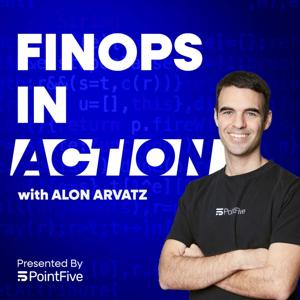
FinOps in Action

FinOps in Action

By PointFiveBusiness
Download on the App Store

FinOps in Action episodes

  • The Cloud Bill Nobody Was Watching ft. Michael Graff | Ep #80

    This week's episode of FinOps in Action takes a different shape, with PointFive Co-Founder and Chief Product Officer Gal Ben-David stepping in to host a conversation with Mike Graff, Infrastructure Architecture Director at Dolby Laboratories and a FinOps Ambassador. Mike shares a couple of real cost inefficiencies he's tracked down in the wild, then the conversation opens up into bigger questions about where FinOps is headed from new roles emerging on the engineering side to how AI might change the way teams find and fix waste. It's a grounded, practitioner led episode for anyone trying to close the gap between what engineering builds and what finance sees on the bill.


    Here’s what we talked about:

    • Small misconfigurations can hide big costs. A couple of the "craziest" inefficiencies Mike's found weren't exotic, they were simple settings almost anyone could miss, and easy to fix once spotted.
    • Platform tools don't always keep pace with the cloud. Vendors can lag behind what cloud providers already support, and Mike argues teams shouldn't just accept those gaps.
    • Cost optimization and security fight the same uphill battle. Both compete for engineering attention against feature deadlines and both benefit from getting into the conversation earlier.
    • The FinOps role may be split in two. Mike and Gal dig into whether cost efficiency is becoming its own engineering discipline, separate from the finance side of FinOps.
    • You don't need a title to start. Many practitioners begin as a side project, start small, find one win, and let momentum build.

    Chapters:

    00:00 Vendor Security Rant

    00:15 Special Episode Setup

    01:25 Meet Mike Graff

    02:18 Databricks Egress Surprise

    05:14 Finding It in Dashboards

    06:06 NAT Gateway Routing Trap

    08:11 Tooling Gaps and Visibility

    10:21 PaaS Transparency and Governance

    13:56 Shifting Left With Engineers

    22:10 Performance vs Cost Wins

    23:30 Gamifying FinOps Scores

    24:23 Unit Economics Challenges

    25:21 AI for FinOps Tools

    26:50 FinOps Agent Vision

    27:50 Platform Engineering Link

    31:24 Cloud Efficiency Engineer Role

    36:25 Getting Started in FinOps

    40:16 Community Wrap and Takeaways

     🎧 Subscribe for more FinOps leadership conversations → https://www.finopsinaction.com/ 


    Quote of the Show:
    "It all starts somewhere. It starts with poking into that data transfer dashboard and figuring out what's going on. Just get those wins, chipping away at the low hanging fruit.” - Michael Graff

    Links:

    • LinkedIn: https://www.linkedin.com/in/michaelegraff/ 
    • Website: https://www.dolby.com/ 

    Ways to Tune In:

    • Amazon Music: https://music.amazon.com/podcasts/f25a9d18-c12f-4ee4-93f5-2aa96e509b55 
    • Apple Podcasts: https://podcasts.apple.com/us/podcast/finops-in-action/id1790497808 
    • iHeart Radio: https://iheart.com/podcast/268443483/ 
    • Podchaser: https://www.podchaser.com/podcasts/finops-in-action-5958339 
    • Spotify: https://open.spotify.com/show/3IpjMc3qxDXZAjic5Zq21t 
    • Substack: https://finopsinaction.substack.com/ 
    • Transistor: finopsinaction.com 
    • YouTube: https://www.youtube.com/@PointFive_Inc 
    42 min
  • Is Your AI Spend Actually Paying Off | Ep # 79

    This episode of FinOps in Action pulls together voices from across the industry, including Pathik Sharma of Google Cloud, Emily Cornock, Kevin Mueller, Zach Johnson, Henrique, Shailaja Beeram, Marit Hughes, and Oliver Milke, all wrestling with the same question: how do you actually manage the cost of AI. Two years ago the idea of "AI for FinOps" got brushed off as premature. Now it sits in the top three priorities in the FinOps Foundation's own survey data, and for good reason. The guests dig into why AI spend is accelerating faster than cloud ever did, why most companies still cannot prove ROI on it, and what it actually looks like to build guardrails without slowing teams down. It is a rapid fire look at where FinOps practice is headed as AI stops being a side experiment and starts becoming the biggest line item on the P&L.


    Here’s what we talked about:

    • Treat your AI investment like a science experiment. Control your variables, change one thing at a time, and always tie spend back to a measurable business outcome, not just a feeling that things are getting more productive.
    • Token cost is only the tip of the iceberg. Storage, the adaptive storage layer, GPU and TPU compute, and platform hosting all add up, so don't let your team optimize the visible 20% while ignoring the rest.
    • Not all AI actions carry the same risk, so treat them differently. Let AI handle low stakes, non disruptive work like cost allocation labeling on its own, but keep a human in the loop for anything disruptive, like rightsizing a Kubernetes workload during Black Friday.
    • Don't let analysis paralysis become your default setting. Make your best reasonable estimate on AI spend, document your assumptions, and move forward instead of letting fear triple your forecasts.
    • Shift FinOps further left than you think you need to. Get engineering and product involved in AI cost conversations early, because the goal is not command and control, it's giving teams the data to make good decisions themselves.

    Chapters:

    00:00 Welcome to FinOps

    00:18 AI Meets FinOps

    01:12 Spend Growth Shock

    01:40 Tech Pace Explosion

    02:28 Making AI Serious

    02:52 FinOps DNA for AI

    03:29 ROI Reality Check

    04:26 Experiment With Controls

    05:06 Claims AI Success Story

    06:49 Unit Economics Mindset

    07:37 Measure Value and Impact

    09:27 Enable Not Control

    10:19 Link Tools to Outcomes

    11:04 Orchestrators Change Costs

    11:48 Guardrails and Fact Checks

    13:12 Copilot Dashboards to Agents

    14:20 Safe Automation Actions

    17:16 Managing AI Spend Layers


     🎧 Subscribe for more FinOps leadership conversations → https://www.finopsinaction.com/ 

    Quote of the Show:

    • "Think about AI as that eager intern. It can do the work, but you also need to trust, verify, and wait for the manager to give you a nod." – Pathik Sharma

    Connect with the Guest’s:

    • Emily Cornock: https://www.linkedin.com/in/emilycornock/ 
    • Oliver Milke: https://www.linkedin.com/in/oliver-milke/ 
    • Kevin Mueller: https://www.linkedin.com/in/kevinmueller/ 
    • Marit Hughes: https://www.linkedin.com/in/marit-hughes/ 
    • Shailaja Beeram: https://www.linkedin.com/in/shailaja-beeram-82324310a/ 
    • Pathik Sharma: https://www.linkedin.com/in/pathik-sharma/ 
    • Zach Johnson: https://www.linkedin.com/in/realzachjohnson/ 
    • Henrique Amorim: https://www.linkedin.com/in/henriqueamorim/ 

    Ways to Tune In:

    • Amazon Music: https://music.amazon.com/podcasts/f25a9d18-c12f-4ee4-93f5-2aa96e509b55 
    • Apple Podcasts: https://podcasts.apple.com/us/podcast/finops-in-action/id1790497808 
    • iHeart Radio: https://iheart.com/podcast/268443483/ 
    • Podchaser: https://www.podchaser.com/podcasts/finops-in-action-5958339 
    • Spotify: https://open.spotify.com/show/3IpjMc3qxDXZAjic5Zq21t 
    • Substack: https://finopsinaction.substack.com/ 
    • Transistor: finopsinaction.com 
    • YouTube: https://www.youtube.com/@PointFive_Inc 
    24 min
  • Sales Strategy Meets Practitioner Reality ft. Sean Kennedy and Amanda Wagner | Ep #78

    What happens when you put the strategic and operational sides of FinOps in the same room?

    In this episode of FinOps in Action, host Taylor Houck welcomes two guests for the first time on the show, Sean Kennedy, Senior Cloud FinOps Consultant, and Amanda Wagner, Cloud FinOps Consultant, both from Trace3. Sean focuses on presales strategy and partner enablement across Trace3's FinOps practice, while Amanda works directly with a portfolio of customers on the practitioner side. Together they unpack why FinOps never really finishes, how customer maturity changes the conversation, and what the AI cost landscape looks like right now.

    Here’s what we talked about:

    • FinOps is a cycle, not a destination. There's no finish line, just an ongoing loop of informing, optimizing, and operating that adapts as engineering, pricing, and business needs change.
    • Document your processes before you need them. Repeatable procedures for tagging, showback, and optimization reviews protect your FinOps program from falling apart when key people leave.
    • Meet customers at their maturity level. Don't push budgeting and forecasting on a team that's still working on basic visibility; introduce concepts in bite-sized chunks as they're ready.
    • The biggest wins often come from on-prem-to-cloud transitions. Companies migrating legacy infrastructure and mindsets tend to have the most untapped savings potential, partly because the human resistance to change is as big a factor as the technical work.
    • Clarify what "AI spend" actually means before optimizing it. Seat-based licenses, hyperscaler AI services, GPU infrastructure, and token-based usage are all totally different cost problems that need different strategies.

    Chapters:

    00:00 Welcome to the Show

    00:51 Meet Sean and Amanda

    01:51 Sean's Role at Trace3

    02:41 Amanda's Practitioner Lens

    03:18 Myth of Being Done

    04:09 Mindset Shift From IT

    05:05 FinOps as Org Adoption

    06:15 Repeatable Processes Matter

    07:09 Core FinOps Processes

    08:12 Enterprise vs Commercial Needs

    11:10 When Spend Forces FinOps

    12:03 Start Early and Build Habits

    14:36 Meeting Customers Where They Are

    16:32 Who Gains the Most

    23:18 AI Expands FinOps Scope

    27:56 Forecasting and Optimizing AI

    31:44 Closing and Personal Journeys


     🎧 Subscribe for more FinOps leadership conversations → https://www.finopsinaction.com/ 

    Quote of the Show:

    • “"I think the myth is that FinOps is something that you finish, right? You don't ever arrive at FinOps." - Amanda Wagner

    Links:

    • LinkedIn: https://www.linkedin.com/in/amanda--wagner/
    • LinkedIn: https://www.linkedin.com/in/sean~kennedy/
    • Website: https://www.trace3.com/

    Ways to Tune In:

    • Amazon Music: https://music.amazon.com/podcasts/f25a9d18-c12f-4ee4-93f5-2aa96e509b55 
    • Apple Podcasts: https://podcasts.apple.com/us/podcast/finops-in-action/id1790497808 
    • iHeart Radio: https://iheart.com/podcast/268443483/ 
    • Podchaser: https://www.podchaser.com/podcasts/finops-in-action-5958339 
    • Spotify: https://open.spotify.com/show/3IpjMc3qxDXZAjic5Zq21t 
    • Substack: https://finopsinaction.substack.com/ 
    • Transistor: finopsinaction.com 
    • YouTube: https://www.youtube.com/@PointFive_Inc 
    39 min
  • Engineering Enterprise FinOps ft. Piotr Kuczmera | Ep # 77

    What if the biggest mistake your FinOps program makes is skipping the requirements phase entirely?

    In this episode of FinOps in Action, host Taylor Houck sits down with Piotr Kuczmera, Head of FinOps at ZF Group, to unpack how he built a FinOps practice from scratch at a 150,000 person global enterprise, and why the first question every organization should ask is not "how do we cut costs" but "what exactly do we need?"

    Piotr shares how a single report request from his manager five years ago turned into a full scale internal FinOps platform, a hub and spoke operating model across 15 to 20 business units, and a team built on the combination of FinOps practitioners and data engineers working side by side.

    Here is what they covered: 

    • Why FinOps is more than cost savings. Piotr explains that equating FinOps with cost optimization alone leads to failed implementations, and that starting with a clear requirements conversation, like a tailor fitting a suit to the right occasion, is what sets a practice up for long term success.

    • How chargeback became the turning point. When ZF connected individual names to specific budgets and sent real invoices, something clicked. Engineers and budget holders stopped asking about aggregate project spend and started asking "why am I paying this much and how do I reduce it?"

    • The case for building your own platform. ZF evaluated the major third party FinOps tools and walked away. Licensing costs, limited multi-cloud support, and a lack of flexibility in adapting to existing finance and procurement processes all pointed toward a homegrown solution built on native cloud tooling and a BI layer they already owned.

    • The hub and spoke model for FinOps at scale. At the center sits a core team of FinOps consultants and data engineers. In each business unit, a nominated budget owner and a FinOps champion bridge the gap between central strategy and local execution.

    • AI for FinOps, not just FinOps for AI. Piotr is most energized by how AI can automate repetitive FinOps workflows and take recommendations beyond basic CPU and memory parameters to consider commitment connections, usage patterns, and resource families all at once. He also sees FinOps as a function that should open doors for AI adoption, not slow it down.

    • FinOps as connective tissue. Across financial colleagues, engineering teams, and business managers, Piotr sees FinOps as the function responsible for translating the right information to the right persona, not flooding finance with VM data, and not giving engineers a budget variance they cannot act on.

    Chapters:

    00:00 What Every Company Gets Wrong About FinOps 

    01:27 Meet Piotr Kuczmera 

    02:14 FinOps Is Not Just Cost Savings 

    03:30 Building Trust Across Departments 

    05:00 The FinOps Team Structure at ZF Group 

    08:00 Hub and Spoke: Champions and Budget Owners 

    10:00 Scale and Cadence Across 15 to 20 Categories 

    12:00 Back to the Beginning: One Report at a Time 

    14:00 Build vs Buy: The Platform Decision 

    18:00 Why Ownership of Data Changes Everything 

    21:00 Chargeback as the Accountability Switch 

    23:00 Translating FinOps Across Personas 

    25:00 FinOps as Connective Tissue 

    26:00 AI for FinOps and FinOps for AI 

    29:00 Treating AI Spend Like Any Other Cloud Service 

    30:00 What the Well Tailored FinOps Suit Looks Like in One Year 

    31:00 From Math Degree to FinOps Leader 

    33:00 Advice for Early Career FinOps Professionals 

    34:00 Where to Find Piotr


    Quote of the Show:
    "Stay humble and don't be afraid of challenges." - Piotr Kuczmera

    🎧 Subscribe for more FinOps leadership conversations: https://www.finopsinaction.com/


    Links:

    • LinkedIn: https://www.linkedin.com/in/piotr-kuczmera-59b39712a/
    • Website: https://www.zf.com/usa_canada/en/home/home.html

    Ways to Tune In:

    • Amazon Music: https://music.amazon.com/podcasts/f25a9d18-c12f-4ee4-93f5-2aa96e509b55 
    • Apple Podcasts: https://podcasts.apple.com/us/podcast/finops-in-action/id1790497808 
    • iHeart Radio: https://iheart.com/podcast/268443483/ 
    • Podchaser: https://www.podchaser.com/podcasts/finops-in-action-5958339 
    • Spotify: https://open.spotify.com/show/3IpjMc3qxDXZAjic5Zq21t 
    • Substack: https://finopsinaction.substack.com/ 
    • Transistor: finopsinaction.com 
    • YouTube: https://www.youtube.com/@PointFive_Inc 
    35 min
  • The Price of Cost Awareness ft. Ruby Agarwal | Ep #76

    What if the biggest cloud savings opportunity isn't hidden in your infrastructure, but in the decisions made before the first line of code is written?

    In this episode of FinOps in Action, Taylor sits down with Ruby Agarwal, VP of Engineering at Avaya, whose responsibilities span engineering, DevOps, DevSecOps, CloudOps, and FinOps. Ruby shares how her team reduced cloud spend by 75% in just two months, why visibility matters more than perfect data, and how cost awareness becomes part of engineering culture rather than a one-time optimization project.

    They also explore how AI is changing operational decision-making and why the future of FinOps will depend on balancing innovation with discipline.

    Takeaways:

    • Start with visibility, not spreadsheets of despair. Ruby's team didn't need perfect data to cut 75% of spend, they needed a one-slider view everyone could understand. Skip the 20 page report and focus your team's attention on the handful of buckets driving most of the cost.
    • Cost isn't the enemy, inefficiency is. Turning everything off would bring spending to zero, but that's not the goal. The goal is getting the same performance, reliability, and security for less, not gutting the services delivering value.
    • Build your COGS model before you write code. On Avaya Infinity, Ruby's team defined their cost model before a single line was written, and they publish and measure it every month. Bake cost discipline into the architecture from day one instead of cleaning up after launch.
    • Separate your AI innovation zone from your production zone. Let engineers experiment freely with the most powerful models while building, but production agents don't need the flashiest reasoning model, they need the cheapest one that gets the job done reliably.
    • The skills that carry your career aren't technical. Ruby calls systems thinking, structured decision-making, communication, and connection-building the real differentiators, not soft skills but critical skills. Investing in those early pays off longer than any single technology wave.

    Chapters:

    00:00 Welcome and Guest Intro

    01:25 The 75 Percent Story Setup

    01:45 Project Context Multi Cloud

    02:37 Cataloging Costs and Buckets

    03:21 Quick Wins Labs Scheduling

    04:15 Storage Cleanup and Tiering

    04:30 Dashboards Make It Visible

    05:44 Working With Developers

    06:50 Culture Tools and Training

    08:58 Cross Functional Momentum

    10:29 FinOps From Day One

    11:21 Avaya Infinity COGS Model

    13:37 Who Owns Cost Decisions

    15:28 Need Dedicated FinOps

    18:00 80 20 Cost Focus

    21:08 Cost Fear vs Cloud Value

    23:04 Regulated Industry Constraints

    26:38 AI Agents and Model Costs

    32:53 Future of Operational Intelligence

    35:30 Career Advice Beyond Tech

    37:36 Giving Back and Mentoring

    39:23 Closing Thanks and Wrap


     🎧 Subscribe for more FinOps leadership conversations → https://www.finopsinaction.com/ 

    Quote of the Show:

    • “ Your first cloud cost bill will be dependent on what architectural decisions you have made for your projects.” - Ruby Agarwal 

    Links:

    • LinkedIn: https://www.linkedin.com/in/rubyagarwal/
    • Website: https://www.avaya.com/en/

    Ways to Tune In:

    • Amazon Music: https://music.amazon.com/podcasts/f25a9d18-c12f-4ee4-93f5-2aa96e509b55 
    • Apple Podcasts: https://podcasts.apple.com/us/podcast/finops-in-action/id1790497808 
    • iHeart Radio: https://iheart.com/podcast/268443483/ 
    • Podchaser: https://www.podchaser.com/podcasts/finops-in-action-5958339 
    • Spotify: https://open.spotify.com/show/3IpjMc3qxDXZAjic5Zq21t 
    • Substack: https://finopsinaction.substack.com/ 
    • Transistor: finopsinaction.com 
    • YouTube: https://www.youtube.com/@PointFive_Inc 
    41 min
  • Agentic FinOps and the AI Cost Explosion ft. Pathik Sharma | Ep #76

    What does agentic FinOps actually look like in practice, and how should practitioners start thinking about it?

    Taylor Houck sits down with Pathik Sharma, Cloud Cost Optimization Lead at Google Cloud and Cofounder of their Cloud FinOps practice, to talk about how AI is closing the gap between knowing and doing in FinOps. Pathik shares how teams can hand off low risk tasks like tagging and labeling to AI agents while keeping humans in the loop on anything production related, and offers a four bucket framework for evaluating AI ROI: cost efficiency, productivity, differentiation, and revenue. His take for practitioners: embrace the change, learn the tooling, and let AI handle the friction so you can focus on business value.

    Here’s what we talked about:

    • Don't silo your FinOps practice. Cost optimization doesn't exist in a vacuum. Factor in performance, security, scalability, and capacity from the start, and build tight relationships with platform, SRE, and app teams to get anything done.

    • Use AI agents for the low risk wins first. Start with non-disruptive tasks like tagging and labeling before giving AI autonomy over anything that touches production. Build confidence incrementally.

    • Keep humans in the loop on consequential actions. Have your AI agent create a pull request and route it to the application owner for approval rather than pushing changes directly. The app team still owns uptime.

    • Don't pick your AI model on instinct. Build a golden dataset, define what good looks like, and test models against it. One retail company cut their AI costs from $340K to $17K a month by switching models after running the data.

    • Start from the problem, not the solution. Identify the real friction points your FinOps and engineering teams face, then figure out where AI reduces that friction. Chasing AI for its own sake is how you burn the budget without value.

    Chapters:

    00:46 Meet Pathik Sharma

    01:58 AI Makes FinOps Urgent

    03:09 From Tinkering To Priority

    06:22 Defining Agentic FinOps

    06:33 Culture And The Knowing Doing Gap

    08:56 Kubernetes Agent Example

    10:58 Is It Still FinOps

    12:37 Humans In The Loop

    13:23 Safe Automation With Tagging

    15:07 PR Based Remediation Workflow

    18:14 Trustworthy Recommendations First

    20:58 Build Trust Incrementally

    23:35 Managing AI Spend Beyond Tokens

    27:27 FinOps For AI Framework

    28:32 Retail Case Study Huge Savings

    32:27 ROI Buckets And Closing Advice


     🎧 Subscribe for more FinOps leadership conversations → https://www.finopsinaction.com/ 


    Quote of the Show:

    • "Embrace the change that is happening and learn it. FinOps holds keys to the kingdom" - Pathik Sharma

    Links:

    • LinkedIn: https://www.linkedin.com/in/pathik-sharma/
    • Website: https://pathiksharma.com/

    Ways to Tune In:

    • Amazon Music: https://music.amazon.com/podcasts/f25a9d18-c12f-4ee4-93f5-2aa96e509b55 
    • Apple Podcasts: https://podcasts.apple.com/us/podcast/finops-in-action/id1790497808 
    • iHeart Radio: https://iheart.com/podcast/268443483/ 
    • Podchaser: https://www.podchaser.com/podcasts/finops-in-action-5958339 
    • Spotify: https://open.spotify.com/show/3IpjMc3qxDXZAjic5Zq21t 
    • Substack: https://finopsinaction.substack.com/ 
    • Transistor: finopsinaction.com 
    • YouTube: https://www.youtube.com/@PointFive_Inc 
    44 min
  • From IT Support to Enterprise Cloud Leader ft. Gerard Sanchez | Ep #77

    What if the best FinOps practitioners are the ones who never set out to be FinOps practitioners at all?

    In this episode of FinOps in Action, host Taylor Houck sits down with Gerard Sanchez, Head of Enterprise Platforms and Cloud Technology at Resolution Life, to unpack what it actually looks like to build a cloud engineering, DevOps, and FinOps practice from absolute zero at a company that was only six months old when he joined. Gerard brings a hardcore infrastructure and networking background to a discipline that too often gets siloed away from engineering, and the results speak for themselves.

    Here’s what we talked about:

    • Set up automated cost alerts and guardrails from the start. Getting notified about a surprise bill is useful, but building automations that throttle or shut down rogue functions before the cost spiral is where you really want to be.

    • Tagging is non-negotiable. If you can't trace spend back to a specific application or team, you'll never have the visibility to make smart optimization decisions.

    • Shift FinOps left into the architecture and design phase. Catching cost inefficiencies before they deploy is far more effective than trying to optimize them after the fact.

    • Match your cloud services to the actual workload. Before defaulting to high-performance, high-cost infrastructure, pressure-test whether the use case actually demands it. A Toyota Corolla solution often performs just as well as a Bugatti for the average user.

    • Keep humans in the loop as you adopt AI. Even as agentic systems get more capable, building strong permissioning, tagging, and auditability into your AI framework now will save you from costly and chaotic surprises later.

    Chapters:

    00:42 Meeting Gerard Sanchez

    01:25 Building from Scratch

    02:52 Fast and Good Over Cheap

    05:22 The Wake Up Call

    07:58 Crawl Walk Run Journey

    10:08 Engineering Led FinOps

    11:53 Right Sizing Use Cases

    14:43 Shifting Left

    16:13 AI and Automation

    18:46 Agentic AI Architecture

    22:12 Trust and Validation

    23:45 Managing AI Costs

    24:55 The Future of Business

    30:31 Building the AI Foundation

    32:50 Career Advice

    36:58 Closing Thoughts


     🎧 Subscribe for more FinOps leadership conversations → https://www.finopsinaction.com/ 


    Quote of the Show:

    • "I think especially for production environments or environments that are super sensitive, there's always gonna be a human in the loop." — Gerard Sanchez

    Links:

    • LinkedIn: https://www.linkedin.com/in/gerard-r-sanchez/
    • Website: https://www.resolutionlife.com/

    Ways to Tune In:

    • Amazon Music: https://music.amazon.com/podcasts/f25a9d18-c12f-4ee4-93f5-2aa96e509b55 
    • Apple Podcasts: https://podcasts.apple.com/us/podcast/finops-in-action/id1790497808 
    • iHeart Radio: https://iheart.com/podcast/268443483/ 
    • Podchaser: https://www.podchaser.com/podcasts/finops-in-action-5958339 
    • Spotify: https://open.spotify.com/show/3IpjMc3qxDXZAjic5Zq21t 
    • Substack: https://finopsinaction.substack.com/ 
    • Transistor: finopsinaction.com 
    • YouTube: https://www.youtube.com/@PointFive_Inc 
    38 min
  • The Cloud Only Era Is Over ft. Mike Jaco | Ep # 73

    What if the biggest driver of cloud waste isn't what shows up in your billing dashboard?

    In this episode of FinOps in Action, Taylor sits down with Mike Jaco, who spent years at Mastercard running one of the most sophisticated hybrid cost programs in enterprise technology. A unified TBM and FinOps practice covering a multi-billion dollar technology budget, on-prem and public cloud, under a single common taxonomy.

    Mike's core belief: most large organizations will be hybrid forever, and the industry hasn't caught up to what that actually requires.

    Here's what they covered:

    • Build a common taxonomy before you do anything else. If your technology teams, product teams, and finance teams are using different languages to describe the same thing, no one is having the right conversation. Get everyone onto one shared structure first and everything else gets easier.
    • Allocate cost down to the product level, not just the business unit. Stopping at the business unit level leaves too much room for ambiguity and not enough room for accountability. The more granular your allocation, the clearer it becomes who owns what and what action to take.
    • Most large organizations will be hybrid forever, so build for it. Regulation, data sovereignty, and steady state workloads mean a full cloud migration is not realistic for most enterprises. Build your measurement framework to cover both worlds under one taxonomy or you are only ever telling half the story.
    • Savings that stay in the team drive more action than savings that disappear. If engineers know that any efficiency they find gets reinvested into their own backlog rather than returned to a central budget, the motivation to optimize shifts completely. Self-funding growth is a more powerful incentive than a cost reduction target.
    • FinOps is a people problem first and a data problem second. When an engineer is not making a change, it is almost never because they want to waste money. They are overloaded, they have competing priorities, or the task does not benefit them. Solve for the people dynamic and the technical changes follow.

    Chapters:

    00:11 Meet Mike Jaco

    01:11 Why Hybrid Is Forever

    01:38 Regulation Drives Reality

    02:55 On Prem vs Cloud Economics

    03:28 The Apples to Apples Problem

    04:58 Building a Common Taxonomy

    06:21 Making Tech Less a Black Box

    06:59 Why Allocate to Product Level

    07:13 Accountability Creates Action

    08:36 TBM vs FinOps Actions

    10:21 18 Months vs 3 Months

    11:45 Granularity vs Peanut Butter

    13:16 Controllable vs Uncontrollable Spend

    14:45 Carbon Becomes a Currency

    17:11 Cloud Carbon Data Gap

    20:39 Cost vs Carbon Tradeoffs

    29:54 AI Spend and FinOps Future

    37:39 Career Next Steps and Advice

    39:47 People First FinOps Lessons

    41:22 Where to Find Mike


    🎧 Subscribe for more FinOps leadership conversations → https://www.finopsinaction.com/ 

    Quote of the Show:

    • “You can do more with the same budget.” - Mike Jaco 

    Links:

    • LinkedIn: https://www.linkedin.com/in/mike-jaco/ 

    Ways to Tune In:

    • Amazon Music: https://music.amazon.com/podcasts/f25a9d18-c12f-4ee4-93f5-2aa96e509b55 
    • Apple Podcasts: https://podcasts.apple.com/us/podcast/finops-in-action/id1790497808 
    • iHeart Radio: https://iheart.com/podcast/268443483/ 
    • Podchaser: https://www.podchaser.com/podcasts/finops-in-action-5958339 
    • Spotify: https://open.spotify.com/show/3IpjMc3qxDXZAjic5Zq21t 
    • Substack: https://finopsinaction.substack.com/ 
    • Transistor: finopsinaction.com 
    • YouTube: https://www.youtube.com/@PointFive_Inc 
    44 min
  • The Hidden Costs of Engineering ft. Kumar Singirikonda | Ep #72

    What if the biggest cost problem in your organization never shows up on your cloud bill?

    In this episode of FinOps in Action, host Taylor Houck sits down with Kumar Singirikonda, Director of DevOps Engineering at Toyota Financial Services, FinOps Foundation board member, and author of the DevOps Automation Cookbook. Kumar makes the case that FinOps as we know it is only the first chapter, and the next chapter belongs to self-healing systems, AI-driven remediation, and a class of costs that traditional cost reports have never been able to surface.

    Here is what they covered:

    • The hidden costs that never appear on your dashboard. Track your direct cloud expenses all you want, but your biggest operational costs are invisible. A single 30 minute outage won't change your infrastructure bill, yet it pulls in engineering teams, delays releases, and creates support volume that compounds for days.
    • From cost control to value creation. Stop asking how to reduce cloud spend and start asking how to maximize business value from your engineering investments. When you do that, cost optimization becomes an outcome of operational maturity rather than the goal itself.
    • What a self healing platform actually looks like. When a routing issue triggers a 404 spike, your system should detect the anomaly, correlate it with the recent deployment, invoke a remediation workflow, and execute a rollback in under two minutes without a human touching a keyboard. That is what operational maturity actually looks like in practice.
    • AI is not a silver bullet. A model alone does not create operational intelligence. Connect AI to your observability platforms, automation workflows, and remediation playbooks, and that is where the real value comes from.

    Chapters:

    00:50 Meet Kumar Singarikkonda

    01:59 Kumar’s Journey to FinOps

    02:33 Hidden Operational Costs

    04:41 From Cost Control to Value

    06:55 Headcount vs Cloud Bill

    07:54 Unknown Costs in Incidents

    10:30 Measuring Engineering Efficiency

    13:13 Self-Healing Systems Defined

    13:39 How Self-Healing Works

    16:23 404 Spike Self-Heal Example

    20:30 Where AI Fits In

    21:07 Agentic Workflows Over Hype

    24:21 Engineering Efficiency Discipline

    26:49 Building Cost-Aware Culture

    29:56 Leadership Lessons at Toyota

    32:11 Book Community and Closing


    🎧 Subscribe for more FinOps leadership conversations → https://www.finopsinaction.com/ 


    Quote of the Show:"The biggest operational cost problem today is inefficiency rather than infrastructure pricing. Organizations that reduce operational friction unlock far greater long-term value than organizations focused only on reducing the compute spend." - Kumar Singirikonda


    Links:

    • LinkedIn: https://www.linkedin.com/in/kumarsingirikonda
    • Website: https://www.toyota.com/usa
    • Book Link: https://www.amazon.com/DevOps-Automation-Cookbook-Harness-automation/dp/9355519060

    Ways to Tune In:

    • Amazon Music: https://music.amazon.com/podcasts/f25a9d18-c12f-4ee4-93f5-2aa96e509b55 
    • Apple Podcasts: https://podcasts.apple.com/us/podcast/finops-in-action/id1790497808 
    • iHeart Radio: https://iheart.com/podcast/268443483/ 
    • Podchaser: https://www.podchaser.com/podcasts/finops-in-action-5958339 
    • Spotify: https://open.spotify.com/show/3IpjMc3qxDXZAjic5Zq21t 
    • Substack: https://finopsinaction.substack.com/ 
    • Transistor: finopsinaction.com 
    • YouTube: https://www.youtube.com/@PointFive_Inc 
    39 min
  • Engineering Enterprise FinOps ft. Piotr Kuczmera | Ep # 72

    What if the biggest mistake your FinOps program makes is skipping the requirements phase entirely?

    In this episode of FinOps in Action, host Taylor Houck sits down with Piotr Kuczmera, Head of FinOps at ZF Group, to unpack how he built a FinOps practice from scratch at a 150,000 person global enterprise, and why the first question every organization should ask is not "how do we cut costs" but "what exactly do we need?"

    Piotr shares how a single report request from his manager five years ago turned into a full scale internal FinOps platform, a hub and spoke operating model across 15 to 20 business units, and a team built on the combination of FinOps practitioners and data engineers working side by side.

    Here is what they covered: 

    • Why FinOps is more than cost savings. Piotr explains that equating FinOps with cost optimization alone leads to failed implementations, and that starting with a clear requirements conversation, like a tailor fitting a suit to the right occasion, is what sets a practice up for long term success.

    • How chargeback became the turning point. When ZF connected individual names to specific budgets and sent real invoices, something clicked. Engineers and budget holders stopped asking about aggregate project spend and started asking "why am I paying this much and how do I reduce it?"

    • The case for building your own platform. ZF evaluated the major third party FinOps tools and walked away. Licensing costs, limited multi-cloud support, and a lack of flexibility in adapting to existing finance and procurement processes all pointed toward a homegrown solution built on native cloud tooling and a BI layer they already owned.

    • The hub and spoke model for FinOps at scale. At the center sits a core team of FinOps consultants and data engineers. In each business unit, a nominated budget owner and a FinOps champion bridge the gap between central strategy and local execution.

    • AI for FinOps, not just FinOps for AI. Piotr is most energized by how AI can automate repetitive FinOps workflows and take recommendations beyond basic CPU and memory parameters to consider commitment connections, usage patterns, and resource families all at once. He also sees FinOps as a function that should open doors for AI adoption, not slow it down.

    • FinOps as connective tissue. Across financial colleagues, engineering teams, and business managers, Piotr sees FinOps as the function responsible for translating the right information to the right persona, not flooding finance with VM data, and not giving engineers a budget variance they cannot act on.

    Chapters:

    01:27 Meet Piotr Kuczmera 

    02:14 FinOps Is Not Just Cost Savings 

    03:30 Building Trust Across Departments 

    05:00 The FinOps Team Structure at ZF Group 

    08:00 Hub and Spoke: Champions and Budget Owners 

    10:00 Scale and Cadence Across 15 to 20 Categories 

    12:00 Back to the Beginning: One Report at a Time 

    14:00 Build vs Buy: The Platform Decision 

    18:00 Why Ownership of Data Changes Everything 

    21:00 Chargeback as the Accountability Switch 

    23:00 Translating FinOps Across Personas 

    25:00 FinOps as Connective Tissue 

    26:00 AI for FinOps and FinOps for AI 

    29:00 Treating AI Spend Like Any Other Cloud Service 

    30:00 What the Well Tailored FinOps Suit Looks Like in One Year 

    31:00 From Math Degree to FinOps Leader 

    33:00 Advice for Early Career FinOps Professionals 

    34:00 Where to Find Piotr


    Quote of the Show:

    • "Stay humble and don't be afraid of challenges." -- Piotr Kuczmera

    🎧 Subscribe for more FinOps leadership conversations: https://www.finopsinaction.com/


    Links:

    • LinkedIn: https://www.linkedin.com/in/piotr-kuczmera-59b39712a/
    • Website: https://www.zf.com/usa_canada/en/home/home.html

    Ways to Tune In:

    • Amazon Music: https://music.amazon.com/podcasts/f25a9d18-c12f-4ee4-93f5-2aa96e509b55 
    • Apple Podcasts: https://podcasts.apple.com/us/podcast/finops-in-action/id1790497808 
    • iHeart Radio: https://iheart.com/podcast/268443483/ 
    • Podchaser: https://www.podchaser.com/podcasts/finops-in-action-5958339 
    • Spotify: https://open.spotify.com/show/3IpjMc3qxDXZAjic5Zq21t 
    • Substack: https://finopsinaction.substack.com/ 
    • Transistor: finopsinaction.com 
    • YouTube: https://www.youtube.com/@PointFive_Inc 
    35 min

About FinOps in Action

From the publisher's feed

Welcome to FinOps in Action! Join host, Taylor Houck, Each week, as he sits down with FinOps experts to explore the toughest challenges between FinOps and Engineering. This show is brought to you by…

More shows like FinOps in Action

AWS Podcast by Amazon Web Services

AWS Podcast

202 Listeners